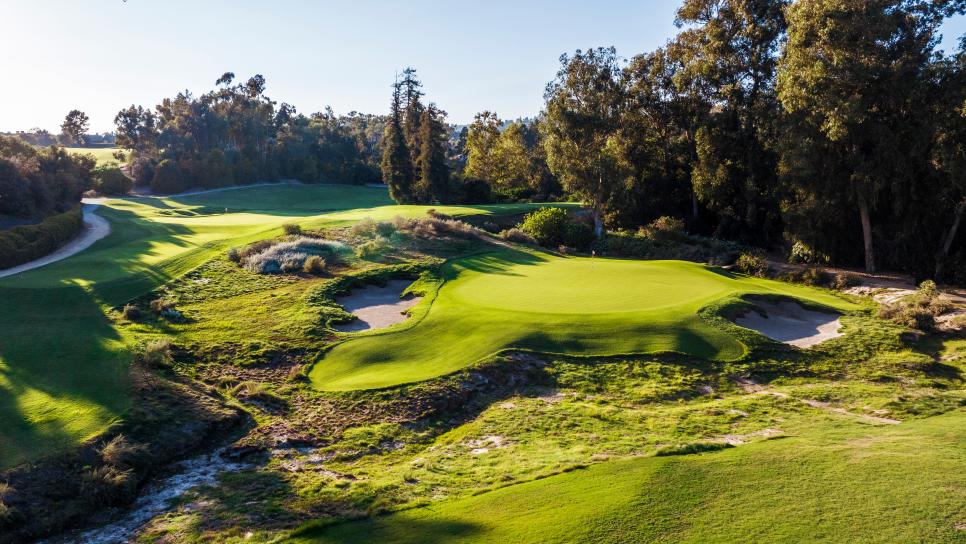
The stars will be shining bright in Tinseltown as the 123rd U.S. Open at the much anticipated North Course at Los Angeles Country Club has finally arrived. A course that has been shrouded in mystery yet lauded as one of the best layouts in the world will open its doors to host its first-ever major golf tournament. Perhaps the greatest course people have never seen, it has a mythical reputation that has been building to a crescendo leading up to this week.
For over half a century the club had chosen to remain a Hollywood recluse. Its leadership and members cherished their privacy and exclusivity over the added clout that majors or other professional tournaments could provide. Before the 2017 Walker Cup, the last USGA championship at LACC was the U.S. Junior Amateur in 1954. The PGA Tour hasn’t played here since the 1940 L.A. Open. But finally, the golf world will get to experience this hidden gem as the U.S. Open returns to the Los Angeles area for the first time since 1948 when Ben Hogan won at Riviera.
Perfectly integrated into the Southern California landscape by legendary architect George C. Thomas in 1927, there is no shortage of rugged natural beauty juxtaposed with the metropolis that is America’s second-largest city. Described as an architectural marvel, it is a massive canvas of 312 acres with huge slopes, ridges, barrancas, swales and valleys. Starting in 2006, the club underwent a five-year restoration project led by Gil Hanse and his team with the goal of bringing the Thomas design back to its roots and ensuring its ability to welcome a major championship field.
As one of the most unique courses to ever host a major, this is not your typical U.S. Open setup. Typically, U.S. Open courses have very narrow fairways. In contrast, LACC features wide open swaths of fairway on many holes. Thomas strongly believed in angles being an important part of course design. So he wanted players to have the opportunity off the tee to hit far left or far right. At the same time, it is not a course to simply bomb away as drives will need to have the proper shape to hold the fairway thanks to the many contours that will funnel the ball towards the incorrect side. It has all the makings of a shotmaker’s dream.
Another huge difference is that the rough will be quite unfamiliar for this event. This will be the first U.S. Open with bermudagrass rough since 2005 at Pinehurst No. 2. This agronomic change will result in much more unpredictability in shots on approach and from around the green.
Length, speed, rolling topography and variety of holes are some of the overarching characteristics of LACC. There is an exceptional diversity of holes from each par range whether it be long, short, doglegs, straight, uphill, or downhill. There is not a weak hole on the course, nor a hole that can only be played one way. Risk/Reward opportunities are everywhere. Thomas believed that golf courses should ask strategic questions and also offer plenty of options on how to answer those questions. LACC does all of that and more as it will test every facet of a player’s game and will demand excellence from every club in the bag.
With the golf world continuing to go through a period of change and upheaval after the recent news of the PGA Tour and LIV Golf combining to form a new entity, the pureness of the setting at the North Course should provide all sides with some degree of harmony as we celebrate the national championship of the United States and continue to cherish the game we all love.
The Field
After a record 10,187 players attempted to qualify for this year’s U.S. Open, the 156-player field is set. 39 of the top 40 in the Official World Golf Rankings will be in attendance with the injured Will Zalatoris the only golfer missing. Daniel Berger and Tiger Woods are the only other players that would have qualified if fully healthy.
World No. 1 Scottie Scheffler and No. 2 Jon Rahm headline the field. Looking for his second career major, Scheffler has won twice already this year including THE PLAYERS Championship. He is amid a record-breaking statistical season leading the Tour in Strokes Gained: Tee-to-Green, Off-the Tee and Approach. Having won the Masters in April, Rahm will attempt to win his second major of the year and has four total wins already in 2023.
Four of the other top-seven ranked golfers in the world will each be looking for their first major win. This includes Patrick Cantlay, Viktor Hovland, Xander Schauffele and Max Homa. World No. 8 and 2022 U.S. Open winner at The Country Club in Brookline, Massachusetts, Matt Fitzpatrick, will attempt to defend his title which was last accomplished by Brooks Koepka in 2017-2018.
There are 14 players from LIV Golf in the field, only slightly fewer than the previous two majors because of fewer exemptions to the U.S. Open. The field is somewhat watered down on the back end due to the 25-plus golfers, including numerous amateurs and club professionals, who will be teeing it up thanks to regional qualifying.
With the exception of a few players, the North Course will be a novel experience for the majority of the field. Both Scheffler and Collin Morikawa were on the 2017 Walker Cup team at LACC. Representing Cal at the 2013 Pac-12 Championship, Homa shot the course record of 61 on his way to winning the conference title. While at UCLA, Cantlay had the previous course record of 62 and knows the layout quite well. “I probably played it a few dozen times,” Cantlay said. “It’s a golf course I’ve played a lot.”
Los Angeles Country Club (North Course) – History
Established in 1897, the Los Angeles Golf Club moved around to different locations before finally finding a suitable location in Beverly Hills. After years of planning, the Los Angeles Golf Club at Beverly Hills officially opened on May 30, 1911, with 36 holes. The original courses, the North and the South, were laid out by the club’s founders, Joe Sartori and Ed Tufts, along with members Norman Macbeth and Charles Orr.
In 1919, George C. Thomas joined LACC, and shortly after assisted British architect Herbert Fowler in upgrading the rudimentary North Course. His architectural ideas became more solidified as he designed several other Southern California courses and began writing extensively on the topic. Among his other designs in the Los Angeles area were Riviera and Bel-Air Country Club, each built with his sidekick, William “Billy” Bell.
The genius of Thomas was his ability to design strategically complex holes on distinctly different sites. He was a master at incorporating natural terrain and elevation changes into his layouts along with constructing elaborate bunkers. He championed a variety of methods to play a hole and what he termed “a course within a course.” That meant designing holes that could be played in totally different ways from one day to the next based on flexible tee boxes and angles, fairway width, the placement of hazards, and diversified hole locations within boldly contoured, well-protected parts of the greens.
After accepting LACC’s invitation to remodel the North Course again in 1927, Thomas eliminated almost everything Fowler had designed by re-routing the holes, locating new green sites, and adding the intricate, chewed-edged bunkering that his design partner Billy Bell was known for. The finished product was Golden Age golf architecture at its best. The course would go on to host the PGA Tour’s Los Angeles Open in 1934, 1935, 1936 and 1940.
Gil Hanse Restoration
In the decades that followed, much of Thomas’ architecture was dulled. Tree growth began to overtake playing corridors. Many greens shrank which included the loss of some of the best hole locations. Bunkers had evolved into basic circular shapes thanks to decades of wear and tear, losing much of the complexity that Thomas and Bell originally built.
Between 2006-2010, the North Course underwent a project to restore it to the original design of George Thomas. In 2009, one of the most renowned course renovators, Gil Hanse, was hired to lead the project along with his partner Jim Wagner. They were assisted with research and insights from Thomas expert and historian, Geoff Shackleford. Archived photos, written documents, and the physical unearthing of landforms provided the framework for the restoration.
Restoring the faded aspects, including the “course-within-a-course” concept motivated the team. “Genius—the guy was a genius,” Hanse says. “When we were brought in to interview, we said that we want to put back George Thomas, and if that’s not what you want, then we’re not the right architects to hire.” As Hanse noted, the restoration was not trying to make the design feel like a new course, but rather make it seem as though it had been there all along.
The scope of the work included complete reconstruction of the greens, bunkers and tees along with restoration of the barrancas Trees were removed to open corridors of play and to improve sight lines throughout the property. Related to the greens, Hanse was especially focused on re-establishing the putting surfaces with surrounding run-offs and low areas for a sharper contrast between an elite approach shot and a slightly wayward one.
As for the barrancas, they had almost blended in with the course and had become closely mowed over ditches. The restoration has brought them back to life and reintroduced them as a true hazard once again. Shackleford especially helped to ensure that Bell’s eccentric bunkers with bulky, grassy top edges were rebuilt.
More recent changes in preparation for this week’s U.S. Open include a few fairway bunkers pushed further back towards anticipated landing zones and back tees added throughout the course to ensure that playing distances stay in line with player gains off the tee.
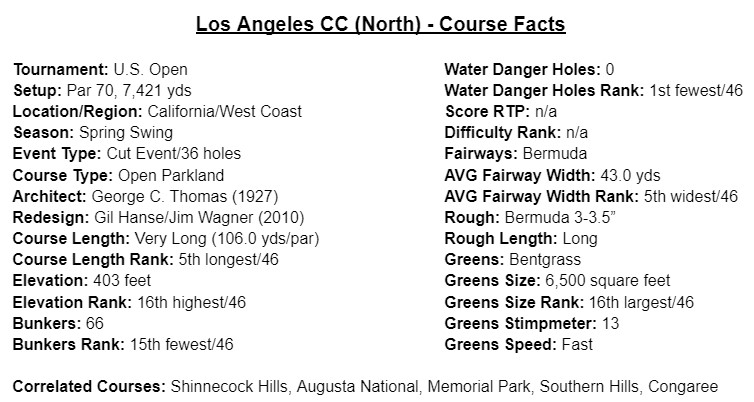
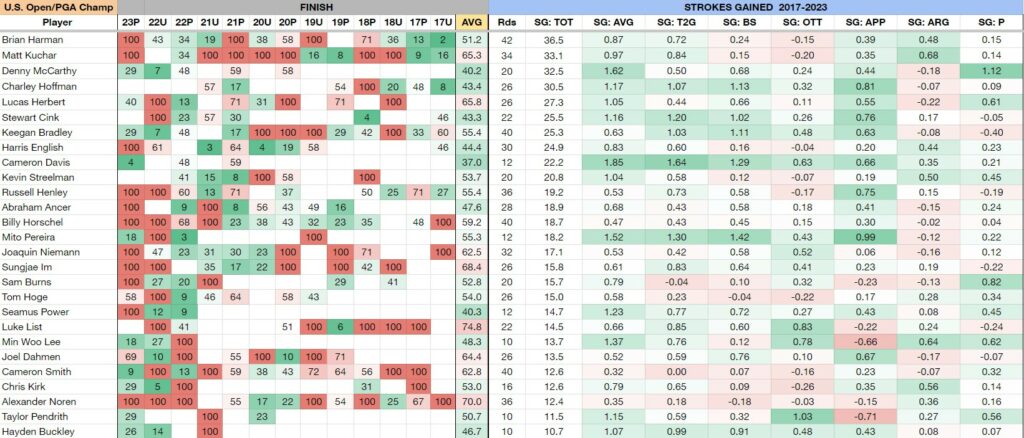
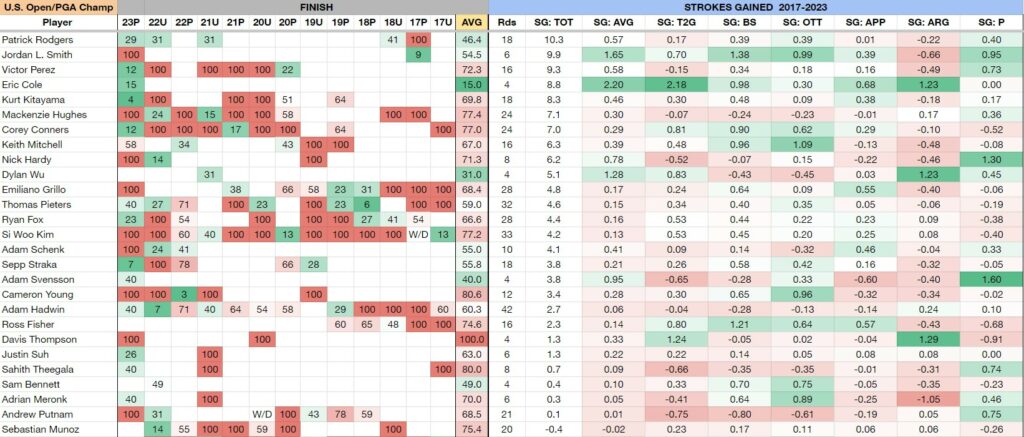
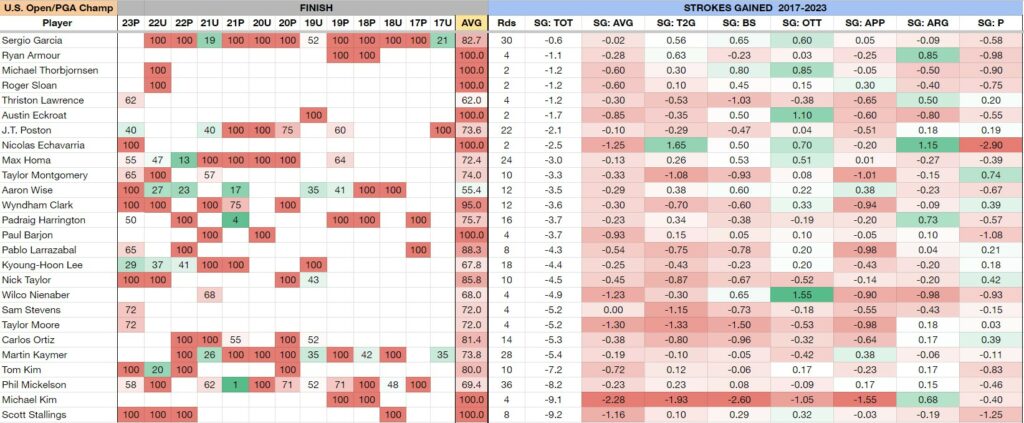
Finish Position and Strokes Gained Event History (2017-2023)
Combined U.S. Open/PGA Championship course history going back to 2017. It includes average finish position and Strokes Gained per round in each category. Players are sorted by SG: Total.
Why include PGA Championship courses? Most PGA layouts have been very similar to U.S. Open-type courses. Even with LACC being so unique, amongst the majors, these two tournaments are the most comparable.
Courses included in the data: Oak Hill, The Country Club, Southern Hills, Torrey Pines South, Kiawah Island, Winged Foot, TPC Harding Park, Pebble Beach, Bethpage Black, Bellerive, Shinnecock, Quail Hollow, and Erin Hills.
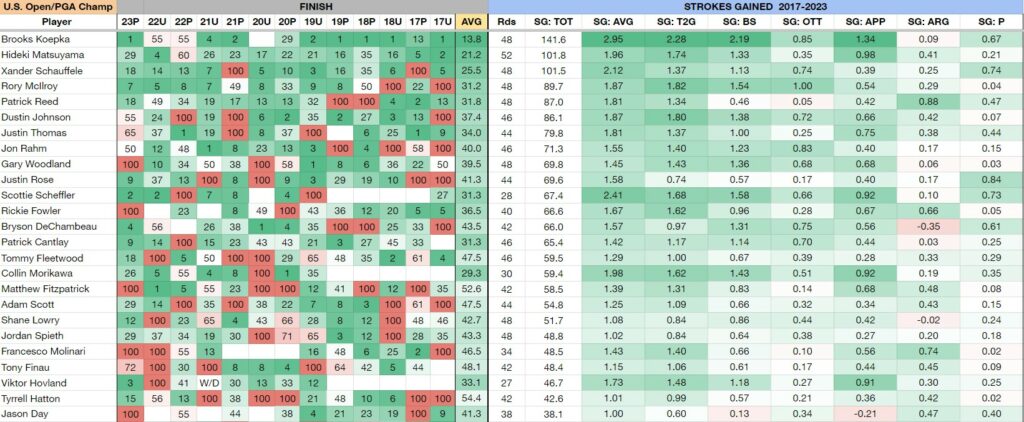
Course Features
Size
One of the encompassing themes of LACC is its size. With a half dozen back tees being added, the total yardage for the par-70 has been set at 7,421 yards. It ranks as the fifth-longest course on Tour and the third-longest course that has hosted a major over the last two years. The North Course can actually be extended to nearly 7,600 yards, but according to Chief Championships Officer for the USGA, John Bodenhamer, its length won’t necessarily favor the longest hitters.
“When I think of the North Course and how we might set it up, the player that does his homework and really studies the architecture will benefit,” Bodenhamer says. “There are strategic nuances there that, if you understand them, you have an advantage.” What Bodenhamer is referring to is how the course will actually play much shorter than the scorecard yardage because of the rollout that even the shorter hitters will get due to the firmness of the terrain and by playing the slopes at the proper angles.
Topography
Similar to the rolling terrain at Augusta National, another one of the striking features of LACC is the massive elevation changes. According to the United States Golf Association (USGA), there are 125 feet of elevation change across the property. These undulations, combined with barrancas, native vegetation, sandy waste areas, and rugged terrain provided a perfect template for Thomas’ naturalistic approach to design. While the fairways are framed by a variety of trees, it’s more of an open parkland look with excellent vistas to other holes and the Los Angeles skyline in the distance.
As for the topography, the land that the North Course lies on is a couple of large ridges bisected by a barranca. (Barrancas are small dormant riverbeds that look like a gully and are typically dry unless the area receives a significant amount of rain.) The course begins on a plateau and then transitions down into the valley for the second hole. For the remaining front nine, players are meandering back uphill to the plateau on the 9th hole. The back nine is played mostly on the high ground but also has some of the bigger ups and downs on the course. One thing is for sure, the movement through the layout offers great variety in elevation and direction.
While one of the core philosophies of George Thomas was creating angles within a design, he did not want them to be comfortable to achieve. As Hanse remarked, “The slope of the ground is the defense for the angles. If the balls are running, it will change the angles and the approaches.” Examples of this can be seen at the third, fifth and tenth holes which will force players to hit drives along the spine of the fairway ridge at the risk of being too far wide and ending up in the rough or in a barranca. The only other option would be to shape their drive directly into the direction of the fairway slope and hope the runout is minimized.
Unique and Unpredictable
The course is also full of eccentricities that are unusual for a U.S. Open course. Along with the ultra-wide fairways and atypical Bermuda rough, there are a multitude of landing spots for golf balls this week. Whether it’s having to hit from a sloped angle on the fairway, or from a short-grass collection area below the green, or from a sandy area of vegetation in a barranca, there is a wide variety of lies, and thus unpredictable outcomes that are rarely seen anywhere else on the PGA Tour schedule. There are also numerous blind shots, both off the tee and on approach that will only add to the unpredictability.
Even with some of the widest fairways in major championship history, LACC will not be a bombers’ paradise. Due to the aforementioned undulations and firmness of the property, it matters what happens when the ball hits the ground. Along with “barranca”, the words “firm and fast” will be spoken more times this week than you ever thought possible. “If we get conditions that we hope for, and the weather cooperates, and we get bounciness and firm and fast conditions, we think the best players in the world will rise to the top,” Bodenhamer says. “When the ball hits the ground here, it will go all over the place.”
Scoring
Whereas most U.S. Open courses turn into a grind-it-out slugfest with pars and bogeys as the most common scoring output, here at LACC, scoring opportunities will be much more in play, as will double bogeys. George Thomas believed that golfers should have multiple options on how to play a specific hole.
The current president of LACC, Gene Sykes described it this way. “Do you decide you’re going to hit your drive in one area to get a different sort of approach shot into the green, or another area where you might be closer but you’re taking more risk? Many holes have that kind of dilemma, that kind of choice presented to the golfer.” This philosophy will be on full display as those who can create the best playing angles, who can think their way around the course and meet its strategic demands will have the most success.
As for the main course defense, other than the mental aspect, the firm and fast conditions, and the difficult green complexes, the barrancas will penalize wayward shots. While they can play just as penal as water, these natural hazards are rugged and sandy. Playing a shot from a barranca this week will be completely lie-dependent as there are all sorts of brush and vegetation golfers will have to deal with. Most often, players will have to take their medicine and hit a punch-out shot. The barranca comes into play on seven holes in the low-lying canyon on the front nine. The 17th is the only barranca-affected hole on the back nine. With a lack of recent precipitation in the Los Angeles area, the barrancas are completely dried out, meaning there are no water hazards on the North Course.
Agronomy
Looking at the variety of turf this week, the greens are bentgrass and will start the week running at a 13 on the stimpmeter. Fairways and rough are bermudagrass. There is some thicker fescue along the bunker faces and beyond some of the green complexes if players are wild on approach.
Plans call for the rough to play at 3 ¼ to 4 inches. Beyond that length, it does not allow for the option of a full recovery shot and basically only accommodates pitch-outs. Bermuda rough is much more difficult to get the leading edge of the club through compared to cool-season grass like rye or bluegrass. It grabs the club, can shut the face, and can be tough to get quality contact on the back of the ball if it’s sunk deep.
According to the USGA, there is some concern that due to cooler-than-average temperatures, the rough may not be as dense and penal as initially envisioned. Nevertheless, even if it were only two inches long, hitting out of Bermuda can be a difficult task. Said Collin Morikawa about the challenge Bermuda offers, “Even if the rough is not that bad, you’re not gonna be able to put enough spin on it,” he said. “So, it’s kind of got that dry thinness to it where you might get some jumpers. You might not be hacking it out, but you might see some balls tumble 20 yards, or fly 10 yards over the green.”
Because of the fairway width, the USGA has decided to eliminate the intermediate cut of rough around fairways to allow for wayward drives to bound directly into the Bermuda rough. It is expected that the rough around the greens will be thicker than what surrounds the fairways and will have a much higher effect on wayward approaches than those off the tee.
Hole Preview
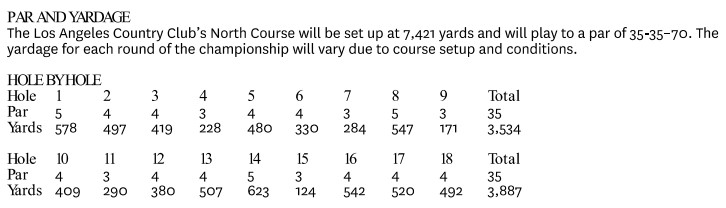
As a unique par 70, LACC has five par 3s to go along with three par 5s and ten par 4s. The par 3s are exceptionally strong and are among the most diverse and memorable holes on the course. Each conveys distinct topographical characteristics that facilitate specific shot options. Amazingly, they can play from as short as 77 yards (15th) to as long as 303 yards (11th).
The 7th is probably the toughest par 3, measuring almost 240 yards where the green sits as its own little island surrounded by sand and waste areas. The 9th might be the signature hole with the clubhouse as the setting, but the 11th is the star of the show with downtown Los Angeles as the backdrop.
Two of the par 5s are reachable in two shots with the 623-yard 14th hole being a true three-shot hole for most players. Six of the par 4s are absolute monsters in length and difficulty with each being over 480 yards and three over 505 yards.
The course begins in true George Thomas fashion with a friendly handshake as the par 5 first hole offers the only real chance to attack in the opening five. He then follows by smacking you in the face with a difficult par 4. Thomas felt like that was the best way to start a round. He thought it important for players to take their hacks on an easier opening hole followed by a true test on the next.
Holes 2-7 might rank near the top as the best stretch of holes anywhere. The 6th in particular is a fascinating 330-yard downhill par 4 where players can try to drive the green even though it would be a blind shot over a hillside. The other option would be to lay back and play to the left in order to have an angle to pitch the ball into the length of a narrow green.
The closing stretch of #16-18 is just one tough par 4 after another. Not only are they lengthy, but the tee shots are each demanding and the greens are among the most challenging on the course. These three holes are a quintessential U.S. Open slugfest, “survive and make par” type of holes.
Finally, certain holes have seen their fairway widths adjusted in order to provide opportunities for players to utilize the terrain and architecture of the course in different ways. For example, the par 5 1st hole that descends downhill 45 feet from tee to green had its fairway narrowed to only 26 yards in the landing zone. By contrast, the 480-yard par 4 5th hole that plays 50 feet uphill from tee to green had its fairway widened to 56 yards due to its severely left-to-right sloped area.
Strokes Gained Analysis
Off the Tee
LACC is one of the most visually formidable courses off the tee that players will face. From vast sloping fairways to hidden barrancas to the rugged California landscape, players will have to use their practice rounds to establish proper lines off the tee. There are even a few blind tee shots that further add to the challenge.
While the massive fairways (43 yards wide on average) will rival the widest in modern U.S. Open history, distance off the tee should not be that large of a factor if LACC plays as firm and fast as expected. With balls squirting in all directions due to the sloping fairways, distance control, calculating roll-out, and precision to the correct side of the fairway will be vastly more paramount than length. This is especially true on a hole like the 13th where a drive to the left section of the fairway offers a clear angle of attack to the green while a drive down the middle or to the right side of the fairway will result in a blind approach from the rough. Also, there are some fairways that measure less than 30 yards wide. When analyzing Total Driving this week, I would give a significant edge to accuracy (70%) over distance (30%).
LACC will penalize big misses much greater than a course like Oak Hill did. A player who missed the fairway by 30 yards at Oak Hill essentially had the same approach shot as a player who missed by five yards. By contrast, a drive that misses badly at LACC will most likely end up in a barranca or another untenable position where the type of lie is a complete toss-up.
That doesn’t mean distance should be completely ignored as the ability to push the ball closer to the hole will allow players to use higher lofted irons with the hope of keeping their ball on the green surface with the second shot. Shorter hitters will still be left with longer irons into rock-hard greens. Along with Total Driving, Good Drive % on other courses with firm and fast conditions and Distance From the Edge of the Fairway (DFEF) are two other important OTT stats for this week.
Approach
It remains to be seen how much of a second-shot course LACC actually is, but one thing seems certain, there will be a majority of long-iron approaches from 175+ yards. Not only do four of the par 3s cover this approach distance but each of the par 5s along with the six lengthy par 4s will also likely require a shot from this range.
Distance control into these firm greens will also be critical as many slope from back to front and have all sorts of penal areas beyond the putting surface. On some holes like the 17th and 18th, bunker complexes start 20-30 yds before the green making club selection a vital part of the process as well. Golfers who find the Bermuda rough on wayward drives will have to deal with tricky lies and account for fliers and that will either trundle out short of the green or will overshoot it completely.
The areas that surround the greens are quite undulating with runoff areas due to many of the greens being elevated. Errant approaches that miss the rough or short grass collection areas will likely find one of the hazardous bunkers, or even worse, one of the sandy wash areas.
With hole locations that are far more diverse after the green expansions by Hanse and his team, pins can be placed in many new positions. This is especially true for putting surfaces at the 3rd, 5th, 12 and 14th holes, some of which have the shape of molars with the roots of the teeth directly behind deep bunkers. Players will have to consider being aggressive toward these flags or risk being above the hole and leaving treacherous downhill putts.
Around the Green and Putting
The most important aspect of LACC this week might be performance around the greens. They are deceptively difficult. Whether it’s playing from Bell’s bunkers, tight-lied short-grass areas, barrancas, or Bermuda rough, there is such a wide variety of challenges that golfers will face if they are continually having to scramble to save par or bogey. Errant approaches will cause balls to race away from the greens leading to pitch shots toward fast-putting surfaces. Many greens have slopes that will run away from the players if they are hitting a recovery shot from the wrong side of the green.
Most holes also have at least two of Bell’s infamous bunkers surrounding them. The tall fescue around the bunker faces makes them play as even more of a true hazard. Creative around-the-green players such as Scottie Scheffler, Jordan Spieth, and Cam Smith should have an edge in this area.
Because the entire property is so undulating, putting on these greens is difficult thanks to all the slope and subtle pockets and ridges. The advice that gets repeated the most is the necessity of playing below the hole due to the back-to-front sloping on many holes.
The bentgrass greens at LACC are notoriously fast and will run at a 13 on the stimpmeter. Their speed, along with some of their surfaces stretching past 8,000 square feet in size, will make lag putting an important skill this week. Of course, putting between 5-15 feet, typically under stress to save par, will also be vital for success.
Most Important Stats For Success at Los Angeles Country Club
*In order of importance
- SG: T2G (Last 6 Months)
- SG: Approach
- Scrambling (Difficult ARG Courses)
- SG: OTT (Long/Difficult Scoring Courses)
- Bogey/Double Bogey Avoidance (Difficult Scoring Courses)
- Proximity 200+
- Birdie or Better %
- SG: Majors/Strong Field Events
- Par 4 Scoring (450+)
- SG: Putting (Bentgrass)
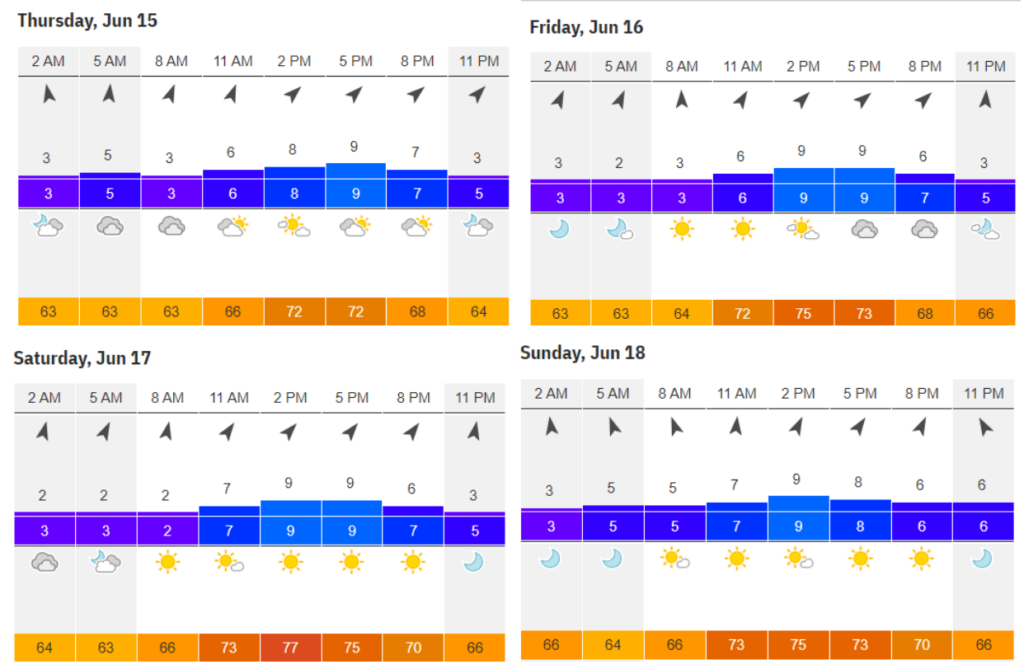
Weather Forecast – Los Angeles, California