We are back! Happy New Year to all. 2025 is shaping up to be another year of immense progress for Betsperts Golf and the Rabbit Hole. I cannot wait to share all of the new data-packed features that we continue adding to the site as we proceed with our goal of having the most comprehensive and unique PGA Tour database anywhere.
There is no better place to kick off the 2025 calendar year than Hawaii’s warmth, beauty, and lush green grass at The Sentry, played at the Plantation Course at Kapalua. Since 1999, the Tour has kicked off the new year with this tournament which has been held at the Kapalua Resort near Lahaina on the island of Maui.
Kapalua is where paradise and golf meet. Once the site of a large pineapple plantation, it’s such a unique course that you can see whales breaching in the distance on the first tee, and on the 18th tee can wallop a 450+ yard drive. Thanks to the wind and elevation changes, it is one of the few courses on Earth where the yardage on the scorecard is irrelevant on many holes.
This compilation of the world’s best golfers (most of whom were tournament winners last year) is a unique, no-cut, small-field event, played on a low-scoring par-73 course that has expansive fairways, numerous elevation changes, and gusty coastal breezes. Thanks to the combination of easy-to-hit fairways and greens, it’s one of the most genuine birdie fests on Tour, and it favors the best wedge players and the hottest putters. It plays the complete opposite of a target-style golf course. The allowance for creativity and multiple options for each shot makes it a fun track to play. Players with every shot in their bag who can maneuver the terrain and manage the wind will best position themselves for success at Kapalua.
After a wind-blown 2020 where the winning score by Justin Thomas was only 14-under par, the past four events have seen scoring return to the more common finishing number of 25-under or lower. There has also been some Sunday drama. In 2022, Cam Smith took birdie-making to another level by winning with an event record of 34-under and outlasting Jon Rahm by one stroke. In 2023, Rahm got his revenge by taking advantage of Collin Morikawa’s final-round collapse and rallying from as many as nine strokes back to win by two. And then last year, Chris Kirk held off a strong charge from Sahith Theegala to win by one stroke with a 29-under score for the week.
The Sentry Field
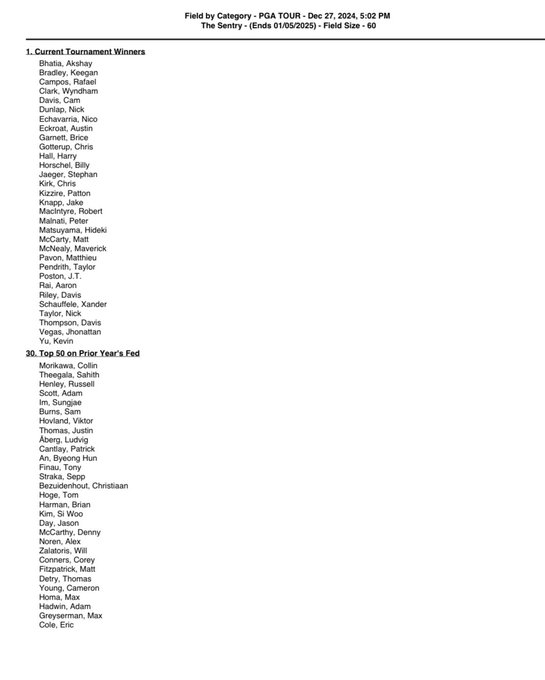
Before last year, the Sentry field comprised only PGA Tour winners from the previous season. But starting with 2024’s tournament, the top 50 from the previous year’s FedEx Cup and any other Tour winner from the past year are eligible to participate. Currently, 60 players are in the field, including 37 of the top 50 golfers in the Official World Golf Rankings.
Unfortunately, the world’s top-ranked player, Scottie Scheffler, had to withdraw after injuring his hand on Christmas Day while preparing dinner. He had surgery to remove pieces of glass from his hand and is expected to miss three to four weeks. Three top-ranked Europeans – Rory McIlroy, Tommy Fleetwood, and Shane Lowry – are also skipping out on the event as each typically prefers to start their season in Dubai in a few weeks. Past Sentry champions that will be teeing off this week include Xander Schauffele, Chris Kirk, and two-time winner Justin Thomas.
The Sentry kicks off the “Hawaii Swing” (which concludes with next week’s Sony Open) and is meant as a paradise of escape from the cold winter enveloping most of America by providing the best players on Tour with a rewarding experience at the Kapalua Resort. With everyone in the field coming in with at least a month off from regular competition, it’s always interesting to see which players have been grinding away back home over the break and come out sharp in the first round. The resort setup is meant to help the pros ease back into the grind after (mostly) putting their clubs away over the holidays.
Related to returning from a long break, Patrick Cantlay remarked, “It’s a good golf course to kind of shake some rust off. The fairways are big and there’s lots of space out here to hit shots and it’s also a golf course where you have to be very creative, and so you have to play all the different shots out here to be successful.”
Plantation Course at Kapalua – Course History
The Plantation course at Kapalua was the creation of famed architects Bill Coore and Ben Crenshaw. Designed in 1991, the course is laid out over an immense terrain area on the lower slopes of the volcanic West Maui Mountains. The scenic 677-yard 18th hole was the original hole that was designed with the rest of the course being built around it. “Coore and Crenshaw” courses are known for providing options off the tee for players to attack the greens from various angles. Thanks to fairways that are wide enough to land a 747 jet, players have multiple landing zone options on each hole.
Sitting on 240 acres, the rugged terrain presented a huge challenge as Coore and Crenshaw had several valleys and gorges with which to deal. According to Coore, the massive resort course was built on such a huge scale to accommodate the wind and the slope of the mountains. As we will get into further below, the course can be very challenging, but not because of the design choices. The architects kept the build elements very minimal to let the natural geography and weather create difficulty.
The course received a renovation (or as Coore called it “a rejuvenation”) in 2019 that was meant to restore the layout to its original condition. “We look forward to the opportunity to restore many elements of the Plantation Course and implement a few ‘refinements’,” said Coore. “It’s like when you have a special piece of art or something really special to you, and you get a chance to dust if off and make it new again. This will be a very thoughtful restoration and refining process, but it’s not a redesign. We are very happy with the way the course looks and the way it has gone through the past nearly three decades.”
In reality, almost every part of the course, including tee boxes, fairways, bunkers, and green complexes, was modified in the $12 million project. Repositioned bunkers and new tee boxes respond to the distance gained by professional players since the course was built. The entire course, from tee to green, was replanted with Celebration Bermudagrass, which is a more durable playing turf for the conditions of the island because it can be mowed shorter and better protects against the year-round trampling the course receives.
Every single green was rebuilt and resurfaced with TifEagle Bermuda. The greens had dramatically shrunk over time since 1991 so they were expanded back to their original size. This also allowed for more pin positions to be utilized. After the renovation was completed, Bill Coore said this about the changes around the greens, “The idea at Kapalua always was to land a shot 60 yards short of a green and let it roll on. In recent years, a ball landing 20 yards short of a green would just stop. Players will be able to use side slopes to feed shots to a flag. And drives will roll out farther, sometimes closer to trouble.”
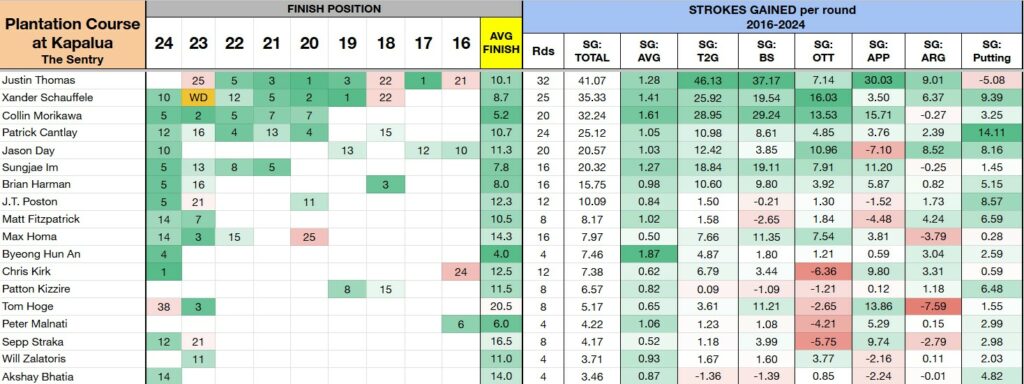
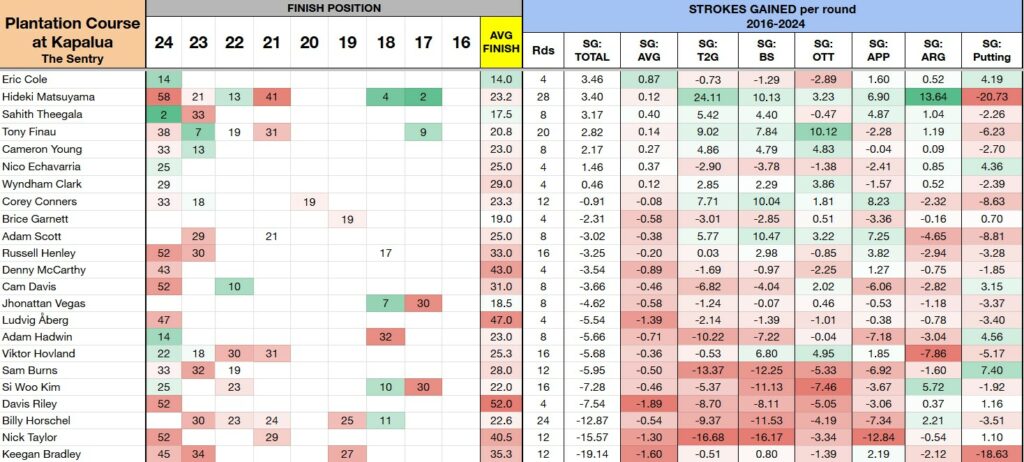
Finish Position and Strokes Gained Course History (2016-2024)
This includes the average finish position and Strokes Gained per round in each category. Players are sorted by SG: Total. The Plantation Course at Kapalua is the 21st most predictive annual course on Tour.
Kapalua Course Features
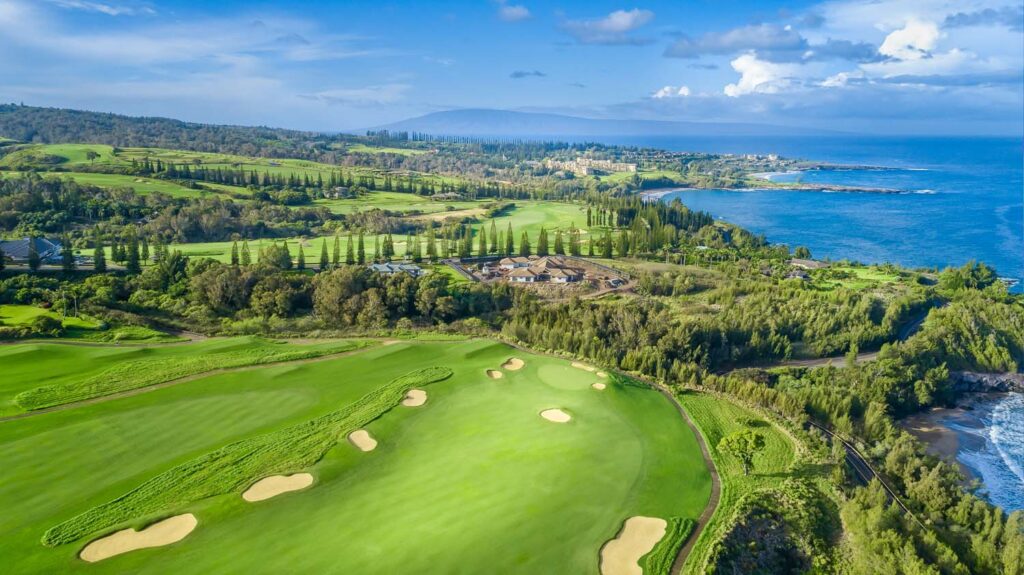
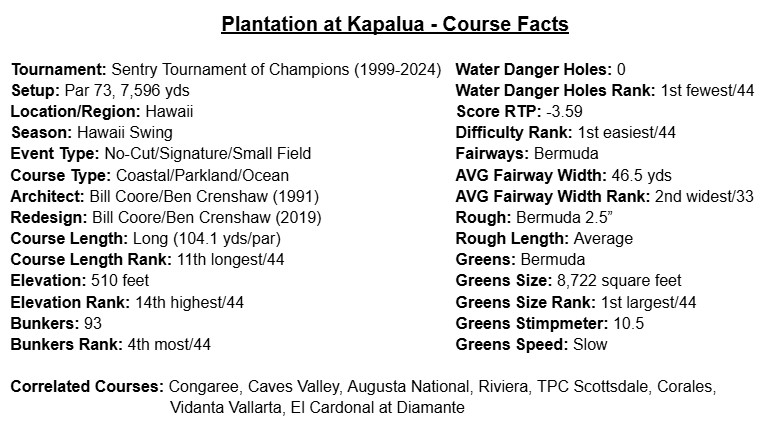
Located on the north shore of the Hawaiian island of Maui, the Plantation Course at Kapalua is a unique Par 73 coastal parkland layout that measures 7,596 yards. It is the 11th-longest course in the annual Tour rotation and sits on a spacious tract of mountainous land. From the breathtaking views overlooking Honokahua Bay to the 500-foot elevation difference between its highest and lowest points, the course is a spectacularly scenic place to host a highly competitive event comprised of a majority of the world’s best golfers.
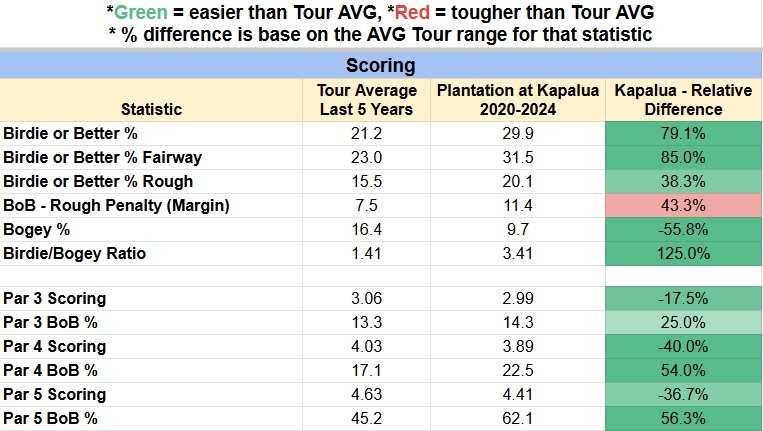
Due to several factors, Plantation has the well-deserved reputation of being one of the lower-scoring courses on Tour relative to par. Since beginning on Tour in 1999, the winning score is typically in the low-to-mid 20s under par. There have been outliers, of course, with Thomas (-14) and Smith’s (-34) victories separated by 20 strokes. Over the past five years, it has ranked as the easiest course on Tour at -3.59 per round. The last three years have seen scoring taken to another level with an average round playing at a staggering -4.50. While plenty of birdie and eagle opportunities exist, the course still offers a few potential challenges, including coastal winds, uneven lies, and expansive tiered greens.
Though it is a parkland course with plenty of trees, they don’t crowd the fairways. While there are no holes that bring any type of water danger into play, there are 93 bunkers (fourth-most on Tour) that litter the course. There are also a few canyons with heavy vegetation and penalty areas to contend with. But even more challenging to golfers this week is the ability to manage the factors mentioned above that could cause trouble – elevation changes, massive greens, and the strength of the wind.
Though located on the coast, it’s the mountains that define Kapalua. The resort’s Plantation Course was built on the slopes of the West Maui Mountains. This terrain creates large undulations throughout the course as golfers progress up and down the elevation changes throughout their round. In fact, the course has the largest amount of elevation changes on Tour. Patrick Reed remarked that all the awkward lies, blind shots, and elevation changes force players to be more engaged and creative in their shot-making throughout the week.
“Fun” is a word that pops up continually in player interviews about the course. Said 2019 winner, Xander Schauffele, “It just kind of fits my eye. Usually, it’s a little windier, you got to sort of do all things in your game correctly. It’s just a lot of fun to play because you’re on these massive hills and a ton of wind and kind of weird breaking putts.” Rickie Fowler, who has four top-6 finishes here in his only starts jumped on the “fun” bandwagon as well by remarking, “This golf course allows you to use your imagination. Obviously with the amount of up and down and side slopes, and in the wind you’ve got to have some imagination on shot shape and hit your windows. So judging that properly is always fun for me.”
Kapalua’s Bermuda rough measures 2.5″ long but poses little threat to golfers as the average proximity to the hole from the thicker grass is only three feet further than from the fairway. The mammoth Bermuda greens at Plantation average 8,700 square feet. Combining the size and slope of the greens with the typical gusty winds makes the course one of the toughest on Tour for proximity to the hole. This, in turn, increases the potential for three putts and bogeys on certain holes.
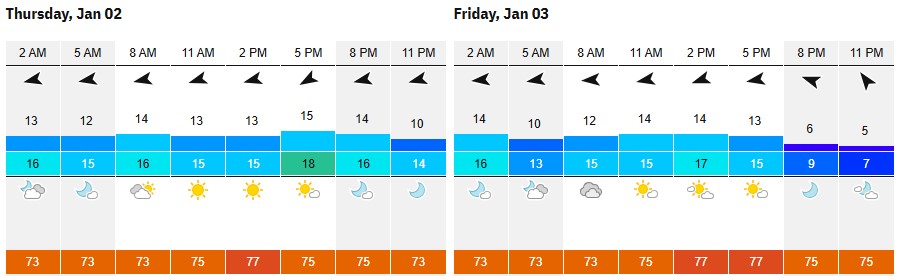
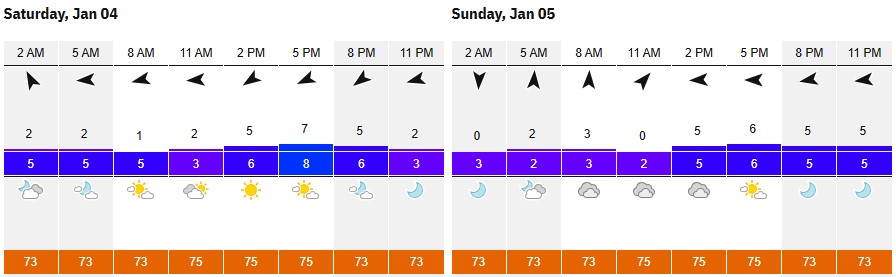
However, the main defense the course offers is in the form of the prevailing east-by-northeast trade winds which can make certain holes much more difficult and which tend to increase as the afternoon progresses. Players who have more experience in windy conditions, especially those who can control their ball flight will have a definite advantage. These are not light and variable breezes, but gusts often exceeding 25 mph that can wreak havoc on the course.
Hole Analysis
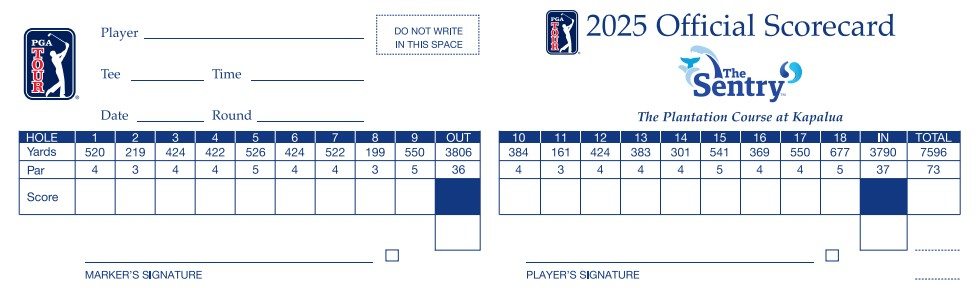
As the only par 73 course on the PGA Tour, Plantation is composed of three par-3s, four par-5s, and 11 par-4s. Not only are the par-4s and par-5s among the easiest on Tour, but they are also among the shortest at an average of only 450 yards per hole. In total, the course features eight par-4s that play under 425 yards, making a strong wedge game a key area for success. That being said, Kapalua is also the only annual course that has seven total holes measuring over 500 yards.
Because the prevailing winds rarely change directions, three of the par-4s are over 520 yards. Coore and Crenshaw wanted to be fair with yardage. This is why the downwind and downhill holes are significantly longer than normal. The first hole, for example, is a downhill 520-yard par-4 that regularly sees drives over 350 yards. Amazingly, even the 12th hole, which is a 424-yard par-4, is sometimes driveable off the tee as you can see in the video of Dustin Johnson below which shows perhaps the best drive in Tour history. On the flip side, the holes that play into the wind are short and uphill.
Being able to take advantage of the par-5s will also be a key target point at Kapalua. Three of them measure 550 yards or shorter, and the enormous 677-yard 18th hole plays straight downhill. Because of this, an eagle is in play on these holes for every golfer in the field.
From a scoring perspective, 15 of 18 holes have a Birdie or Better rate of 13% or higher with eight holes at 25% or better. If running your own model this week (which you can do using our unique PGA Tour licensed database called “The Rabbit Hole“), make sure to include metrics such as Birdie or Better %, Par 5 Scoring, and past history on “Easy Scoring Courses”.
Speaking of the signature 667-yard 18th hole, the view down the fairway and out to the ocean with Molokai in the distance has become one of the Tour’s most recognizable views since the PGA Tour started kicking off the season here in Kapalua. If simply looking at the scorecard it seems impossible to think that even professional golfers could reach the green in two shots. But with a steep elevation drop down the fairway golfers can hammer mammoth drives with ease as the ball just keeps going and going and going.
Since 2003, there have been over 150 drives of over 400 yards on this hole. In fact, Tiger Woods blasted his longest-ever drive, a 498-yard bomb on this hole at Kapalua during the 2002 Tournament of Champions, which remains the longest drive in PGA Tour history recorded by ShotLink.
Strokes Gained Analysis
The chart below shows how correlated each metric is to a player’s SG: Total over the last five years of play here at the Plantation Course at Kapalua. The closer the correlation is to 1.0 the more important it is to perform well in that metric this week. For the main SG categories below, I have also included the 5-year PGA Tour course average for each metric to allow for easy comparisons to the current event.
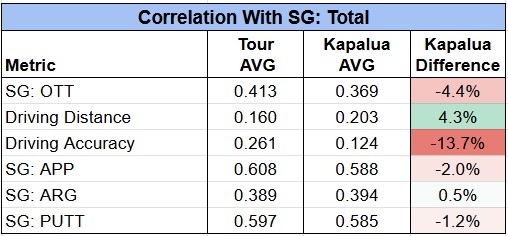
Also being added for each tournament this year is an SG: AVG/rd by finish position chart – along with the value (based on the field size) for the winner, and those in the top 5 and top 15. As you can see below, the last five winners of the Sentry Tournament of Champions had an excellent week putting on these greens. Those in the top 5 and top 15 ranked highest in SG: Approach with SG: Around the Green being the least important by a good margin for those finishing higher on the leaderboard.

Off the Tee
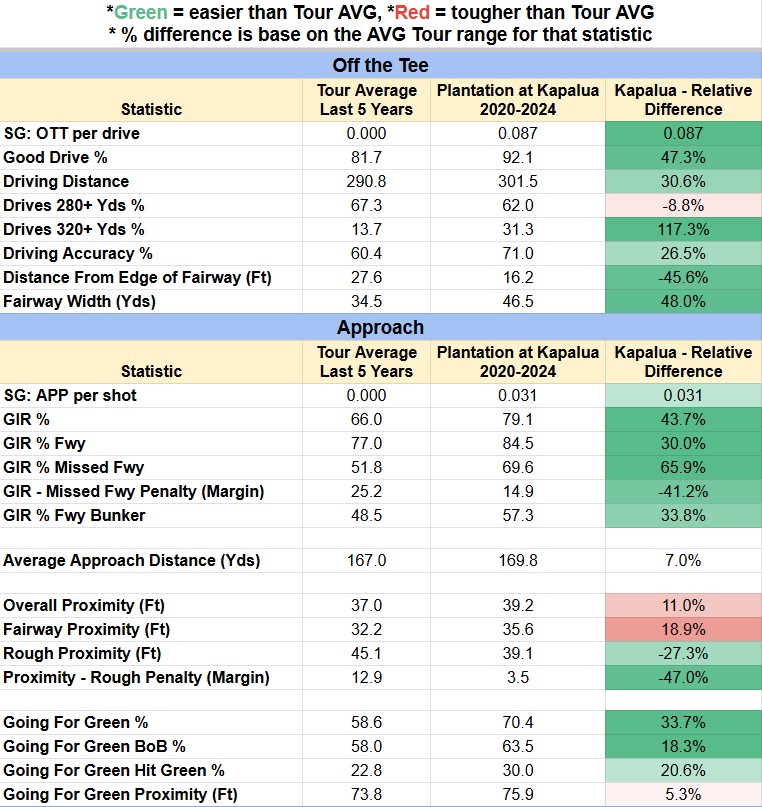
With the second widest fairways on Tour which average 46 yards across (100 yards wide in some spots), and numerous downhill sloping holes, players will be teeing it up on a course that allows the 5th-highest driving distance. Combine that with driving accuracy at 71% and you have a golfer’s dream scenario off the tee. Both bombers and wildly inaccurate drivers have had great success here.
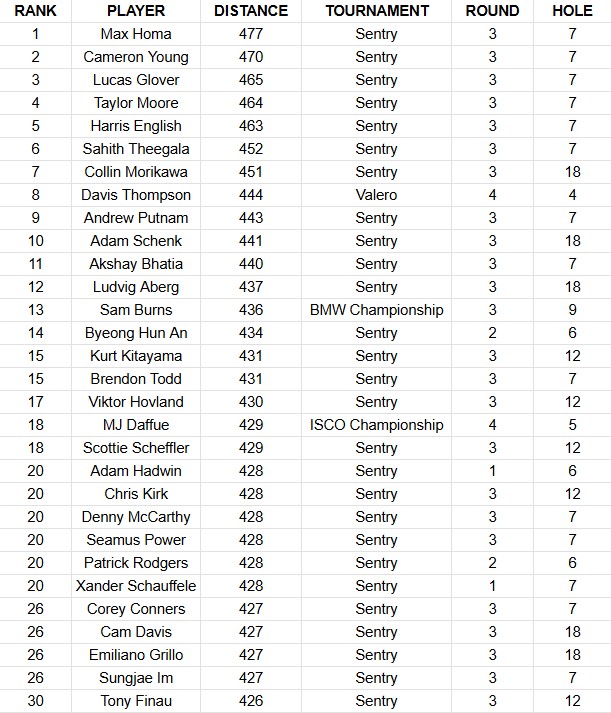
With fairways so spacious and no real danger or hazards near the landing zones, players are free to blast away with driver. Thanks to the sloping fairways and downhill breezes, players will hit some of the longest drives of their lives this week. As you can see in the chart below, 27 of the 30 longest drives on Tour last season came at this course, specifically at the 7th and 18th holes. That being said, distance is not a winning advantage because even shorter hitters will get extra yardage here thanks to the conditions with the likes of Chris Kirk, Jordan Spieth, Patrick Reed, and Harris English having won here in past years.
Said English regarding off-the-tee strategy, “I know guys have different strategies, but I’m hitting driver a lot this week. I would say more so than a normal golf course. These fairways are wide. You can be as aggressive as you want to, but it’s still about putting the ball in the fairway. You drive the ball well out here, you’re going to have a lot of short irons, a lot of wedges, and you just got to get your putting dialed in.”
Out of the 85 Shotlink-equipped PGA Tour courses that have been used since 2015, the Plantation course ranks as the easiest to gain strokes OTT and the second-easiest to find the fairway. Golfers who are wild off the tee or that have the ball run through the fairway have little to worry as the rough at Kapalua is the third-easiest to play from.
Approach
Kapalua is one of the true “second-shot” courses on Tour. Accurate iron play to set up makeable putts is the recipe for success. Overall, players are hitting the greens in regulation at Kapalua at a clip that is 13% higher than the Tour average. On the rare occasion that the fairway was missed off the tee, players are still hitting the green an astounding 70% of the time from the rough. The Tour GIR average from a missed fairway is only 52%. This confirms two facts we already know: The 2.5” Bermuda rough is not a threat, and the greens are so massive that even poor approach shots have a chance to find their surface.
With the potential for coastal winds, combined with the large undulating greens, there is a premium on precise approach play in the form of proximity to the hole. And when analyzing the data, it is clear that hitting the ball close to the pin is very difficult at this course.
What makes precise approach shots at the Plantation Course so vital is that accuracy in finding the proper quadrant of the green is one of the few factors that allow players to separate from each other. Many of the greens have undulations where the slope must be used to feed the ball towards the pin. A majority of approaches will also be struck from uneven lies.
Players on average leave the approach shot almost four feet further from the hole than on the typical Tour course. While it’s nowhere close to a links-style track, with most of the greens open in the front, bump-and-run type approaches to keep the ball low in the wind are an advantage for those who can pull it off. The chart below shows how correlated to success each range is based on every golfer’s average proximity to the hole. The higher the correlation the more important it is to hit close approach shots from that range.
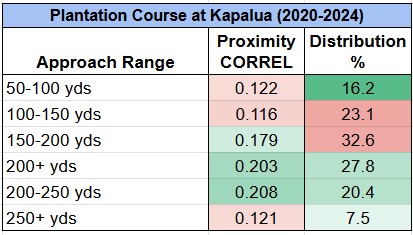
As far as the distribution rates from each of the approach yardage ranges, there is an above-average % of short and long approaches. Looking even closer, from 50-100 yards there is a 5% increase compared to the average Tour course. Over 39% of all approaches will be with wedges which is the highest rate of any course on Tour. And with all of the lengthy holes at Kapalua, the 200+ yard range will also see an increased number at 28% compared to the Tour average of 25%.
Around the Green and Putting
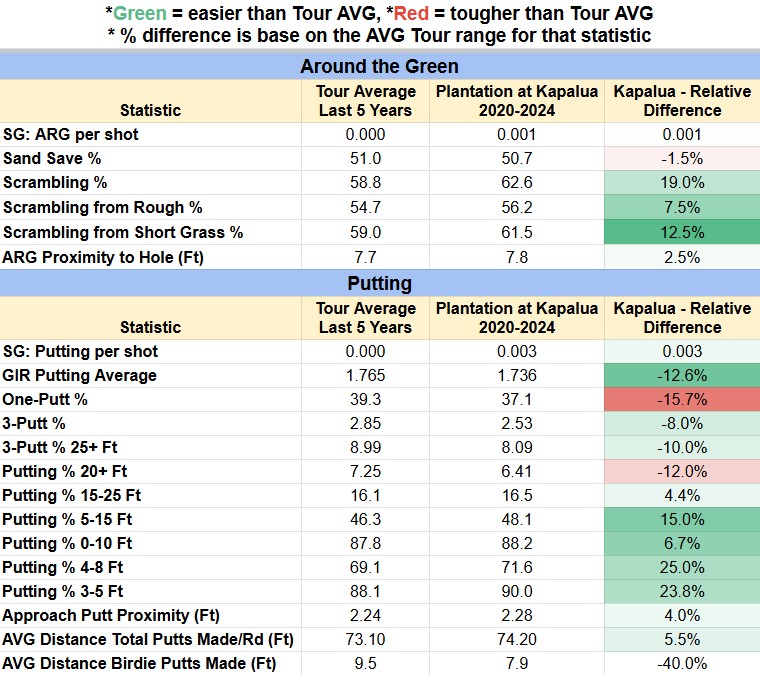
This is one of the few “birdie-fest” events where certain holes require competent play around the greens. But instead of trying to get up and down for par, some golfers will be instead scrambling for birdies. That’s because four of the par-4s are under 390 yards, potentially leaving bombers with short wedges into the greens. Also, golfers who miss when going for the green on the par-5s will typically be left with shots from less than 30 yards to the pin. But with such a high GIR%, ARG play will be less relevant for many golfers in the field.
While sand saves are slightly more difficult at Kapalua, historically, other shots from around the green (30 yards or less) are among the least frequent on Tour. Golfers who do miss the green will mostly be dealing with closely mowed areas that will challenge a player’s ability to chip the ball close to the hole on these mammoth surfaces.
The main facet of the short game that will be tested is putting on these tiered Bermuda greens. With the greens being massive in size at 8,700 square feet, players will be faced with numerous putts from longer distances. Looking at the short game metrics above, while many of the shorter-length putts have easier “make” rates than the Tour average, putts from 20+ feet will be a challenge. Three-putt avoidance from 25+ feet is one of the main putting metrics I am including in the model this week.
The main reason lag putting is so demanding is that the Bermuda grain combined with tricky slopes make these putts tough to read. With the stimpmeter measuring at a slow 10.5, aggressive putting is rewarded here. Players must also factor in the wind when considering the force of their putting stroke.
Most Important Stats For Success at the Plantation Course at Kapalua
- BoB %
- SG: Putting (Bermuda)
- Proximity 200-250 yds
- Par 5 BoB%
- SG: Putting 5-15 ft
- Proximity 50-100 yds
- 3-Putt Avoidance
- Driving Distance
- SG: Easy Scoring Courses
- SG: Plantation Course at Kapalua
Unique Rabbit Hole Filters
- Course Region: Hawaii
- Scoring Conditions: Very Easy/Easy
- Course Length: Long
- Field Strength: Strong
- Course Type: Coastal/Resort
- Field Size: Small Field
- Event Type: No Cut
- Greens Surface: Bermuda
- Green Size: Large
- Rough Surface: Bermuda
- OTT Club Type: Driver Heavy
- Gain OTT: Very Easy
- Rough Penalty: Low
- Gain APP: Very Easy
Weather Forecast – Honolua Bay, Maui, Hawaii