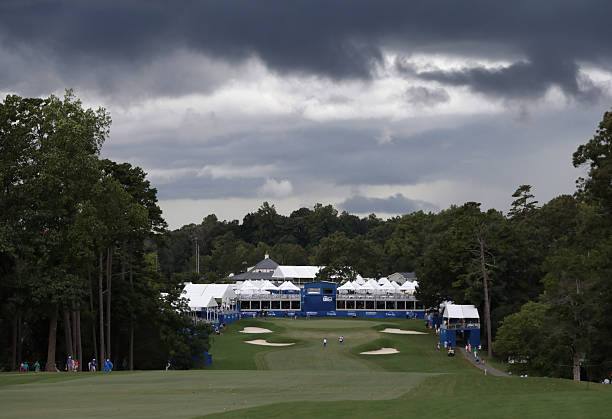
In the final PGA Tour event before the start of the FedExCup Playoffs, Sedgefield Country Club will play host to the Wyndham Championship. Located near Greensboro, North Carolina, Sedgefield has been a regular Tour stop since 2008. It is a Donald Ross-designed classical course with a storied history that was built during golf’s “Golden Age”.
The recently updated and preserved Sedgefield course provides a tactical challenge rarely found on Tour. It is a shorter course where finding the contoured fairways carries real worth. While scoring has continued to be low over the years, the narrow, tree-lined fairways, strategic routing and bunkering, and elevated tricky green complexes ensure that Sedgefield will continue to be a fair test of golf.
Bombers off the tee do not have that much of an advantage at Sedgefield, and most tend to avoid this event. Instead, the course favors accurate positional drivers of the ball who are positive with short-to-mid irons and wedges and who are consistent putters, especially on Bermuda greens. Recent past winners like Lucas Glover, Tom Kim, Kevin Kisner, J.T. Poston, Webb Simpson, and Si Woo Kim each exemplify these traits.
The Field
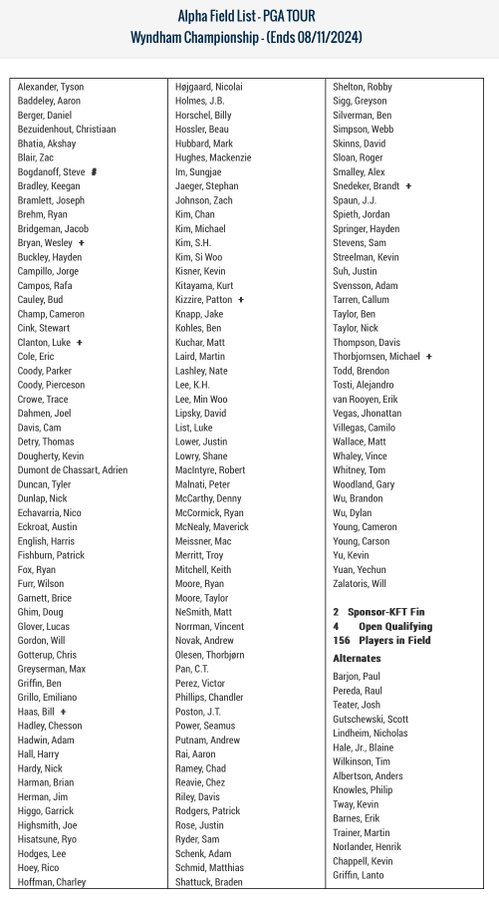
With many of the world’s best choosing to rest up and prepare for the three-week FedExCup Playoffs on their own, we will see another field lacking in star power. Brian Harman, Robert Macintyre, and Sungjae Im represent the only top-20 players in the world golf rankings in attendance.
There is, however, some quality depth this week with players like Shane Lowry, Keegan Bradley, Cameron Young, Denny McCarthy, Si Woo Kim, and Akshay Bhatia in the field. Motivation becomes a real intangible this time of year as many players will be trying to either qualify for the playoffs or better their position with this being the final event before the end of the season.
This is magnified even more so as only the top 70 in the FedExCup point standings will be eligible for the playoffs. Almost every player just outside the top 70 will be teeing it up this week including the likes of Victor Perez, Kurt Kitayama, Keith Mitchell, Nicolai Hojgaard, and last year’s winner, Lucas Glover.
Sedgefield Country Club – Course History
Designed and built by legendary architect Donald Ross on a former hunting estate in 1925, Sedgefield Country Club has quite the storied past. Ross was initially supposed to design two 18-hole layouts but the Great Depression prevented the second course from being built. Before it became the Wyndham Championship in 2008, it was formerly called the Greater Greensboro Chrysler Classic and also the Greater Greensboro Open.
Between 1938 and 1965, Sam Snead won this event a record eight times. Along with hosting the first professional event in North Carolina, the club also helped to break down racial barriers by inviting Charlie Sifford to participate in 1961 before the Tour had removed its segregation clause.
As time passed, the course had been altered and changed so much that it had little resemblance to the original design. The fairways and bunkers, specifically did not make strategic sense. The course underwent a $3 million restoration project by Kris Spence in 2007. The goal was to rebuild the course and also restore the original Ross feel. Sedgefield was closed for 10 months as Spence relied on 80-year-old aerial pictures and original blueprints. Among the main renovations were adding 400 yards in length, re-positioning bunkers, and restoring the greens to their original size. Spence also took out the Bentgrass greens and added Champion Bermuda.
We have partnered with Underdog to bring you an easy way to claim a FREE, no-strings-attached 90 days of Premium Access to Betsperts Golf, plus up to $250 in bonuses when you deposit! Click here to learn more!
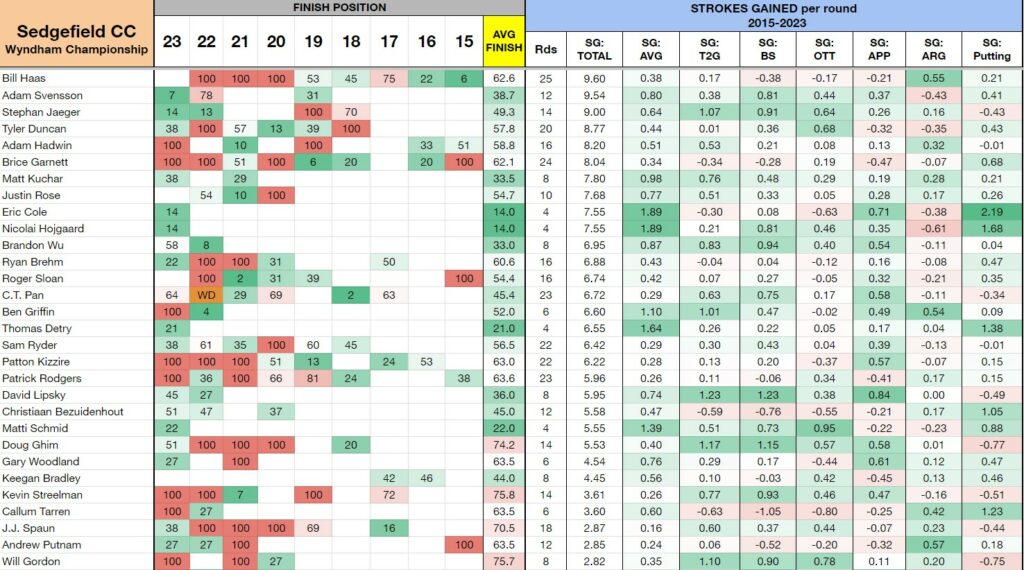
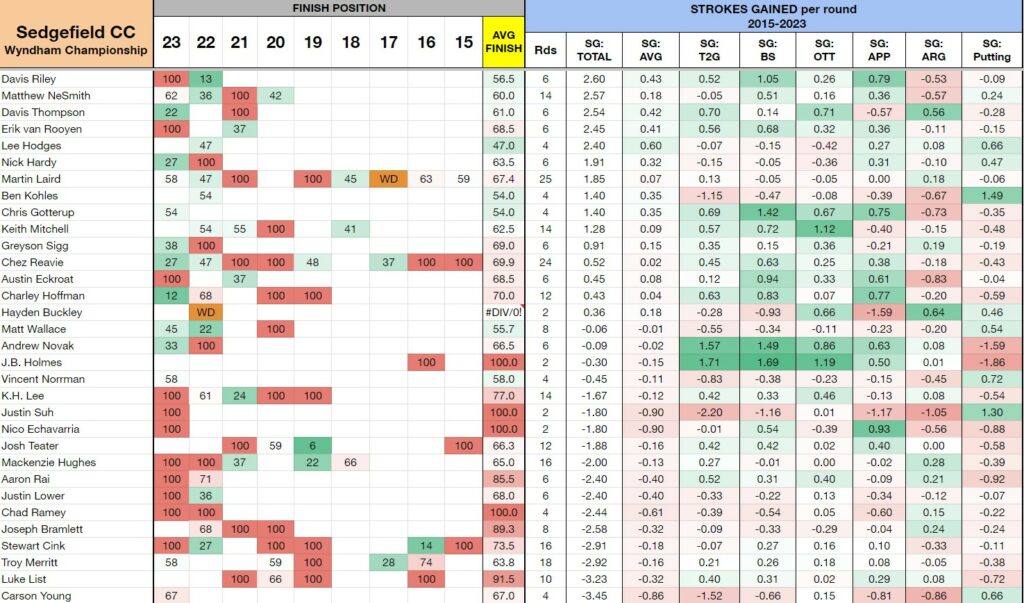
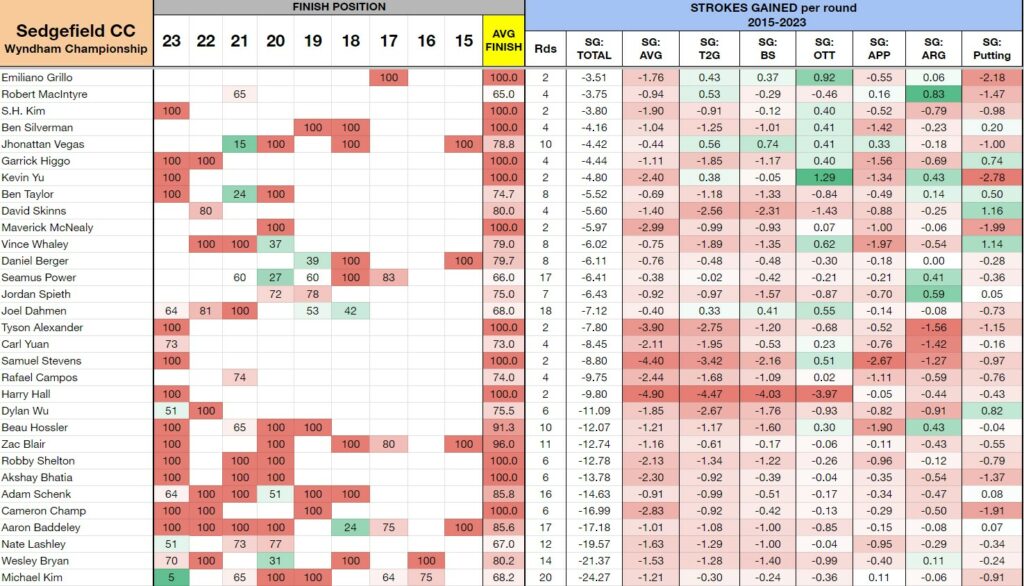
Finish Position and Strokes Gained Event History (2015-2023)
This includes the average finish position and Strokes Gained per round in each category. Players are sorted by SG: Total. Sedgefield CC is the 11th most predictive course on Tour.
f684b2f3d4218ee06dad551b3bb2074b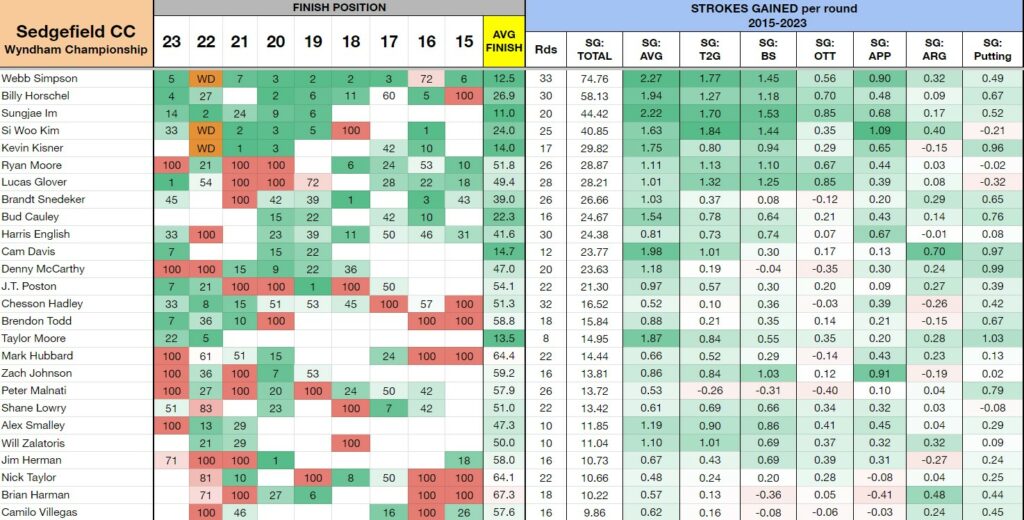
Course Features
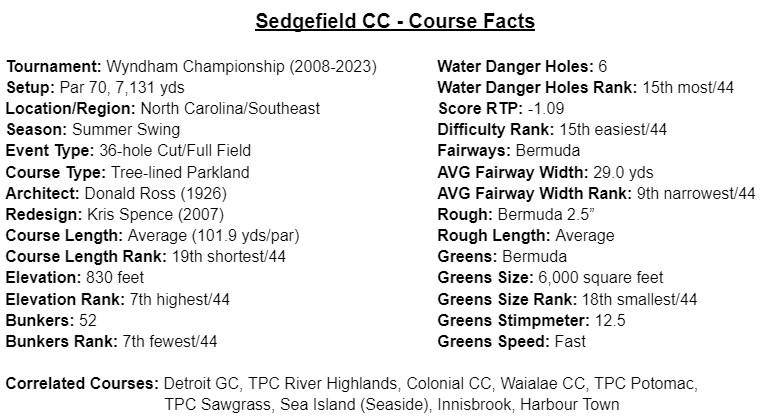
Sedgefield Country Club is classified as a positional track that is slightly shorter than the average Tour course. It is a par-70 that measures out to 7,131 yards. With fairways that are heavily tree-lined, the course is routed over an undulating, wooded landscape. Just southeast of Greensboro among the rolling hills of the Piedmont region, it has a definite Carolina feel.
The course features wall-to-wall Bermudagrass with average-sized greens that run between 12.5 to 13 on the stimpmeter. The rough only measures 2.5 inches, but with Bermuda being the most unpredictable grass, even that length can be tricky to hit from.
Sedgefield places a premium on positioning your ball on the proper side of the fairway and finding the best angle to attack the tricky green complexes. Donald Ross was well-known for using the topography of the land to determine the routing of the course and how it should be played. Players will also be challenged to be strategically aggressive and will be rewarded with scoring opportunities if they are successful.
The visual challenges that Ross provides throughout the course are a perfect illustration of this. On the second hole tee, for example, there are numerous bunkers that appear to surround the fairway landing zones, yet they are actually much further back than anticipated. Numerous holes with doglegs also force players into decisions to either attack the dogleg or lay up with a shorter club.
While only a par 70 course, conditions are typically scoring-friendly at Sedgefield Country Club. Six of the past seven years the winning score has been at least 20-under. Over the past five events, the course has played to an average of 1.09 strokes under par per round, making it the 15th easiest track in the Tour rotation. There are only six holes that average over par. When winds are down and conditions are soft, low scores are in play, especially if someone catches fire with the putter as evidenced by Brandt Snedeker’s first-round 59 back in 2018.
There are three main defenses of this golf course that will somewhat challenge players—the Bermuda rough, the undulating green complexes, and the fairway bunkers. The routing of the course can also be challenging when the wind increases. Golfers tee off in a different direction on almost every single hole, which can affect distance control and accuracy if needing to calculate different wind speeds and directions. Water comes into play on six holes but is not a huge threat.
The fairway bunkers are the toughest on Tour from which to reach the green in regulation. The average GIR rate last year on Tour courses from fairway bunkers was 48.3%. Over the past couple of years at Sedgefield, it has been only 23.3%. Typically played in the sweltering heat and humidity of the Carolina summer, fatigue could also play a role in performance for those players who are not in the best physical shape.
Hole Preview
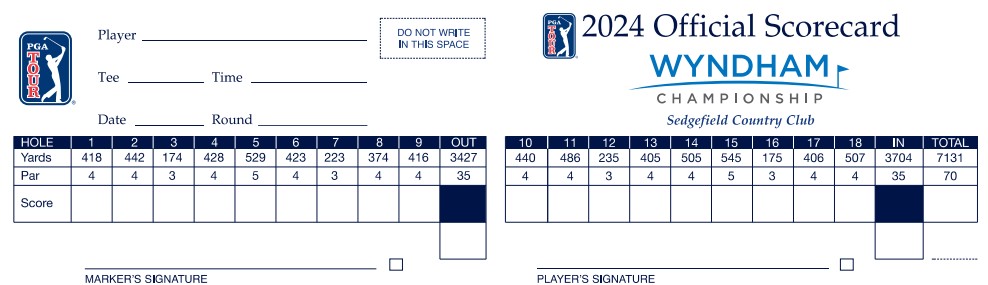
The course is a stock-par 70 with only two par-5s and four par-3s. Nine of the 12 par-4s are less than 445 yards and are a huge reason so many approach shots are with short irons and wedges. The two par-5s are each less than 550 yards and are the easiest group on Tour with a combined birdie or better rate of 59%. In fact, Sedgefield features the fifth-shortest set of par-4s and par-5s on Tour. The four toughest holes include two 500+ par 4s and two of the par-3s that measure over 225 yards.
The final two-hole stretch at Sedgefield features two of the best holes on the course. One of the most beautiful holes in North Carolina, the par-4 17th has a deep, saddled fairway that meanders up an old creek bed filled in by Ross. A short iron approach into the smallest green on the course is compounded by the difficulty of finding a level lie in the fairway. A natural amphitheater surrounds the green, making it a great place to view an exciting finish. The 507-yard par-4 18th is one of the toughest finishing holes on Tour. A tee shot to the crest of the downhill-sloping fairway leaves an uphill long iron or fairway metal into this severely undulating hilltop green.
Strokes Gained Analysis
Off the Tee
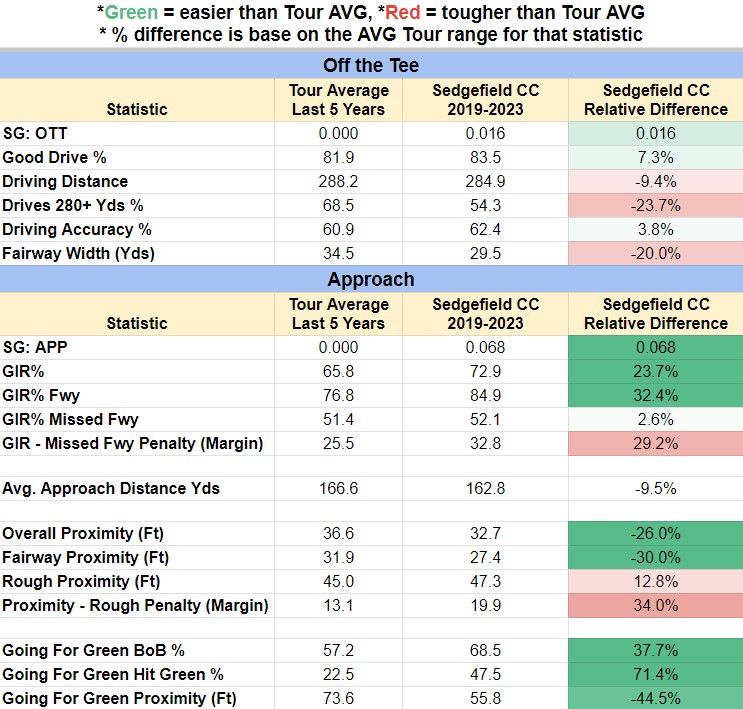
Though there are some blind tee shots, narrow fairways, and gnarly Bermuda rough to contend with on errant drives, driving accuracy is slightly easier than the Tour average. That being said, the Wyndham Championship is one of the most important weeks to “Gain the Fairway”. The GIR rate drops from 85% from the fairway to 52% from the rough. Proximity to the hole also increases from 27 feet to 47 feet due to the lack of distance control from the rough.
Also, with trees heavily lining the fairways, errant tee shots will lead to numerous pitch-outs and blocked approaches. Thus, “Fairways Gained” and more importantly, “Distance From Edge of Fairway” are vitally important metrics this week. With numerous doglegs and the ninth narrowest fairways on Tour, players often elect to “club down” and hit shorter woods or longer irons off the tee. Driver usage rate is only 54% which is one of the lowest driver values on Tour. This is the course where, infamously, seven years ago, tournament champion, Henrik Stenson did not use his driver one single time.
Not only is accuracy crucial here but positioning is as well. While homes and trees line most holes, the corridors are still wide enough to allow golfers to position their tee shots to play the best angle into the greens. As previously mentioned, the fairway bunkers can be very problematic as many actually lie inside the fairway. They also tend to distort a player’s depth perception when standing on the tee box.
Approach
Compared to other Tour courses, Sedgefield has ranked as the easiest course to gain strokes on approach since 2015. Once players are taking aim at their approach shots, they will be hitting into incredibly receptive greens that have one of the highest GIR rates on Tour at 73%. One of the reasons for this is the constant watering due to the heat of the Carolina summer.
Also, 55% of approach shots come from the 100-175 yard range which is the highest rate on Tour from that distance. This means plenty of wedges and short irons into greens. If in the rough, the 2.5″ Bermuda grass tangles around the ball and is difficult to square up, often causing fliers and mishits. With Sedgefield being a positional golf course, there are certain angles into the greens that give golfers the best angle to attack the pin placement. With greens typically sloped from back to front, there will be a premium on keeping the ball below the hole.
Around the Green and Putting
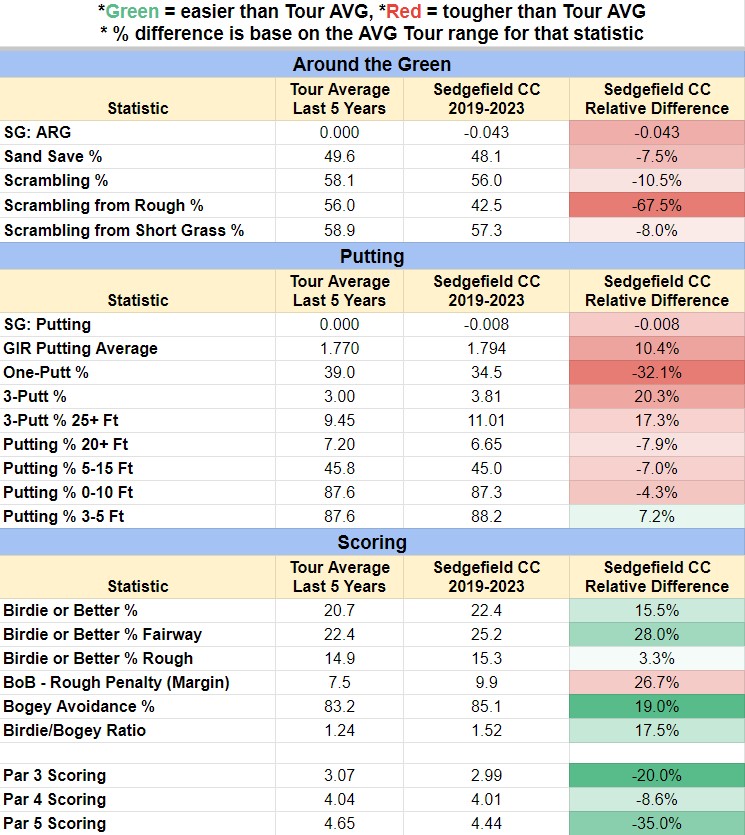
As is typical with Ross designs, elevated and sloping putting surfaces feature multiple run-off locations that can make putting and scrambling tricky if players are not hitting the proper spots on their approach shots. In keeping with the strategic theme, most greens provide a variety of options for flop shots, bump-and-run type plays, and other creative chips around the green. Chipping from the greenside Bermuda rough is the second toughest on Tour with golfers only scrambling at a feeble rate of only 42%.
Once on the green, putting can be a challenge as averages here are more difficult than Tour standards. Many greens have sharp ridges which allow for some interesting and tricky pin placements. While averaging between 12.5 to 13 on the stimpmeter they do tend to run as one of the faster greens on Tour. The difficult green complexes also tend to expose the below-average putters on this course making it important to consider that fact when selecting players this week.
Looking back at past tournaments gives us a window into how important gaining strokes putting is here at Sedgefield. Last year, the top four on the leaderboard each gained at least five strokes on the greens. Three years ago, 22 of the top 23 on the leaderboard gained strokes putting with 18 of those players gaining three strokes! And in 2020, you had to go all the way down to 27th place to find a golfer who lost strokes on the greens with 18 of the top 20 gaining at least two strokes.
Most Important Stats For Success at Sedgefield Country Club
*In order of importance
- Fairways Gained
- SG: Putting (Bermuda)
- SG: Approach
- SG: Par 4
- Birdie or Better %
- 3-Putt Avoidance
- Bogey Avoidance
- SG: Less Than Driver Courses
- Good Drive % (Bermuda rough courses)
- SG: Sedgefield CC
Key Rabbit Hole Filters
- Course Region: Southeast
- Course Length: Short
- Par: 70
- Field Size: Full Field
- Course Architect: Donald Ross
- Greens Surface: Bermuda
- Green Speed: Fast
- Rough Surface: Bermuda
- OTT Club Type: Less Than Driver
- Missed Fairway Penalty: High
- Fairway Accuracy: Average
- GIR Accuracy: Easy
- Gain Approach: Very Easy
- Scrambling (Rough): Difficult
- Gain Putting: Difficult
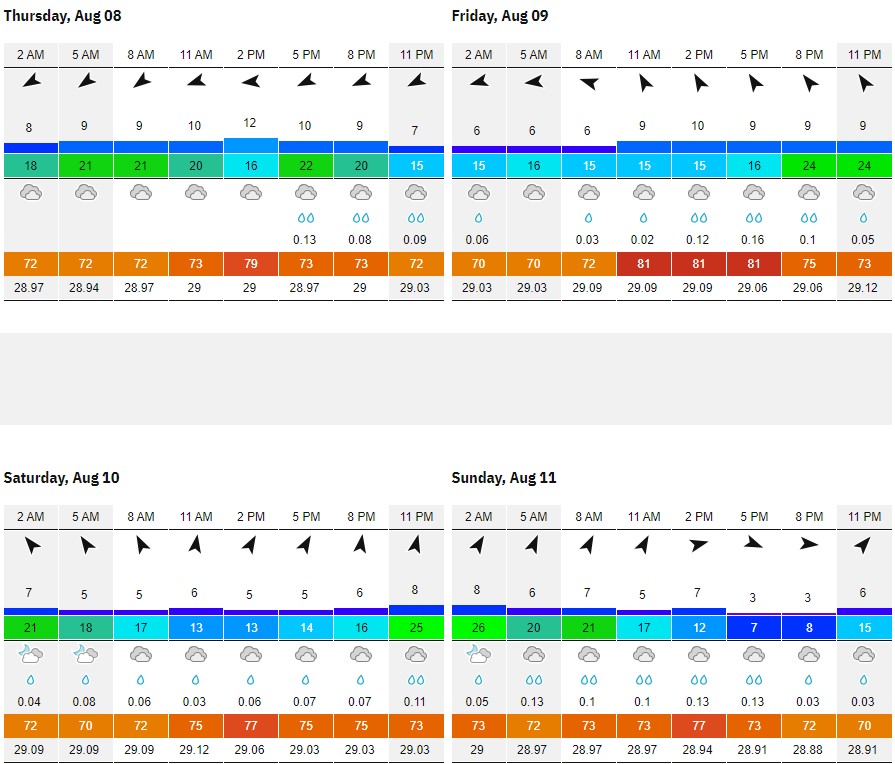
Weather Forecast – Greensboro, NC