Strategy
With a three-headed monster on top of Scottie Scheffler, Jon Rahm, and Rory McIlroy, you can’t go wrong starting a lineup with either of them. One thing I won’t be doing is playing two in the same lineup. There are just not enough players with upside in the low $7K range and below. The $8K range is absolutely stacked and is where I will be buttering my bread this week. Jason Day, Cam Young, Hideki Matsuyama, Will Zalatoris…sign me up!
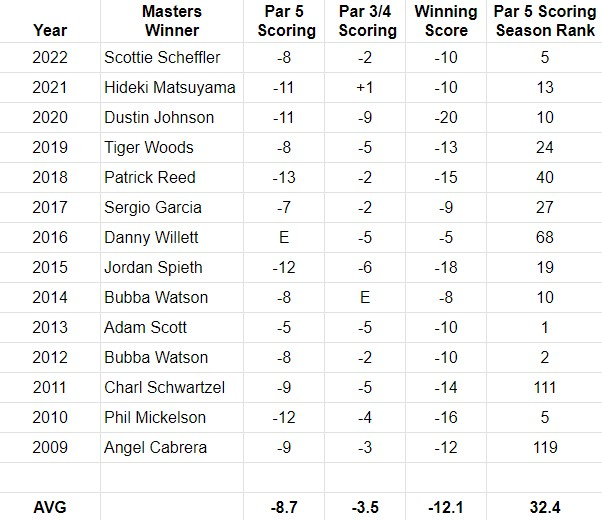
If you are playing multi-entry contests this week I believe it is very important to target high-ceiling players who excel in DraftKings scoring. As will be discussed below, par-5 scoring will be huge. Two years ago, Hideki Matsuyama was 10-under par on the par 5s and 1-over par on the par 3/4s. He also had three eagles which bumped his point totals up even further. Players who can consistently reach the par-5 greens in two shots and set themselves up for eagle and short-birdie opportunities are gold this week.
Also, when you cross off the old-timers this is really only around a 70-player field. The cut-line this week is only top-50 and ties. Having all six of your players simply make it through this cut-line won’t get it done this week. You will need lineups where everyone finishes in the top-20 or better to score high. I firmly believe you have to cross multiple guys off your player pool at each tier. Taking a stand will be huge. If you are playing 100 lineups, for example, I would encourage a player pool of around 30 golfers at the most.
As for players participating in the Masters from the LIV Golf League – most are not high on my radar. With no data combined with fewer events, weaker fields, unchallenging courses, and an emphasis on team play over individual play, it is hard for me to trust that they are in any type of quality form entering such an intense tournament. Dustin Johnson, Patrick Reed, and Taylor Gooch are the ones that I trust the most.
2023 Masters – Narratives and Important Metrics
Unique Model Weights
- SG: Difficult Courses/Strong Fields/Majors
- SG: Winds 15+ mph
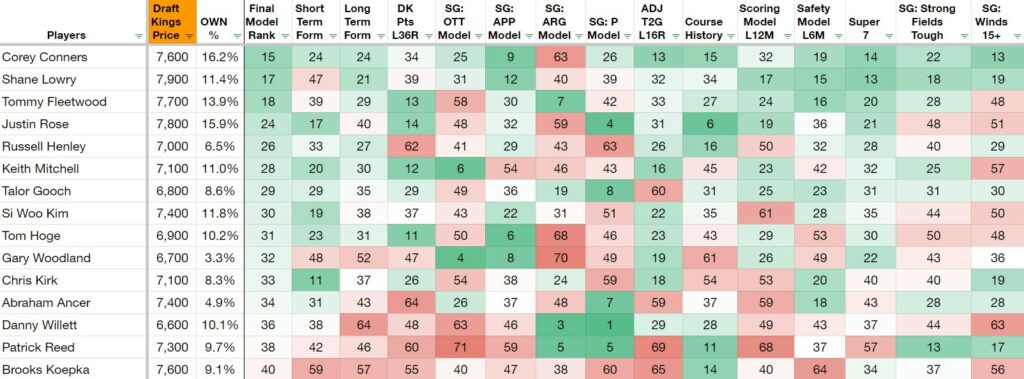
My player selection strategy this week is very simple. Related to the statistical and past Masters’ trends for this event, I am focusing on a very specific list of attributes. Each of these makes up this week’s “Super 7” metric in the model for this event. These include distance off the tee, gaining tee-to-green with recent play, Par 5 Scoring, SG: Approach, SG: Around the Green and past performance at Augusta National and in other major tournaments.
Distance Off the Tee
The first one is players who are long off the tee, and who especially rank high in Carry Distance. 13 of the past 14 winners ranked 47th or better for the season in Driving Distance in the year leading up to their Masters’ win.
Simply put, Augusta National is a bombers paradise. When Bobby Jones was designing Augusta National he wanted golfers to “have an unrestricted feeling of being able to swing away amid a wide swath of parkland”. When analyzing the numbers off the tee, the data most definitely bears that out. Players are free to bomb away with driver without any fear of thick rough or water hazards of any kind. Driving distance is one of the highest on Tour at 295 yards.
This year, Augusta National will stretch out to its longest distance ever at 7,545 yards. At that length, it measures as the eighth longest course in the annual Tour rotation. And with the fairway grass being mown in the direction from green to tee in the opposite direction of the hole, rollout on drives will be minimized even further. With easy-to-hit fairways and no harsh penalty from being in the minimal “second-cut” of rough, bombers have a distinct advantage. More than half of the driving holes also lack fairway bunkers. Added distance also helps on ensuring players can reach each of the par 5s in two shots by hitting longer irons into the greens instead of fairway woods. This is significantly more vital this year with the par 5 13th hole being lengthened by 30 yards.
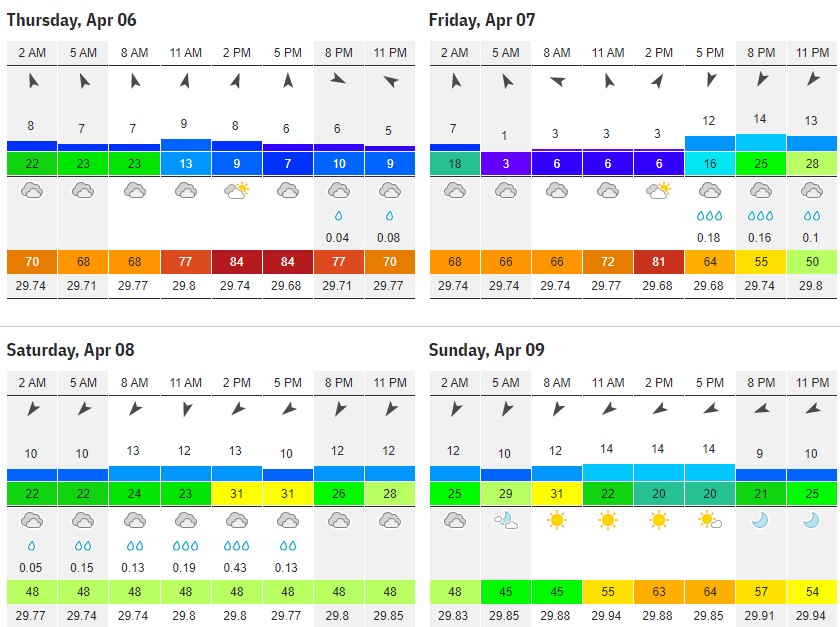
From a weather angle, over the past 10 days, the area has received over two inches of rainfall. This should soften up the fairways making the course play even longer and giving an advantage to players with more carry distance off the tee. And with cooler temperatures forecast in the 45-60 degree range along with westerly winds, the ball will not travel as far. This emphasizes even more of a need for distance off-the-tee in this year’s tournament.
SG: Tee-to-Green
Next on the list is recent Tee-to-Green (T2G) form. Each of the past 13 Masters winners gained a minimum total of 18 strokes gained T2G in the four events leading up to their Masters win.
Recent form is everything in golf. History has proven that golfers entering Masters week in superb form have a much better chance at success than those coming in struggling with their game. This has been exemplified in the past with a player’s Strokes Gained: Tee-to-Green (T2G) in the four events leading up to their Masters win. The T2G metric measures a player’s strokes gained off-the-tee, on approach, and around the green. It does not use putting as part of the equation. Putting is much more volatile with even the best putters having bad weeks, and the worst putters sometimes have great weeks. Both history and research show that being an elite ball-striker is the quickest way to the top of major championship leaderboards. Gaining strokes off-the-tee or on approach is the foundation. Combine that with the necessary touch that is needed chipping from tight lies around the treacherous Augusta National greens and it’s easy to see why T2G is so vital this week.
Here are the SG: T2G totals for the last eleven Masters winners in the four events leading up to their victory.
2022: Scottie Scheffler – 20.1
2021: Hideki Matsuyama – 18.5
2020: Dustin Johnson – 36.1
2019: Tiger Woods – 22.2
2018: Patrick Reed – 18.0
2017: Sergio Garcia – 31.4
2016: Danny Willett – 18.2
2015: Jordan Spieth – 28.6
2014: Bubba Watson – 37.9
2013: Adam Scott – 24.2
2012: Bubba Watson – 40.9
Par 5 Scoring
11 of the last 13 winners ranked inside the top 40 for the season in Par 5 Scoring in the year leading up to their Masters win. With it being so important for players to be aggressive and attack the par-5s, it will be paramount for players to score on those holes well above the field average. Another advantage of a longer distance off the tee is the ability to take shorter, more lofted irons into the firm, bouncy greens.
The data supporting its importance is quite staggering. Since 2009, Par 5 scoring at the Masters accounts for 72% of the winners’ total output. For the last two winners, Scottie Scheffler and Hideki Matsuyama, 95% of their scoring was on these holes. In the chart below, you can see how each of the champions since 2009 has fared on the par 5s compared to their par 3/4 scoring.
SG: Approach
It has been said that Augusta National is one of the few courses that present two challenges on almost every hole. The first is a challenge to reach the green on approach and the second is a challenge to solve the tricky undulating contours after reaching the green. While length is important, this is definitely a second-shot course. With so many approach shots being hit from uneven lies combined with firm sloping greens, ball-striking is paramount for success. The course ranks as the sixth-toughest course to gain shots on approach. Over the past eight Masters, the winner has finished 1st, 1st, 2nd, 3rd, 1st, 5th, 4th, and 6th in Strokes Gained: Approach for the week.
As previously mentioned, while being in position to approach the tough hole locations from the proper angle is important, it is only half the battle. When greens as firm as the ones at Augusta come into play, even great approaches are often unrewarded as balls will bounce far from the hole or roll off the green entirely. This year, it remains to be seen how soft or firm the greens will be. That will depend on how much of a deluge of rain actually falls along with how quickly the SubAir system can get the greens dried out to their preferred firm condition.
Elite iron players such as Justin Thomas and Collin Morikawa who have amazing distance control and can get the ball to spin and stop have a distinct advantage. But with 67% of approach shots coming from the 150-250 yard range, trying to control trajectory, location, and spin with longer clubs is not an easy task, even for the elites. Also related to the firm greens is that players with higher ball flights and those who are approaching from shorter distances with more lofted clubs have an edge as well. It’s basic physics. Balls landing from a higher trajectory will stop closer to their intended location than those on a lower plane angle.
And here’s another thing to consider which makes the approach game even more tricky. Most of the greens are either elevated or protected by bunkers or water on the short side. This naturally forces players to hit more conservative shots that carry onto the back sections of the greens well past the trouble areas. The problem with this is that most of the greens slope from front to back. If golfers can’t spin the ball back toward the hole they will be faced with long downhill putts. This is also why playing experience and course history matter so much at Augusta. The Jordan Spieths and Brooks Koepkas and Adam Scotts of the field – who have built up a great deal of knowledge here – know exactly where they can and can’t miss on each hole.
Around the Green Play
10 of the last 10 winners had gained at least 0.25 strokes Around the Green in the 16 rounds prior to their Masters win. Augusta National features some of the toughest greens to hold on approach. This leads to some of the tightest lies around the green that players will face all year. Whether chipping from the short grass to get into birdie position on a par 5 or simply scrambling to save par, Augusta National places more of a premium on short-game technique and skill than any other course. Hitting cleanly under the ball while attempting to control where it goes on these treacherous greens puts extra pressure on golfers who are oftentimes just trying to survive the hole.
One of the best short-game players on Tour, Jason Day, gave a good example of the touch needed here. “Around the greens, you definitely have to have that touch. I always say you have to hit it hard enough but soft enough around here. If you get that, then you understand what it means to chip around Augusta. You could be hitting a chip shot and you might hit the same chip shot, one with less spin and one with more spin, and they could be 20, 30 feet apart, but you could hit it on the same line. So you have to be precise here.”
Here are the SG: Around the Green averages per round from the last 10 winners at Augusta National in the 16 rounds leading into the Masters tournament.
2022: Scottie Scheffler – 0.43
2021: Hideki Matsuyama – 0.66
2020: Dustin Johnson – 0.33
2019: Tiger Woods – 0.53
2018: Patrick Reed – 0.56
2017: Sergio Garcia – 0.38
2016: Danny Willett – 0.71
2015: Jordan Spieth – 0.63
2014: Bubba Watson – 0.26
2013: Adam Scott – 0.42
Augusta National Course History/Past Major Performance
Along with course experience at Augusta National being more important than at any other course, players constantly speak about the learning curve that is necessary to have success here. Whether it’s knowing where to miss below the hole on a particular approach shot or having a knowledge bank in your mind of how putts break on certain holes, the more repetitions players gain, the better their chances are to win. As 2018 winner Patrick Reed said, “It truly is a course knowledge golf course. You need to know where to put the ball on certain pins and if you miss you need to miss it in certain spots because there’s some areas around here that it’s literally impossible, unless you make a 15‑, 18‑footer.”
No Masters debutant has won since Fuzzy Zoeller in 1979. To extend the value of playing experience at Augusta even further, 19 of the last 24 winners had played in at least three previous Masters before their win. Per that same Data Golf study, a player experiences significant jumps in performance in their 3rd, 7th, and 9th Masters. One peaks at the Masters in their 9th appearance and continues to enjoy sustained success up through their 13th appearance. The other trends in this group equate to some level of previous success on this course, whether simply making the cut or having successful finishes in prior years.
As you will see in the model, I’m targeting players who have played well in strong fields and on difficult scoring courses. Experience winning tournaments, along with the pressure and everything that goes into those occurrences, is a definite pre-requisite for becoming a Masters champion. And not only that, but being in contention in a recent major event also seems to add to a player’s confidence in having success in future “big-stage” events. In a pressure-packed moment of time as critical as contending during “Sunday at the Masters”, and being able to draw from those past lessons and experiences, is an edge that can push a player over the top to a green jacket celebration.
Finally, if the windy forecast holds for the weekend, I will look at players who have had past success in those conditions. Players like Jason Day, Justin Thomas, and Tommy Fleetwood have each proven strong in gusty winds and poor weather conditions.
Top 10 Most Important Stats
- SG: APP
- Course History
- Driving Distance
- SG: T2G L24 rds
- Par-5 Scoring
- Majors History
- Scrambling
- SG: ARG
- Par-4 Scoring: Tough Courses
- Bogey Avoidance
Augusta, Georgia Weather Forecast (April 6-April 9)
The Masters – DraftKings Picks
Each week along with presenting my top choices for each of the categories below, I will include each of the pertinent stats for the specific event that comes directly from my model. Except for the “Core Plays,” which most weeks will typically be somewhat on the chalky side, I will include at least one player I am positive on who is forecast to be lower-owned and who will present a good pivot from some of the higher-owned options. In essence, the players you see below make up the majority of my player pool for this event.
Core Plays

Upper-Tier Plays

Mid-Range Plays

Value Plays