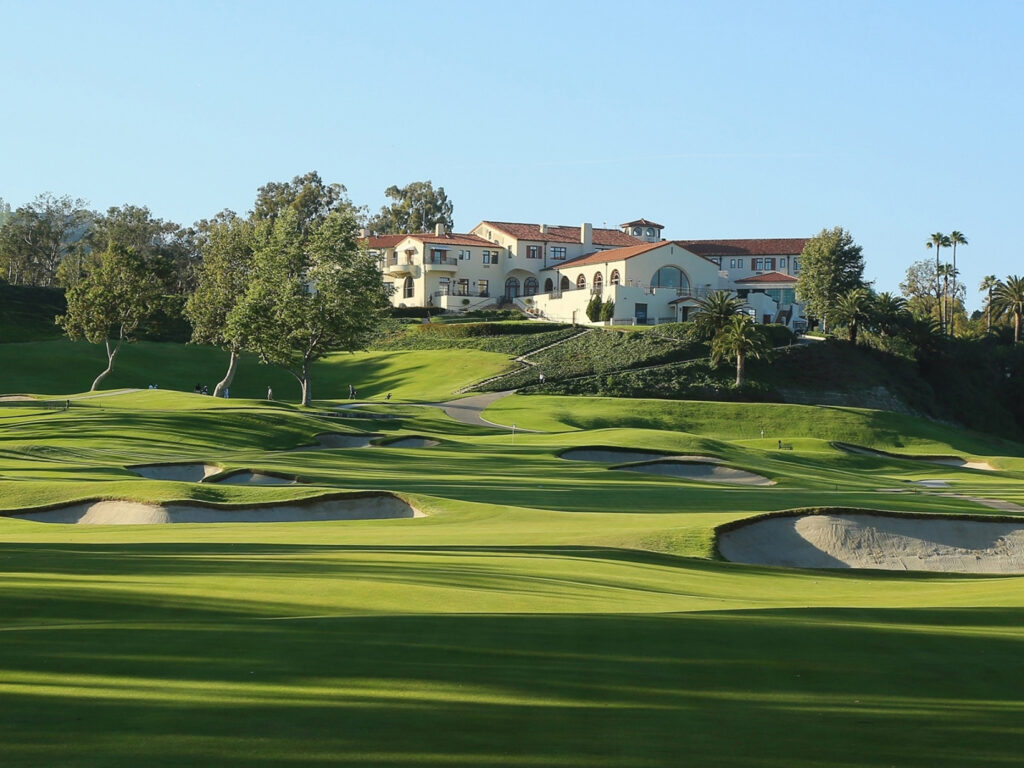
After another Scottie Scheffler win at TPC Scottsdale, the Tour heads back to California for the Genesis Invitational and the final event of the West Coast Swing. Built in 1926 in the Santa Monica Mountain Canyon just outside of Los Angeles, Riviera Country Club remains one of America’s iconic golf courses.
Not only is it iconic, but Riviera is always in the conversation among the best-designed golf courses in America. Even as it approaches its 100-year birthday, most experts believe that it doesn’t have any weak holes. The scope and size of the course don’t really stand out, but it forces players to execute and commit to every shot in their bag. It is a challenging layout that forces golfers to make strategic decisions. Designed and built in 1926 by George C. Thomas, Jr., it opened as the Los Angeles Athletic Club Golf Course and has been a fixture on the PGA Tour since 1973. The routing is near-perfect as Thomas utilized all the available natural features of the terrain in creating his masterpiece.
Riviera features tight driving corridors, erratic Kikuyu rough, and speedy greens with subtle undulations. It tests all aspects of a golfer’s game and requires players to hit specific areas on both fairways and greens in order to maximize their scoring opportunities. Being out of position creates extreme pressure to save par because the course is relentless. Shot-makers who can position themselves off the tee, who can shape the ball in both directions, and scramble for par around these treacherous greens will have the most success.
Two of the greatest golfers of all time, Jack Nicklaus and Tiger Woods, never managed to win at Riviera. It has the universal admiration of Tour pros because it’s tough but fair. Speaking on the challenge that the course presents, Patrick Cantlay summed it up best. “The greens aren’t overly firm and it’s not crazy long. The golf course always defends itself. There’s no tricks. There’s no water on the whole golf course. There’s no real goofiness. I just think, all in all, it’s just the best test that we play.”
The Field
We go from one star-studded elevated event to another at the Genesis Invitational. It was already a “major-style” field as every single eligible PGA Tour golfer in the top 60 of the OWGR has committed to play with the exception of Aaron Wise and Chris Kirk. But on Friday, the ante was upped as we learned that golf’s biggest star, Tiger Woods, is playing as well. Woods, the tournament host, will be making his first official PGA TOUR start since last July. The 82-time PGA TOUR winner will headline a stacked field competing for 550 FedExCup points and a $20 million purse.
Since it is an “Invitational”, the field is usually capped at 120 players. But for this year, the field was expanded from the original size because each player that is defined as eligible by the tournament regulations is guaranteed a spot in the field. In other words, because everybody wants to play this elevated event, everyone inside the number gets in.
Withdraws will not be replaced by alternates unless the total number of entrants drops below 120. With Kirk, Davis Riley, Maverick McNealy, and Webb Simpson already withdrawing, the field currently sits at 130. Like last week, the cut line remains the top 65 and ties advancing to play the weekend. The cut line has been over par here every single year over the past decade.
Riviera Country Club – History
Sitting inside a small canyon, and tucked away in a residential area just south of Sunset Boulevard lies one of golf’s monumental courses, Riviera Country Club. In the 1920s, golf was becoming more popular in Southern California, and the Los Angeles Athletic Club wanted to build a champion course that was located away from the congestion of the city. About 20 miles to the west of downtown Los Angeles, a tract of land in the Pacific Palisades area was settled upon as the best location.
Tasked with the course design, George Thomas was familiar with the area having just finished Bel-Air Country Club which was only five miles away. One of the most underrated architects of his time, up to that point, Thomas had only been an amateur designer and agreed to take on the project free of charge. He was joined in the project by his “construction man”, William P. Bell, and Alister MacKenzie who helped in the course’s creation. Thomas initially despised the property’s location in the Santa Monica Canyon. It was a small, dreary, treeless, mostly flat piece of land that seemed far from suitable for building a premier golf course.
It appeared that heaven and earth would need to be moved to construct a course from scratch in that canyon. But instead of moving tons of dirt and land, and because of financial constraints, Thomas took the naturalist approach and developed all sorts of holes that blended into the canyon and its surroundings. As renowned professional golfer, Hale Irwin attests, “The integrity of the course is influenced greatly by the fact that no two holes are alike and the course has been placed, rather than forced, into the land.”
The course was developed over an 18-month span as Thomas put together 15 different versions of the design over this time period. It finally opened to critical acclaim in 1927 and remains a crowned jewel to this day.
Since it opened, Riviera has been an institution in American tournament golf currently serving as the annual venue for the Genesis Invitational. This event was originally known as the Los Angeles Open and was first played here in 1929. Since 1973, The Los Angeles Open has been played here every year except in 1983 and 1988. Riviera was one of Ben Hogan’s favorite courses and it’s sometimes referred to as “Hogan’s Alley”.
It has also hosted a handful of majors including the 1948 U.S. Open, the 1983 and 1995 PGA Championships, the 1998 U.S. Senior Open Championship, and the 2017 U.S. Amateur. In 2028, Riviera will host the Summer Olympics.
The course itself has been relatively unaltered since its opening. It has held up magnificently over time as it has only undergone one major renovation back in 1992 when Ben Crenshaw and Bill Coore redesigned the bunkers to look as they did when the course first opened. In 2008, Tom Fazio completed a minor restoration of the 7th and 8th holes.
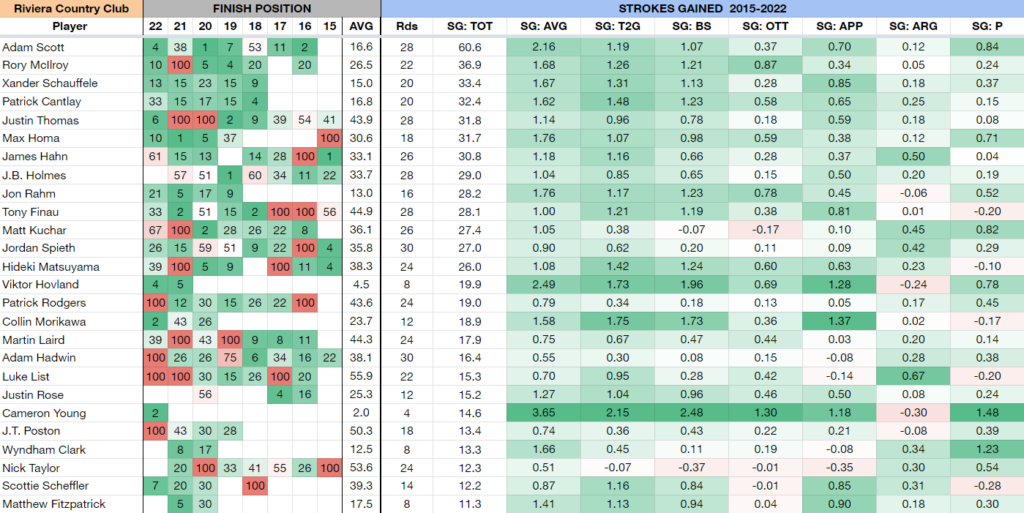
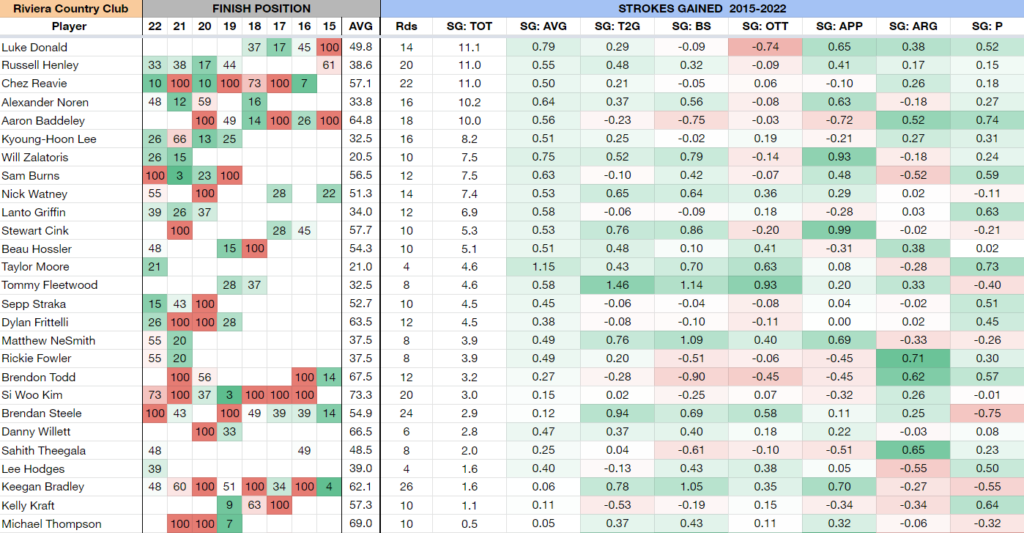
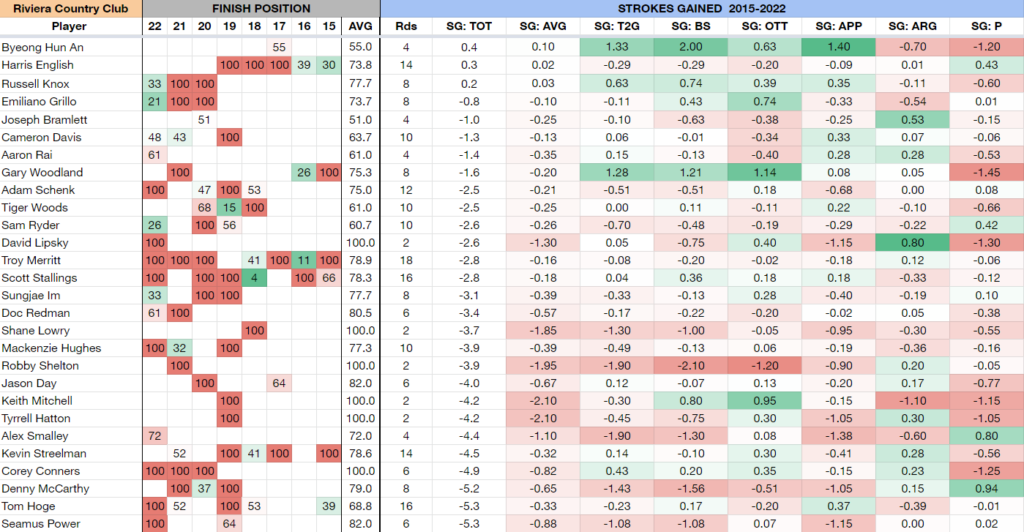
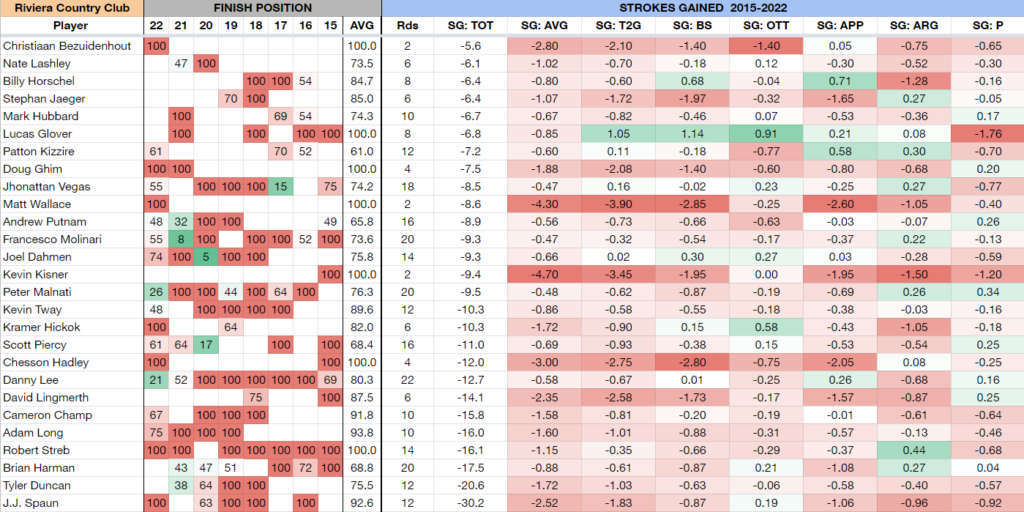
Finish Position and Strokes Gained Course History (2015-2022)
Course Features
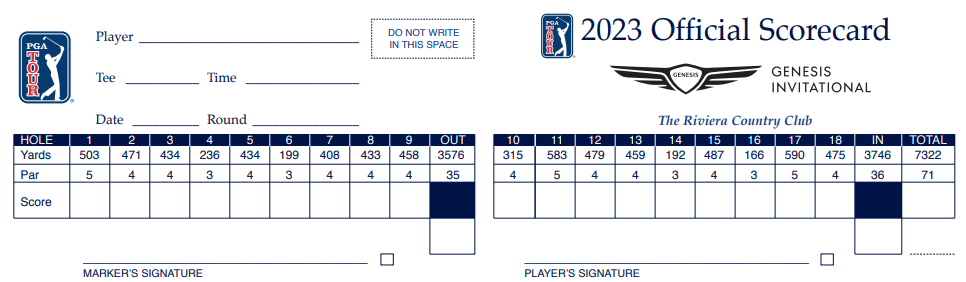
Located just a couple of miles away from the Pacific coastline, Riviera is a Par-71 course that stretches to 7,322 yards. It features tight, tree-lined undulating fairways with fast Poa green complexes that average 7,500 square feet. It is a classical, old-school track that still packs a punch as it’s averaged 0.19 strokes over par per round since 2018. That makes it the 13-toughest Tour course in the annual rotation.
Overall, there are very few statistical categories at Riviera that are easier than the Tour average. With the second-lowest Driving Accuracy/GIR% combo, it is a true test of all-around golf. An amazing dichotomy that shows the difficulty of the course is that it has the second largest greens on Tour yet also has the toughest overall GIR rate at 56.7%. And because of the intricacies of the course, it usually takes years of experience for most players to master. 15 of the last 17 winners had played in at least four previous Genesis Invitationals, and DataGolf lists Riviera as having the 8th “stickiest” course history correlation.
Another part of Riviera that makes it such an engaging place is players needing to think and strategize their way around the course. Each hole offers opportunities to exercise aggressiveness or caution – to take a risk or play it conservatively. George Thomas was also a master of “angular” golf, and its impacts can be seen on many holes at Riviera where the best angle into the green is almost always the angle off the tee with the most trouble. Thomas also increased the number of trees near the greens on the back nine which adds to the strategy of many approach shots down the closing stretch of holes.
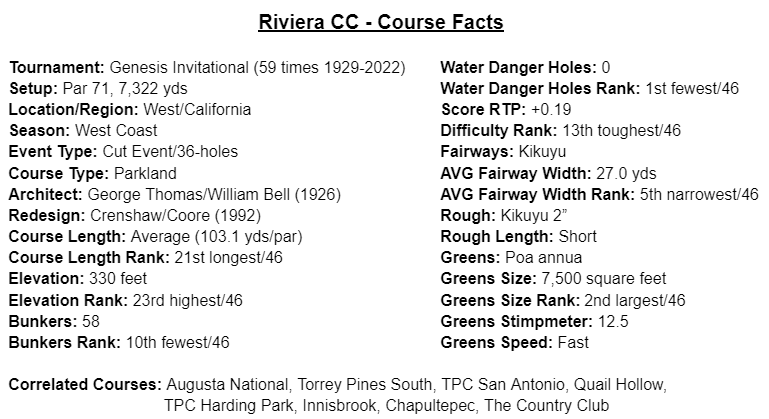
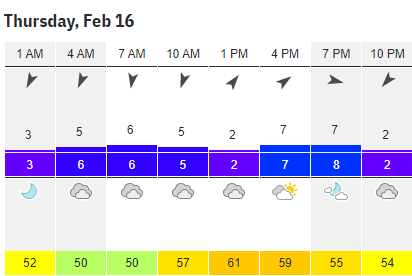
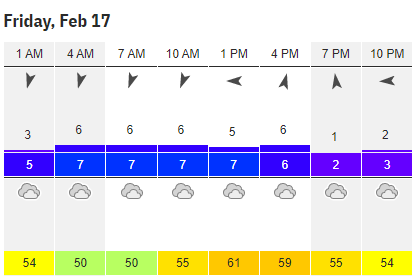
While there is no water danger on the course, the 58 bunkers are some of the deepest and most difficult on Tour. This lack of water and other natural hazards is why the penalty rate is almost zero. The course defends itself without any tricks or manipulations thanks to ingenious hole design, narrow fairways, well-placed bunkers, a barranca that comes into play on seven holes, and tricky pin positions on the lightning-fast greens. Barrancas are deep gullies or holes that are hard to get out of once your ball is in it, and the one at Riviera runs throughout the course. Also, keep an eye on the wind forecast this week. If winds increase, they can become very volatile inside of the canyon and will cause the course to play even more difficult as we have seen in years past.
Riviera (along with Torrey Pines) is one of the few courses that feature Kikuyu fairways and rough. While the rough is only two inches thick, Kikuyu lies can be very tricky, especially if the ball gets buried in the spongy strands of grass. The rough can completely entangle itself around the club forcing players to hack the ball out which almost always leads to par at best.
On the flip side, when the ball sits up on top of the Kikuyu on fairways, it can lead to “flyer lies” on approach shots to the green. It’s almost like playing on velcro as it has the innate ability to stop rolling balls dead in their tracks. It is a very unpredictable grass surface and takes time to get used to it. The greens are Poa annua and are intentionally firm and fast, measuring 12.5 on the stimpmeter.
Hole Preview
Riviera might be one of the few courses that has no specific weaknesses. The beauty in George Thomas’ design is that each hole presents a new challenge. Johnny Miller, winner of the 1981 Los Angeles Open, described Riviera as, “Definitely one of the greatest, no-nonsense golf courses in the world! It requires a player to play every club in his bag and every shot in his game.”
One of the best things about Riviera is the routing of the course. When laying out the holes, Thomas and Bell paid attention to the prevailing winds. Both nines extend all the way across the property with the front nine working its way counter-clockwise and the back nine running clockwise.
Each par 3 is very distinctive from the others and among the best set in the world. The 4th was called the greatest par 3 in America by Ben Hogan. It’s a 235-yard long Redan-style hole with a huge bunker short of the right-to-left sloping green. The 6rh is a 200-yard Thomas original and one of the most unique par 3s in the world.
The 11 par 4s hold their own against the length and difficulty of any other course on Tour, with seven of them over 450 yards. They rank as the fourth toughest set of par 4s on Tour and cannot be overpowered. Measuring anywhere from 282-315 yards, the 10th is the most infamous. It is a driveable par 4 with a tee shot that challenges even the best shot-shapers in the world, with deep bunkers protecting the green on three sides.
Each of the three par 5s is very scoreable with a combined Birdie or Better rate of 44.5% and must be taken advantage of for players to move up the leaderboard. In fact, this importance is highlighted by the fact that the most recent seven winners have totaled 59 shots under par on the par 5s. Last year’s champion, Joaquin Niemann went 10-under on these holes for the week.
Strokes Gained Analysis
Off the Tee
Off the tee, players will stare down narrow fairways lined by eucalyptus trees. The fairways are even more narrow this year compared to years past at only 27 yards wide on average, which makes them the 5th narrowest on Tour. This leads to the fifth-lowest driving accuracy rate at only 52.5%. With numerous doglegs, combined with firm fairways that get tighter closer to the 300-yard landing zones, it will be a challenge to stay out of the Kikuyu rough. Yet even because the rough is mostly non-penal, and there is no penalty danger off the tee, “bomb and gauge” is not really a completely viable strategy due to the shape of the holes and the angles you need to play from the tree-lined fairways. Riviera routinely ranks in the top-10 of toughest courses to gain strokes off the tee.
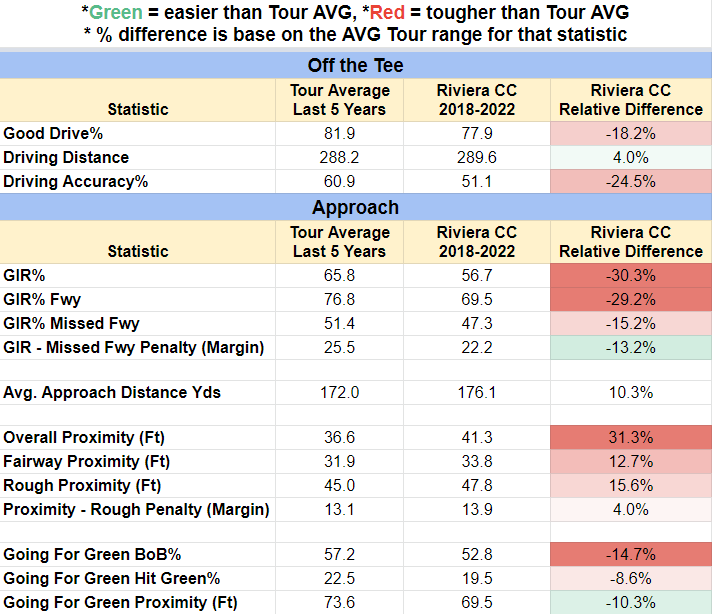
Taking a look at recent winners like Adam Scott, Bubba Watson, and Dustin Johnson, shows that distance definitely plays here. Another argument to favor distance over accuracy is that if most golfers are missing the fairway and playing their approach shots out of the rough, you want the players hitting higher lofted clubs like wedges and short irons into these “bouncy” greens to keep the ball closer to the pins. Along with distance, Good Drive % is another important stat to use this week in determining which players commonly hit greens out of the rough.
Another factor to consider is that almost every driveable hole has some type of dogleg or curve to it. It is also a course with sloping fairways and very few perfectly flat lies. A lot of the holes are also curving around fairway bunkers. Similar to Augusta National, it is a true shot-makers course where you need to be able to shape your ball both ways off the tee and also be creative with a poor lie from the fairway. This is why Bubba Watson has been so successful here winning three times. He is perhaps the ultimate shot-shaper.
Approach
With the greens so firm, pinpoint precision is required to get easier birdie opportunities. Players must be able to shape their shots both ways in the air to access the correct tier of the green and to keep the ball below the hole to set up a much easier uphill putt. Tiger Woods echoed this fact by remarking, “You’ve got to hit the ball high into any of these greens and really control your spin and put the ball in the right spots.” A staggering 75% of approach shots come from 150+ yards with 47% coming between 150-200. Both are among the highest percentages on Tour.
Even though the greens are huge in size, the GIR rate is only 56.7%. Along with firm greens that repel shots, poor drives off the tee lead to approach shots from bunkers or from locations that can be partially obstructed by trees. The greens also have sharp edges that lead to run-off areas if players get too aggressive on approach. Taking the conservative route and aiming for the correct tier or middle of the green is generally the best strategic play.
Around the Greens and Putting
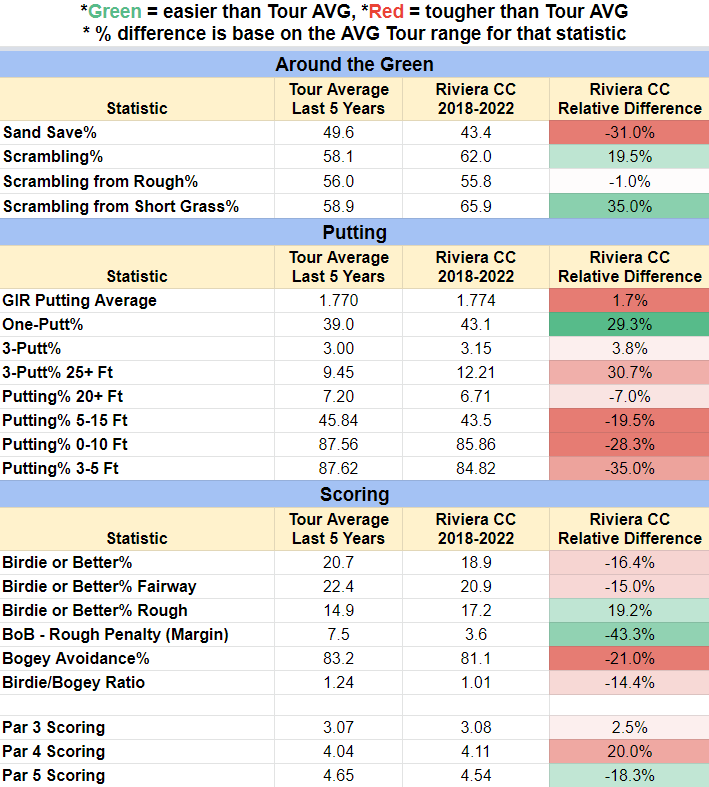
The Genesis Invitational is one of the most critical weeks for short-game play. With greens missed at a 44% rate, golfers will be challenged to scramble from the Kikuyu rough onto the fast and undulating Poa greens. Riviera’s deep bunkers cause sand saves to be 6% tougher than the Tour average. In fact, the bunkers are the second toughest in which to gain strokes. A missed green that finds a green-side bunker is a genuine penalty, especially if missing on the short side. Some of the bunkers also toy with players’ depth perception as many appear to be right next to the greens when in fact they are 30-50 yards away.
While trying to save par from the sand can’t get much more challenging, scrambling from both the rough and the short grass is actually easier than average. While the sticky kikuyu surface makes bump-and-run type shots very difficult around the greens, there hasn’t been a negative effect on the scrambling rate.
It’s once players are on the greens that they will need to hold on for dear life. These greens are allegedly the reason that Tiger Woods never won at this course. Riviera’s fast Poa annua greens are the toughest on Tour for putts less than five feet and the fourth most difficult for putts between 5-15 feet. They are ultra-fast and are very tricky to putt with numerous ridges and spines for golfers to maneuver. That being said, the difficulty tends to level the playing field, allowing inconsistent putters to find some success in this event.
Players report that it is almost impossible to “die” a putt into the hole as the cups are always set just the slightest bit above the green surface causing many putts to come up short. Short-range putting on Poa is already difficult enough. Add in massive greens with speed and subtle slopes and you can see why Riviera is the fourth toughest course on Tour in which to gain strokes with the flat stick. Golfers not proficient in lag putting will run the risk of numerous three-putts this week making 3-putt avoidance an important stat to analyze.
Most Important Stats For Success at the Genesis Invitational
*In order of importance
- SG: APP
- SG: ARG
- Driving Distance
- Scrambling on Poa
- Bogey Avoidance
- Good Drive %
- Course History
- Par 4: 400-500 yds
- Proximity 150-200 yds
- Par 5 Scoring
Early Weather Forecast – Pacific Palisades, California