*In case you missed it, here are my complete thoughts and strategies on every pricing tier for the DraftKings slate
2023 Wells Fargo Championship – Narratives and Important Metrics
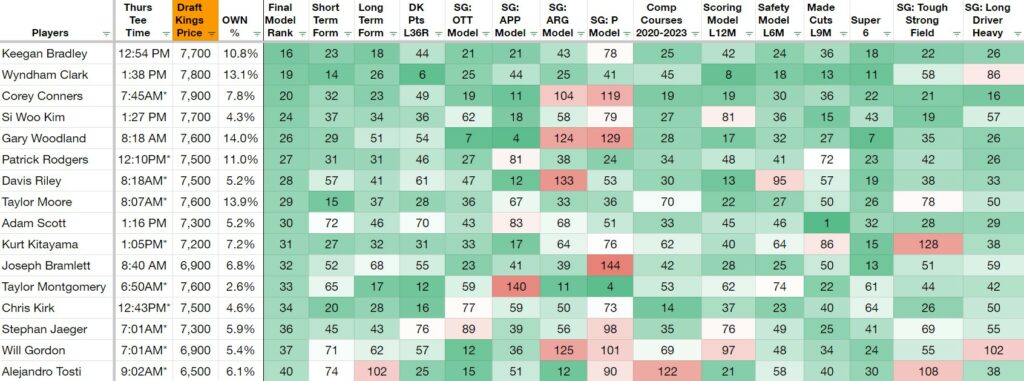
Unique Model Weights
- SG: Strong Fields
- SG: Long Courses
- SG: Difficult Scoring Conditions
- SG: Driver Heavy Course
While past course history has been spotty here recently with no tournaments being held in 2017, 2020, and 2022, I lumped performance at Quail Hollow with other comparable courses for the “Comp Courses” section of the model this week. Whether it’s Bay Hill or Torrey Pines or a few others, the key theme relates to the unique splits listed above – long, difficult-scoring courses where gaining strokes off the tee with your driver is paramount.
Similar to last week’s Mexico Open, “bombers” off the tee who are also well-rounded in other areas fit the bill this week. The Charlotte area has had a good deal of precipitation over the last couple of weeks, meaning the fairways will be very soft and Carry Distance even more important. This field is littered with players who fit the bomber narrative including some of my favorites: Rory McIlroy, Patrick Cantlay, Cameron Young, Sam Burns, Keith Mitchell, Joseph Bramlett and Wyndham Clark.
With an average driving distance of 300 yards, combined with the course’s length, lack of hazards, and minimal rough, the course sets up perfectly for being driver-heavy off the tee and gives “bombers” a clear advantage. 84% of all drives measured at least 280 yards which is one of the highest rates on Tour.
Shorter drivers who have accurate long-iron games can still compete here but their path to success is much more difficult. While fairway accuracy is one of the lowest on Tour at only 54%, it has proven to not matter. The last four winners have averaged 314 yards off the tee with none of them finishing in the top-40 in accuracy for the week. In fact, when McIlroy won in 2021 he finished second in driving distance and shockingly finished dead last out of 156 golfers in fairways gained.
Along with inaccurate drives not being punished as much as at other venues, those with longer distance off the tee will have shorter approach shots into the firm greens. This will allow them to benefit more from those shots than at other courses where holding the green is not as difficult. In summary, Quail Hollow presents more opportunities to play aggressively off the tee and will allow those players a better chance to separate from opponents that are shorter hitters.
Even with all the emphasis on being long off the tee, gaining strokes on approach will always be vital on a course that plays this tough. On approach, Quail Hollow ranks as the 11th toughest ShotLink course on which to gain strokes. The average Greens in Regulation (GIR) rate over the past three events is 60.5% which is well below the Tour average of 65.8%.
Much of the difficulty is due to the aforementioned firmness of the greens combined with 55% of approaches coming from 175+ yards. Long approach shots that don’t have the necessary precision and trajectory could bounce ten yards off the green and leave difficult recovery shots. Thanks to many of the tricky pin placements which make the greens even tougher, proximity to the hole is one of the furthest on Tour at 42.7 feet.
This brings us to short-game skills. Around the green, Quail Hollow rates as slightly tougher than average when compared to other courses. Because of the difficult green complexes, scrambling from the rough and from the short grass is between 2-4% tougher here. There are some shaved runoff areas and false fronts that players will have to contend with that can make chipping difficult. Players will miss greens here, meaning there will be more shots from around the green. While not emphasizing it too heavily in my model, the slope and speed on the greens is enough for me to consider crossing off players who are very weak in this area.
The same can be said for putting. The greens at Quail Hollow are among the most challenging aspects of the course. Overall it ranks as the 6th toughest venue in which to gain strokes putting. Longer putts will be even more difficult as it ranks as the second toughest course for putts outside of 15 feet. The 3-putt rate is one of the highest on Tour at 3.95%.
While tee-to-green play is much more important than putting this week, going cold on the greens will quickly knock a player out of contention. Each of the last three winners here – McIlroy, Homa, and Day – gained more strokes putting than any other category.
Most Important Stats For Success at the Wells Fargo Championship
*In order of importance
- SG: APP
- Driving Distance
- Proximity 175+
- Par 5 Scoring
- SG: Long/Difficult Courses
- SG: Putting
- Scrambling
- Bogey Avoidance
- Total Driving
- 3-Putt Avoidance
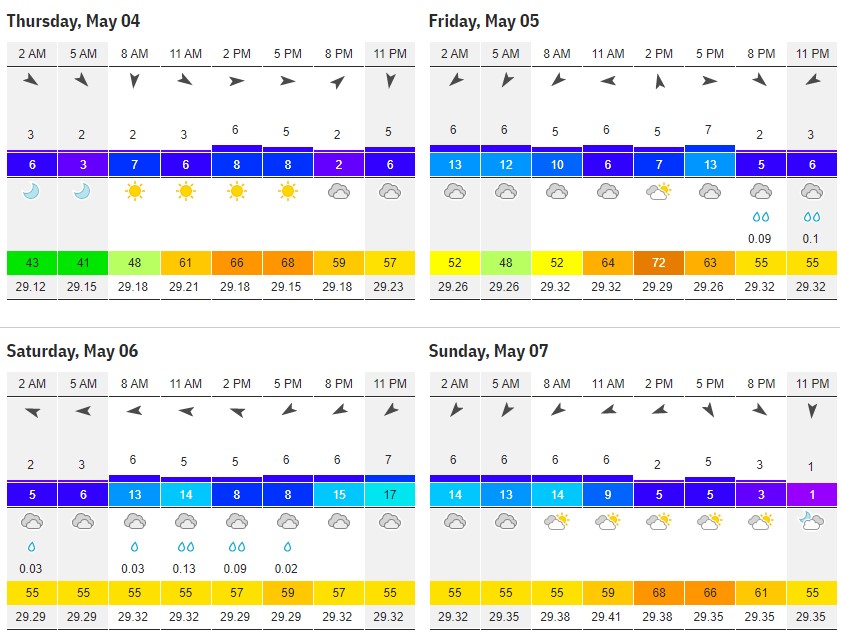
Weather Forecast – Charlotte, North Carolina
Wells Fargo Championship – DraftKings Picks
Each week along with presenting my top choices for each of the categories below, I will include each of the pertinent stats for the specific event that comes directly from my model. Except for the “Core Plays,” which most weeks will typically be somewhat on the chalky side, I will include at least one player I am positive on who is forecast to be lower-owned and who will present a good pivot from some of the higher-owned options. In essence, the players you see below make up the majority of my player pool for this event.
Core Plays

Upper-Tier Plays

Mid-Range Plays

Value Plays