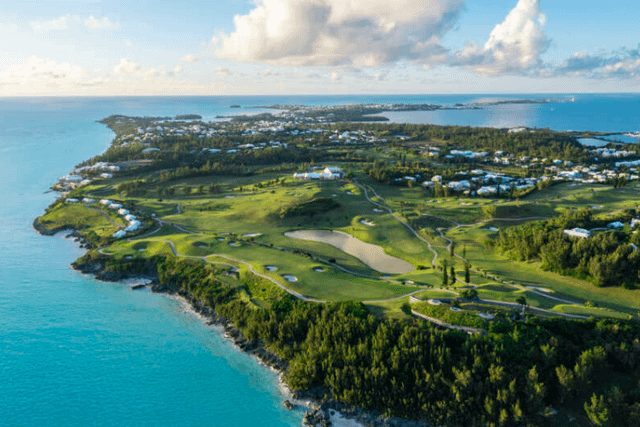
With only two events remaining in the “FedExCup Fall”, the Tour heads to the island of Bermuda for the sixth edition of the Bermuda Championship. Located on high ground overlooking the Atlantic Ocean on the western shore of Southampton Parish, Port Royal Golf Course is one of the world’s most scenic island courses. Known as one of Jack Nicklaus’ all-time favorites, it is a government-run municipal course designed by Robert Trent Jones in 1970.
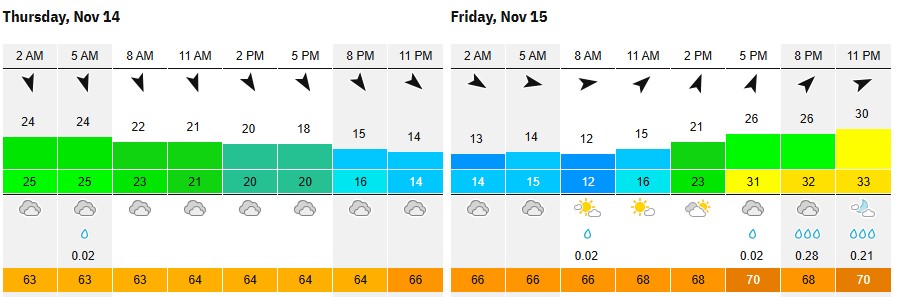
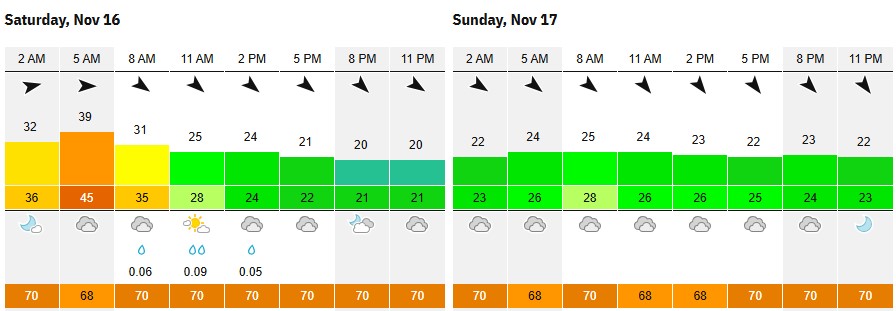
One of the shortest courses played in the PGA Tour’s annual rotation, it is characterized by its hilly terrain, challenging par-3s, and the seemingly ever-present threat of windy conditions for much of the course. The island has had a challenging leadup to this tournament with more than six hurricanes or tropical storms passing through the area in the last three months.
While any type of player can win here, past winners have included some of the best putters on the Tour, including the likes of Seamus Power, Lucas Herbert, Brendon Todd, and Brian Gay. Fairways are narrow and wedge opportunities are plentiful. This leads to numerous short to mid-range birdie putts that players will need to consistently make in order to be in contention.
The Field
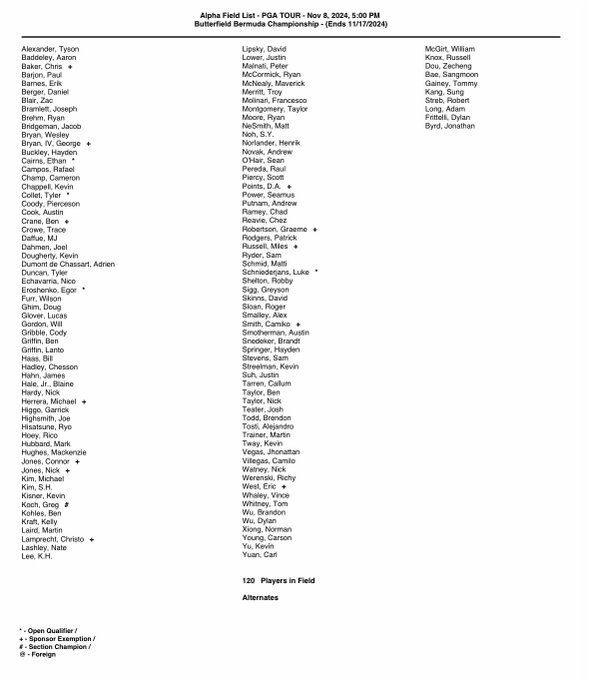
This week’s Bermuda Championship is critical for players hovering around the top 125 bubble, with those finishing inside that number securing PGA Tour cards for 2025. Players like Daniel Berger, Hayden Springer, and Joel Dahmen are right on the bubble of that magic number in the standings. They, along with numerous other golfers in the field will be hoping for a big performance this week.
Past champions in the field include last year’s winner, Camilo Villegas along with Seamus Power and Brendan Todd. Other notable players in the field include ZOZO Championship winner Nico Echavarria, Lucas Glover, Ben Griffin, Mackenzie Hughes, Maverick McNealy, Andrew Novak, Patrick Rodgers, Nick Taylor, and Jhonattan Vegas.
Port Royal GC – Course History
Originally known as Southampton Golf Club, the property was purchased in 1965 with construction led by famed architect Robert Trent Jones beginning in 1967. Though the design had to be changed numerous times due to land agreements, the course was finally completed and opened in 1970. In 2008, an original member of the design team, Roger Rulewich, was in charge of the $14.5 million renovation that also made Port Royal the longest golf course in Bermuda.
Originally used by the PGA Tour in 2019 as an alternate-field event played opposite the WGC-HSBC Championship, thanks to the COVID-19 pandemic, the tournament was elevated in 2020 to a standalone event. Taylor Pendrith holds the course record with a 61 in 2021.
We have partnered with Underdog to bring you an easy way to claim a FREE, no-strings-attached 90 days of Premium Access to Betsperts Golf, plus up to $250 in bonuses when you deposit! Click here to learn more!
Finish Position and Strokes Gained Event History (2019-2023)
This includes the average finish position and Strokes Gained per round in each category. Players are sorted by SG: Total. Port Royal is the 13th least predictive course on Tour.
f684b2f3d4218ee06dad551b3bb2074b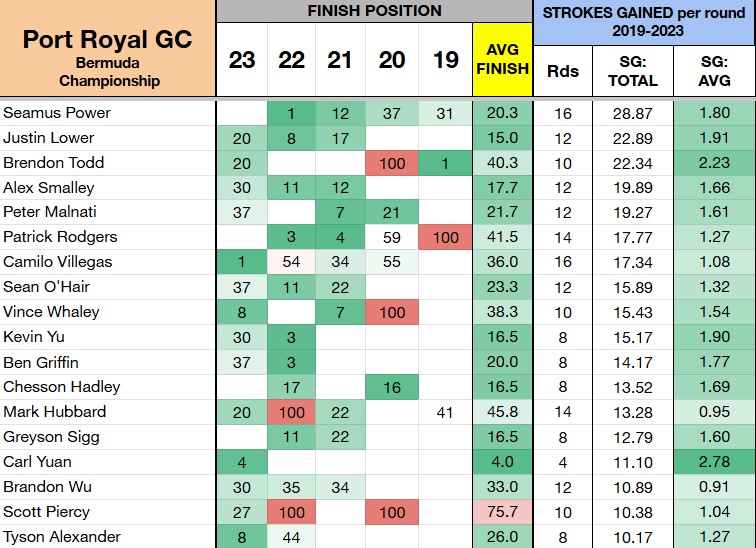
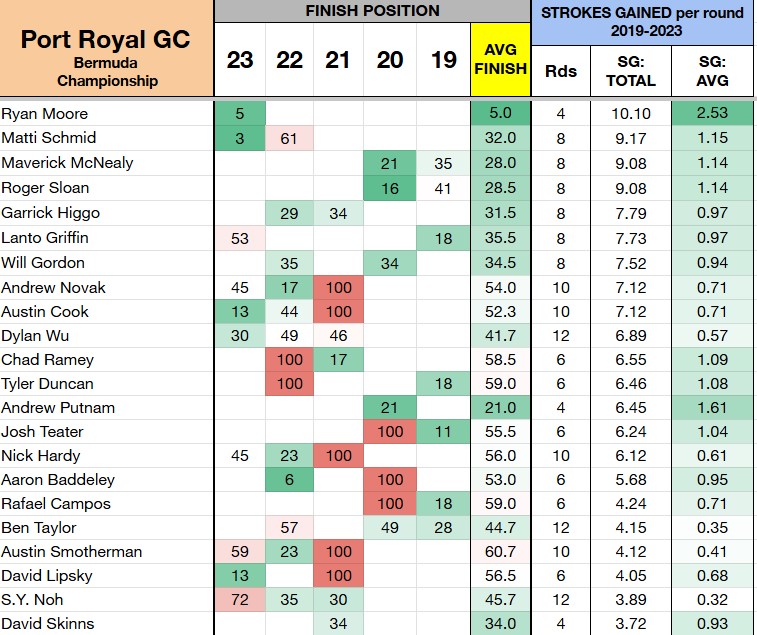
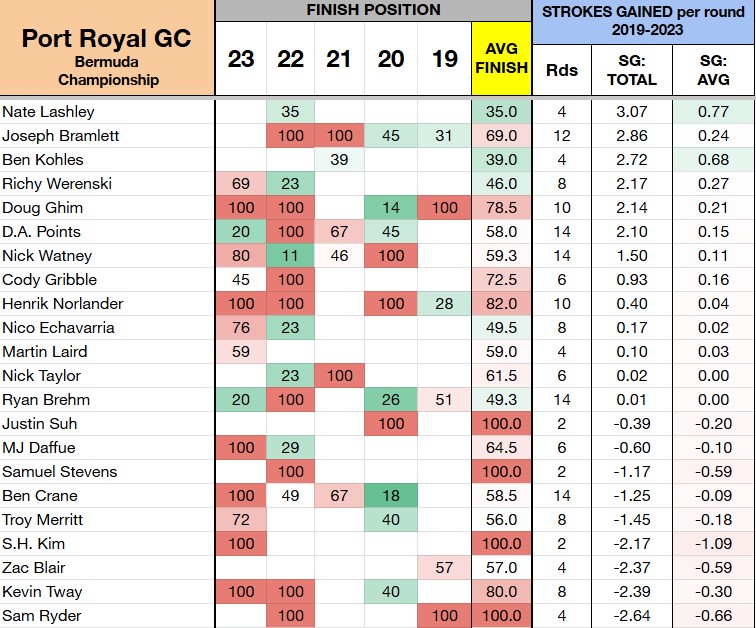
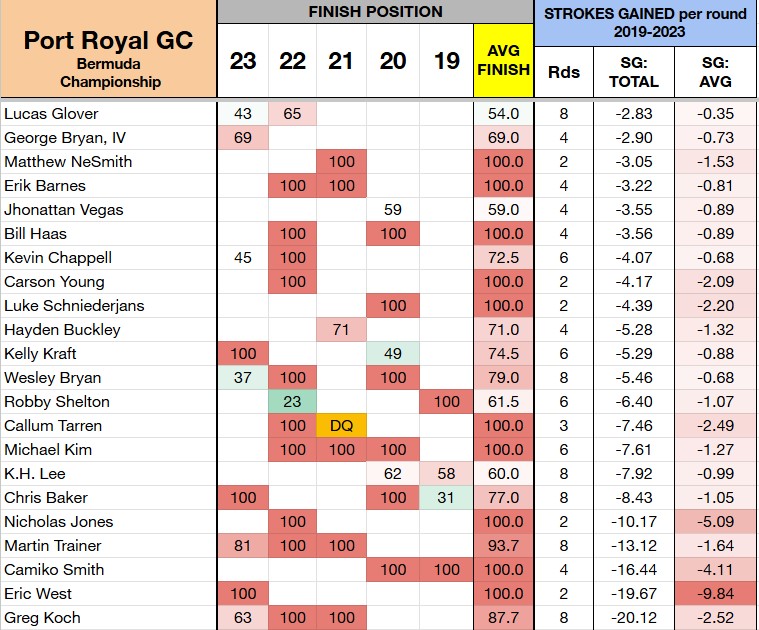
Course Features
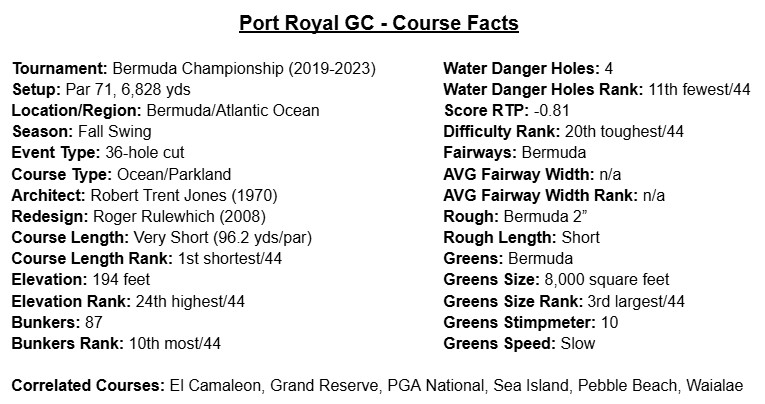
At 6,828 yards long, Port Royal is the shortest course played in the annual Tour rotation. Labeled as a “great resort course”, the par 71 track is one where any type of player can have success. The main “X-factor” that determines the scoring conditions each year is the wind. Blustery conditions have factored into every tournament here, and anyone attempting to predict player outcomes should have past performance in windy conditions built into their model.
As Patrick Reed once said about Port Royal, “It’s one of those golf courses that if they didn’t have wind around here, you’d go out and you’d destroy. So I almost feel like they need the wind here to be kind of a defense mechanism for the golf course.” And it is not just the wind that can challenge, it is also the changing direction mid-round. Said Aaron Wise about the course, “It’s definitely not a bomber’s golf course. The crazy part is how much it changes because the wind’s blowing 30 miles an hour. Then all of a sudden, if the wind switches to the dead opposite way, a ball goes 50 yards shorter or longer than it did the day before.”
Winning scores have ranged from 15-under (twice) to 24-under (twice) – with the tougher scoring years resulting from windy conditions. From shorter hitters like Brendon Todd, Brian Gay, and Camilo Villegas to longer hitters like Taylor Pendrith and Lucas Herbert, all types of players have been in contention. The enormous average green size of 8,000 square feet helps scoring, especially in the wind.
When winds were stronger and certain holes played longer, the scoreboard showed that the bombers off the tee had a definite advantage. Even so, the course is short enough that it cannot be overpowered either way. Early weather forecasts have winds between 15-25 mph each day with higher gusts on the weekend.
Port Royal also features consistent elevation changes similar to the Plantation Course at Kapalua. And as should be expected by a Robert Trent Jones design, heavy fairway bunkering is another part of the challenge. For agronomy this week, the course is 100% bermudagrass.
As for the holes themselves, the course is an interesting mix of seaside and parkland holes. The first hole tee box is perched on high with players hitting downhill as they head away from the ocean. In fact, the first seven holes are somewhat protected by trees that appear like a tropical parkland course. It is not until you reach the 7th green that you get full panoramas of the Atlantic Ocean and the crystal blue waters of Bermuda’s south shore. This is also where the wind typically intensifies as players must deal with ocean breezes for the remaining holes except holes 11-13.
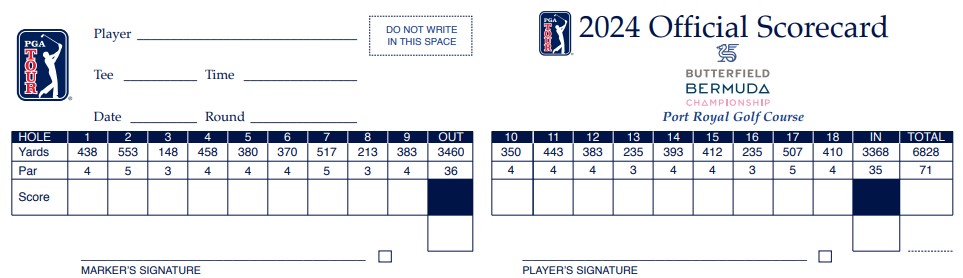
Including the effects of the wind, the par-3s at Port Royal are among the most difficult set on Tour. Three of the four measure over 213 yards and are the most difficult holes on the course. The par 3 16th is Port Royal’s signature hole. Widely considered one of the toughest par-3s in all of golf, it is a 235-yard crescent-shaped beauty with a carry directly over the Atlantic Ocean.
Eight of the 11 par-4s are less than 415 yards with the longest playing at 458 yards. Overall, Port Royal has the shortest group of par-4s on Tour that can also play as the easiest if winds are low. Historically, however, seven of the 11 par’4s have averaged over par. The three par-5s measure at only 507, 517, and 553 yards and have a birdie or better rate of 45%. Even in strong winds, players will need to take advantage of these scoring holes.
Strokes Gained Analysis
Port Royal does not have ShotLink data. The analysis is based on limited course data.
Off the Tee
With generous fairways, but yet enough hazards to get your attention, Port Royal does a great job of testing decision-making off the tee. With the shortness of the course, players can club down if they choose but on almost every par 4 and par 5, there are bunkers staggered down the fairway that will force golfers to consider their club selection and target landing area.
The driving accuracy at Port Royal has been only 54% which is well below the Tour average of 61%. While the fairways are somewhat on the narrow side, the more likely reasons for the lower rate are the winds blowing tee shots offline combined with the 2-inch rough not being penal enough to scare players off using their driver. Also, as Brendon Todd mentioned, because of the cross bunkers near the landing zones, everyone is almost forced to use the same club off the tee to clear the bunkers.
As previously mentioned, distance can be very beneficial here if playing into the wind as was the case at times in last year’s event. While the Bermuda Championship is not an event with ShotLink data and thus does not have complete driving distance readings, it does take two drivers per player per round. On last year’s leaderboard, the top 10 golfers in distance off the tee all made the cut and had an average finish position of 26th.
Approach
While it is somewhat easier to flight your ball down off the tee, hitting approach shots into the wind, and especially higher lofted wedges from inside 150 yards will be a test for players. Close to 60% of all approach shots are estimated to be hit from that distance. There will also be an above-average rate of approaches from over 200 yards when considering the three long par-3 and the three par-5s. With fairly simple green complexes and an average GIR of 64%, it becomes a matter of judging wind conditions and trying to get the ball as close to the pin as possible to set up scoring chances.
Around the Green and Putting
With both Scrambling and Sand Save % near the PGA Tour average, there is not much to be said regarding “Around the Green” performance. The numerous greenside bunkers and unpredictable bermuda rough can cause some issues, but overall, unless the wind is pushing balls away from the greens, the main focus should be taking advantage of any scoring chances by making putts.
As is typical on coastal tracks, the green speeds are much lower than normal because greens that are exposed to the wind can become very treacherous and unfair. Depending on the gusts, the green speeds at Port Royal have been as slow as a 9 on the stimpmeter but typically run around 10. While there won’t be enough scoring to call it a putting contest, performance on the greens is vital this week because of how massive the greens are. Because of this, the best ball-strikers in the field will not be able to easily separate themselves from the field. Golfers who are especially competent putting on bermuda greens and in windy conditions should be targeted this week.
Most Important Stats For Success at Port Royal GC
*In order of importance
- SG: APP
- SG: Coastal Courses/Windy Conditions
- SG: Putting (Bermuda)
- Good Drive %
- Scrambling
- Birdie or Better %
- Bogeys Avoided
- Fairways Gained
- SG: Weak Fields/Short Courses
- Proximity 75-150 yds
Weather Forecast – Southampton, Bermuda