
Unlock the potential of every hole with Rithmm AI Caddie. Our AI’s 1,000 simulations per hole change the game of live betting, giving you unparalleled insights and a new way to bet live. Discover a smarter path to live betting success. Get a FREE 7-Day Trial today!
The 106th edition of the PGA Championship, the second major of the 2024 calendar, will be held at Valhalla Golf Club in Louisville, Kentucky from May 16-19. Designed by all-time major champion Jack Nicklaus, Valhalla is ranked as the top course in Kentucky and is listed among “America’s 100 Greatest Courses” by Golf Digest. Valhalla has hosted three previous PGA Championships, two Senior PGA Championships, and the 2008 Ryder Cup.
Located just east of Louisville, Valhalla is a beautiful 486-acre property that features rolling terrain, narrow tree-lined fairways surrounded by penal rough, and tricky undulating greens. It’s a stern but fair test of golf that will challenge players in every area. While there are some definite scoring opportunities, poor shots will be punished.
Resembling the length of some of the most recent PGA Championship courses in Kiawah Island, Southern Hills, and Oak Hill, it’s a brute of a par-71 layout that measures 7,609 yards from the tips. It also boasts an impressive balance of scenic, risk/reward, and difficult holes. Gently meandering throughout the course is Floyd’s Fork, a stream that comes into play and forces strategic decisions on numerous occasions.
The last PGA Championship at Valhalla was in 2014 when Rory McIlroy held off Phil Mickelson by one stroke and won his second Wanamaker Trophy and fourth major overall. Mcllroy hasn’t won a major championship since. This was also the scene where Tiger Woods held off Boby May in a riveting three-hole playoff to claim the 2000 PGA Championship.
Last year, Brooks Koepka defeated both Viktor Hovland and Scottie Scheffler by two strokes at Oak Hill for his third career PGA title while also becoming the first LIV golfer to win a major. At Valhalla, he is attempting to become the fourth golfer in history to win at least four PGA Championship titles.
The Field

It is seemingly said for every major, but the PGA Championship does have the strongest field, perhaps of all time. 99 of the top 100 players in the world rankings are in attendance at Valhalla. The 156-player field also features 16 players from the rival LIV Golf league including major championship stalwarts Jon Rahm, Dustin Johnson, Cameron Smith, and the defending PGA winner, Brooks Koepka. Others from LIV were granted exemptions including Talor Gooch, Joaquin Niemann, and Patrick Reed.
The main storyline is that three of the game’s biggest heavyweights, world No. 1 Scottie Scheffler, Rory McIlroy, and Brooks Koepka are each coming off victories in their most recent starts heading into this week. Scheffler is gunning for his second consecutive major after winning another Green Jacket last month and enters as the overwhelming favorite having had a couple of weeks away from the game after winning the RBC Heritage and coming off the birth of his first child. Not only did McIlroy win his second straight event at Quail Hollow last week, but he also crushed everyone, gaining 19.9 strokes on the field. And Koepka, who is perhaps the biggest game hunter of them all with five combined PGA/U.S. Open titles since 2017 won the most recent LIV event in Singapore.
There are plenty of other big names in the second-tier of favorites that are ready to contend including Xander Schauffele, Patrick Cantlay, Wyndham Clark, Ludvig Aberg, and Max Homa. Other past PGA champions in the field include Justin Thomas, Collin Morikawa, Jason Day, Phil Mickelson, Keegan Bradley, and Tiger Woods. Woods is a four-time winner of this event and is coming off his 24th consecutive made-cut at the Masters.
Valhalla Golf Club – History
It all started on a rainy Saturday afternoon in 1977. Sitting in one of his business offices with his son, Louisville businessman Dwight Gahm was lamenting his inability to play at his local country club without having to scramble for a tee time. And then it dawned on him. He owned 486 acres of property in the eastern part of Jefferson County. Louisville also lacked a premier golf course and the land would be perfect for one.
Most of the land had been used as a quarter-horse farm with another portion housing a Boy Scout camp. Not long after that rainy day, Gahm contacted Jack Nicklaus and got the ball rolling by convincing him to design what would eventually become Valhalla Golf Club. Nicklaus described the site in 1983 as a “golf designer’s dream because there is a variety of terrain, vegetation, and water to work with. Everything necessary for an excellent golf course is here: room for wide, tree-lined fairways and spectacular golf holes.”
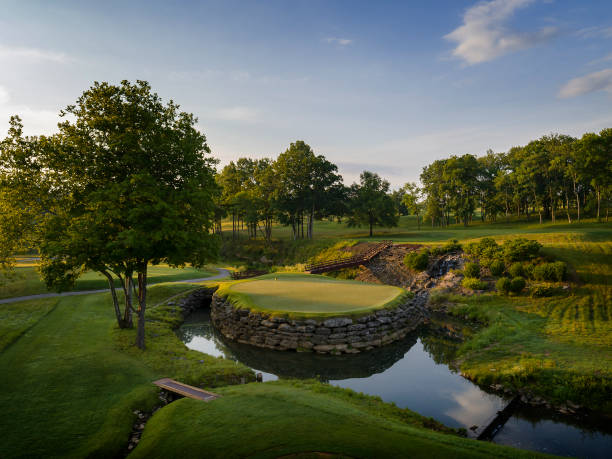
Before it became a golf course, the property was difficult to develop because half of the site was a floodplain with high-tension electric poles everywhere. Nicklaus, however, drew on his extensive training and prior experience to produce a unique design that includes a par 5 with an alternate fairway, a par 4 with an island green, and a finishing hole with a horseshoe-shaped green. In the spring of 1984, after considering 40 potential course routings, construction began and the final product opened for play in June 1986. As he is known to do, Nicklaus has returned periodically to update and renovate the course.
In 1992, Valhalla was selected to host the 1996 edition of the PGA Championship. The following year, the PGA of America purchased a 25% interest in the club. After the championship in 1996 (won by Mark Brooks), the PGA of America raised its stake to 50% and announced that the event would return to Valhalla in 2000. At its conclusion, the PGA of America exercised an option to purchase the remaining interest in the club. Later that year, it announced that the Ryder Cup would be held at Valhalla in 2008. Team USA won 16.5 – 11.5 to end the streak of three successive victories for Europe. This was the USA’s largest margin of victory since 1981 and the first time since 1979 that the Americans had held the lead after every session of play.
The PGA Championship returned in 2014 with Rory McIlroy’s triumphant victory. And in November 2017, the PGA of America announced that the PGA Championship would return to Valhalla in 2024.
In preparation for the tournament this year, Valhalla’s new ownership group has made numerous updates to the course. Included in those are the renovation of the clubhouse, adding a new agronomy center, a waterfall on the 13th hole, and new tee boxes on the first, 12th, 14th, and 18th holes. The entire course has also been re-sodded from Bentgrass to Zoysia, a warmer-season turf. This should allow for easier maintenance of the course during the summer. The course will play about 100 yards longer than it did in 2014. The first hole is 50 yards longer, and No. 14 can be played as a 250-yard par three.
We have partnered with Underdog to bring you an easy way to claim a FREE, no-strings-attached 90 days of Premium Access to Betsperts Golf, plus up to $250 in bonuses when you deposit! Click here to learn more!
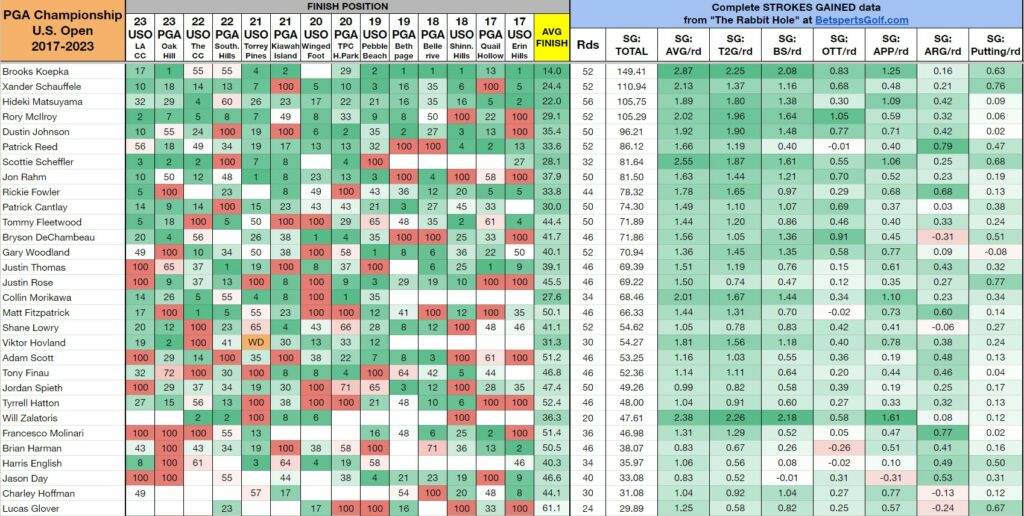
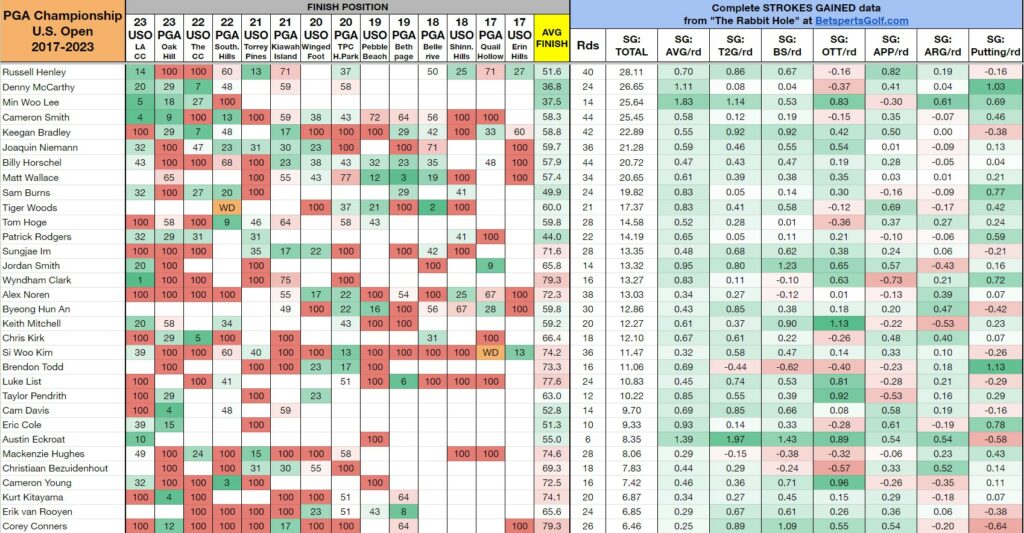
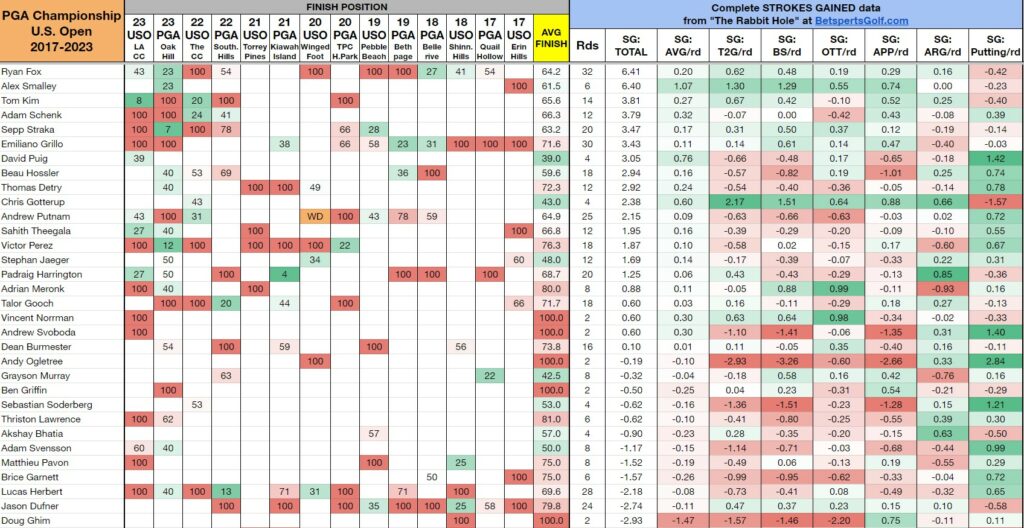
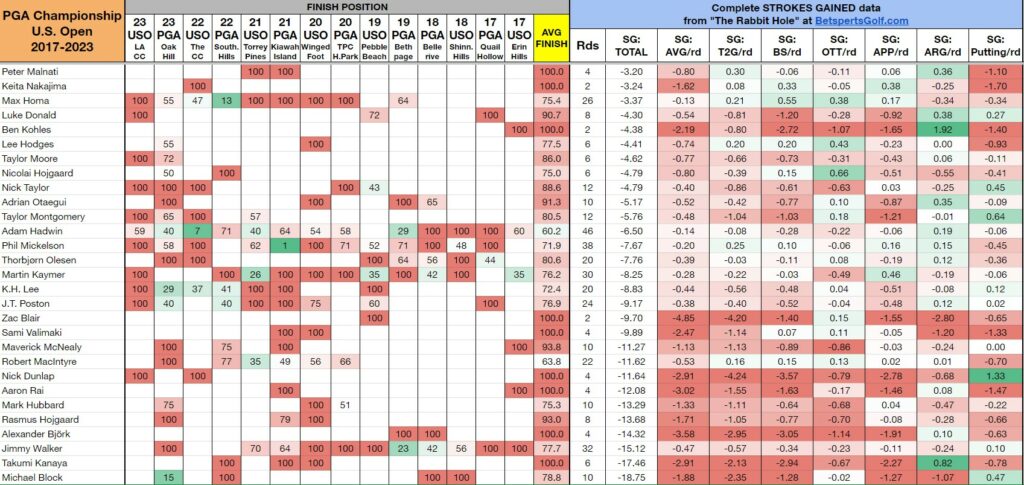
Finish Position and Strokes Gained Course History (2017-2023)
f684b2f3d4218ee06dad551b3bb2074bCombined PGA Championship/U.S. Open course history going back to 2017. Includes average finish position and Strokes Gained per round in each category. Players are sorted by SG: Total.
Why include U.S. Open courses? PGA Championship layouts have usually been “U.S. Open-lite” type courses. Amongst the majors, those two events are the most comparable. And the last few courses, including Oak Hill and Southern Hills, have had challenging U.S. Open-style scoring conditions.might be as close to a U.S. Open challenge as we’ve seen in years.
Courses included in the data: Los Angeles CC, Oak Hill CC, The Country Club, Southern Hills, Torrey Pines (South), Kiawah Island, Winged Foot, TPC Harding Park, Pebble Beach, Bethpage Black, Bellerive, Shinnecock Hills, Quail Hollow, and Erin Hills.
Course Features
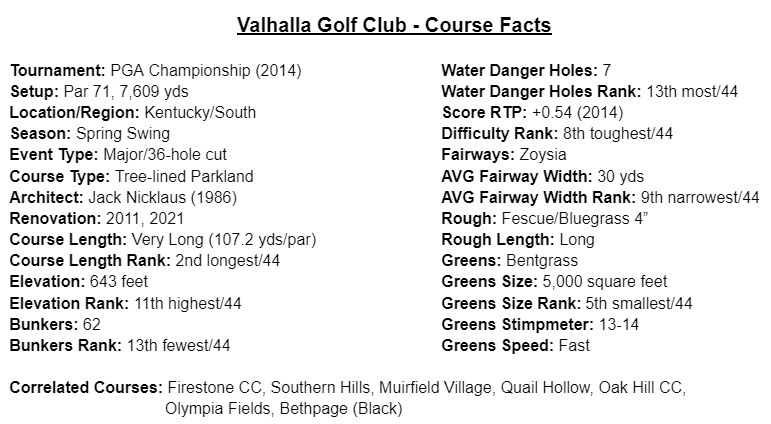
Valhalla will play as a par 71 measuring over 7,600 yards. It has the reputation of a course that favors “total drivers” of the ball with fairways that are somewhat wider than normal for a major. Back in 2014, it played as the longest par-71 course in PGA Championship history. Said Tour veteran Brandt Snedeker about the course, “You’ve got to drive the ball in play there, first and foremost, if you’re going to have any chance at all of being successful. Par 5s are a key factor. If they’re reachable for guys like me, the medium hitters, then I have a good chance. If they’re not, the big hitters have a huge advantage.”
The countryside property features a rolling terrain with elevation changes throughout providing uneven lies on many shots. While there are plenty of hazards, including 62 bunkers and seven holes with water danger, there is plenty of room to play away from the trouble. One of the best things about Valhalla is the numerous options to navigate holes that Nicklaus provides.
Keeping the ball in the fairway, however, remains crucial. Doing so will give players a green light to attack the flag. On the other hand, if constantly playing from the 4″ bluegrass/fescue rough, golfers will be forced to play defensively and fight for par. In the 2014 PGA Championship, the course averaged 0.54 strokes over par per round which would rank it as the eighth toughest course on Tour.
The change in playing turf will be the biggest difference from the 2014 tournament. “The biggest change, which I think is one of the neatest things, in 2021, the PGA of America came in and made the decision to change the tees and the fairways from a cool season Bentgrass to a warm season Zoysia grass,” John Ballard, Valhalla’s superintendent said. The grass, Ballard said, is more environmentally friendly, requiring less water, fewer chemicals, and fewer fertilizers to maintain.
For the players, the grass provides a firmer (and less forgiving) surface. “It can be good and bad,” Ballard said. “If you hit a really good shot straight, it’ll go a lot further, but you could hit one that’s maybe marginal, and because it’s so firm and fast, it may run out of the fairway, get you into the rough, get you into a bunker, get you into trouble.”
Hole Preview
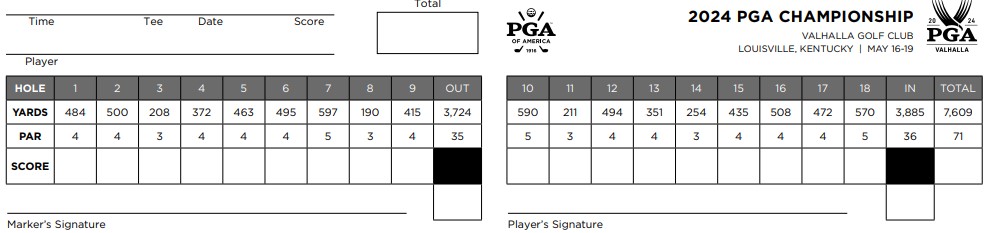
Valhalla contains a great mix of difficult holes, attackable birdie holes, and plenty of risk-reward decision opportunities. The two very different nines blend together to create a distinctive whole. The easier front nine is more flat and wide open with slightly undulating fairways that pitch and roll through a low-lying valley that doubles as a flood plain for Floyd’s Fork. Many have described it as almost having a links vibe. The front nine also features fescue-carpeted mounding and naturally occurring limestone used to bulwark greens and water areas. The 2nd, 3rd, and 6th are situated along the edges of the property and each interacts with Floyd’s Fork
Along with being more difficult and having more imaginative holes, the back nine is a much more traditional tree-lined layout that also has plenty of hazards and changes in elevation. The signature island green 13th hole is more gimmicky than anything and requires only a short wedge on approach from the fairway.
There is a good mix of longer and shorter holes for each of the par types. Overall, the par 3s are very challenging with three of the four playing over 205 yards. They averaged 3.08 in 2014. Six par 4s measure at 460+ yards. These holes averaged 4.17 in 2014 and a few are even longer than they were a decade ago. The three par 5s are reachable in two shots, but both the 7th and 10th holes only have an eagle rate of 1.2% as water and bunkers around each green add plenty of risk for playing too aggressively.
The stretch of holes from 13 through 16 are some of the best on the course. The meandering creek combined with numerous demanding shots makes this stretch very difficult. The course culminates with the dramatic uphill par 5 18th which has a split fairway option and a horseshoe green set in a vast amphitheater. Two of the previous PGA Championships here have ended in playoffs and the third, in 2014, ended in equally theatrical fashion when Rory McIlroy, leading by one, scrambled for a winning par.
Strokes Gained Analysis
Off the Tee
“Hitting the fairways is way more at a premium here than it is at a lot of places,” said Keith Reese, PGA general manager at Valhalla since 2013. While players have some room off the tee with fairways averaging around 30 yards wide, the club removed all the rough between the fairways and the bunkers near the landing areas, allowing balls to bound unimpeded into the sand traps. Combined with the penal 4″ rough, this will place an even greater emphasis on finding fairways and controlling run-out off the tee. “It’ll be interesting to see if the players have to adjust their aiming points off some of the tees this year, just because we are getting more roll than we typically would,” said Reese.
While accuracy off the tee is vital, Valhalla is a massive course ranking as the fifth-longest track played on Tour since 2016. In 2014, 10 of the top 15 on the leaderboard also ranked inside the top 15 in driving distance for the week. On the tee box, Valhalla provides clearly defined targets and rewards powerful driving. Total drivers who can combine distance with accuracy will have a huge advantage this week and favor players like Scheffler, McIlroy, Ludvig Aberg, Cameron Young, and Min Woo Lee.
Approach
It is a typical “Nicklaus design” that places a huge premium on precise second shots. It’s also a shotmakers course. Greens are firm and fast. Said Phil Mickelson back in 2014, “The fairways are always generous. But the biggest thing is coming into the greens, you want to hit a lot of shots high and soft. There’s a lot of collection areas. You’ve got to carry a lot of bunkers and get the ball stopped quick. The higher and softer you hit the ball, you seem to be able to make a lot more birdies at Valhalla. So that will be the biggest thing.”
Many of the green complexes at Valhalla are elevated so that wayward iron shots will be repelled away from the green even more. The greens also contain subtle ridges that can turn quality approaches into 30-foot putts depending on the slope in the landing area.
The thick rough makes approach play very unpredictable. The Louisville area has seen a much warmer spring this year which has placed the course several weeks ahead of its normal growing patterns. This has resulted in even thicker rough than expected and further elevates the premium on both finding fairways and shot control. “I think that’s probably the most difficult thing for the Tour players, putting them in a situation where they can’t predict how far a shot is going to go or how much it’s going to spin,” Reese said.
Around the Green and Putting
The bentgrass putting surfaces are deceptive and undulating and often partitioned into distinct areas. They often appear to break in two different ways depending on the angle. Valhalla is also known for its extremely fast greens which will start at 13 on the stimpmeter and play closer to 14 on the weekend.
As is standard in major tournaments, both scrambling and bogey avoidance is crucial for success. These green complexes place a premium on creative shotmaking and skillful chipping. The bluegrass rough around the greens is very lush and will provide a challenge, especially if chipping from below the hole. The bunkers surrounding the greens are quite penal and had a sand save rate of only 50.7% in 2014.
Most Important Stats For Success at Valhalla
*In order of importance
- Total Driving
- SG: Approach
- Driving Distance
- SG: Total – Difficult Scoring/Majors
- Proximity 175+ yards
- SG: Putting (Fast Greens)
- Scrambling
- Bogey Avoidance
- Good Drive %
- Par 4 Scoring (Difficult Par 4s)
Key Rabbit Hole Filters
- Course Region: Southeast
- Scoring Conditions: Difficult
- Course Length: Very Long
- Field Strength: Very Strong
- Event Type: Major
- Greens Surface: Bent
- Green Speed: Fast
- Green Size: Small
- Fairway Surface: Zoysia
- Rough Surface: Bluegrass
- Rough Length: Long
- OTT Club: Driver Heavy
- Missed Fairway Penalty: High
- Rough Penalty: High
- Gain APP: Difficult
- Par 4 Scoring: Difficult
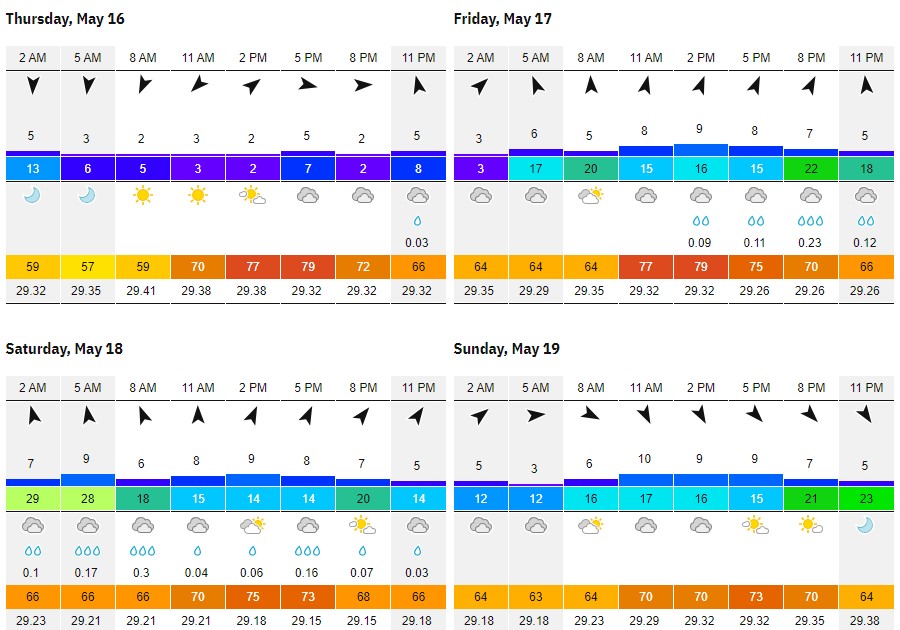
Weather Forecast – Louisville, Kentucky