The PGA Tour heads down to Bayou Country just southwest of New Orleans for a unique team event at TPC Louisiana known as the Zurich Classic. With its origins 88 years ago, the tournament was a regular, stroke-play PGA event until 2017, when it became a two-man team event. With 80 teams in the field, one player from each team is initially chosen via the Tour priority rankings. That player can choose any partner who is also a PGA Tour member. The teams will play “best ball” format during the first and third rounds, while the second and fourth rounds will be “alternate shot” format. After Friday’s round, the top 33 teams (and ties) will make it through the cut line. The PGA Tour further describes the format in more detail:
For Foursomes play, players will rotate tee shots. One player will hit the tee shots on all the odd-numbered holes, and the other will hit the tee shot on even-numbered holes. Example: Player A and Player B are partners. On the first hole, Player A tees off; Player B plays the second shot; Player A plays the third shot; and so on until the ball is holed. The total strokes taken will result in the team’s score for that hole.
For Four-Ball play, the players on each team will each play his own ball throughout the entirety of the round, with the best score on each hole recorded. Example: On the first hole, both golfers on each team tee off. Player A pars the hole and Player B birdies it. The team will be credited with a birdie.
The winners earn 500 FedEx Cup points and two-year exemptions, but no world ranking points are awarded, which takes away some pressure to make the cut. Both winners will earn invitations to the Sentry Tournament of Champions, THE PLAYERS Championship, and the PGA Championship.
It’s a unique competition and provides a way for players to relax after some strenuous past events, such as the Masters, and before others like the upcoming PGA Championship. The format typically makes for interesting teams, from best friends to countrymen to random pairings. The New Orleans food and culture also add to the “pull” of this event, and why there are typically numerous high-ranked players in attendance each year.
The Field
f684b2f3d4218ee06dad551b3bb2074bThis year’s tournament appears to have even fewer upper-tier players than in the past due to the recent string of consecutive signature events. Some high-ranking players are teaming up, including defending champions Ben Griffin and Andrew Novak, brothers Matt and Alex Fitzpatrick, Shane Lowry and Brooks Koepka, Ryan Gerard and Sudarshan Yellamaraju, and Sahith Theegala and Aaron Rai.
Other interesting pairings include TPC Louisiana stalwart, Billy Horschel with Tom Hoge, Tony Finau and Max Greyserman, Karl Vilips and Michael Thorbjornsen, and Wyndham Clark and Taylor Moore. After these groups and a smaller second tier, the talent level of the teams declines quickly.
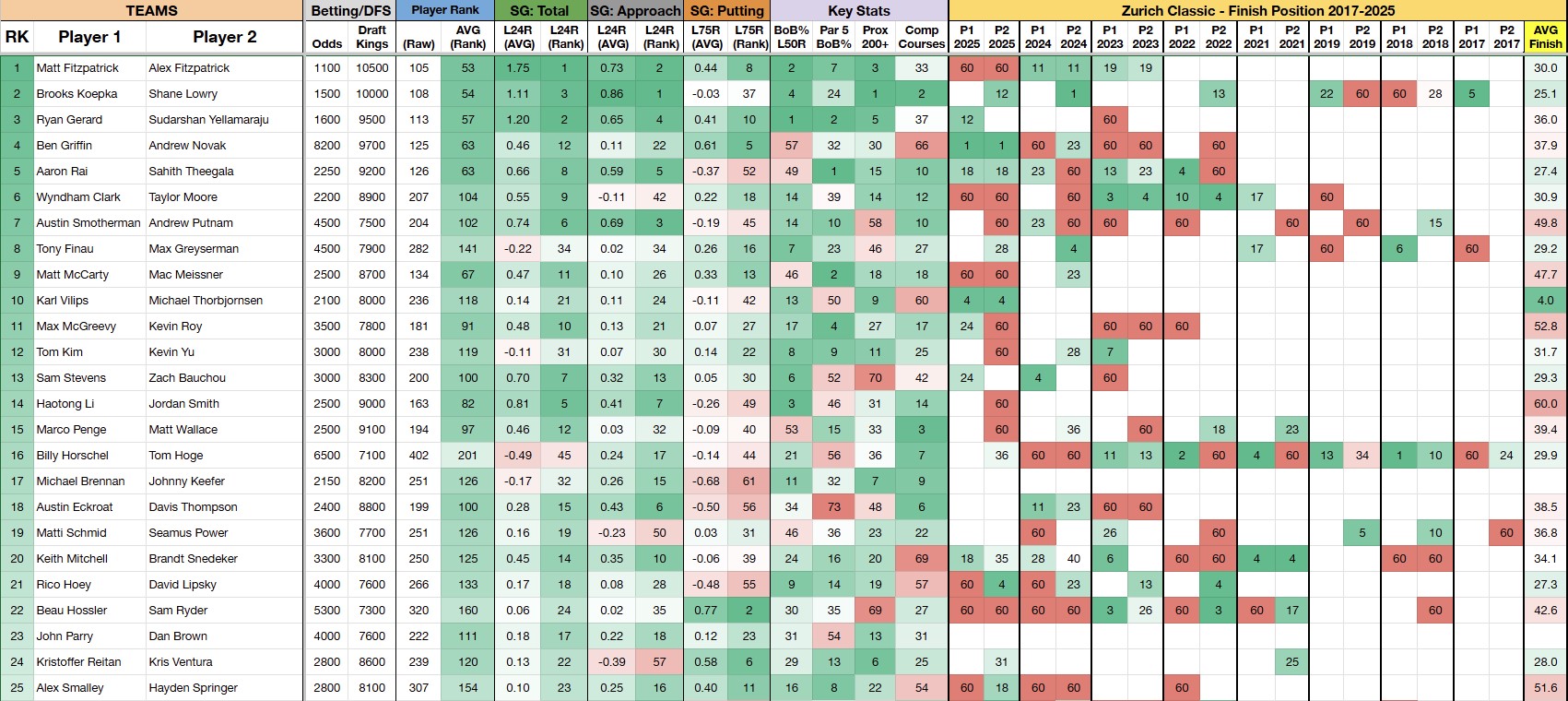
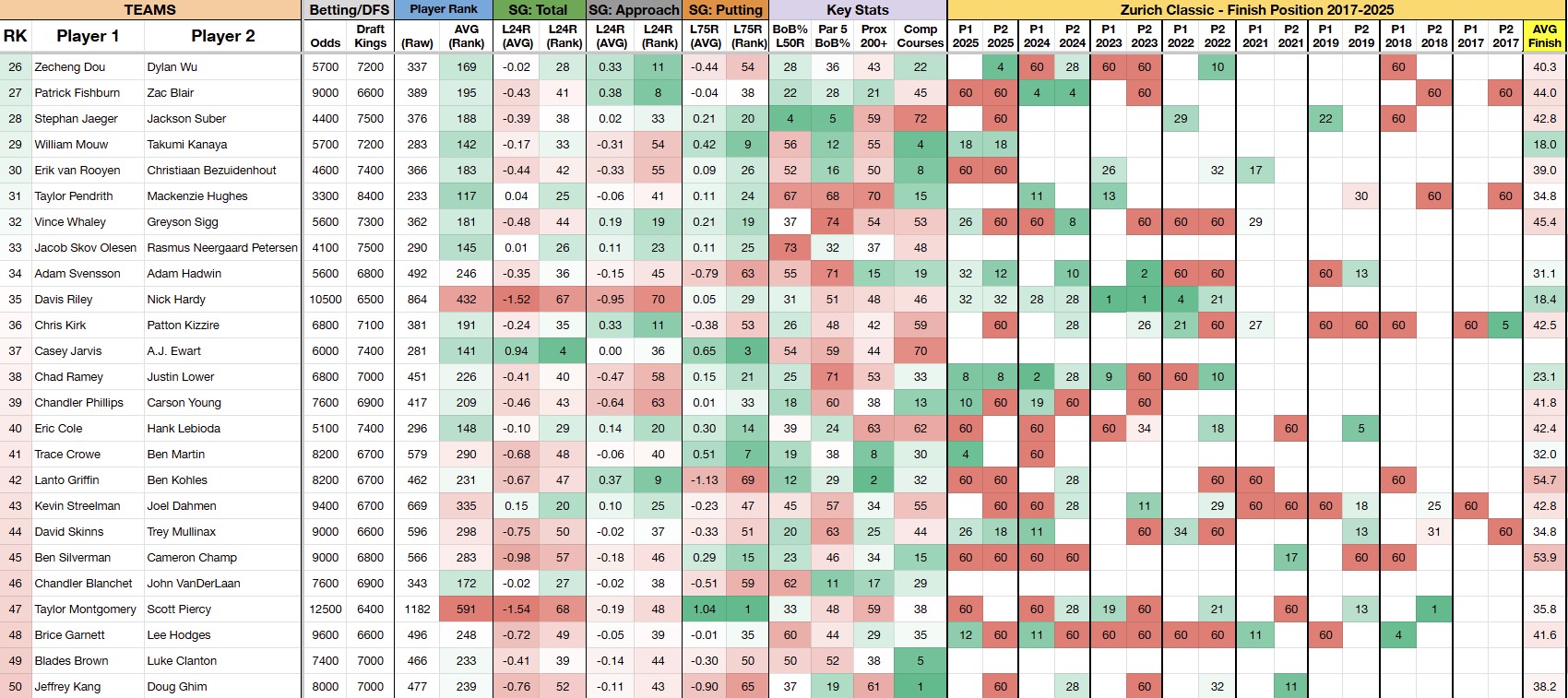
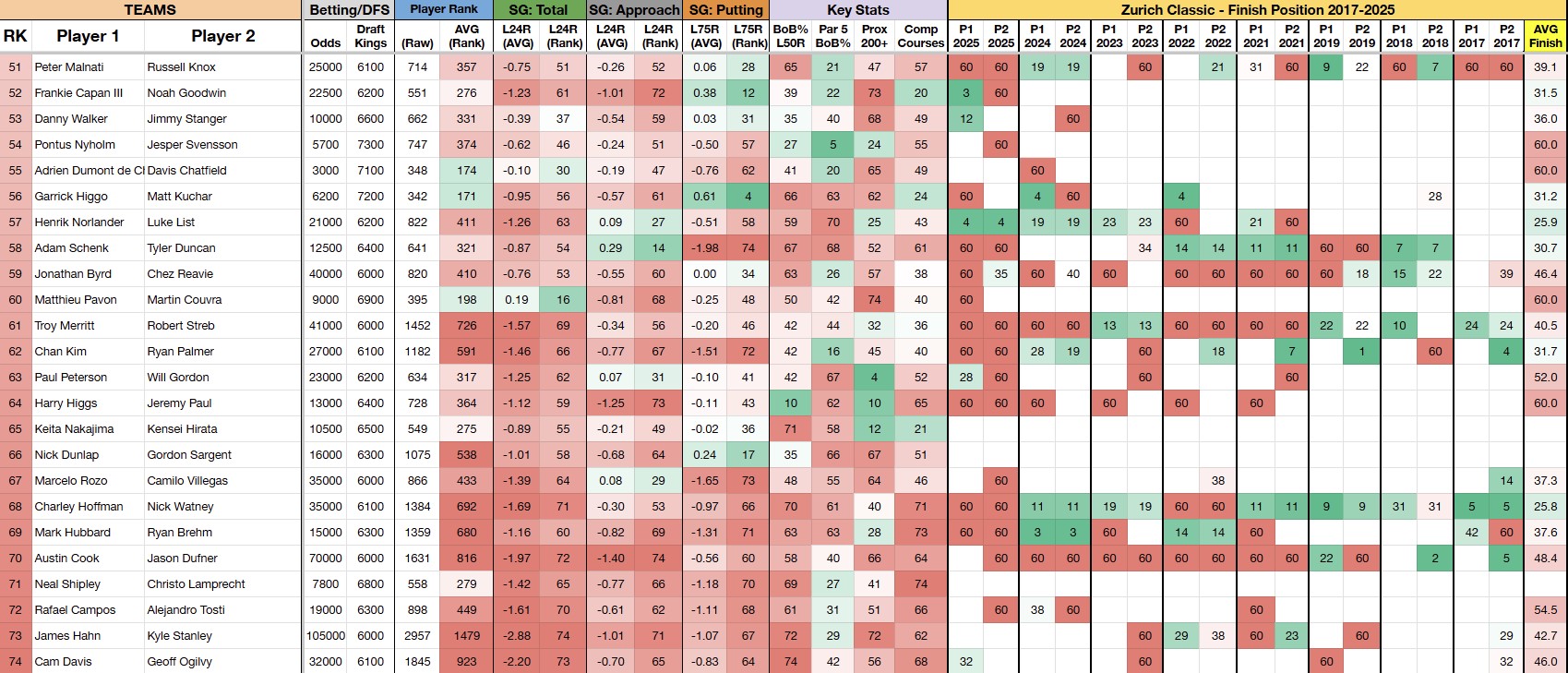
Zurich Classic Data Sheet – Model and Course History
Course Features
Located just south of the Mississippi River in the New Orleans suburb of Avondale, TPC Louisiana is a par-72 layout stretching 7,425 yards. While the Zurich Classic of New Orleans has been part of the PGA Tour schedule since 1958, TPC Louisiana has served as its host venue since 2005.
During its time as an individual stroke-play event through 2016, past champions included Brian Stuard, Justin Rose, Billy Horschel, and Bubba Watson. Since transitioning to a team format, scoring has reached historic lows. In 2022, Patrick Cantlay and Xander Schauffele set the team scoring record at 29-under par, only for Davis Riley and Nick Hardy to surpass it at 30-under in 2023. In 2024, Irish duo Rory McIlroy and Shane Lowry captured the title in a playoff at 25-under, while Ben Griffin and Andrew Novak claimed the most recent victory at 28-under.
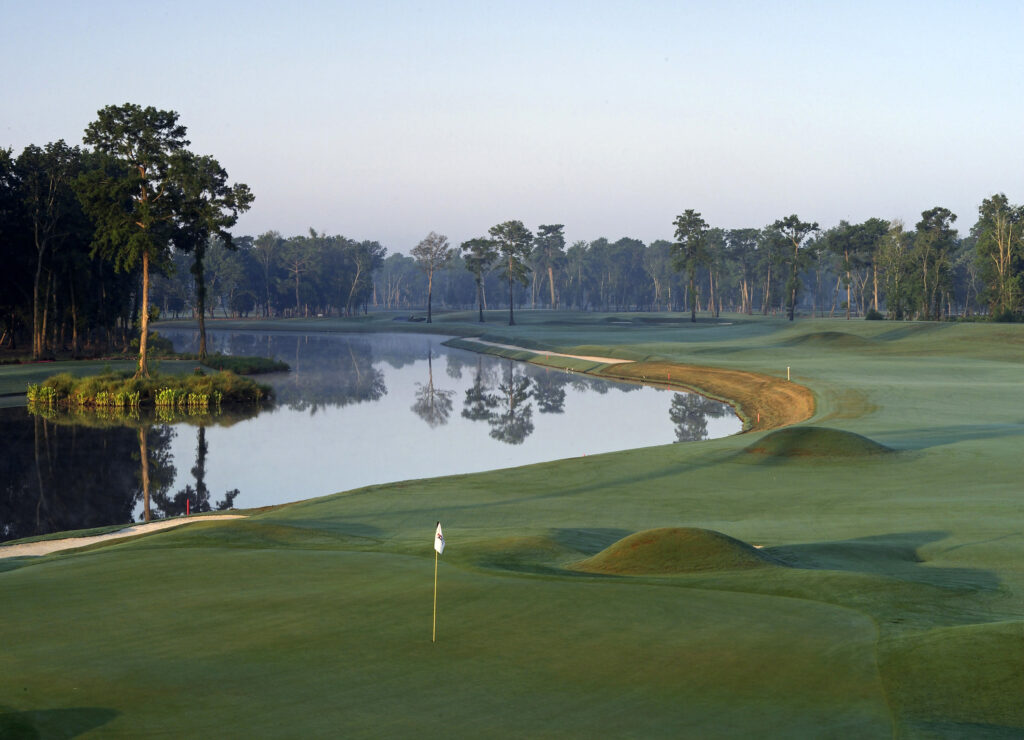
Opened in 2004, the course was designed by renowned architect Pete Dye in collaboration with former players Steve Elkington and Kelly Gibson. Built on a 250-acre tract of drained cypress swampland, the course features a flat layout supported by pumped river sand. Dye transformed the wetland landscape with an intricate mix of trees, lakes, mounding, and strategically placed waste areas. With 106 bunkers and water in play on seven holes, the course demands precision, while its cypress and pine-lined corridors provide a distinct and scenic Louisiana character.
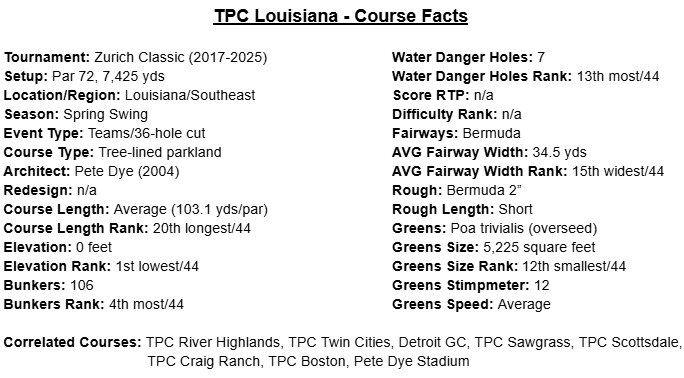
At TPC Louisiana, the playing surfaces are a blend of bermudagrass fairways and rough, with TifEagle bermuda greens overseeded with Poa Trivialis. The greens are smaller than average at about 5,225 square feet and typically roll around a 12 on the stimpmeter. The rough is about two inches in length and is generally non penal, reinforcing that this is a second shot golf course.
The par 5s provide the best scoring opportunities, with at least three reachable in two shots for most of the field. The par 4s vary significantly in length. Four stretch beyond 475 yards while five measure under 405 yards, including the drivable 16th hole. In contrast, all four par 3s play over 200 yards and present a difficult test, with three ranking among the six toughest holes on the course.
As expected from a Pete Dye design, strategy is critical. Water hazards, bunkering, and angled layouts force players to think carefully about positioning and risk tolerance. Holes like the 16th highlight this approach by offering a clear risk reward decision that can quickly influence scoring.
Even with the strategic demands, the course remains highly scoreable, especially in the team format of the Zurich Classic of New Orleans. With accessible par 5s and plenty of birdie chances, winning scores in recent years have approached 30-under par.
Strokes Gained Analysis
With strokes gained and other ShotLink data not applied to the team format at the Zurich Classic of New Orleans, we have to look back to pre-2017 data to understand how TPC Louisiana typically plays.
Although the course is average in length, many holes force players to club down off the tee to avoid hazards. That said, longer hitters can still capitalize by attacking the par 5s. Statistically, driving hasn’t been a major differentiator here. Fairways average over 34 yards wide and the rough is relatively forgiving. Through the first 11 editions at TPC Louisiana, the average driving distance rank of winners was just 32nd, while driving accuracy ranked even lower at 38th.
Approach play has historically been the key separator. Before the format change, both “Strokes Gained: Approach” and Greens in Regulation were critical, with seven of the 11 winners finishing inside the top 10 in GIR%. The course consistently ranked among the easiest on Tour for approach shots, but that doesn’t mean it lacks nuance. With four par 3s all measuring between 200–225 yards and over 30% of approach shots coming from beyond 200 yards, elite long-iron play is essential.
Around the greens, the test is far less demanding. TPC Louisiana has regularly played as one of the easiest short-game courses on the PGA Tour, allowing players to survive with mediocre scrambling. Putting, however, has been a major factor in converting opportunities. Six of the final seven winners before 2017 ranked inside the top 10 in putting average, and each of the last four gained at least 4.2 strokes on the greens. When Justin Rose won, he led the field in putting average for the week.
In classic Pete Dye fashion, the greens feature tiers and subtle slopes that reward precision into the correct sections. That emphasis is amplified in best-ball rounds, where each team has two opportunities to hit quality approaches and set up birdie chances.
In short, the most predictive stats this week are Strokes Gained: Approach, putting, par-5 scoring, and proximity from 200+ yards, along with birdie-or-better percentage—which becomes even more important in a team format where low scoring is required.
