With the “West Coast Swing” concluded, the PGA Tour heads south of the border for the Mexico Open. Dating back to 1944, the Mexico Open has quite a historical past and has been considered Mexico’s national championship. Located a few miles off the Pacific coast near the town of Puerto Vallarta, the Vidanta Vallarta Resort (one of the highest-rated hotels in Mexico) and its “Signature Course” designed by Greg Norman will host this event for the fourth time. Jon Rahm won the inaugural tournament in 2022 at -17, followed by Tony Finau’s victory in 2023 at -24. Last year, easy scoring conditions continued with Jake Knapp winning at -19.
With its considerable length and lack of penal rough, it is a course that favors bombers off the tee and players that excel on approach from over 200 yards. Holes wind along the banks of the Ameca River and provide scenic views of the Sierra Madre mountains. Like most resort-style courses near the ocean, past success in coastal winds and familiarity with Paspalum grass will also play a significant factor in determining the winner.
The Field
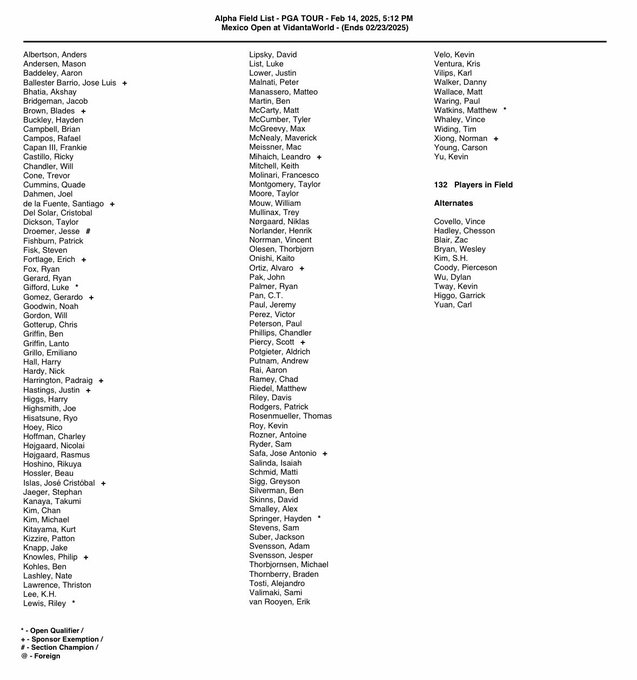
As has been the case in the previous three editions, the overall strength of this field is quite weak. There is not a single top-25 player teeing it up this week and only five golfers ranked in the top-50 of the OWGR. With its position in the schedule (after a Signature event, pre-Florida swing) along with it being an international event on a “bombers” course, it is easy to see why few top-ranked players would choose to make the trip to Mexico.
The main headliners in this 132-player field are Akshay Bhatia, Aaron Rai, Stephen Jaeger, Kurt Kitayama, and Rasmus Hojgaard. Jake Knapp also returns to defend his 2024 Mexico Open title.
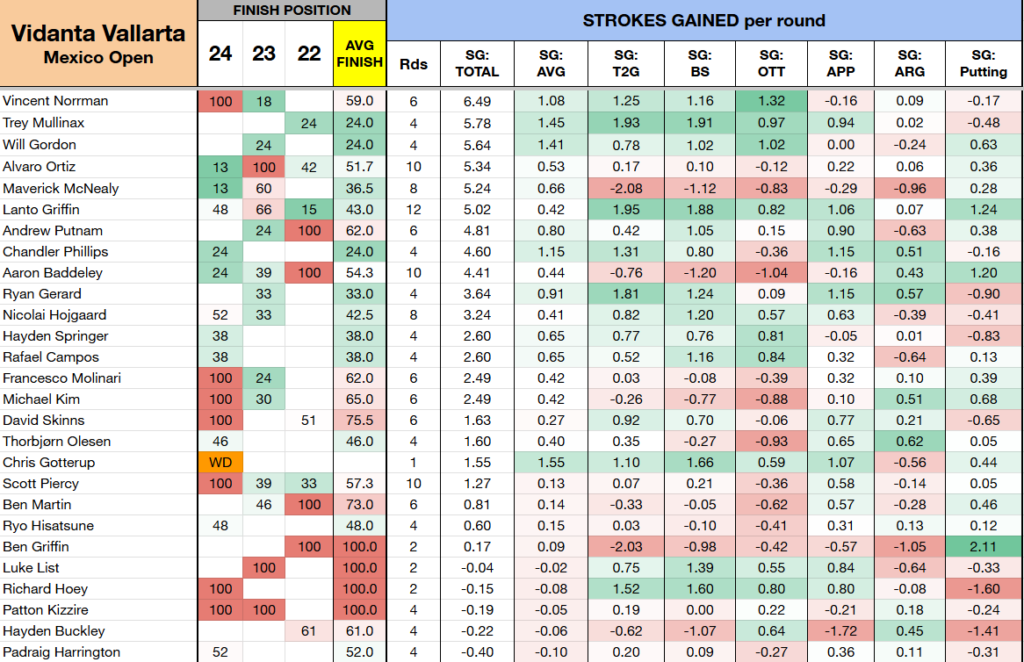
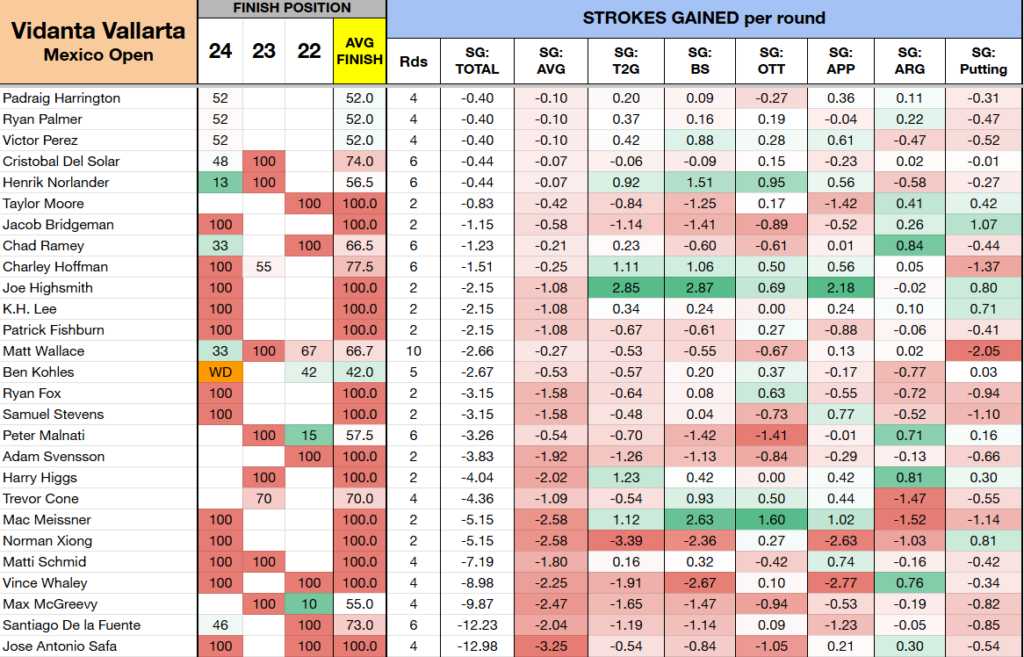
Finish Position and Strokes Gained History at Vidanta Vallarta (2022-2024)
This includes the average finish position and Strokes Gained per round. Players are sorted by SG: Total.
f684b2f3d4218ee06dad551b3bb2074b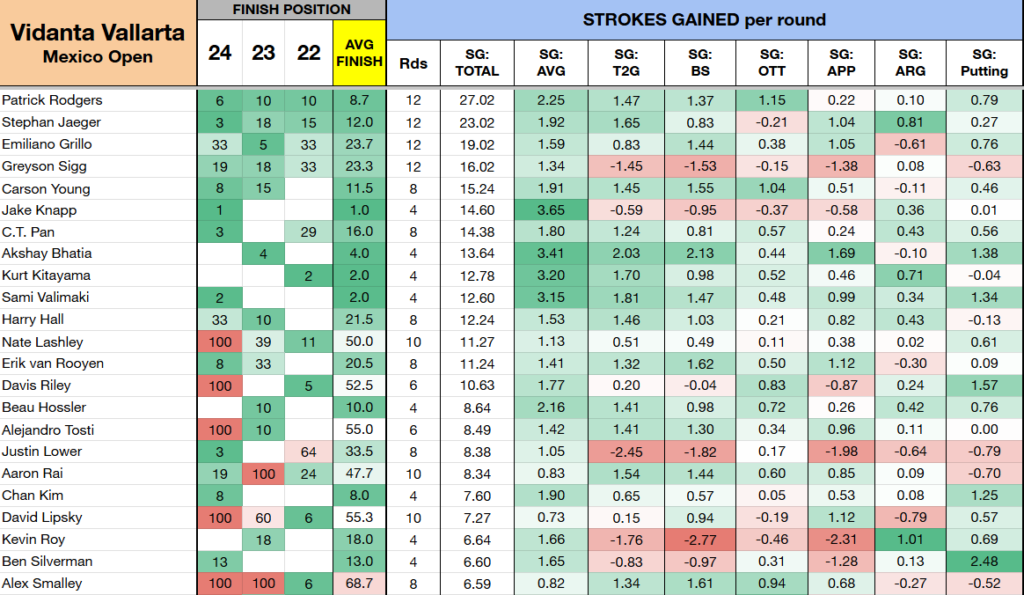
Course Features
Tucked away along the banks of the Ameca River in between the beaches of Nuevo Vallarta and the resort town of Puerto Vallarta sits Greg Norman’s “Signature Course” at Vidanta. Featuring panoramic views of the Sierra Madre mountain range and the Banderas Bay to the southwest, this recent design from 2015 is surrounded by parota trees, native grasses, and patches of lush jungle.
It’s isolated on its own little plot of unspoiled tropical serenity with no housing or commercial developments in sight. Just to get to the course, players will have to cross the Ameca River on the world’s longest golf cart suspension bridge. Similar to a couple of his other courses at TPC San Antonio and El Camaleon, Greg Norman tries to closely incorporate elements of nature into his layouts. This includes water, elevation changes, native plant life, and an appreciation for the surrounding scenery. While it is a fairly flat piece of property, each of these other elements is seen here at Vidanta.
As Norman said in his own words, “When designing this course, respecting and promoting the conservation of ecologically sensitive areas was of primary concern. As a result, routing was dictated by nature, according to dense vegetation corridors, streams, and wetlands.”
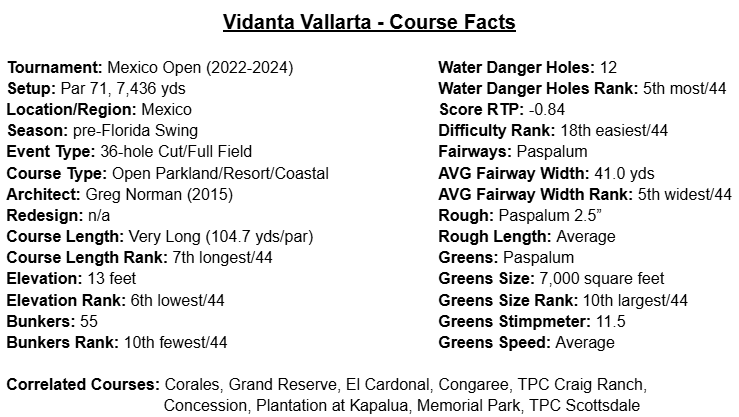
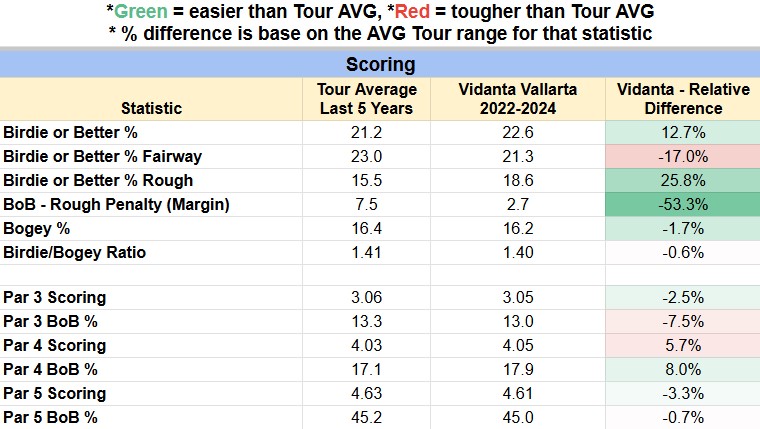
Vidanta Vallarta is a par-71 course that measures out to 7,436 yards. It ranks as the 7th longest course on Tour. It is a unique track that has five par-3s to go with four par-5s and only nine par-4s. Unlike most resort courses, the first three years of this tournament have not resulted in a birdie-fest. Even though there isn’t a ton of sample size, it ranks near the middle of the pack for scoring difficulty.
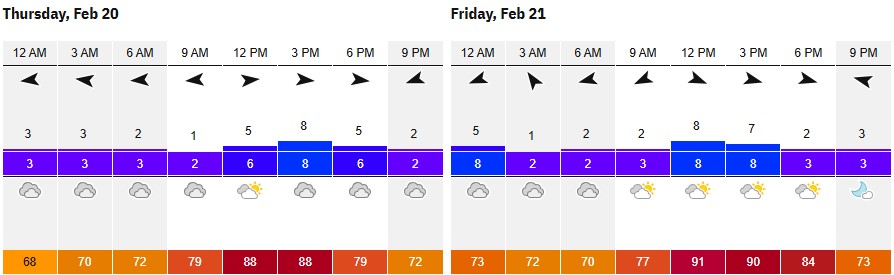
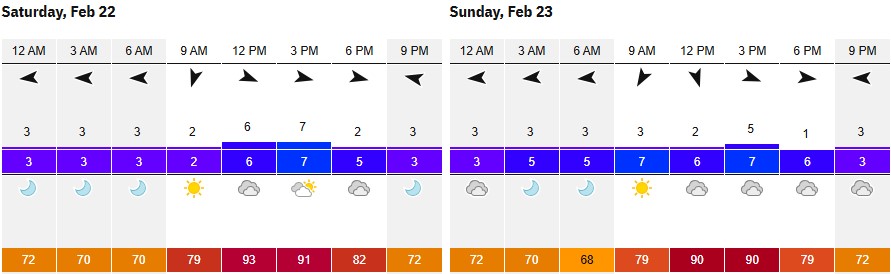
Along with its length, coastal winds appear to be one of the course’s most prominent defenses. With the Pacific coast just down the road, crosswinds are known to impact the course starting around 11 am on most days. Jon Rahm had this to say about the effects of the wind in 2022. “There’s a big difference between morning and afternoon. We had no wind for 13, 14 holes, and it was very scorable. Once the wind starts going 20-30 miles an hour, this golf course starts showing some teeth. It’s long. You have a couple really long par 4s. 4 and 8 are straight into the wind. Both of them 500 yards. So you can start seeing higher scores out there.”
There are also 12 holes with water danger (fifth most), 55 bunkers, numerous large sandy waste areas, and patches of indigenous vegetation that can also cause trouble. The course features wall-to-wall Paspalum grass which is a very common turf used on coastal courses and is known for its “stickiness”. This means that drives will not roll out as much on the fairways and will stop much quicker on the greens. The rough here is up to 2.5″ this year compared to 1.5″ in previous years. Greens should run between 10.5-11.5 which is in the slow-to-average range on the stimpmeter.
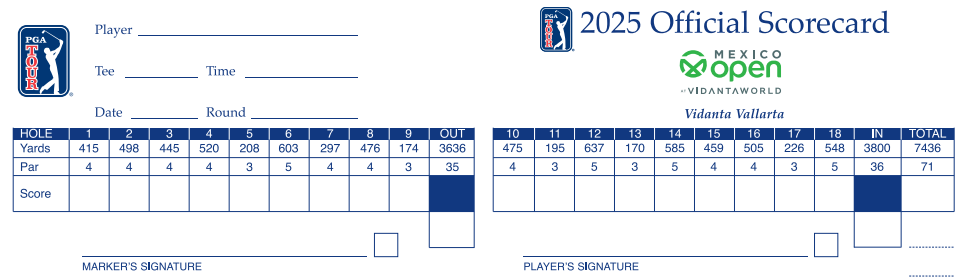
Vidanta is one of the few PGA courses that has five par-3s to go along with four par-5s and nine par-4s. The par-3s vary in length and play right around even par except for the 226-yard 17th hole which has a bogey-or-worse rate of 28%.
The course gets much of its teeth from some lengthy par-4s. Five of them measure at least 475 yards and are especially challenging when played into the wind. They combined to average 0.24 strokes over par with a birdie or better rate of only 8.8%. Three of the par-5s are massive with two over 600 yards including the 12th hole which is beastly in length at 637 yards and an eagle rate of only 0.7%. In fact, Vidanta Vallarta has the longest combination of par-4s and par-5s on Tour.
Most of the holes are quite straightforward and non-descript with either large waste areas and bunkers or water lining each fairway. The 7th hole is a 297-yard par-4 that is described as risk-reward but it doesn’t have much risk because the water to the left side of the fairway is non-threatening. Players should have little trouble driving the green and ending up with eagle and birdie chances. The 18th hole should also set up some excitement, as in typical Norman fashion there is a closing par-5. At only 548 yards, it is very reachable in two shots even with the jungle area on the right and waste area on the left.
Strokes Gained Analysis
Off the Tee
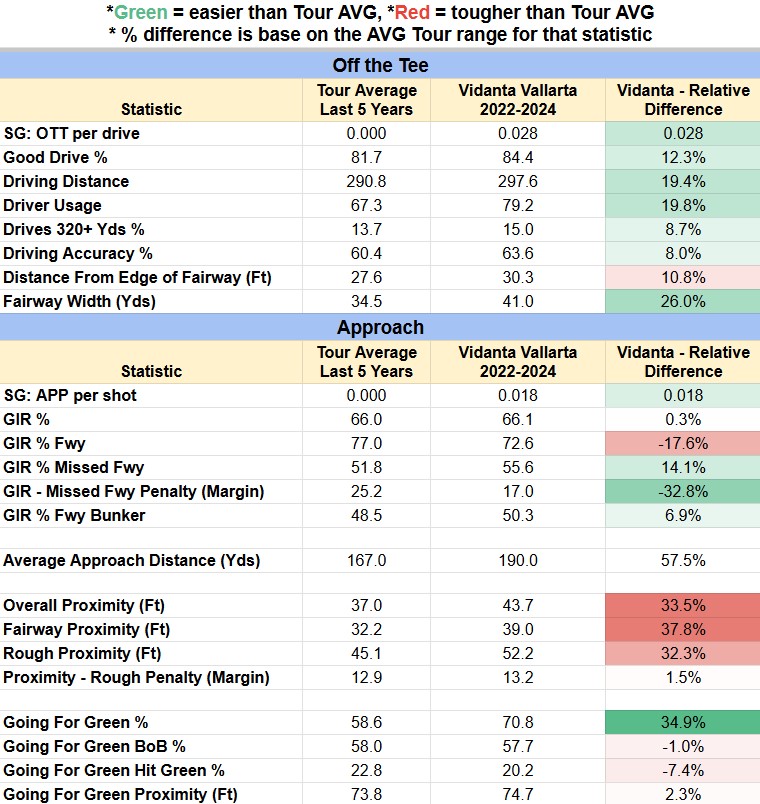
Off the tee, players will be met with wide landing areas on fairways that are perfect for bombers who love to hit a ton of drivers. Almost 78% of drives were over 280 yards which is one of the highest rates on Tour. Over the first two years, long hitters like Rahm, Finau, Cameron Champ, Joseph Bramlett, and Patrick Rodgers filled the top 10 of the leaderboard. Jonathan Byrd spoke about the “grip it and rip it” mentality here, saying, “When you’ve got so many tee shots where you can just let it go and swing as hard as you want. It kind of gives you plenty of room off the tee and the rough’s not bad, so it’s just kind of swing away.”
Fairways here average 41 yards wide which makes them the fifth widest on Tour. While five holes present water danger off the tee, only two feature water that is tight to landing areas. Along with the rough being non-penal, the slower paspalum fairways will give a bonus to those with longer carry distance. Accuracy off the tee is very close to the Tour average but lacks importance with the rough posing little threat in past editions. It will be interesting to observe if an extra inch of rough length will change anything.
Approach
Whenever a course is easy to gain strokes off the tee and has expansive fairways combined with huge greens, it places a much stronger emphasis on the approach shot to the green. Long-iron skills are paramount for success this week. The greens were also much firmer last year than in 2022. Tony Finau commented on this saying, “The greens are actually a lot firmer than they were last year. Greens are also a little bit faster so you’ve got to respect some of these pins.”
With this being such a lengthy track, 42% of approaches have been from over 200 yards which is the highest rate by a large margin from any Tour course. This second-shot length does lead to fewer quality scoring chances as the average proximity to the hole is almost 44 feet which was the furthest distance on any course last year. Harry Higgs spoke to this last year. “You’re going to have to hit a lot of long irons really well and hit some lag putts well because long irons are hard to get close to the hole.” On the flip side, only 21% of approach shots are from inside 150 yards.
Said Stephen Jaeger on approach play here, “I think this golf course requires a lot of shots between about 140 and 200. There’s not a lot of wedges out there unless you get some holes downwind or something. They’re big greens and you’ve got to put them in the right spots to have a good look.”
When golfers can use wedges and short irons, Vidanta was the easiest course to gain on approach. They will also have to take on six different greens that have water in the vicinity on approach. And in typical Greg Norman style, most greens have at least two deep bunkers to deal with. So while the greens are larger than average, second-shot accuracy will still be crucial, especially if coastal winds have an impact.
Around the Greens and Putting
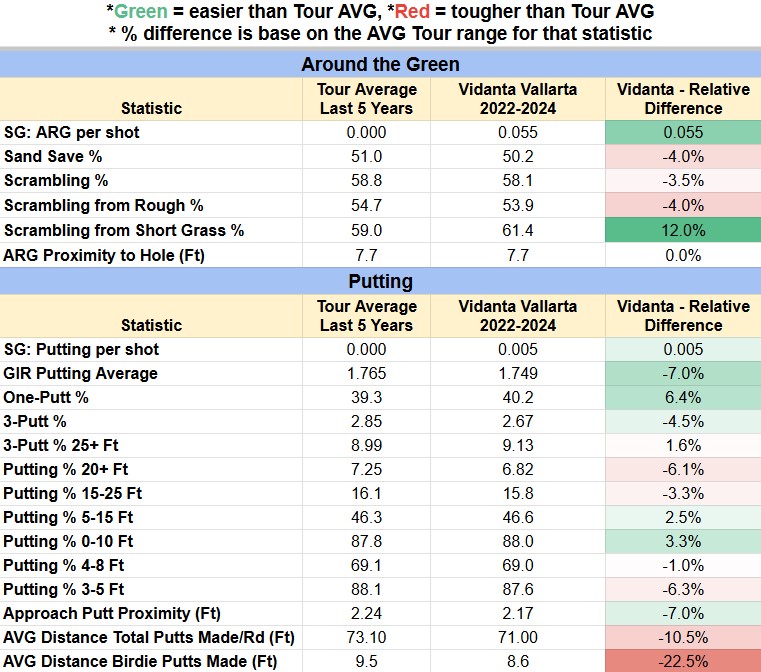
Through two years, Vidanta is the easiest course on Tour in which to gain strokes around the green. Some of the greens are elevated with collection areas behind them which eat up wayward approaches that are long. Because the ball tends to sit on top of the Paspalum turf blades combined with slower greens, less touch is needed when chipping which should make the short game much easier. With all the bunker areas, sand saves will take on added importance and is the only area around the greens that should be factored into a model this week.
Putting is the only area that presents a true challenge at Vidanta as it has been the 15th toughest course to gain strokes with the flat stick. And it was also inside the top 10 for difficulty inside of 15 feet. While the greens don’t have any type of tiered or severe undulations, they do have some subtle sloping around many of the pin locations. And because of all the long approach shots along with the greens being the 10th largest on Tour, 3-putt avoidance will be key. Also, Paspalum greens tend to neutralize putting for both good and bad putters alike.
Most Important Stats For Success at Vidanta Vallarta
*In order of importance
- SG: APP
- Proximity 200+ yds
- Driving Distance/Carry Distance
- BoB%
- Par 5 Scoring
- SG: Long/Very Long Courses
- SG: Winds 15+ mph
- SG: Total – Paspalum
- Bogey Avoidance
- SG: Par 3
Unique Rabbit Hole Filters
- Course Region: Mexico
- Course Type: Coastal/Resort
- Scoring Conditions: Easy
- Course Length: Very Long
- Field Strength: Very Weak
- Greens Surface: Paspalum
- Greens Size: Large
- OTT Club Type: Driver Heavy
- Rough Penalty: Low
Weather Forecast – Puerto Vallarta, Mexico