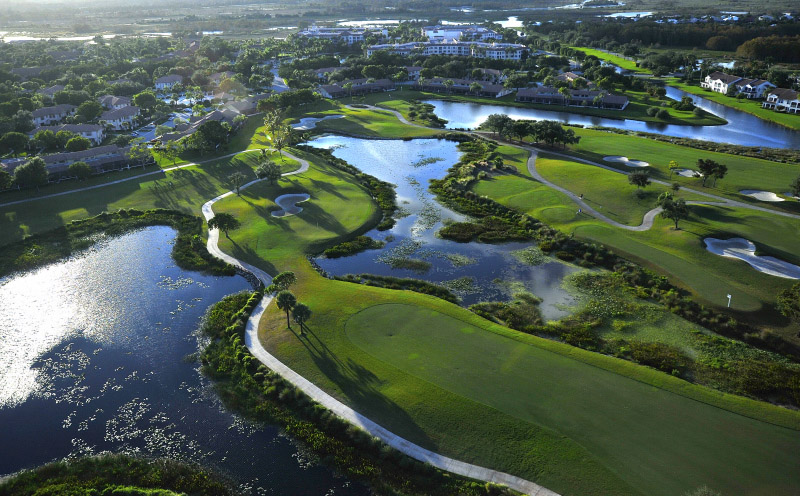
The PGA Tour journeys north to Florida for the newly-named “Cognizant Classic in the Palm Beaches” and the start of the Florida Swing. Previously known as the Honda Classic, the tournament will be hosted once again by the Champion course at PGA National in Palm Beach Gardens, Florida. Not only does it have a new name but the layout has been changed from a par-70 to a par-71 course with the 10th hole now playing as a par 5 instead of a par 4.
PGA National is not an easy introduction to the Florida Swing as it has annually ranked as one of the most difficult courses on Tour, averaging 1.14 strokes over par the last five years. The average winning score over the past 13 years has been 10-under par. It has been the toughest non-major course on the PGA Tour in six of the past 10 seasons. With fewer trees than other parkland courses and only seven miles off the Atlantic coast, PGA National is exposed to gusty conditions as winds often affect this event and make scoring that much more difficult. Add in narrow fairways, firm greens, and water everywhere you turn and it is one of the toughest tee-to-green tests on the Tour.
The winner has either been a favorite or a longshot in 12 of the past 14 years. Part of the reason for the disparity in winners is that this tournament is one of the most volatile events on the Tour. Famous for its 15 holes with water danger. PGA National will favor golfers with a balance of short game and ball-striking who can avoid penalty areas, scramble for pars, and manage any windy conditions. It plays similarly to a major tournament and favors those players who demonstrate patience. As past champion, Keith Mitchell remarked, “You’ve got to stay so patient. A lot of times par is a good score. I don’t think you can play aggressively out here. If you do, I think it will eat you because this golf course is tough.”
Success here will also depend highly upon the player’s ability to navigate the closing stretch of intimidating holes, which is famously known as the “Bear Trap”. The 15th and 17th holes are long par-3s over water, while the 16th is a forced layup to another approach shot over water.
The Field
This year’s tournament provides the last opportunity for players to qualify for next week’s Signature event, the Arnold Palmer Invitational. Even though this event has not drawn the deepest of fields in the past, we have seen numerous high-profile winners including Sungjae Im, Justin Thomas, Rickie Fowler, Adam Scott, Russell Henley, and Rory McIlroy. This year, however, one of the deepest fields in recent memory will assemble on the west Florida coast.
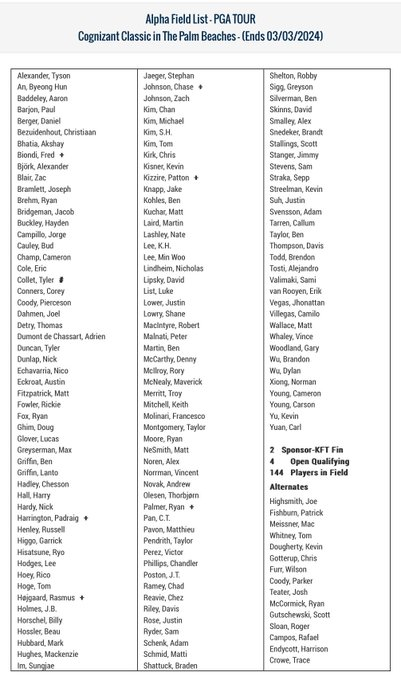
The field for this year’s Honda Classic is set at 144 golfers and includes 19 of the top 50 players in the Official World Golf Ranking. 2012 champion and world No. 2, McIlroy headlines the field along with Matt Fitzpatrick, Tom Kim, Cameron Young, Sepp Straka, Henley, Fowler, Im, last year’s runner-up Eric Cole, and last year’s champion, Chris Kirk.
PGA National (Champion) – History
Designed by Tom and George Fazio, the Champion Course at PGA National first opened in November of 1981. It was built with the specific purpose of hosting major tournament play and has become the home course for this event since 2007. The course has lived up to its purpose as it has hosted the 1983 Ryder Cup, the 1987 PGA Championship, and the Senior PGA Championship from 1982-2000.
The Champion course received a complete redesign in 1990 from Jack Nicklaus. He returned for further renovations in both 2002, 2014, and 2018. By the end of the third renovation, the course had been completely changed to the point that instead of a “Fazio-designed” course it is now known as a “Nicklaus-designed” course. Even the closing trio (holes 15-17) is now called the “Bear Trap” after the “Golden Bear” himself.
As Nicklaus himself said, “We didn’t just change the golf course, we basically designed a new one. For the most part, we kept the previous routing intact because most of the original land usage including the changes in direction were fine and it also made good economic sense. The basic objective of the redesign was to try to make the Champion course a more playable golf course.”
Nicklaus has become one of the premier course architects in the world of golf. This includes courses played on the PGA Tour such as Muirfield Village, The Concession Golf Club, and Valhalla, each of which is similarly demanding and penal like PGA National.
We have partnered with Vivid Picks to bring you an easy way to claim a FREE, no-strings-attached 2024 season at Betsperts Golf, plus a 100% deposit match up to $250! Click here to learn more!
Finish Position and Strokes Gained Course History (2016-2023)
This includes the average finish position and Strokes Gained per round since 2016 for each of the categories. Players are sorted by SG: Total. PGA National is the 18th-most (out of 44) predictive annual course on Tour.
f684b2f3d4218ee06dad551b3bb2074b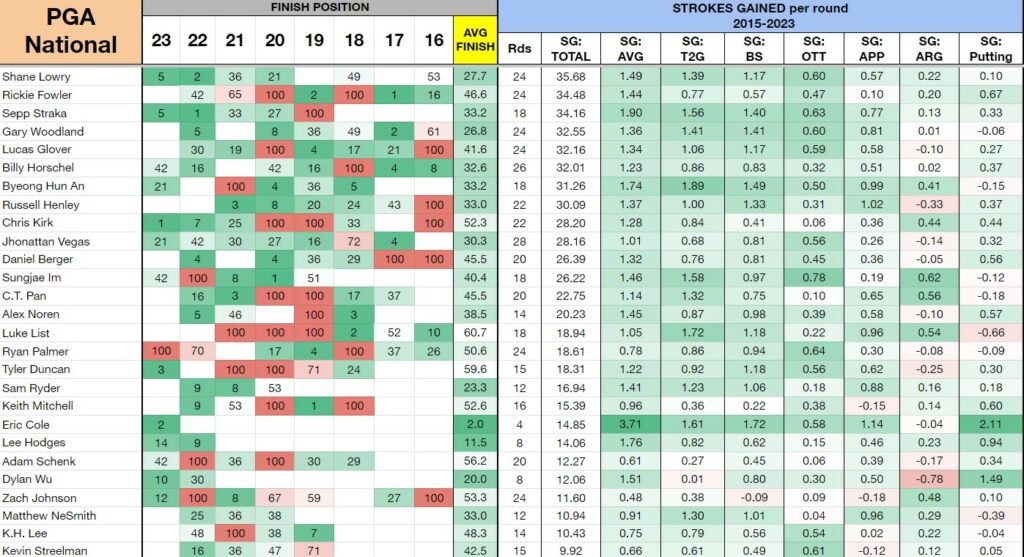
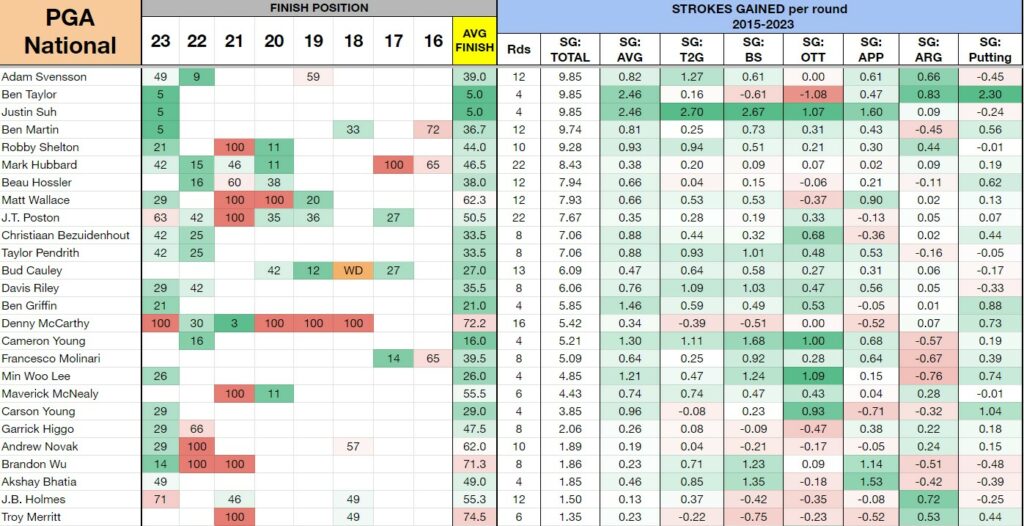
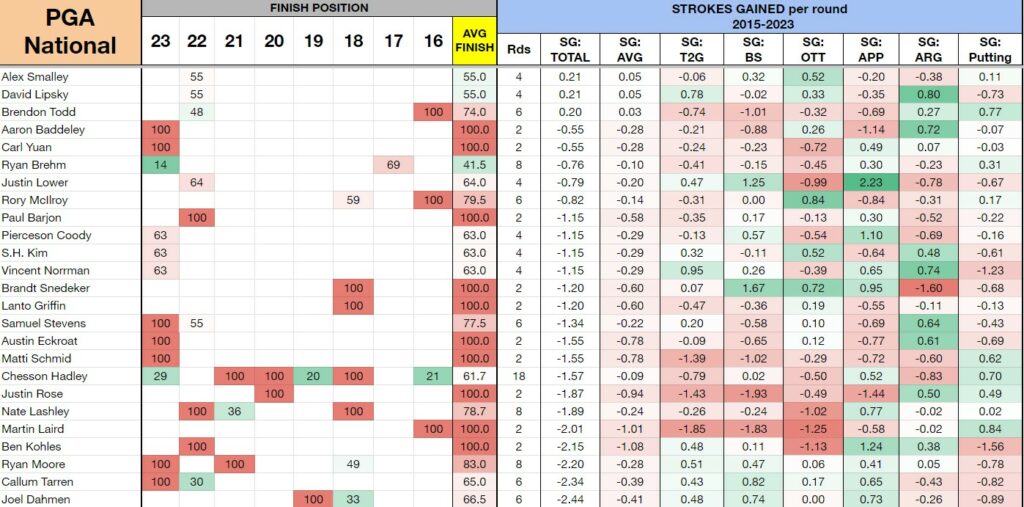
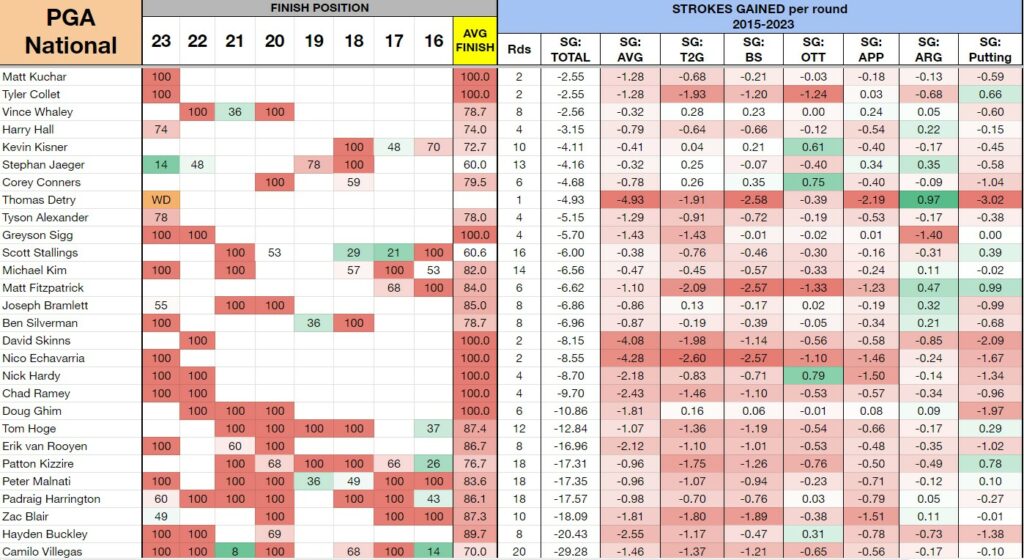
Course Features
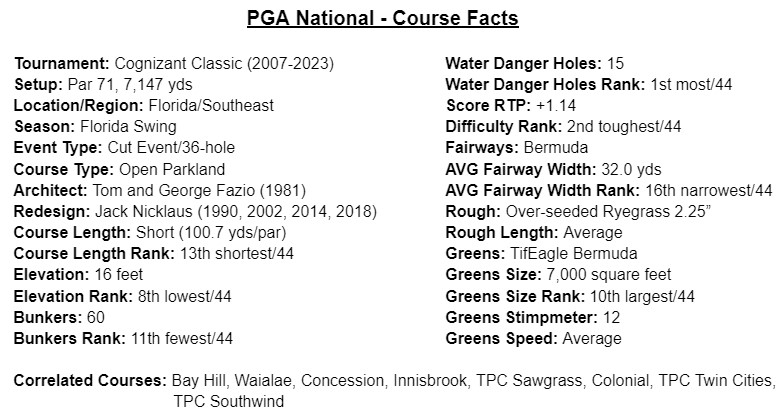
Just a few miles off Florida’s Atlantic coast, halfway between Jupiter and West Palm Beach sits the Champion course at PGA National. While the length seems short by average Tour standards at just 7,147 yards, it plays much longer with eight par-4s measuring longer than 420 yards. With only three par-5s to score on, there are only four total holes with a scoring average under par.
Playing similar to a major championship, the winning score has been 10-under or less in eight of the last 11 years. According to Keegan Bradley, “It’s kind of like the U.S. Open, where you’ve got to hit a lot of fairways and greens and make those 10-footers for par. I just like the style of golf course, where you know that 10-under or less is going to win. So you know you’re always one round away from being in contention.”
PGA National is a standard “Florida” track. It is one of the flattest courses on Tour with unimaginative architecture. With this in mind, (similar to The Concession Golf Club), Jack Nicklaus decided to add drama to the course in the form of water hazards everywhere. Each part of a player’s tee-to-green game will be tested. Trouble is lurking everywhere as strategic bunkers along with 26 actual water hazards on 15 different holes litter the property. Eight holes require approach shots to cross a water hazard making accurate iron play paramount. Over the past five years, the field has averaged 2.42 double bogeys or worse per 72 holes which ranks as the most from any course on Tour.
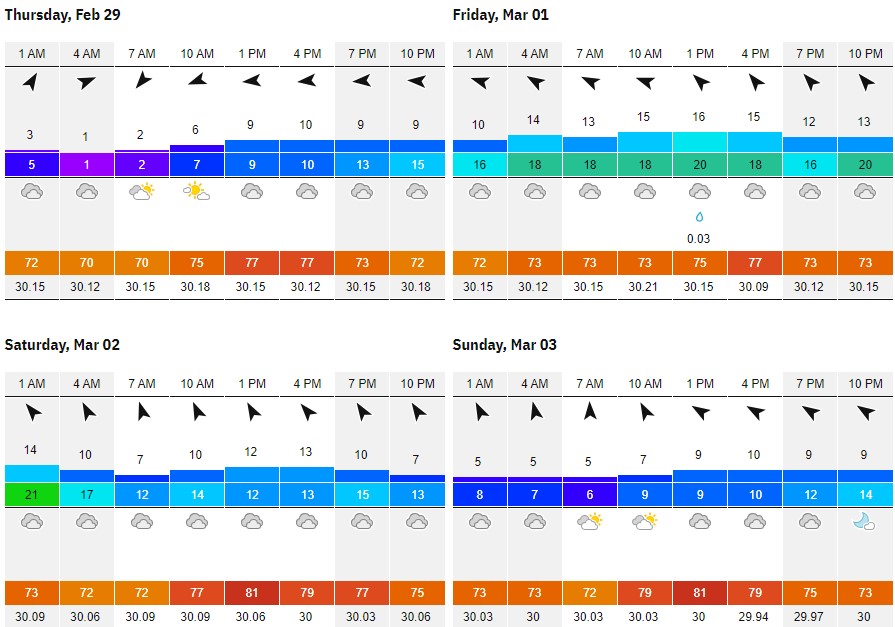
Another factor that makes PGA National one of the toughest courses on Tour is the prevalence of gusty winds. There are typically at least one or two rounds every year at this event where winds will kick up over 20 mph. Not only does the wind play havoc on ball flights but it also dries out the greens making approach shots even more difficult to hold on the putting surface. When you combine the potential windy conditions with all the water hazards, you have a recipe for scorecards to look like trainwrecks.
It is these coastal breezes that allow for many of the holes that face directly into the wind to play even longer. The 550-yard par 5 18th hole is a perfect example of this. It plays at a yardage that should be easily reachable in two shots except when the prevailing winds are blowing, which happens more often than not. As Tommy Fleetwood said a couple of years ago, “The wind is a massive factor all the way around the golf course. I feel like there are so many cross-winds that bring misses off the tee, into the greens, cross-winds affect the putts, and it’s just an all-around very, very difficult test, and it tests everyone. It tests every part of your game.”
Along with the breezy conditions and water hazards, part of the switch to Florida golf is the return of actual Bermuda grass. While the rough is still mostly overseeded rye due to the cooler conditions so far this year, fairways and greens are Bermuda. The rough has been shortened this year to 2.25″, down from 2.5″ in past years. With much of the Bermuda still dormant, I wouldn’t expect the rough to cause much of an issue this week. Greens are large at an average of 7,000 square feet and run around 12 on the stimp-meter.
Hole Preview
PGA National has the toughest set of par 3s on Tour. Collectively, they average 0.19 strokes over par. Two are longer than 215 yards and three of them have water in play. As you can imagine on a course that plays so difficult, the par 4s are no walk in the park either. They rank as the 8th toughest group on Tour with only the two holes below 400 yards, the 1st and 15th playing under par. With only three par 5s to score on, players must take advantage of both. The two consistent par 5s are the two easiest holes on the course averaging a combined 39% birdie or better rate. Expect the newly-crowned par 5 10th hole to play as the easiest hole on the course, emphasizing par 5 scoring much more than in past years.
While almost every hole at PGA National is a challenge, the “Bear Trap”, holes 15-17 get most of the notoriety and are among the most arduous three-hole stretches of golf on the PGA Tour. In all reality, the 14th and 18th holes could easily be added to this tough closing section. 89% of golfers that have played PGA National have a career scoring average over par on the “Bear Trap”, and two years ago every single player in the field had at least one bogey on these holes.
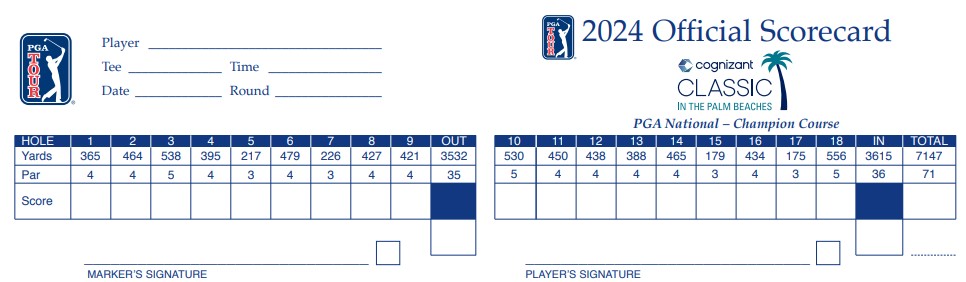
Along with the water in play, each of the “Bear Trap” holes is played straight into the prevailing ENE wind. It begins with the 179-yard par 3 15th hole that typically has the pin located on the back right of the green. Golfers face bunkers to the left of the green and water to the right. With an average birdie rate of only 11%, it is one of the most difficult par 3s on Tour.
The 16th hole is a 434-yard par 4 with a bogey or worse rate of 24%. With a dogleg to the right, the entire right side of the fairway is lined with water. Making matters worse, the fairway landing zones slope toward the water. Hitting your ball to the left side of the fairway causes your approach shot to travel directly over the hazard.
The par 3, 175-yard 17th hole has annually been the toughest on the course. With an average bogey or worse rate of 27%, golfers once again have to deal with bunkers on the left and water on the right.
Course redesigner Jack Nicklaus said it best regarding the “Bear Trap” when he said, “It should all be won or lost here. It’s not about length, it’s about precision. It’s about guts. It’s all about what do you have in your chest that you can finish those holes.”
Strokes Gained Analysis
Off the Tee
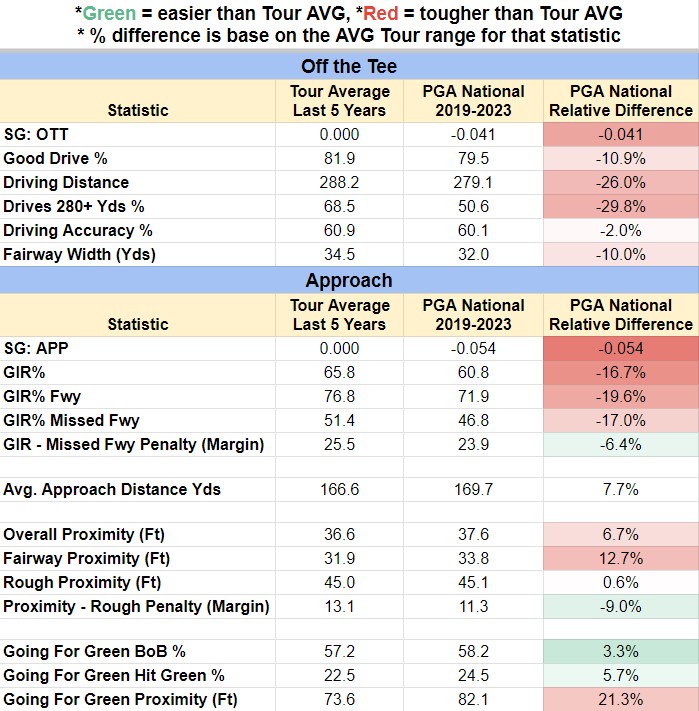
With narrow fairways, 11 out of 14 drives with water danger, and potential moderate winds, players at the Honda Classic will have their hands full off the tee. Even with fairways being slightly widened this year, strategy off the tee remains key. Since danger areas dictate where you can hit the ball, golfers need to play positionally on many occasions, which makes the course play longer than it’s measured.
While added distance and accuracy are beneficial, they are not necessary for success. The rough is not as penal, meaning golfers just need to keep the ball in play and away from the water hazards and fairway bunkers. With fairways pinched by numerous bunkers along with lakes and ponds everywhere, that is easier said than done. PGA National has had more “water balls” off the tee the past three years than any other course on Tour.
The numerous doglegs and water hazards force players to hit less than driver off the tee. This leads to one of the shortest average driving distances at only 277.8 yards. Even with players clubbing down, driving accuracy is only average at 60.3%. This combination of low distance and average accuracy results in PGA National being the fourth toughest course to gain strokes off the tee.
It’s a confusing course to figure out in this regard because so many past winners have missed plenty of fairways the week they won. For example, Keith Mitchell, Justin Thomas, Padraig Harrington, and Rory McIlroy each finished worse than 35th in driving accuracy for the week. On the other hand, almost every golfer going back to 2016 with the exception of Sungjae Im has finished in the top 15 in the field in driving distance for the week. The data shows that longer players off the tee have an edge, but the bottom line is that you simply want golfers to be able to avoid disaster and give themselves the best approach opportunity with their second shot.
We will finish this section with a couple of relevant quotes about the importance of off-the-tee this week.
Justin Thomas: If you’re driving it well, you can play this course well and make a lot of pars and sprinkle in some birdies and you’re going to beat a lot of the field. You can grind it out at around par if you’re not driving it great, but if you’re driving it bad, it’s a tough place to play well. It’s very difficult. This course presents such a challenge in itself with just the amount of hazards out there.
Ricke Fowler: I love that it’s a ball-strikers golf course. You’ve got to drive the ball well to give yourself an opportunity to get a ball close on the greens. Yeah, putting can save you, but you’ve got to be solid tee-to-green here. You can’t really overpower it too much. There’s a lot of holes where you’re hitting less than driver off the tee.
Approach
Because so many holes require “less than driver” it becomes a true second shot course on many of the par 4 holes. The GIR rate at PGA National is only 59%, which makes it the sixth-toughest “GIR” course in the Tour’s annual rotation. As for actually gaining strokes on approach, PGA National was the toughest course on Tour in that respect last season. Along with wind and water, another reason approach play is so difficult here is because of greens that are typically very firm. Between the middle of December through January, over nine inches of rain fell in the area making it interesting to see if the greens play any softer this year.
About 65% of all approach shots come between 125 and 200 yards. With so many high-pressure mid-to-long iron approach shots over water, GIR % is actually a stat that matters this week. As Keith Mitchell said after his win in 2019, “I know a couple of holes out here you don’t even look at a flag. You just hit it in a certain spot on the green, and it doesn’t matter where the flag is, you’ll be all right.”
Wedge play is very minimal here with only 13% of approaches from that range. With birdies few and far between, players can actually par their way into contention by simply hitting the green and getting up and down. Proximity to the hole on these large greens, especially in windy conditions, can be its own challenge. Jhonattan Vegas spoke about how important it is to be patient on approach. “To be honest, it’s very hard to be aggressive around here, even with some of these pins. There’s always trouble around the corner that you – even if you’re hitting it great, it’s really hard to start hitting at some of those pins. Sometimes hitting it to 25 feet, 30 feet, it’s a good shot, and you have to use your best judgment and go from there.”
Around the Greens and Putting
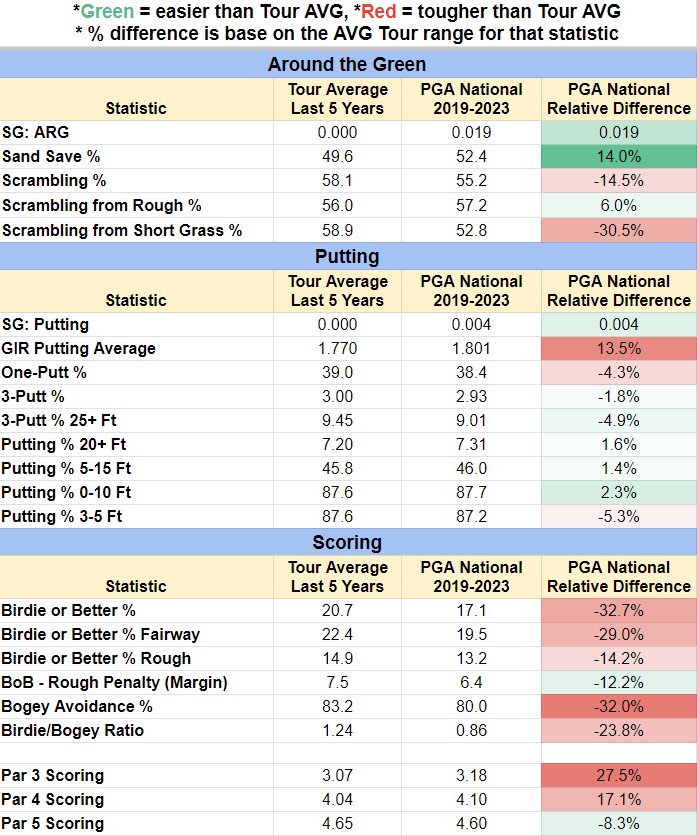
With golfers missing greens over 40% of the time, scrambling performance will play a huge factor in the results on the leaderboard this week. Whether it’s getting up and down for par from around the greens or on a penalty drop after hitting an approach into the water, players who can avoid bogeys and grind out pars will be best able to survive PGA National. While scrambling from the bunkers and rough is easier than average, getting up and down from some of the short-grass runoff areas is 6% tougher than normal.
Overall, the data shows that putting at PGA National is as close to average as possible. The greens are some of the largest on Tour so three-putt avoidance comes into play. While the contours and undulations of the greens are on the flatter side, it is the grainy Bermuda texture that will most affect the putting of those who struggle on these types of greens. With so many more shots taken from around these greens, most players will be able to chip the ball to within 15 feet of the hole. This will leave many more close putts than is typical and will increase the value of those golfers who are most consistent from that range.
Most Important Stats For Success at PGA National
*In order of importance
- SG: APP
- Bogey/Double Bogey Avoidance
- Scrambling
- SG: Tough Scoring Courses
- Par 4 Scoring
- Course History PGA National/comp courses
- Proximity 125-200 yds
- SG: Putting (Bermuda)
- SG: OTT
- 3-Putt Avoidance