
The PGA Tour returns to the mainland as players head to the Coachella Valley desert in La Quinta, California, for The American Express at PGA West. This tournament is unique for several reasons. It is played as a Pro-Am, with each professional paired alongside an amateur for the first three rounds. Additionally, the event utilizes three different courses rather than the traditional single-course setup. Another departure from the norm is the cut, which takes place after 54 holes on Saturday instead of the usual 36-hole cut on Friday. Only the top 65 players and ties will advance to Sunday’s final round on the Stadium Course. Alongside the Pete Dye Stadium Course, the Nicklaus Tournament Course and La Quinta Country Club round out this week’s rotation. The latter two have ranked as the two easiest courses on the PGA Tour over the past five years, making extremely low scores the expectation. Players will compete on each of those courses just once during the week. After more than 50 years of various course changes, the current rotation has remained intact since 2016, with the lone exception coming in 2021 when La Quinta Country Club was not used.
Each course in the rotation shares many of the same characteristics. With typically calm winds and clear desert skies, this event is often described as “dome golf,” creating some of the easiest scoring conditions players will face all season. All three layouts feature four scoreable par 5s and measure under 7,200 yards. They also share similar agronomy, with smooth Poa trivialis greens and ryegrass fairways bordered by a non-penal first cut of overseeded rye rough, followed by a layer of dormant Bermuda rough beyond that.
The Stadium Course is the most demanding of the three layouts and will host two of the four rounds, including Sunday’s final round. Designed by Pete Dye, it features a challenging set of par 3s, numerous visually intimidating bunkers, and water hazards in play on seven holes. The course also underwent a significant restoration of its greens and bunkers between the 2024 and 2025 seasons, a renovation that contributed to tougher scoring last year, as it played to an average of 0.65 strokes under par per round.
Despite the Stadium Course’s added bite, winning scores at The American Express typically approach the 25-under-par range. All three venues are resort-style courses with pin placements intentionally set on the easier side to accommodate amateur partners from Thursday through Saturday. As a result, this event tends to favor a wide range of player profiles, with success often coming down to a pure putting contest—rewarding those with the hottest flat stick.
The Field

With the loss of the Sentry, the year’s first signature event, this year’s American Express is welcoming one of its strongest fields in recent memory. World No. 1 Scottie Scheffler will make his season debut this week. He last played here two years ago and finished a pedestrian 17th, while amateur Nick Dunlap claimed a stunning victory.
In addition to Scheffler, 11 0ther top-25 players are in the field including Russell Henley, Robert MacIntyre, Ben Griffin, Justin Rose, Harris English, Alex Noren, Ludvig Aberg, Matt Fitzpatrick, Sam Burns, Patrick Cantlay, and defending champion Sepp Straka.
Other notables in the field include Max Homa, Rickie Fowler, Adam Scott, Akshay Bhatia, Wyndham Clark, Kurt Kitayama, Min Woo Lee, Andrew Novak, and Will Zalatoris. Thanks to the multiple-course format, a full field of 156 players will tee it up in the desert, making this week a valuable opportunity for those not fully exempt to improve their status and potentially earn a spot in the next signature event at Pebble Beach.

Pete Dye Stadium – Course History
The Stadium Course at PGA West was designed by Pete Dye in 1986 and was created as a sequel to the TPC at Sawgrass. It was inspired by the Scottish links-style courses even though it shares relatively few characteristics with links courses.
Dye was given simple instructions when tasked when building the Stadium Course. “Build the hardest damn golf course in the world,” developers Ernie Vossler and Joe Walser told him. Dye indeed was up to the task as when it opened, its course rating of 77.1 was the highest ever given by the United States Golf Association.
Famous for its dramatic features, including railroad ties, penal hazards, cavernous bunkers, and long forced carries over water, the course is not for the faint-hearted. As Dye wrote in his autobiography, “Length alone would not be the ultimate test for the new course, but I believed strategic hazards, deep bunkers, difficult angles across fairways, slightly offset greens, parallel lakes, and desert plants, when combined with cross-current winds, could provide the type, of course, Joe and Ernie expected.”
When it opened, it was one of the first venues for the popular “Skins” game which was a televised 4-ball match where some of the best players competed against each other in 4-ball matches.
In 1987 the course made its PGA debut by hosting the annual Bob Hope Classic. In what had typically been an easy course setup, players were shocked to see an actual challenge in front of them. Players vociferously voiced their opinions on the course. Raymond Floyd called it “spiteful” and “hateful.” Tom Watson said he was “sick and tired” of Dye’s radical designs. “It requires you to execute shots that no sane golfer should be expected to play,” Watson added. Al Geiberger said that the Stadium Course was like “working through the stages of grief”.
Dye responded, “The professionals forget that the whole idea of a Pete Dye golf course is to require players to hit a wide variety of shots. I’ve always felt that a good player who’s playing well wants to play a difficult golf course because he knows the winner won’t be someone who can just out-putt him.” Dye wanted to truly challenge the best players in the world and give them a chance to display their amazing skills. As he once said about his style, “We’re just giving them the opportunities to hit great golf shots.”
The PGA Tour professionals were so adamant about how unfair the course was that they united together and signed a petition to get it removed as one of the host courses. Believe it or not, they were successful as the course was banned from Tour play until it returned to the rotation in 2016.
In the summer of 2022, the course underwent extensive renovations in which the greens were re-grassed to TifEagle Bermuda and changed back to their original sizes and contouring which had been lost over the years. Also, more than 200 trees from the interior of the course were removed, possibly changing some of the lines that golfers with previous history on the course are used to playing.
Last year, the course featured new greens. The idea was simply to return the green complexes at the Stadium Course to the original plans by famed architect Dye in 1986. To make the changes, PGA West used Tim Liddy, an architect who worked closely with Dye in the 1980s when Dye was shocking the golf world with stadium-style courses featuring deep elongated bunkers, sloping greens, and plenty of water.
The primary changes involved restoring the greens to their original, larger dimensions, averaging roughly 7,000 square feet, up from 5,000. This restoration allowed for new pin placements and replaced the concave bunker shapes that had developed over four decades with flat-bottomed bunkers surrounding the greens. Although most of the Stadium Course’s putting surfaces had four to five inches of built-up organic material removed, architect Tim Liddy preserved the original slopes and swales.
After averaging -2.07 strokes per round from 2021-2024, the Stadium Course played to just -0.65 last year. Firm putting surfaces are expected again this year, making it difficult to hit approaches close and ensuring the course will provide a distinct challenge.
Finish Position and Strokes Gained History at PGA West (2016-2025)
This includes the average finish position and Strokes Gained per round since 2016. Players are sorted by SG: Total.
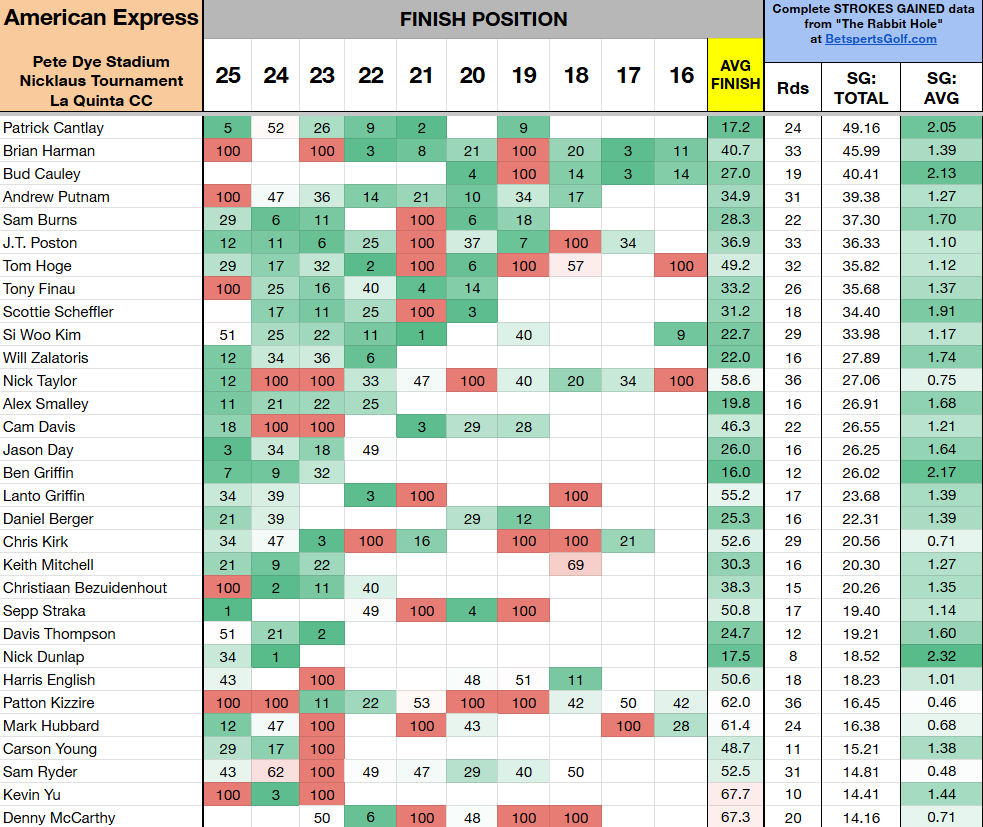
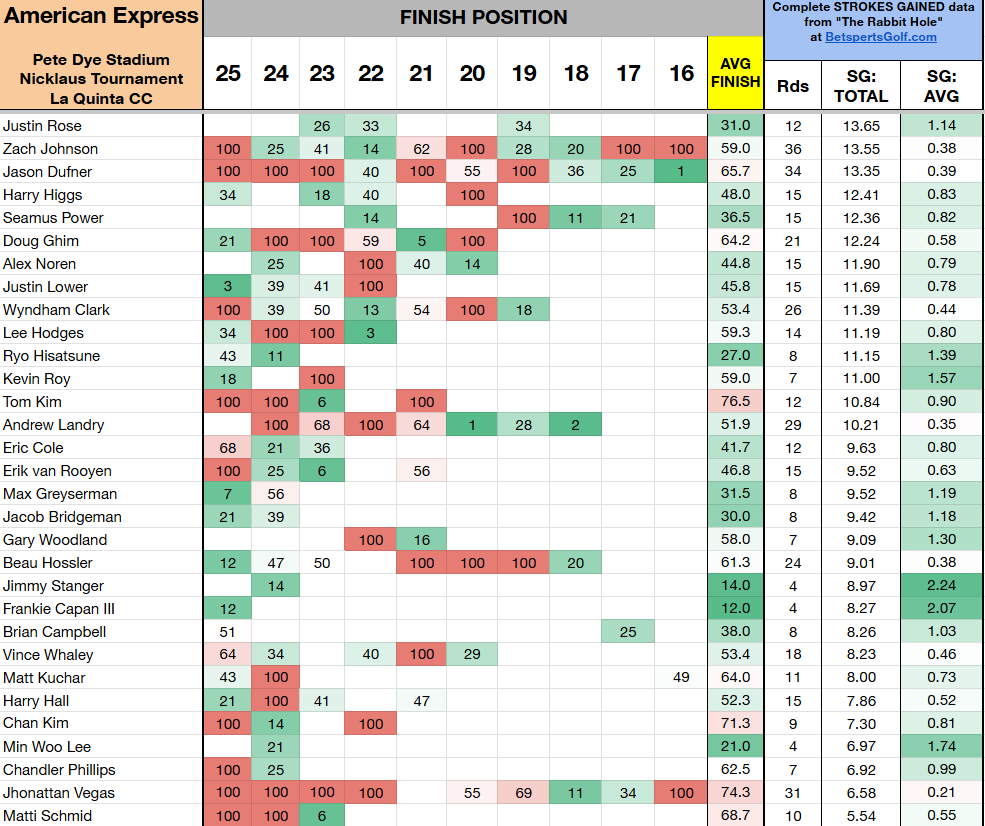
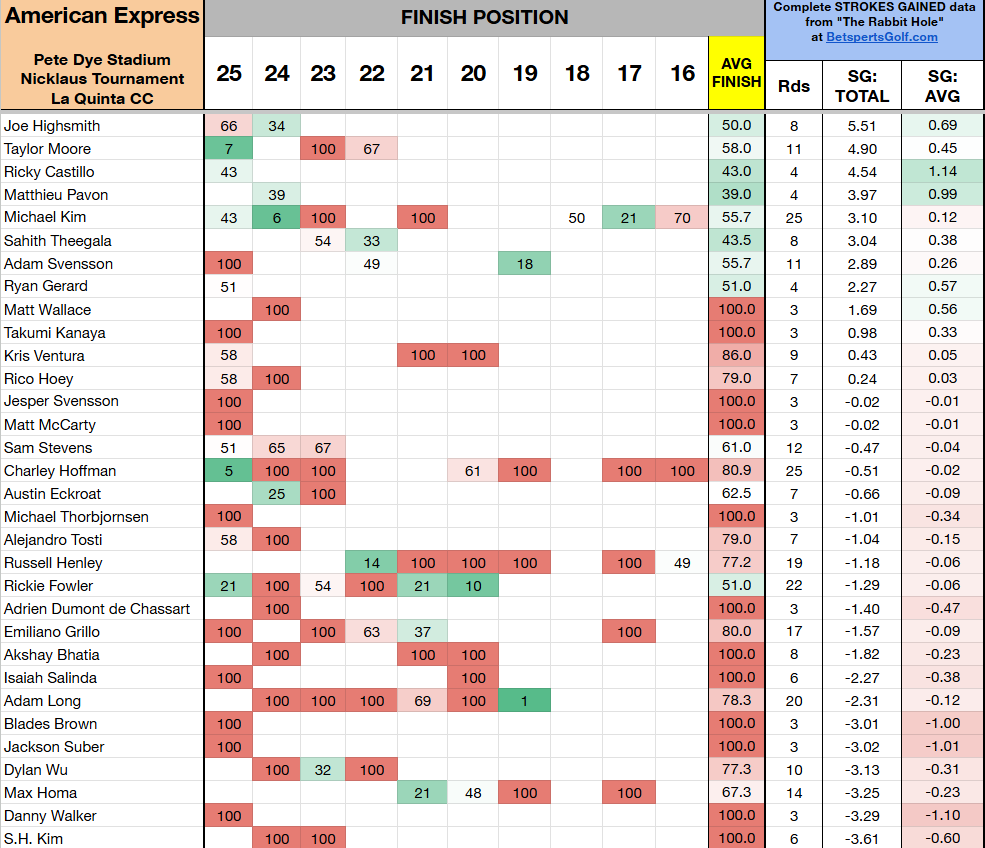
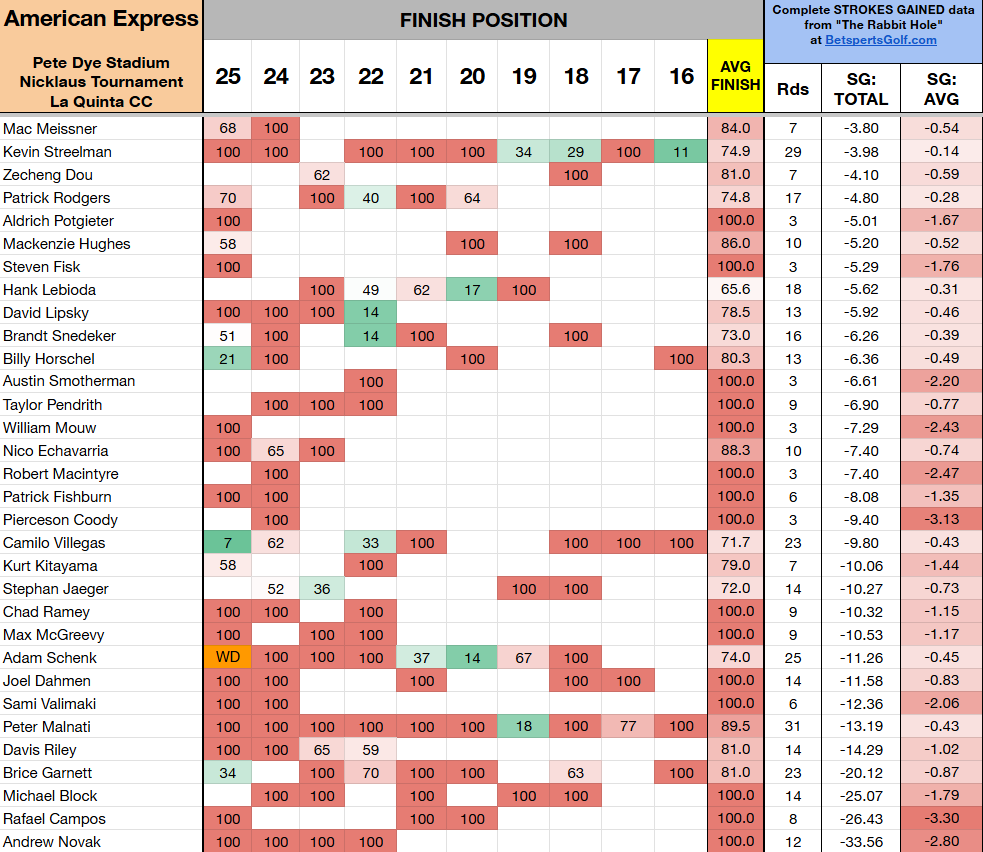
Pete Dye Stadium Course
*With two of the three guaranteed rounds (at La Quinta CC and the Nicklaus Tournament Course) not using ShotLink/Strokes Gained data, a majority of the data analysis will be from the Stadium Course. There will also not be any stat correlations for this event since the SG data is incomplete.
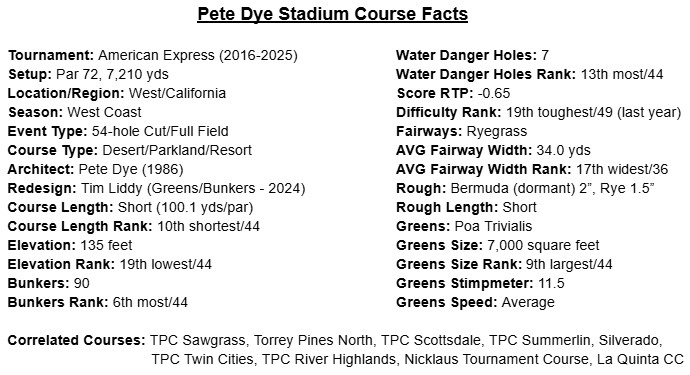
Designed in 1986 by legendary architect Pete Dye, the Stadium Course is the toughest of the three layouts and will be played twice this week. Modeled after TPC Sawgrass, it features seven holes with water directly in play, including its own par-3 17th-hole island green. It is a true risk-reward course, capable of producing plenty of birdies but also the occasional blow-up round.
The course is known for Dye’s memorable finishing stretch of holes, numbers 16-18. He called these final three holes “maybe the most difficult finishing holes I’ve ever built.” Included is the infamous “San Andreas” hole (#16) which has a greenside bunker over 20 feet deep that runs at least 50 yards up the left side of the green.
At only 7,210 yards, the Stadium Course is the 10th shortest on Tour. Two of the par-5s stretch out beyond 590 yards, but other than that, Tour players have the length to overpower the forced carries as well as many of the shorter holes on the course such as the four par-4s that are each less than 390 yards.
Success on the Stadium Course often comes from bombing it off the tee, but err even slightly, and water and sand are waiting everywhere. Since 2015, it has ranked ninth in penalties off the tee among all Tour courses. Fairway accuracy sits at just 63%, only slightly above the Tour average, while driver usage was below average at 67% last year. Players will need to exercise caution on many holes, laying back off the tee to avoid trouble.
In addition to the challenging bunkers around its small greens and select fairways, the Stadium Course’s par 5s serve as another key area of defense. Players attempting to go for the green in two often find trouble if they aren’t long off the tee or precise with their approach. While distance is an advantage, success ultimately comes down to smart decision-making and course management. 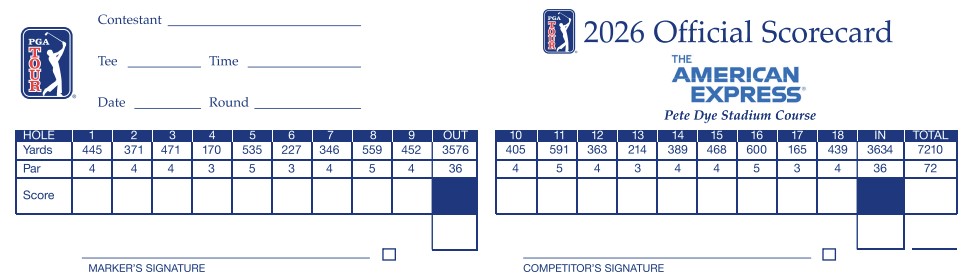
Most of the par 4s here are “less-than-driver” holes due to tight fairways and the strategically placed bunkers. Strong wedge play from 125 yards and closer is paramount for those who take a more aggressive approach off the tee. Almost half of all approaches come from the 125-200 yard range.
The remodeling of the greens had a major impact last year, increasing their size from the fifth smallest on Tour to the 10th largest at 7,000 square feet. Many of the greens are elevated, and the firmness of the new surfaces punishes approaches that are not struck to the correct distance or line.
Another often-overlooked challenge at the Stadium Course, as well as the Nicklaus and La Quinta courses, is the difficulty of the par 3s. Of the 12 toughest holes players will face this week, nine are par 3s, with an average scoring of 3.10.
While sand saves rates around the green are among the toughest on Tour, scrambling from the almost non-existent rough is the easiest. One important note about the grasses at all three courses is that the Bermuda grass lies dormant this time of year. Fairways and rough are over seeded ryegrass and the greens are over seeded with Poa trivialis. As eight-year PGA Tour caddie, Brian Mull commented, “It’s nothing like Poa annua. They’re like perfect greens, pure carpet…can be a little sticky, not fast, and with minimal grain. Anybody can putt well on them.”
Nicklaus Tournament Course
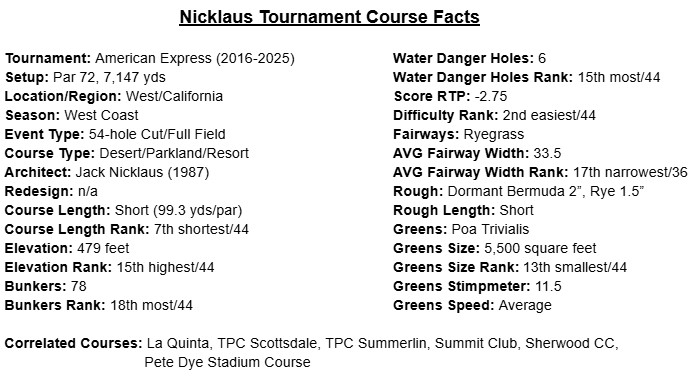
Designed by legendary golfer, Jack Nicklaus, and opened in 1986, the Nicklaus Tournament Course at PGA West joined the rotation for The American Express in 2016. Golfers will play this course just once this week. In 2021, it played the most difficult it ever has at -1.05 per round after they installed new Bermuda grass and expanded the greens back to their original shapes and sizes. But over the last three years it has actually scored easier than La Quinta CC at -3.65 per round.
Minimal strategy is required as it weaves its way through the retirement community homes. Most of the danger off the tee and on approach is very avoidable thanks to the huge fairways and the ability of most Tour professionals to hit over or around any of the six water hazards. The elevated greens do require accurate approach shots. The biggest challenge is “around the green” play thanks to the deep bunkers that will test players’ sand skills. Great iron play and short-game are the important components to success at the Nicklaus Tournament Course.
Three of the four par 5s sit under 550 yards so you can expect birdies and eagle shots to fly off the shelves here. Each of them offers risk/reward opportunities and measures at less than 570 yards, meaning plenty of scoring chances will be the norm. The signature hole is the par-5 15th which has an island green that is guarded by both the surrounding water hazard and two large bunkers.
With many shorter par 4s, positive short-iron and wedge play is vital for setting up shorter birdie putts on these massive greens. Not a single par 4 measures over 465 yards. The huge, undulating double-green that serves the 9th and 18th holes is a well-known feature on the course and is guarded by more deep bunkers. The 18th is also a very underrated finishing hole with water running down the entire right side and affecting a player’s decision-making both off the tee and on approach. It’s not easy either averaging 4.11 strokes with a 19% bogey-or-worse rate.
The par 3s rank as four of the seven toughest holes on this layout. The 172-yard 8th is a hole with an island green and is the toughest on the course averaging 3.15 strokes along with a bogey-or-worse rate of 21%. The 17th also plays over par and features a green with a false front with bunkers guarding it on both sides.
La Quinta County Club
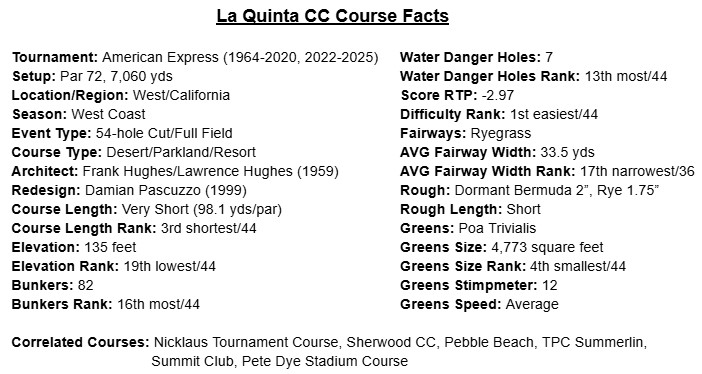
La Quinta is the oldest course used in The American Express rotation and will also be played just once this week. It’s a classical layout that opened in 1959 and was designed by Lawrence Hughes. Even with a renovation in 1999, it plays much the same it did when it first opened 67 years ago.
Since 2021, it has been the easiest course on Tour, averaging -2.97 per round. It sports narrow fairways, non-penal rough, reachable par-5s, and what Phil Mickelson described as, “the best greens on Tour.” This ultimately leads to a putting contest on these greens. Numerous players have gone low here over the years, including Adam Hadwin‘s 59 back in 2017.
There are no tricks or subtleties at La Quinta; the course is straightforward, with everything in front of the player. With virtually nothing to challenge golfers, La Quinta is a place where failing to shoot multiple strokes under par means losing serious ground to the field. Its fourth-smallest greens, measuring just 4,773 square feet, make strong iron play a key differentiator for players looking to separate themselves.
Like the Nicklaus Tournament Course, La Quinta’s four par 3s rank among the nine toughest holes on the layout. Its par 4s, by contrast, offer almost no length or difficulty: none exceed 470 yards, and only three measure more than 425. At 7,060 yards and a par 72, it is the sixth-shortest course on Tour—easily overpowered by the modern PGA player.
Most Important Stats For Success at PGA West
*In order of importance
- Course Region: West
- Scoring Conditions: Very Easy/Easy
- Course Length: Short/Very Short
- Course Type: Desert
- Architect: Pete Dye
- Field Size: Full Field
- Event Season: West Coast
- Greens Surface: Poa Trivialis
- Rough Length: Short
- Missed Fairway Penalty: Low
- GIR Accuracy: Easy
- Gain Approach: Very Easy
- Gain Putting: Very Easy
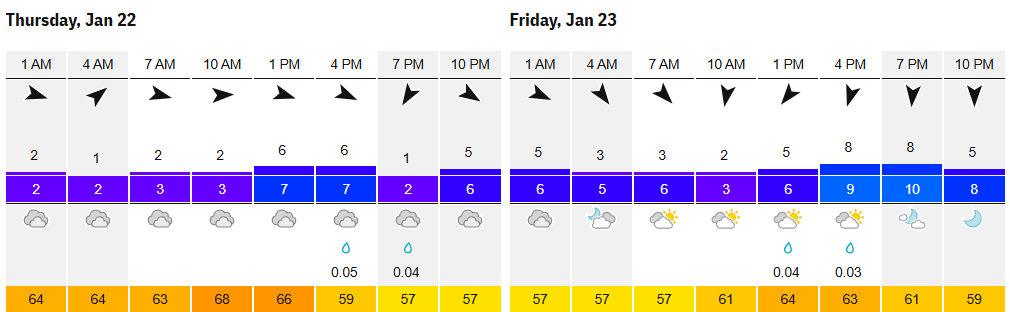
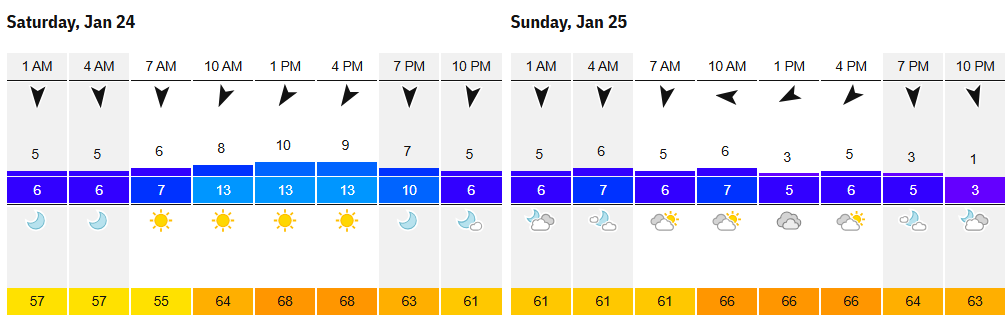
Weather Forecast – La Quinta, CA
- Birdie or Better %
- SG: APP
- Par 5 Scoring
- SG: Putting
- Par 3 Birdie or Better %
- Proximity 125-200 yds
- SG: Easy Scoring courses
- SG: Short courses
- SG: Putting 5-15 ft
- Bogey Avoidance (easy scoring courses)
Unique Rabbit Hole Filters
- Course Region: West
- Scoring Conditions: Very Easy/Easy
- Course Length: Short/Very Short
- Course Type: Desert
- Architect: Pete Dye
- Field Size: Full Field
- Event Season: West Coast
- Greens Surface: Poa Trivialis
- Rough Length: Short
- Missed Fairway Penalty: Low
- GIR Accuracy: Easy
- Gain Approach: Very Easy
- Gain Putting: Very Easy
Weather Forecast – La Quinta, CA