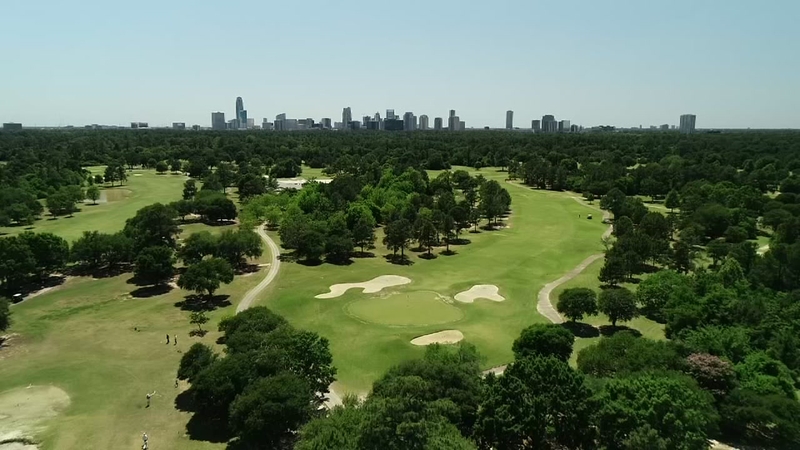
With the Florida Swing concluded, and only two weeks before the Masters, the PGA Tour heads west to Memorial Park Golf Course and the Houston Open. One of the country’s best public, municipal courses, Memorial Park is a long par 70 that measures 7,475 yards and can trace its origins back to 1912. The course features five par 3s and three par 5s. There are only 21 bunkers on the entire course and only four water danger holes. The defense of the course is the unique green complexes that feature plenty of undulations and short-grass runoffs with false fronts. “Nothing is hidden, it’s all out in front of you. But these green complexes can be treacherous if they don’t hit their target,” said course superintendent, Parker Henry.
Playing two-thirds of a stroke over par after its first four editions, Memorial Park emphasizes the importance of a well-rounded game. Due to the tournament moving from its fall slot (where it was held from 2020-2022) to the spring for last year’s event, the agronomy change has allowed the course to play less challenging. What was once a wall-to-wall bermudagrass course is now overseeded with Poa trivialis on the greens, with the biggest change – switching from penal 2.5″ Bermuda rough to the much easier and shorter 1.25″ ryegrass overseed. What was once one of the toughest non-major tee-to-green courses on Tour became less so thanks to this switch in turf necessitated by the tournament’s seasonal change. Players can take more aggressive shots coming out of the rough than in years past without having to worry about “fliers” or bad lies from the unpredictable Bermuda turf.
According to the data, and also the type of golfer that signs up to play here annually, this is one of the clearest “bomber” courses on the PGA Tour. Whether it’s past winners (Stephan Jaeger, Tony Finau, Carlos Ortiz), contenders (Scottie Scheffler, Dustin Johnson, Thomas Detry, Alejandro Tosti), or golfers who have played here all four previous tournaments (Taylor Pendrith, Wyndham Clark, Jason Day, Keith Mitchell, Luke List), players who crush the ball off the tee typically have a sizeable advantage at the second longest course on Tour.
The Field

Headlining the 144-player field are nine of the top-30 ranked players in the world led by No. 1 Scottie Scheffler and No. 2 Rory McIlroy. Other notables include Wyndham Clark, Houston resident Sahith Theegala, Tony Finau, Sungjae Im and Jason Day. Stephan Jaeger also returns to defend his 2024 title. McIlroy, who is currently the hottest player in the world, will be getting in his Augusta National prep this week as he makes his course debut. With two runner-up finishes in the last three years, Scheffler returns to Memorial Park looking for his first Houston Open victory.
There is also a decent mid-tier group of golfers in attendance this week including Si Woo Kim, Maverick McNealy, Aaron Rai, J.J. Spaun, Thomas Detry, and Taylor Pendrith. The first two Houston Open champions at Memorial Park, Carlos Ortiz and Jason Kokrak will again be absent this week as each is on the LIV Tour. There is a 36-hole cut on Friday with the top-65 and ties making it through to the weekend to compete for the $9.5 million purse.
Memorial Park Golf Course – History
Memorial Park Golf Course had its official beginning in 1912 when a rudimentary 9-hole course with sand greens was laid out and intended for soldiers who were staying nearby at Camp Logan. In 1935, architect John Bredemus redesigned the course and added a second nine. The course hosted the Houston Open 14 times from 1947-1965 before the event moved to different state courses in both Humble and The Woodlands.
In 2017, after Shell did not renew its deal after 25 years of sponsoring the Houston Open, Astros owner Jim Crane began planning to have the event return to the city of Houston. While Memorial Park underwent a complete restoration in 1994, it was still not suitable enough for PGA Tour standards. So fast forward to 2019 when Crane hired famed course designer Tom Doak to dramatically change the course with the goal of keeping it playable for the average golfer, and yet making it a more demanding challenge for Tour professionals.
Though the routing remained unchanged, the course was transformed in numerous ways. The course has a much more wide-open look thanks to the elimination of underbrush and many of the overhanging trees in certain areas. The ravine that runs through the front nine was incorporated into more holes. Eight of the original greens were moved and certain other holes were altered in different ways. Tour player, Brooks Koepka was brought on as a consultant to Doak’s team. His contributions included getting rid of half of the bunkers, incorporating more short grass around the greens, and creating additional water hazards on the closing stretch of holes.
Along with the aforementioned agronomic changes, there is one major hole change for this year’s event. The green on the 17th hole was moved 30 yards farther back along the water, creating a landing pad to where the old green was, in an effort for the players to attempt to carry the ball over the water. That should create some excitement on the hole by adding pressure down the stretch. Two bunkers were also added to the left of the green.
There have been small tweaks to a couple of par 3s. On the 9th hole, the green surface was brought in closer to the right-hand side of the front along the water to allow for a well-struck shot to remain on the green instead of rolling off into the water. The same was done on the left side of the 15th green.
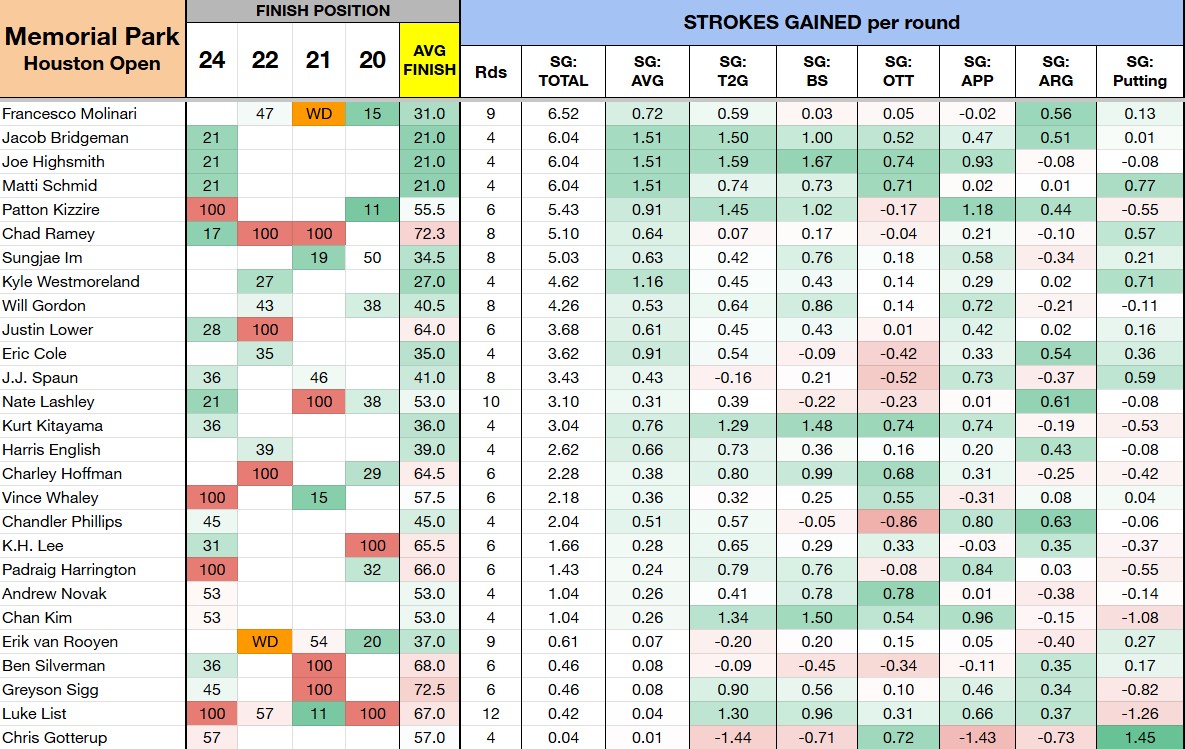
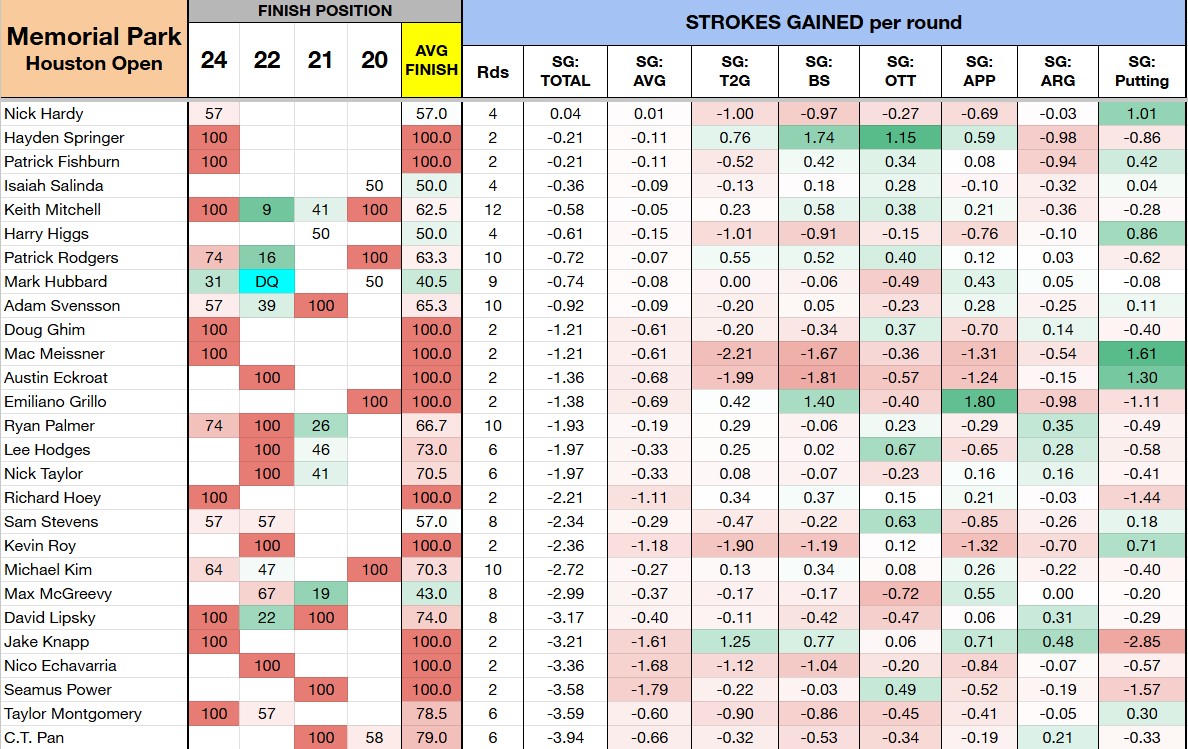
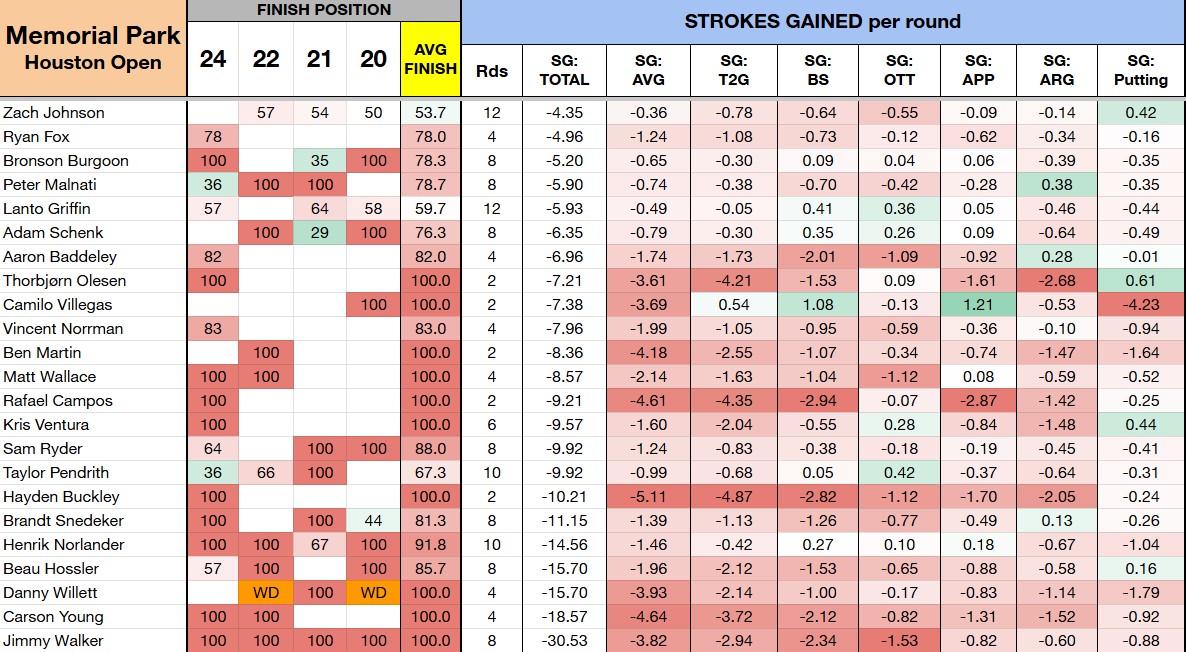
Finish Position and Strokes Gained History at Memorial Park (2020-2024)
This includes the average finish position and Strokes Gained per round since 2020 for each of the categories. Players are sorted by SG: Total. Memorial Park is the 13th-least (out of 44) predictive annual course on Tour. f684b2f3d4218ee06dad551b3bb2074b 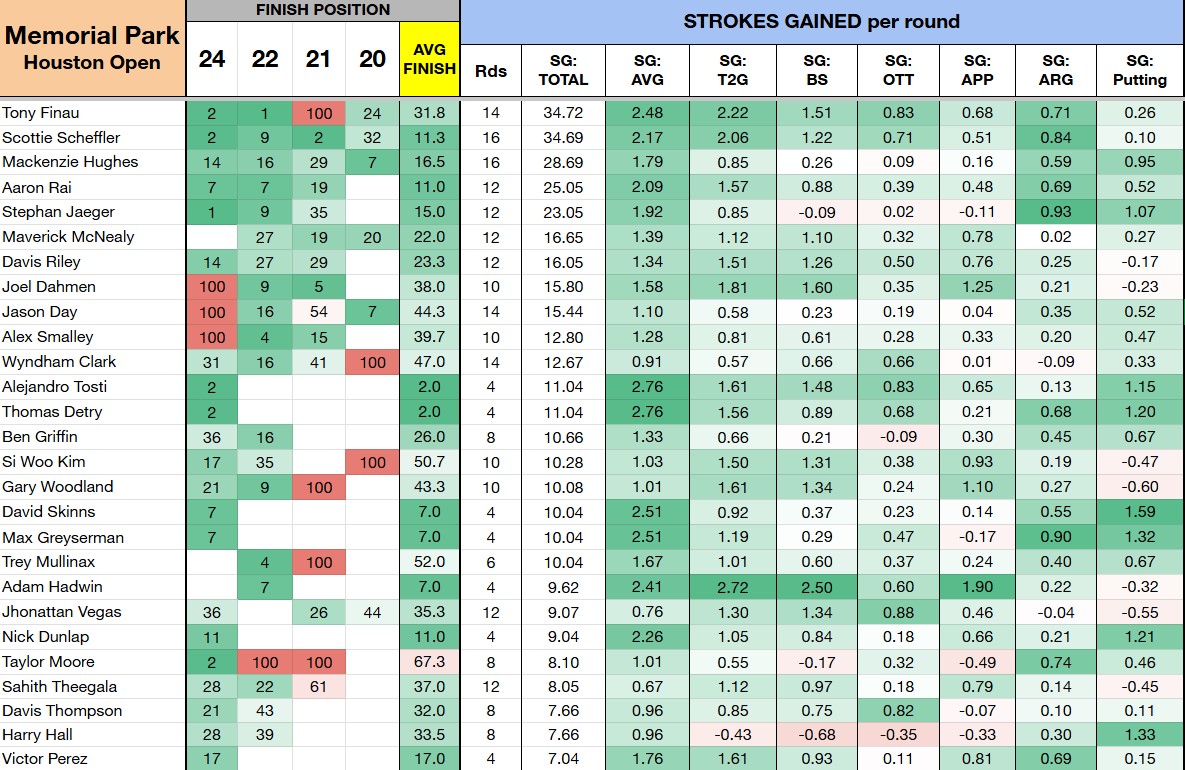
Course Features
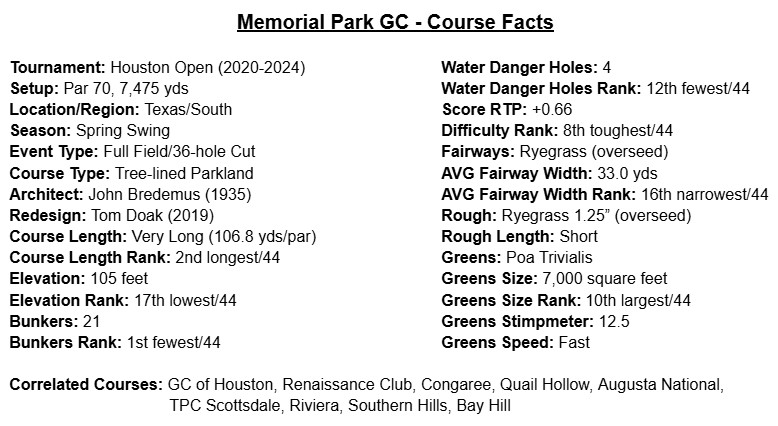
Memorial Park Golf Course is a long Par 70 that measures 7,475 yards. Not only is it the second-longest course in the annual Tour rotation, but it has also played as the eighth-toughest annual course with golfers averaging 0.66 strokes over par per round. Along with it being a bomber’s paradise, it is a course that also demands accuracy, touch around the greens, and patience.
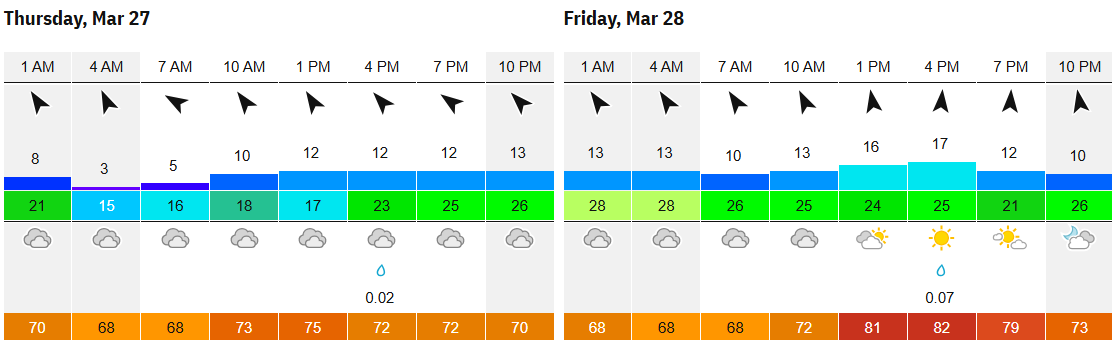
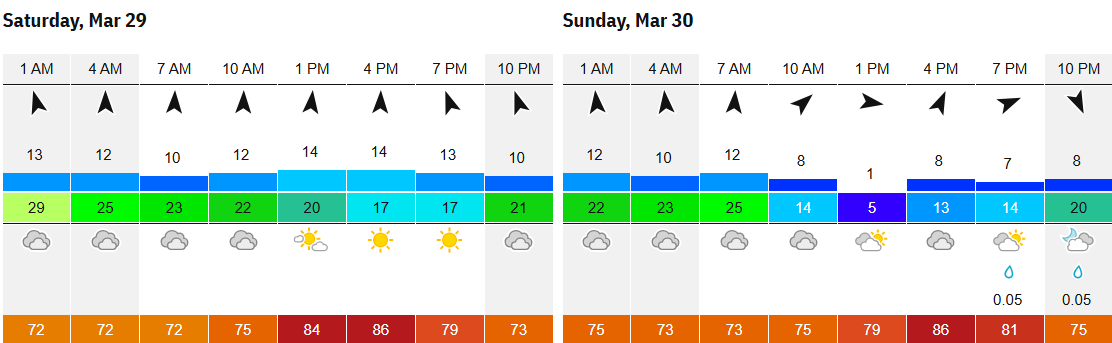
The course features overseeded Ryegrass in the fairways and rough with firm “bouncy” greens that typically run at fast speeds between 12-13 on the stimpmeter. With the seasonal change to Poa trivialis last year, the greens were not as firm as they were in the fall – making the approach game a bit easier. With a lack of penal bunkers and rough along with little water hazard danger, the heavily contoured green complexes along with potential windy conditions are among the course’s most prominent defenses.
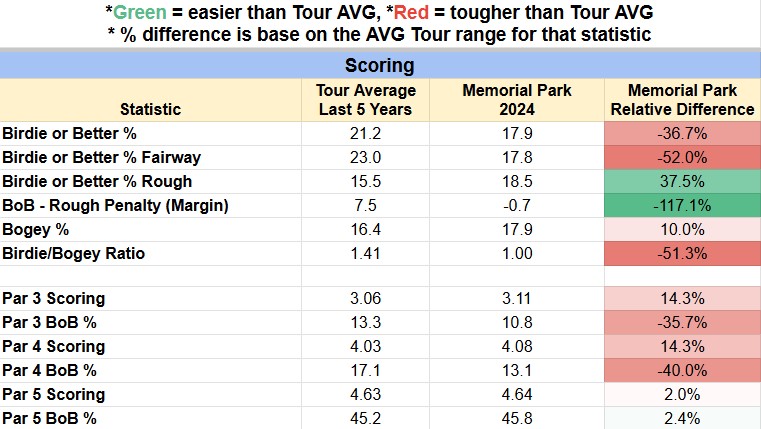
Overall, it is a flat parkland course, but Doak did a great job of creating the potential for uneven lies in the fairways and in the short-grass areas around the greens. The exposed ravine that cuts across the front nine also adds a degree of unexpected scenery until you witness it first-hand.
“It’s really a course of misses,” said Tour veteran Kramer Hickok. “It’s not a course of how well you’re hitting it. You could hit it great and have a couple misses in the wrong spots and make easy doubles.” Scottie Scheffler chimed in on the course’s difficulty by saying, “It’s a place where you can score, it’s just really difficult to. It’s a challenging golf course. I really appreciate that. I feel I get a little tired of playing the golf courses where you’ve got to shoot 20-something under to win.”
Hole Preview
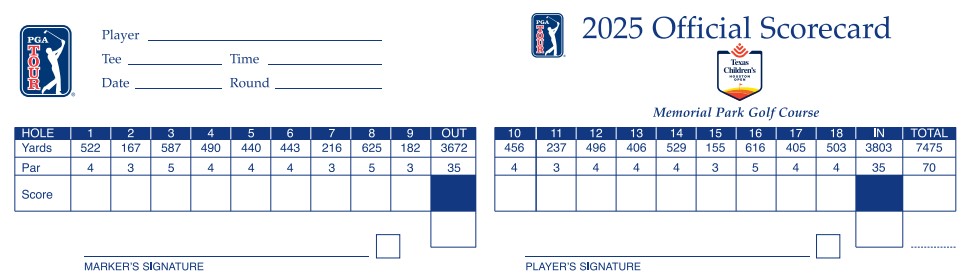
Along with a good mix of doglegs and straight holes, Memorial Park features a variety of holes with varying distances. Lengthy holes, however, are a common theme. Three of the five par 3s are over 200 yards with eight par 4s playing over 440 yards. The course shows its teeth with five of those playing over 490 yards and averaging a bogey or worse rate of 28.9%. Even the par 5s are challenging which includes the 576-yard 16th hole which only has a Birdie or Better rate of 22%.
The best holes at Memorial Park are the closing stretch of #15-18 which are full of risk and reward. Known as the loudest hole in Texas, the 15th is a short par 3 that plays anywhere from 115 to 155 yards. It has a difficult green to land on with little room for a safe miss. With a false front on the right side, a creek short and left, and a very narrow green, bogey or worse is very possible.
The aforementioned par 5 16th hole has plenty of risk if choosing to go for the green in two shots. The green is protected by water on three sides and there is very little room behind for a bailout. The 17th is a short par 4 that requires two precise shots to hit the green which sits behind another water hazard. Finally, the closing 18th is a monster 488-yard par 4 that is a slight dogleg right with plenty of strategic options off the tee. The green slopes from left to back right creating a difficult approach from a longer distance.
Strokes Gained Analysis
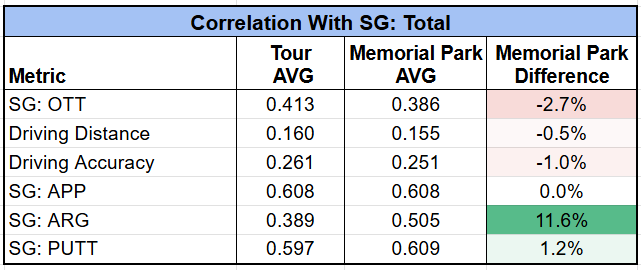
Off the Tee
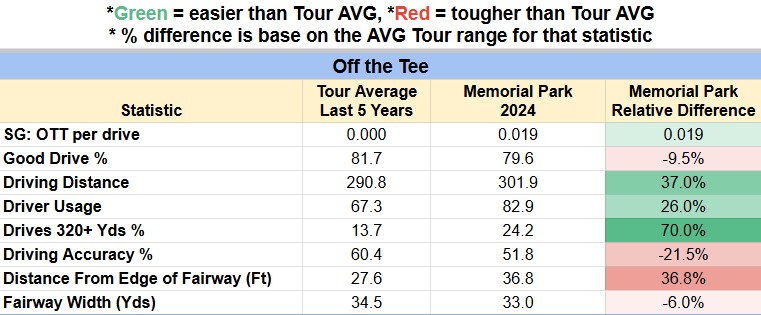
As one of the longest courses on Tour along with a lack of hazards and bunkers off the tee, golfers can use driver without hesitation on almost every par 4 and par 5 hole. Distance is a definite advantage and ranks as the 10th highest on Tour at 293 yards. Longer drives mean players have less lengthy approach shots into firm greens.
Accuracy matters much less this year because golfers who miss fairways will not have to deal with the unpredictable bermuda rough. Instead, they will see resort-length rough at only 1.25″. Last year’s “Missed Fairway Penalty” and “Rough Penalty” both ranked among the lowest on Tour.
Approach
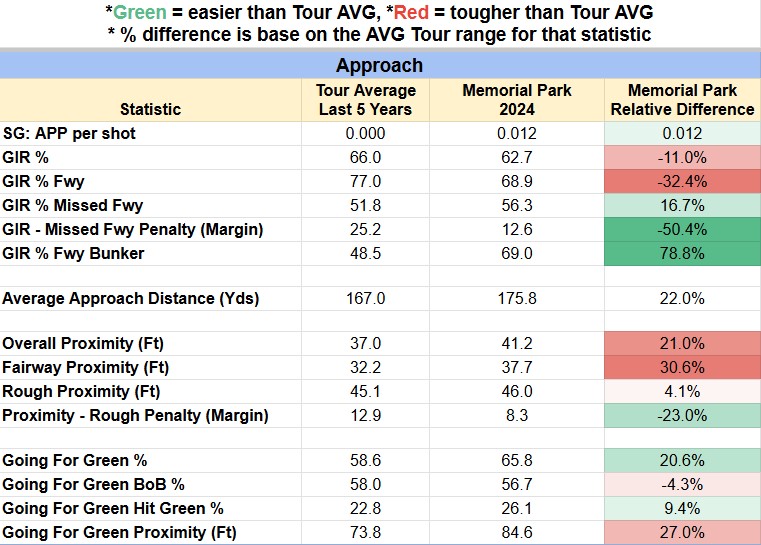
Every single approach stat at Memorial Park is more difficult than the Tour average. It’s the 14th toughest GIR course from both the fairway and the rough. It’s the 8th toughest in Proximity to the Hole at 38.6 feet. Regarding the challenge these greens present, 2020 winner Carlos Ortiz said, “Once you push it with these greens, they’re pretty undulated and they all fall off, so if you start pushing it, it’s easy to hit it to the side and you’re going to have a hard time putting it again on the green.”
The biggest challenge is getting your second shot to settle on the correct quadrant of these large surfaces. The firm undulations that slope off near the edges make it very difficult to get makeable birdie putts if you hit the wrong sector of the green. In some cases, missing the green on the correct side might be better than hitting the green but having to putt from 40 feet across multiple breaks and slopes. 2021’s winner, Jason Kokrak emphasized this by saying, “There are some pins out here that are pretty nasty if you do miss, so I’ve been playing away from the pin on occasion, which I don’t normally do.”
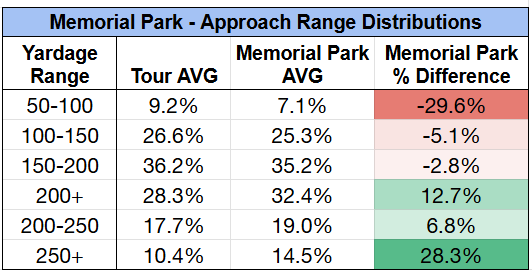
In 2024, 70% of approaches came from 150+ yards (33% from 200+) which is well above average. Joel Dahmen spoke to this difficult combination of hitting tough greens from distance, “With the way the greens are, you have to be so precise on the greens, and it’s tough to be precise from 200 yards.”
Around the Green and Putting
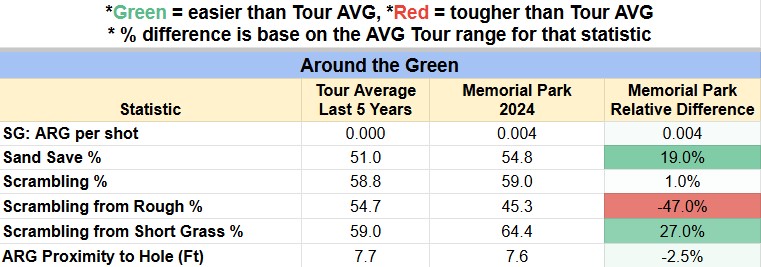
Around 27% of strokes gained at Memorial Park came from around the greens. That is one of the highest rates on Tour and speaks to the importance of having a quality short game to contend here. Last year, each of the top 13 players on the leaderboard gained strokes around the greens with those in the top five gaining an average of 0.92 per round. Most of the greens fall off around the edges to short-grass runoff areas which can make life quite difficult for even the best players when missing the putting surface.
Not only that but the greens are also sloped and very fast. Instead of the deeper rough that most courses have, Doak wanted tight, sloping uphill lies that would test players’ ability to demonstrate touch with their chipping. And with so many players missing greens, a poor short game will be very difficult to hide.
Said course superintendent Parker Henry on the agronomy changes last year, “We are tighter around the greens. Hopefully, it will create some different shots around the greens in areas we’ve struggled in the past. The players may not have had a great lie even if they may have been in the short grass.”
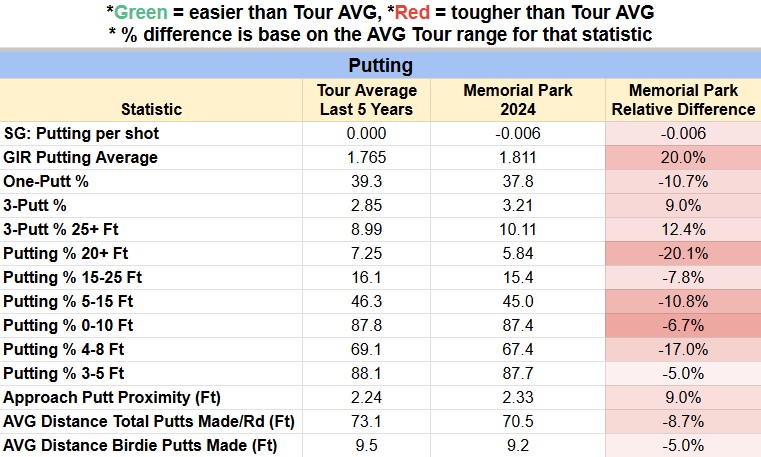
In typical Doak fashion, the greens are filled with sloping contours and roll firm and fast. Once on the greens, the data shows putting averages are very close to the Tour average. Because they do run a bit faster than normal, and if they are firm, they will test a player’s ability to avoid three-putts and bogeys.
Most Important Stats For Success at Memorial Park
*In order of importance
- Course Region: Texas
- Comp Courses: GC of Houston, Renaissance Club, Congaree, Quail Hollow, Augusta National, TPC Scottsdale, Riviera, Southern Hills, Bay Hill
- Scoring Conditions: Difficult
- Course Length: Very Long
- Field Strength: Weak
- Greens Surface: Poa Trivialis
- Green Size: Large
- Rough Length: Short
- OTT Club: Driver Heavy
- Gain APP: Difficult
- Gain ARG: Difficult
- Scrambling Short Grass: Difficult
- 3-Putt AVD: Difficult
Weather Forecast – Houston, Texas
- SG: APP
- Scrambling (Short Grass)
- Bogey Avoidance
- Driving Distance
- Good Drive %
- Birdie or Better %
- SG: Putting (Poa Trivialis/Overall)
- Proximity 200+ yards
- 3-Putt AVD
- SG: Total on Difficult Scoring courses
Key Rabbit Hole Filters
- Course Region: Texas
- Comp Courses: GC of Houston, Renaissance Club, Congaree, Quail Hollow, Augusta National, TPC Scottsdale, Riviera, Southern Hills, Bay Hill
- Scoring Conditions: Difficult
- Course Length: Very Long
- Field Strength: Weak
- Greens Surface: Poa Trivialis
- Green Size: Large
- Rough Length: Short
- OTT Club: Driver Heavy
- Gain APP: Difficult
- Gain ARG: Difficult
- Scrambling Short Grass: Difficult
- 3-Putt AVD: Difficult
Weather Forecast – Houston, Texas