In this series, we will examine how current PGA Tour players have performed above or below their baseline on specific types of courses or in specific conditions. For this research, and in order to draw sharper contrasts in player skill, it will not be a golfer’s Strokes Gained (SG) Total baseline that will be analyzed. Instead, it will be their baseline in the opposite data point of what we are comparing it with so as to best identify those players with the greatest SG Total disparity between the two categories.
So in this case, if we are analyzing player performance on “long” courses, we will be comparing it to their performance on all “non-long” courses. And likewise, when looking at past history on “short” courses, it will be compared to all other “non-short” courses. Average length courses are included in each of the “non” charts.
It’s no secret that based on their ability off the tee (among other factors), certain players thrive on courses of different lengths. It is fairly obvious that certain PGA Tour courses favor bombers off the tee while others favor shorter, more accurate hitters. But do most longer hitters play below their baseline on “short” courses? Which players who are known more for finding fairways than distance also perform well on longer courses? Another interesting angle that won’t be covered here but will be in the future is SG: Off the Tee on different length courses.
The methodology for determining course length, whether short or long, is very simple. Each course played on the PGA Tour over the past five years had its yardage divided by its par number. So for example, Port Royal is the shortest course on Tour at an average of 96.2 yards per par (6,828 yards, par 71). While the dividing lines between categories are typically imperfect, any course that was below 102.0 yards per par was classified as a “short” course.
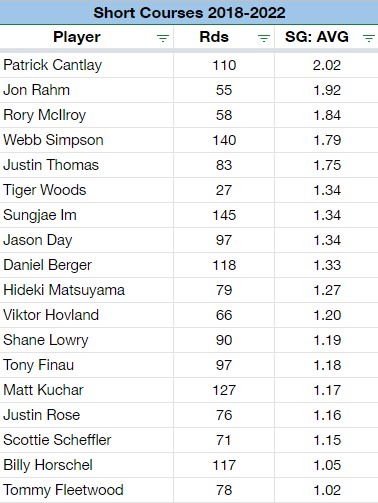
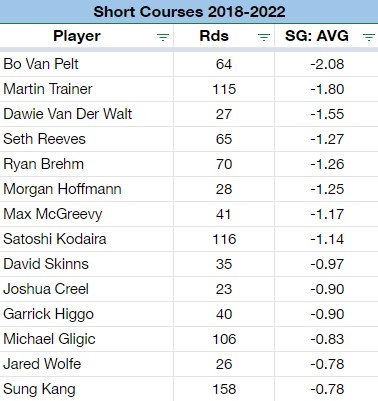
Before we compare players using their “non-short” course baseline, below are the best and worst golfers according to SG: Total per round on “short” courses since 2018. Of course, as is the case, we would expect most of the best players in the world to be very good on all types of course lengths.
Best SG: AVG on Short Courses
Worst SG: AVG on Short Courses
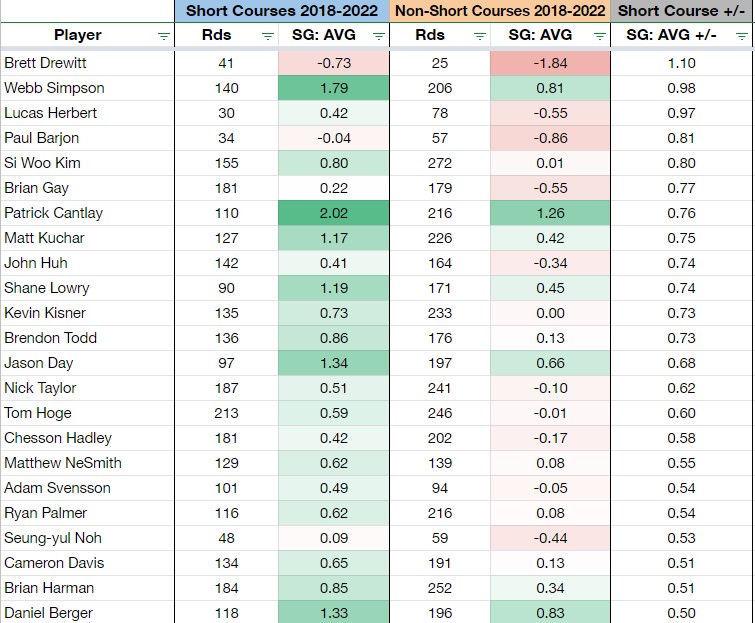
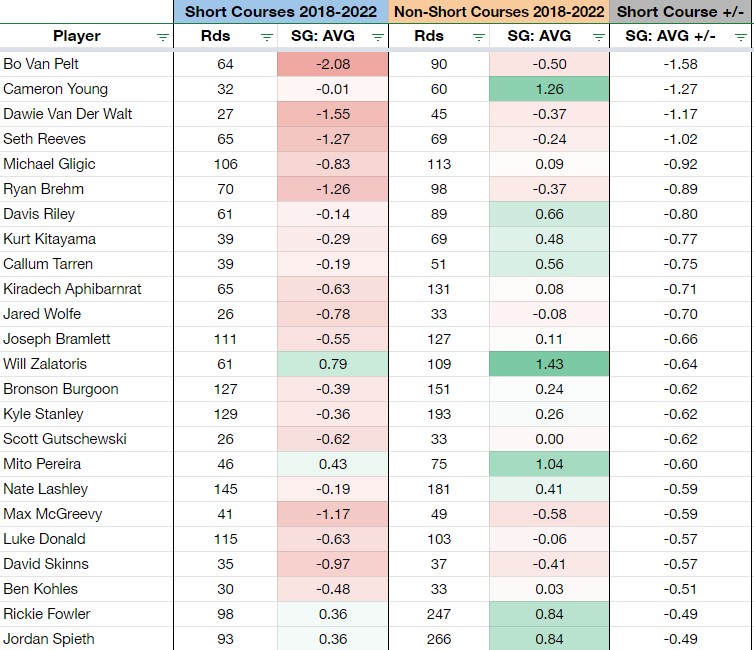
Next are the best and worst players from 2018-2022 on short courses compared to their non-short course baseline. It’s no surprise seeing players like Webb Simpson, Matt Kuchar, Kevin Kisner, and Brendon Todd at the top end of this list. Some surprises that I wasn’t expecting to have a positive “short course” differential this high would include Lucas Herbert, Si Woo Kim, and Shane Lowry. On the flip side, seeing Cameron Young with the second-largest negative differential on short courses really confirms his ability to use his length off the tee to his advantage on longer courses.
Best +/- SG: AVG on Short Courses
Worst +/- SG: AVG on Short Courses
Next, we will flip this around and look at the best current PGA Tour players on long courses. The longest course played on Tour over the past five years is the Kiawah Island Ocean Course at 109.4 yards per par (7,876 yards, par 72). Any course that averages over 105 yards per par qualified as a “long” course.
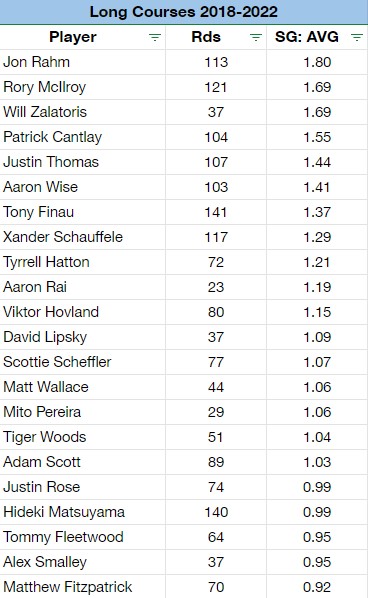
Best SG: AVG on Long Courses
Worst SG: AVG on Long Courses

Looking at the best and worst players in the +/- section on long courses, there are definitely a few surprises. Players like David Lipsky, Aaron Rai and Cameron Percy rank in the bottom half of driving distance on Tour yet play some of their best golf on longer courses. And then in the “Worst” chart, we see two of the longer hitters off the tee, Cameron Champ and Scott Stallings, playing well below their baseline on longer courses.
Best +/- SG: AVG on Long Courses

Worst +/- SG: AVG on Long Courses
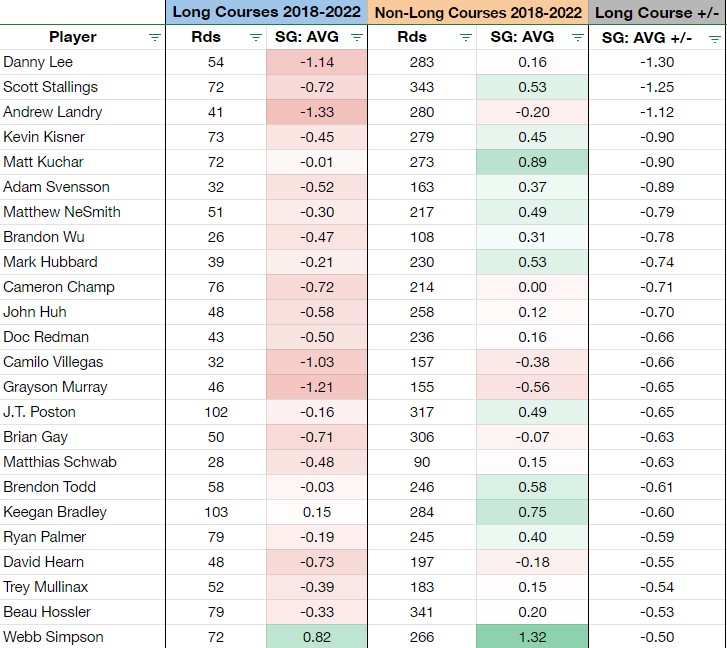
Photo by Jed Jacobsohn/Getty Images