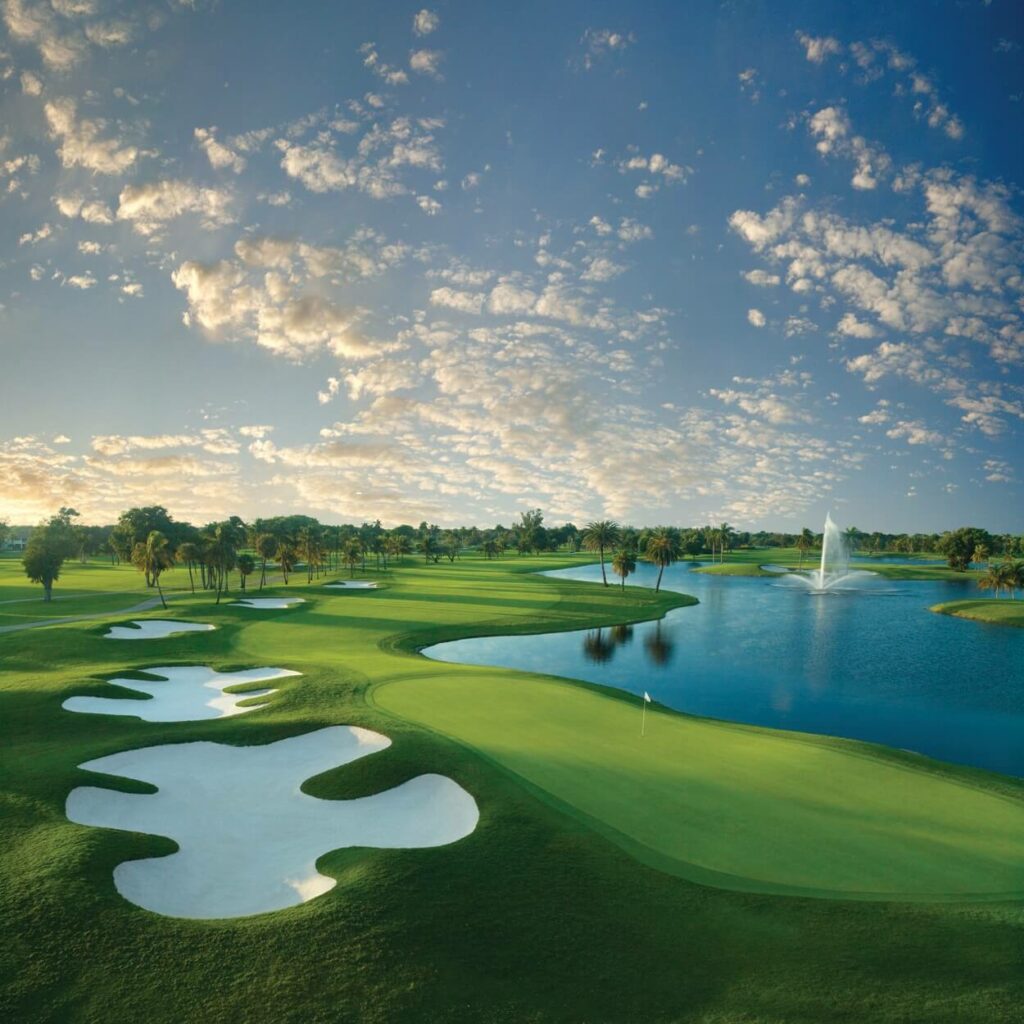
The 2026 Cadillac Championship marks a return to one of professional golf’s most storied venues, as the Blue Monster Course at Trump National Doral in Miami reclaims its place on the PGA Tour schedule as a $20 million Signature Event featuring an elite, limited field of the game’s top players.
First opened in 1962, the Blue Monster built its legacy by hosting the Doral Open and later the World Golf Championships–Cadillac Championship from 2007–2016, becoming synonymous with dramatic finishes and major-caliber leaderboards. More recently, it hosted the final event of the inaugural LIV Golf Invitational Series in 2022 and a regular season event in each of the subsequent three seasons.
Stretching over 7,700 yards as a par 72 following Gil Hanse’s 2014 renovation, the course remains a demanding test defined by water hazards on numerous holes, thick Bermuda rough, and large, grainy green complexes.
Success at Doral typically hinges on a blend of power and precision—length off the tee to handle its long par-4s, controlled iron play into well-protected greens, and the ability to manage ever-present South Florida winds.
The Field

The Cadillac Championship debuts as a new stop on the PGA Tour, awarding 700 FedEx Cup points to the winner and featuring a $20 million purse in a no cut format. The field is headlined by world No. 1 Scottie Scheffler, reigning FedEx Cup champion Tommy Fleetwood, Cameron Young, Justin Rose, Collin Morikawa, Russell Henley, and Chris Gotterup.
While the field is strong, there are also several notable absences, led by Masters champion Rory McIlroy, marking the second consecutive Signature Event he has skipped. World No. 3 Matt Fitzpatrick is also out after winning in consecutive weeks. Ludvig Åberg, Robert MacIntyre, and Xander Schauffele have also elected to sit out.
The last time the Tour competed at Doral, Adam Scott captured the 2016 WGC–Cadillac Championship closing with a final-round 69 to finish at 12 under par. The victory marked his second World Golf Championships title and highlighted a dominant ball-striking performance, as he consistently controlled the demanding layout and handled the course’s ever-present water hazards.
Course Features
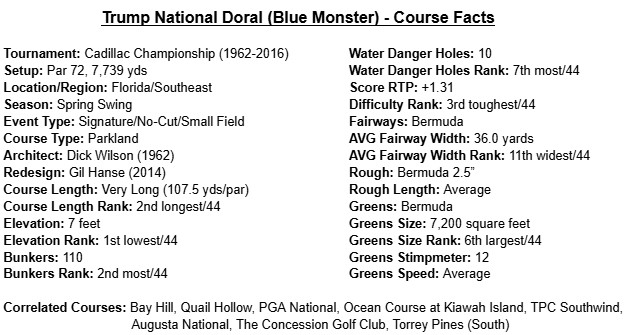
The historic Doral course at Trump National was first designed in 1962 by Dick Wilson. After it’s debut, the severity of the challenge it presented attracted it the name of “Blue Monster”, and that nickname has stuck over the years. It has been renovated by a number of golfing greats such as Robert von Hagge, Bruce Devlin, Raymond Floyd and the renowned instructor, Jim McLean. Several of these renovations in the 1990s and early 2000s moved it away from the original Wilson look, and the course lost some of its edge.
In 2014, with legendary architect Gil Hanse at the helm, the layout underwent a complete redesign. Hanse’s goal was to restore the course to its past grandeur by meticulously re-sculpting every hole. It was essentially a ground-up reconstruction aimed at restoring strategy while amplifying the course’s difficulty. The end result was a tougher, significantly longer, and more dramatic venue than ever before.
He recontoured every green complex, making them larger, more undulating, and better integrated with tightly mown runoff areas that place a premium on short game creativity. Surrounding bunkers were completely rebuilt with sharper edges and more penal positioning, often cutting into greens and landing zones to demand precise shot placement.
Hanse also reshaped nearly every fairway, adding movement and strategic angles rather than simple, flat corridors. He expanded and repositioned water hazards so they are more visually intimidating and more directly in play, especially on key finishing holes like the par-4 18th. The rough was thickened and the overall turf presentation shifted to firm Bermuda conditions, encouraging a faster, more links-style feel despite the South Florida setting.
In addition, Hanse lengthened the course and introduced more variety in hole design, forcing players to think their way around rather than relying purely on power. The Blue Monster is a literal beast of a course, spanning 7,739 yards, making it the second-longest non-major course on Tour.
Said Hanse, “This is one of the most exciting projects that I have ever had the privilege to work on. The property itself, being all sand based, is very unusual and unique – and a tremendous asset for a golf course. On top of it all, its location, in the middle of Miami, is unprecedented.”
In the years prior to the Hanse renovation, the course averaged -0.75 per round. After the renovation, from 2014-2016, the difficulty increased as intended to +1.31 per round.
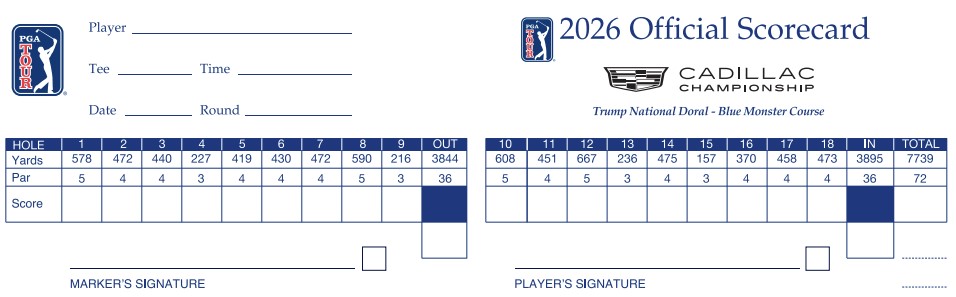
The Blue Monster is laid out over relatively flat terrain with a plethora of strategically placed bunkers dotting the landscape. It also features long flowing fairways, penal Bermuda rough and a challenging assortment of water hazards.
In every respect, this is a true brute of a golf course. While the fairways offer some room off the tee, the unpredictable Bermuda rough and ever-present water hazards ensure that even slight misses can quickly turn into a scramble just to save bogey. It’s long, demanding, and absolutely uncompromising.
Off the tee in 2016, Doral had the most penalty strokes out of any course on Tour. With the course stretching even longer this year, golfers will continue to be challenged with pressure-packed tee shots to avoid the threatening water hazards.
The greens are firm, fast, and true, and each hole demands both precision and full commitment. When you strike it well, there are scoring opportunities, but there are no routine pars and very few places where a miss won’t be punished.
The famed 18th hole at is widely regarded as one of the toughest finishing holes on the PGA Tour, having produced both dramatic collapses and unforgettable heroic finishes over the years. Playing as a narrow par 4 of roughly 473 yards, it demands absolute commitment and precision from the tee, with water running the entire length of the left side of the hole and becoming more intimidating when the wind is up.
The fairway is tightly framed, forcing players to choose between flirting with the lake or steering away from it into a series of bunkers, deep rough, and palm-lined hazards that guard the right side.
The green continues the challenge, stretched long and narrow while angling toward the water and sloping subtly away from the clubhouse, making control of distance and spin essential on the approach. With trouble waiting everywhere and no truly safe miss, the 18th effectively captures the identity of the Blue Monster in a single hole. A closing par here is often earned the hard way and stands as one of the most satisfying fours a player can record.
Most Important Stats For Success at the Blue Monster
*In order of importance
- SG: APP
- Driving Distance
- Good Drive % (Difficult OTT/APP)
- Proximity 50-100, 200+ yds
- SG: ARG (Bermuda)
- SG: Long/Difficult courses
- DFEF (Difficult OTT)
- Scrambling (Bermuda)
- Bogey Avoidance (Difficult)
- Birdie or Better %
Key Rabbit Hole Filters
- Region: Southeast
- Course Length: Very Long
- Scoring Conditions: Difficult
- Field Strength: Strong
- Event Type: No Cut/Signature
- Field Size: Small Field
- Water Danger: High
- Bunker #: High
- Greens Surface: Bermuda
- Rough Surface: Bermuda
- Gain OTT: Very Difficult
- OTT Club Type: Mixed
- Gain APP: Very Difficult
- Scrambling (Rough): Difficult
