The first leg of the U.K. swing kicks off at The Renaissance Club in North Berwick, Scotland, for Year 3 of the co-sanctioned Scottish Open. Previously a D.P. World Tour event, the Scottish Open is now equal parts DPWT and PGA Tour, with 75 golfers from each tour participating, designed as a warm-up for next week’s Open Championship at Royal Troon.
The course is not a pure links setup with the numerous tree-lined holes, undulations, and heavy rough in play just off the fairways (especially on the back nine). But there is a definitive links-style component to the course. It is off the coastline and subject to windy conditions, and the red fescue turf is firm and tight. This leads to fast-running surfaces on the fairways and aprons leading to the greens, where a lack of bunkers in front encourages the use of the ground game and bump-and-run shots. Many of the course’s 83 bunkers are links-style pot bunkers with deep riveted faces.
As we should expect in Europe, the weather is the course’s best defense. When the wind is quiet, this place can be easily picked by the world’s best. Unfortunately, we’ve seen very different scores come Sunday afternoon when the winds swirl and gust. We’ve also seen that the penalty for missed fairways off the tee is non-existent, which changes the way that I’m handicapping this event.
For more course details, check out Ron’s course preview. It’s the best in the business, but there are none. Here’s an important tidbit about The Renaissance Club:
Due to potential windy conditions, The Renaissance Club was built with extreme versatility in tee placements and can play as short as 5,400 yards out to its Scottish Open length of 7,237 yards. While it was a par-71 course in its first four editions, this is the second year it will be a par-70 course with a unique mixture of ten par-4s, five par-3s, and three par-5s.
The Renaissance Club was seeded with the most common grass choice in Scotland – red fescue. Fairways, rough, and greens are all 100% fescue. The rough is much thicker here compared to the wispiness of other links-style courses in Great Britain. As is typical for most coastal courses, greens run very slow at around 10 on the stimpmeter. The greens here are cut at a minimum of 5 mm high. Most PGA Tour greens are typically cut to around 2.5 mm. With the greens playing so slow, many of the PGA Tour players who are used to faster speeds will have to adjust.
When the weather cooperates, hitting these greens is not even a remote issue. Out of the 77 players to make the cut in 2021, for example, only 13 of them had a GIR rate of under 70%. 15 players were above 80%! That being said, with the greens being so huge and undulating, proximity to the hole and positioning approaches relative to the pin to leave an uphill putt is vital. The course favors strong iron players. Last year, six of the top seven on the leaderboard gained at least 2.3 strokes on approach. In 2022, seven of the top 15 on the leaderboard gained at least 4.6 strokes on approach.
The green complexes, in a word, can be described as adventurous. They are firm, large, and well-contoured, with a variety of possible pin positions. Last year, these greens ranked as the fifth most difficult on which to gain strokes putting. Making putts inside 15 feet, especially in windy conditions, will be crucial.
Remember to check out the Rabbit Hole, our customizable stat database that can help you pair down your player pool each week.

Please take advantage of the Discord feature and community. It’s the best way to get up-to-the-minute lines and advice, and if you need help getting started, please reach out. My full card and any live in-tournament bets will be posted here.
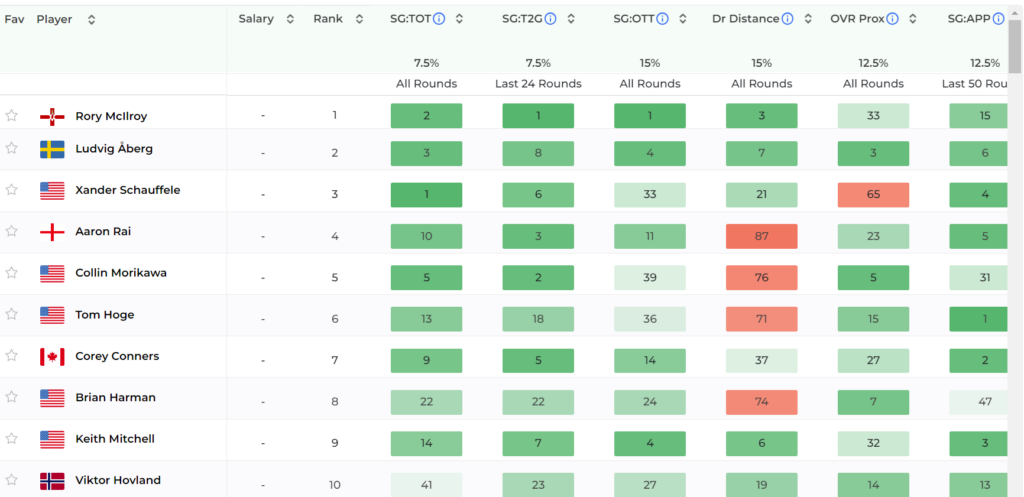
My top 5 key stats this week:
- Driving Distance
- SG: OTT (Missed Fairway Penalty – LOW, Last 12 months)
- SG: APP (Long and Short-term form)
- Overall Proximity (GIR Accuray – EASY & AVERAGE)
- 3-putt Avoidance (Last 12 Months)
Noonan’s Scottish Open Betting Picks
Collin Morikawa
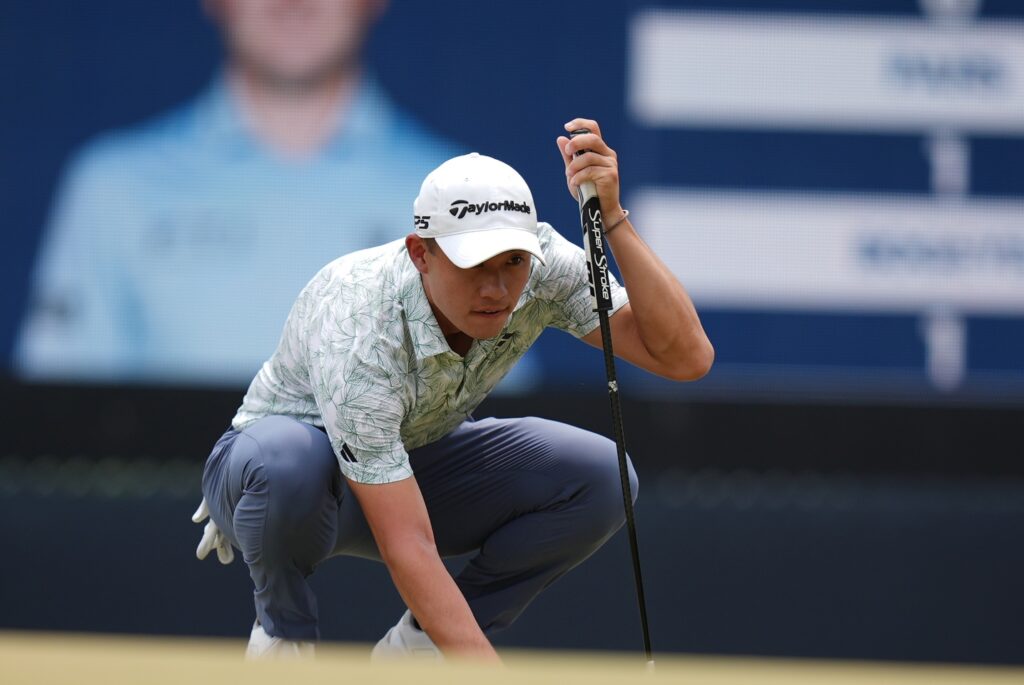
I absolutely love this spot for Collin Morikawa. You can make the case that his current form is as good as it’s been at any point over the past 2-3 seasons. He hasn’t found the winner’s circle yet in 2024, but he’s been in the mix in nearly every start since the Masters in April. Morikawa has made eight starts since Augusta and has finished inside the top five in five of them, finishing no worse than T16 during this stretch.
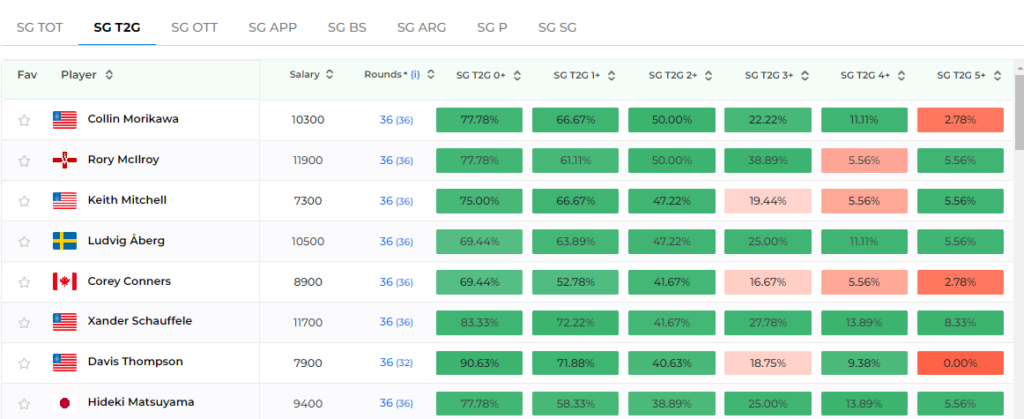
Morikawa’s game has shown a level of consistency and ceiling that puts him firmly among the best players on Tour. He’s gaining on the field (SG: Total) at a rate of about 10% higher than last season, and it’s even better than that tee-to-green. Over the past 36 rounds, Morikawa has gained 2+ strokes T2G in 50% of his rounds, which is the best in this week’s field (tied with Rory McIlroy).
Morikawa ranks fifth in my model this week, with no real weaknesses other than finishing middle of the pack in driving distance. What’s interesting about that is I would put driving distance up there as a key stat for Augusta, Valhalla, and the Memorial as well, and Morikawa finished inside the top four in each of those events.
- To Win: +1600 BetRivers
- Top 10: +130 DraftKings
Ludvig Aberg
We’ve seen the top of the board come through and take this down in each of the past two years, and that’s where I’m going this week. Two shots at the top, with the second being the young Swede, Ludvig Aberg. Just like Morikawa, he’s yet to bring home any hardware in 2024, but he’s danced around it time after time, mostly against the strongest field on the toughest tracks.
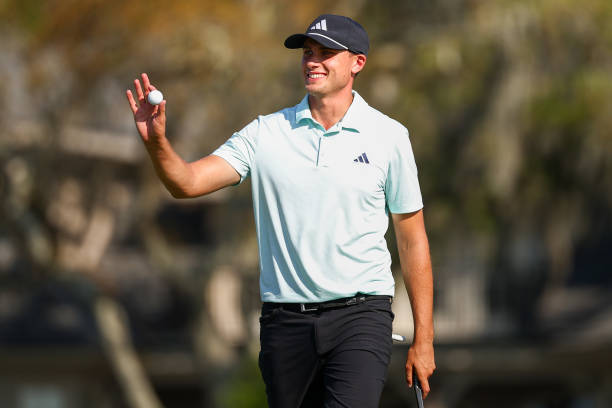
It’s clear that he wasn’t 100% healthy heading into the PGA Championship at Valhalla, where he missed the cut. Outside of that, his last start at the Travelers (T27) was his first finish outside the top 25 since the Sony Open back in early January. Aberg’s ball striking is remarkably consistent. Over the past six months, Aberg’s gained 3+ strokes ball striking (OTT + APP) in 27.66% of his rounds. Viktor Hovland (20.59%) is the only other golfer in this week’s field who’s topped 20%, which shows consistency and ceiling, which is required if you’re going to win on Tour.
Aberg is second in my model this week, and I was happy to see him close to 20/1 in the opening odds on Monday morning.
- To Win: 18/1 BetMGM
- Top 10: +175 DraftKings