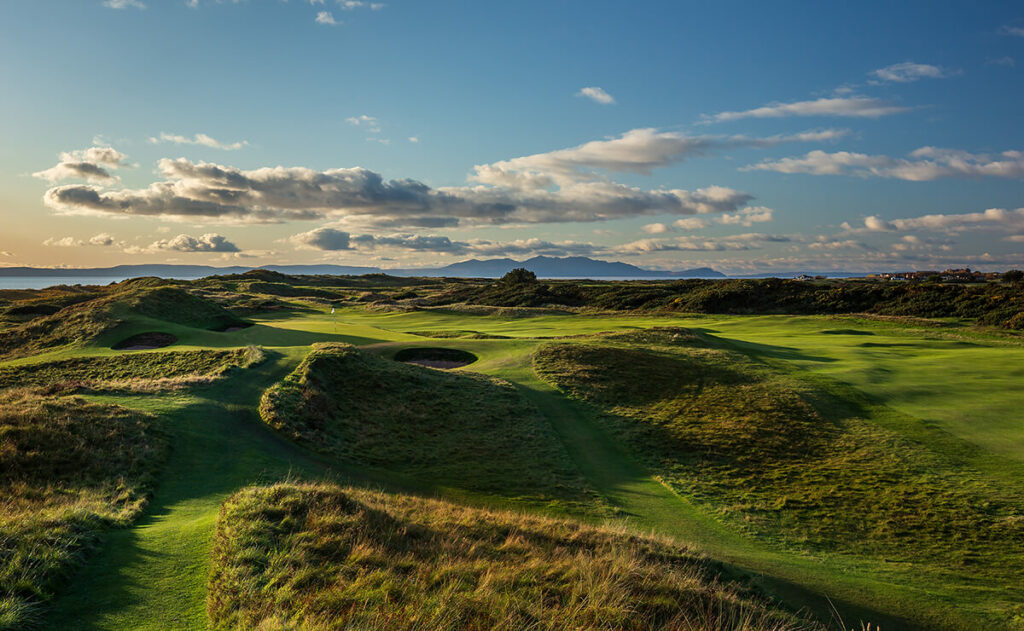
Golf’s oldest major championship returns for the 10th time to the seaside town of Troon on the western coast of Scotland. Located in the South Ayrshire region, roughly 30 miles southwest of Glasgow, Royal Troon Golf Club will host the 152nd Open Championship.
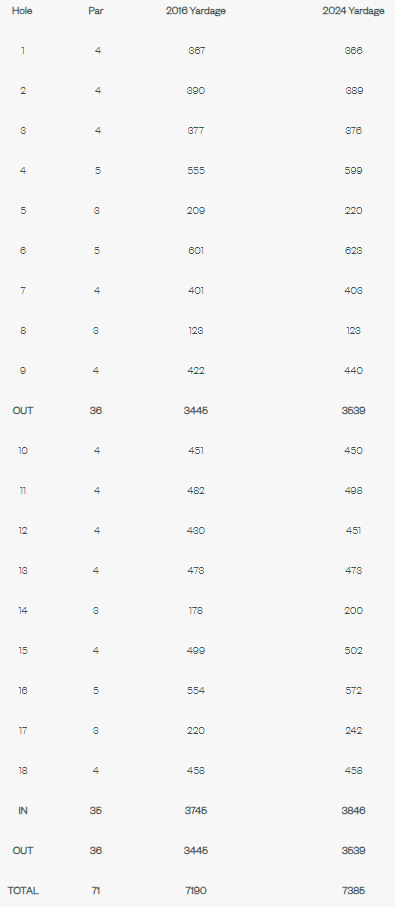
With a reputation as one of Scotland’s greatest links courses, it will provide a challenging tee-to-green test. It most recently staged the Open Championship in 2016, when Henrik Stenson outdueled Phil Mickelson down the closing stretch. Stenson joined Johnny Miller as the only player to shoot 63 in the final round to win a major. He beat Mickelson by three strokes. No one else was closer than 11. This time around, the par-71 layout has been extended to 7,385 yards and will play close to 200 yards farther than it did eight years ago.
Designed in the traditional out-and-back manner of the Old Course at St Andrews, Troon’s test begins with a gentle opening through some of the most striking links terrain to be found at any of the Open venues. The front nine typically plays downwind and provides plenty of birdie opportunities. Mostly into the wind, the back nine is as tough as any finish in the world.
Last year, Brian Harman captured his first major by building a five-shot lead at Royal Liverpool and closed with a 1-under 70 for a six-shot victory. He never trailed over his final 51 holes. Harman epitomizes the nature of the Open Championship. You can’t fake it around an Open course. Whoever is playing the best will win – longshots included – and they may even run away with it as Harman did.
Elite players have raised the Claret Jug at Royal Troon like Stenson, Arnold Palmer (1962), and Tom Watson (1982). But there have also been random champions like Todd Hamilton (2004), Justin Leonard (1995), and Mark Calcavecchia (1995). It’s the variables of wind, weather, undulating terrain, and unpredictable lies that make the Open so enjoyable to watch and which frequently seem to leave the door open for an unexpected champion.
The Field
After this week’s Genesis Scottish Open, 158 players have qualified for the event, with three past champions (Ben Curtis, David Duval and Paul Lawrie) electing not to play. This exceeds the usual 156-player field which hasn’t happened since 1995 at St. Andrews. If any players withdraw in the next few days, no alternates will replace them.
After a four-week layoff, world No. 1 Scottie Scheffler eyes his seventh PGA victory of 2024. He is the first player with six wins before July since Arnold Palmer in 1962. World No. 2 Rory McIlroy will try to rebound from his collapse at last month’s U.S. Open at Pinehurst where he was the runner-up to Bryson DeChambeau by one stroke after two bogeys in his last three holes. His major drought reaches back to 2014. As for DeChambeau, he has yet to find the formula for mastering links golf with only one top-30 finish in nine career events on links courses.
As would be expected in a major championship, the depth of the field is terrific. From recent major winners like Harman, Xander Schauffele, and Wyndham Clark to past Open Championship victors in Collin Morikawa, Cameron Smith, Shane Lowry, Jordan Spieth, and Louis Oosthuizen, every player in the top-50 of the world rankings will be in attendance except for Cam Davis (who broke into the top-50 after the qualification deadline).
Similar to the U.S. Open, its British counterpart is comprised of a mix of tour pros and amateurs fully exempt into the championship from past performances and players who earn invitations via various qualifying events during the course of the year. Additionally, 16 spots were reserved for players who compete in 36-hole qualifying events at four local courses on July 2.
As for LIV Golf, 17 players are in the field, highlighted by DeChambeau, Jon Rahm, Brooks Koepka, Cam Smith, and Joaquin Niemann. Of course, the two runaway trains of the last Open at Troon, Stenson and Mickelson, will make their return as well. Numerous DP World Tour regulars like Sebastian Soderberg and Rasmus Hojgaard, who are in the top-30 “Race To Dubai” rankings have also gained entry into this week’s field.
Other past champions in the field include Tiger Woods, Francesco Molinari, Padraig Harrington, Ernie Els, Darren Clarke, Stewart Cink, and John Daly.
Royal Troon Golf Club – History
Troon Golf Club was founded in 1878 with a mere five holes. In 1881, George Strath was appointed as the club’s first golf professional and partnered with 1882 Open champion, Willie Fernie, to design the original 18-hole course which was completed by 1888. This included Royal Troon’s two greatest holes – The Postage Stamp and Railway.
Just before Royal Troon hosted its first Open Championship in 1923, the course was renovated and lengthened by five-time Open champion, James Braid, who was also one of the era’s top architects and a member of the World Golf Hall of Fame.
Fast forward to 2016 and the British architect team of Martin Ebert and Tom Mackenzie made minor adjustments to every hole before the Open Championship that year. They also renovated major parts of the 9th, 10th, and 15th holes.
For the 152nd Open, three new bunkers have been added, two of which are on the 6th hole with the other added to the first fairway. There are new tees on nine holes with the 10th tee introducing a completely blind drive. Ebert also added 22 yards to the par 5 sixth hole stretching the back tees to 623 yards and making it the longest hole in Open Championship history. Altogether, 195 yards have been added to the layout.
We have partnered with Underdog to bring you an easy way to claim a FREE, no-strings-attached 90 days of Premium Access to Betsperts Golf, plus up to $250 in bonuses when you deposit! Click here to learn more!
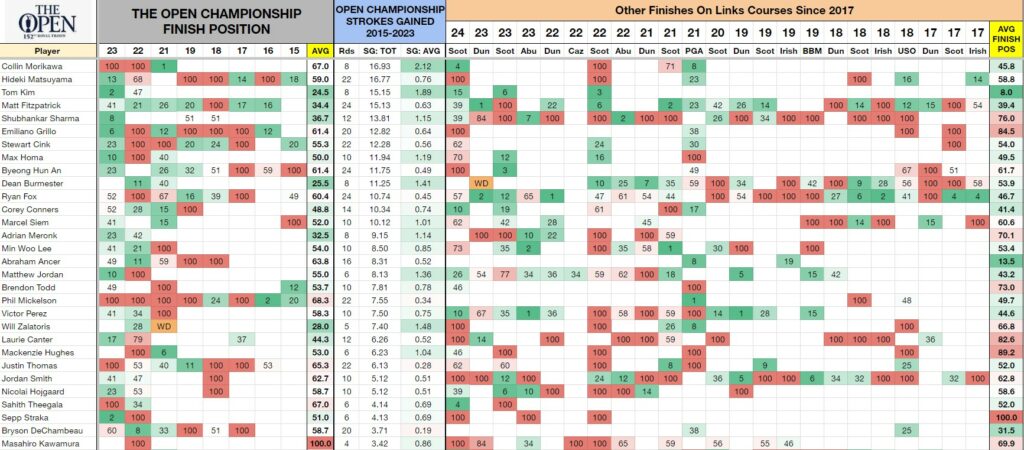
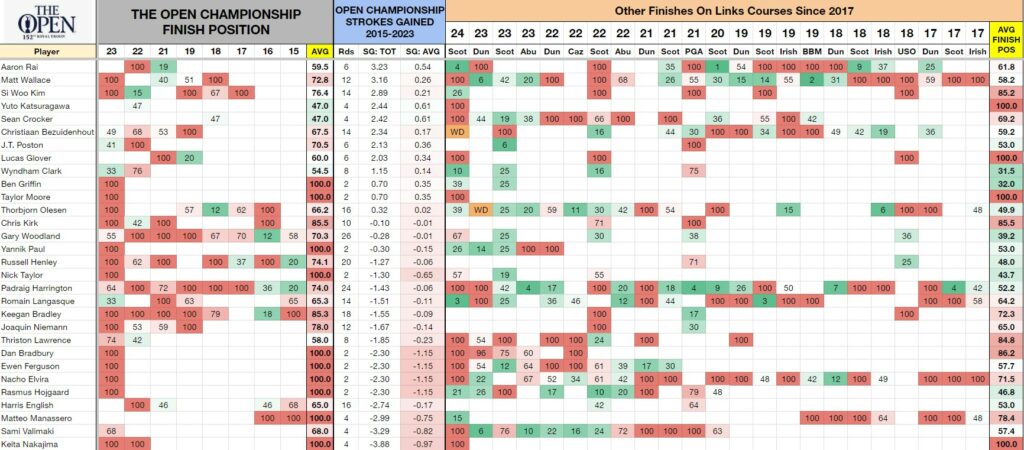
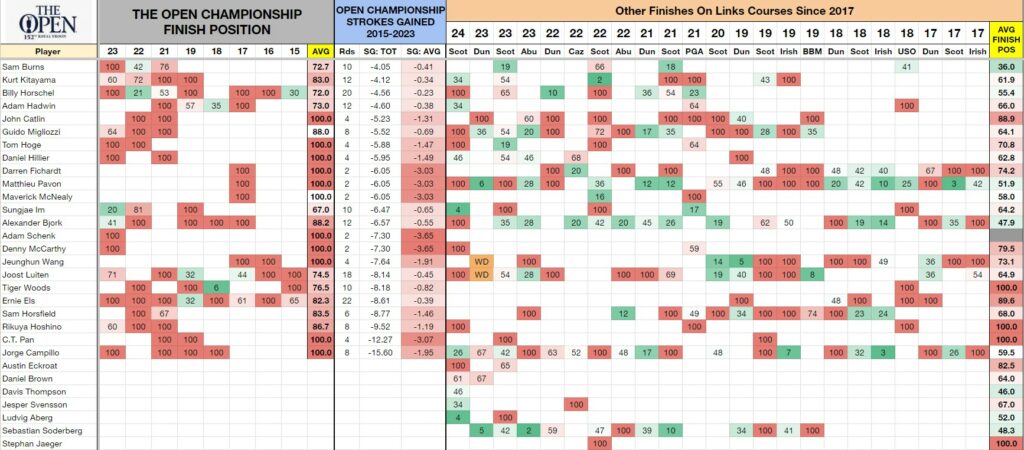
Finish Position and Strokes Gained Open/Links History (2014-2024)
Combined Open Championship/other links course history going back to 2014. Includes average finish position and Strokes Gained per round. Players are sorted by SG: Total.
f684b2f3d4218ee06dad551b3bb2074b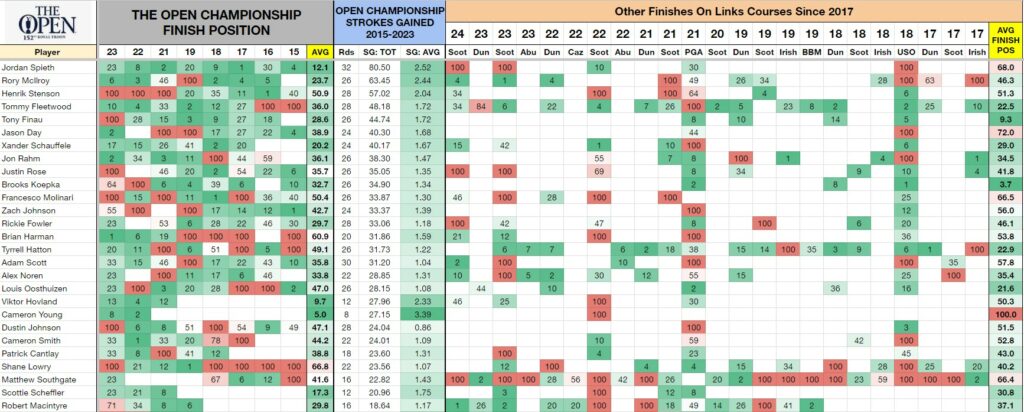
Course Features
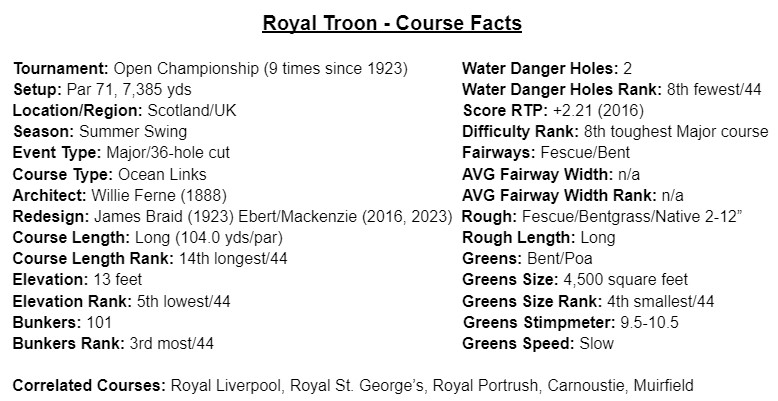
With an increase of 195 yards from Troon’s most recent Open in 2016, the par-71 layout is set to measure at close to 7,400 yards this week from its farthest tees. Though it looks like a mostly benign links course, those who have regularly played it have stated that it can take a lifetime to learn its infinite complexities. Royal Troon favors no specific style of play, and as the great golf commentator Iona Stephen remarked, “Success here isn’t always about what you can do but often about what you mustn’t do.”
Being right next to the beach and the Firth of Clyde, Royal Troon has sandy terrain with low-lying dunes. When the wind whips off the ocean there is nowhere to take cover. Shaped shots and the ability to manipulate ball flight are necessary to play well. Along with the wind, the course demands shotmaking to navigate the numerous bunkers, native bushes, and sandhills.
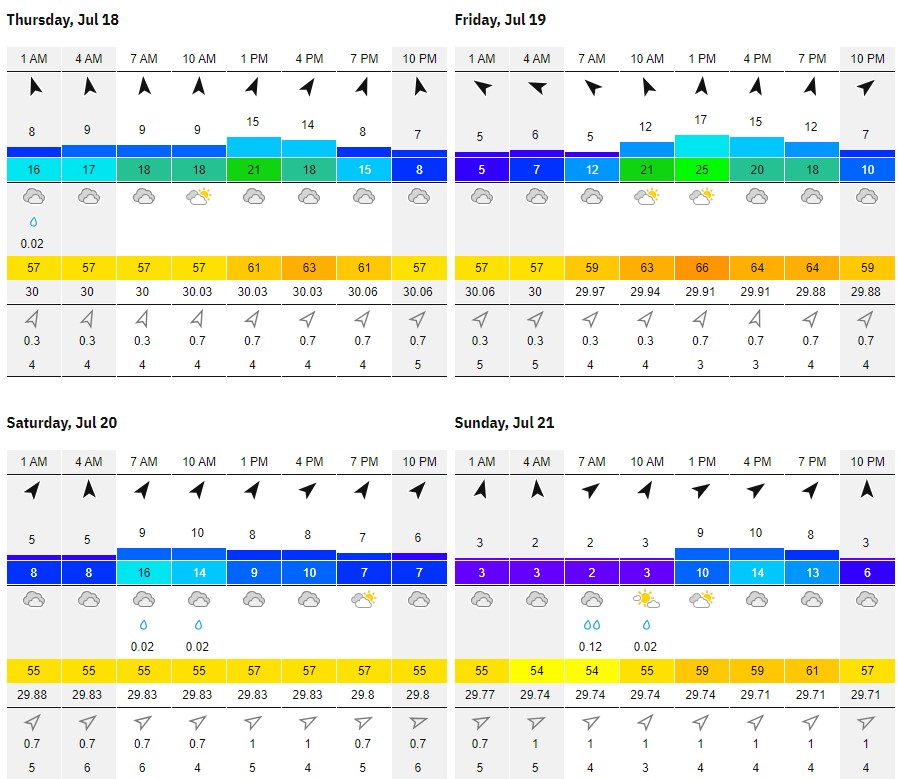
Rain and gusty winds are predicted for Thursday’s opening round with the potential for gusty conditions heading into the weekend. Those who most successfully navigate the varying elements on the Ayrshire coast will find their way towards the top of the leaderboard come Sunday evening.
“We want a traditional links feel,” said Billy McLachlan, course manager at Royal Troon Golf Club. “Firm, fast and bouncy. That’s what we’re trying to target for at The Open, and at any time. We’re doing everything we can to get a linksy feel and if the weather goes with us, we will hopefully achieve it.”
Due to a warmer and wetter last couple of months, the rough will play much thicker than it did in 2016 and will create that much more of a premium on fairway accuracy off the tee. Along with the wild rough and 101 total bunkers, there is plenty of high gorse, hillocks, and other mounds with which to contend after hitting wayward shots. Whether off the tee or on approach, the bunker placement is incredibly strategic and will leave golfers pondering and debating club selection on almost every hole.
Strokes Gained Analysis
Off the Tee
Off the tee, Royal Troon will never be confused with the massive fairway landings at St. Andrews. Fairways are tight on many holes, and on others, pot bunkers cut into play around the landing zones. Rolling ground contours tend to funnel balls into them effectively reducing the size of what appears to be a generous landing area. In the 2016 Open, both Stenson and Mickelson took 3-wood or iron off the tee on almost every driving hole.
Fairway positioning and keeping the ball in play off the tee is essential for success at Royal Troon. The club motto here is “As much by skill as by strength.” Due to a high penalty for missing fairways, pounding away with driver comes with plenty of peril. With potentially windy conditions, anything too high in the air with excess spin will disappear into the deep foot-long fescue rough. The same result can also happen on low bounding shots that run through the fairway due to a poor angle off the tee. Fairway bunkers are among the course’s biggest defenses and are a true one-stroke penalty They are dotted around the landing area making strategy and accuracy off the tee paramount.
Approach
On approach, in these conditions and with greens so diminutive in size, hitting and even holding these targets is difficult, even with a wedge. Pinpoint accuracy in potentially tough conditions will be essential. On numerous holes, and especially the par 5s, revetted bunkers protect the narrow front entries of the greens, and on others, the sides of the putting surface are fortified with deep and menacing bunkers.
Around the Greens and Putting
Greens are a mix of native bentgrass and poa annua and are much smaller than other courses in the Open rotation at an average of only 4,500 square feet per hole. Troon’s greens tend to be pinched in front and larger in the rear, so even when pins are forward it’s often better to take extra club and play towards the center. While putting surfaces are not as undulating as others, they have very subtle movement and can be difficult to hold in firm conditions. Due to the coastal breezes, greens typically run very slow between 9.5 and 10.5 on the stimpmeter.
Hole Preview
Royal Troon is a traditional out-and-back links course. The opening few holes are relatively gentle, with a series of short par fours running along the Firth of Clyde. It’s from these early holes that you get the chance to soak up the views.
Most Important Stats For Success at Royal Troon
*In order of importance
- SG: Approach (Difficult APP Courses)
- Distance From Edge of Fairway (DFEF)
- SG: Total – Difficult Scoring/Majors
- SG: OTT – High “Missed Fairway Penalty”
- Scrambling
- Bogey Avoidance (Difficult Scoring)
- Sand Saves
- SG: Open Championship/Links Courses
- SG: Putting (Slow Greens)
- Good Drive % (Difficult APP Courses)
Key Rabbit Hole Filters
- Course Region: UK/Ireland
- Course Type: Links
- Scoring Conditions: Very Difficult
- Field Strength: Very Strong
- Event Type: Major
- Greens Surface: Native
- Greens Size: Small
- Greens Speed: Slow
- Rough Length: Long
- Gain OTT: Difficult
- OTT Club: Less than Driver
- Missed Fairway Penalty: High
- Gain APP: Very Difficult
- Par 3/4 Scoring: Difficult
- Sand Saves: Difficult
- Wind: Windy (19+ mph)
Weather Forecast – Troon, Scotland