The PGA Tour heads to the “Lone Star State” for the World Golf Championships-Dell Technologies Match Play event as the best golfers in the world take a week off from stroke play and battle it out in head-to-head competition. For the seventh and final year since 2016, the tournament will be held at Austin Country Club on the outskirts of the Texas capital.
It was announced last week that the tournament will not be continuing next year. “We’re formally announcing today that the 2023 World Golf Championship Dell Technologies Match Play will be the final playing of the event here at Austin Country Club, and not be included on the 2024 calendar or moving forward,” executive director Jordan Uppleger confirmed. “The event has had an incredible run here at Austin Country Club.” The tournament’s slot on the calendar is expected to be filled by the Cadence Bank Houston Open as it moves from the fall portion of the schedule.
The Field
Following the conclusion of THE PLAYERS Championship, 64 players are eligible for this event through their Official World Golf Ranking. Headlining the field is Scottie Scheffler, who reclaimed World No. 1 with his victory at TPC Sawgrass. The six-time PGA TOUR winner will be attempting to defend his Dell Match Play title at Austin Country Club, where he defeated Kevin Kisner, 4 and 3, in 2022 for the victory.
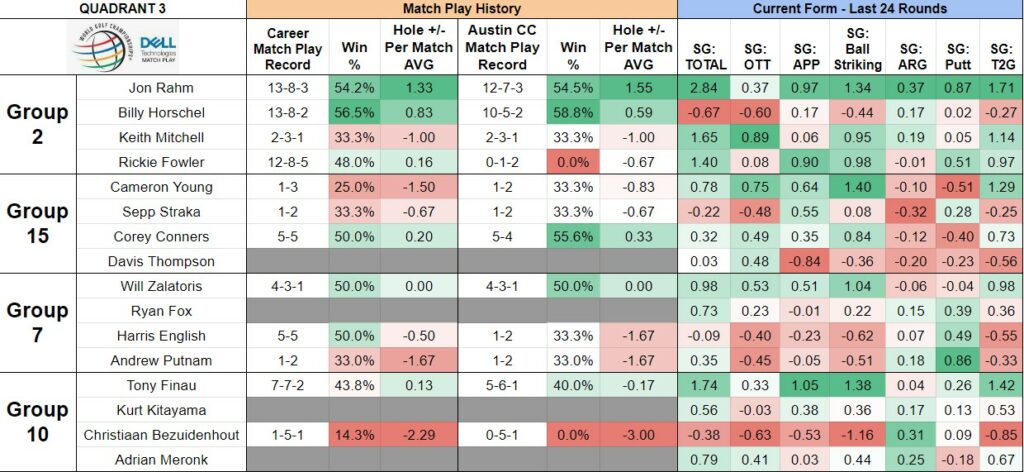
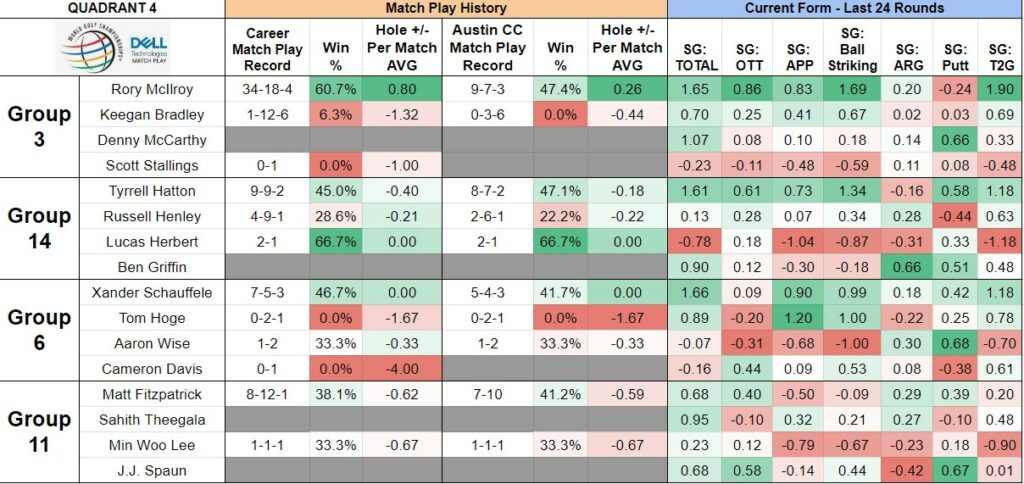
Eight of the top 10 players in the world will be teeing it up in group play starting on Wednesday. Only Justin Thomas (rest) and Cam Smith (ineligible) will not be in attendance. Justin Rose is the only other eligible player to skip the event. Eleven LIV members are ranked inside the top 75 in the world but are suspended by the PGA Tour and thus unable to compete in Tour events. The 16 four-man groups for the three-day, round-robin stage were recently revealed and are listed quadrant by quadrant further below.
Austin Country Club – Scorecard

Match Play Format
The players are split into 16 groups of four players (each group has a player seeded 1–16, 17–32, 33–48, 49–64). Each group plays in a round-robin format on Wednesday, Thursday, and Friday (similar to soccer’s World Cup). One point is awarded for a win, and one-half point for a tie, with only the group winner qualifying for the next round. If two or more players are tied at the top of the group, there is a sudden death stroke play tie-breaker played to decide who progresses. The second phase is played as a knockout tournament, with the round of 16 and quarter-finals played on Saturday, and the semi-finals, third-place playoff, and final played on Sunday.
Match Play itself is much different and is more volatile and unpredictable compared to stroke play. Match play is a form of competition where one golfer plays directly against an opponent in a head-to-head match. You win a hole by completing it in the fewest number of strokes, and you win a match when you are ahead by more holes than remain to be played. Your actual score for the round means nothing. You could shoot the second-worst round of the day, but as long as you defeat your opponent you win.
There are certain players over the years who possess the skill set of patience, adaptability, hot iron play, and a streaky putter which has allowed them to continually defeat more talented opponents in this format. Putting is much more important in match play compared to stroke play. Golfers that fit this description in this year’s event include the likes of Kevin Kisner, Billy Horschel, Matt Kuchar, and Alex Noren.

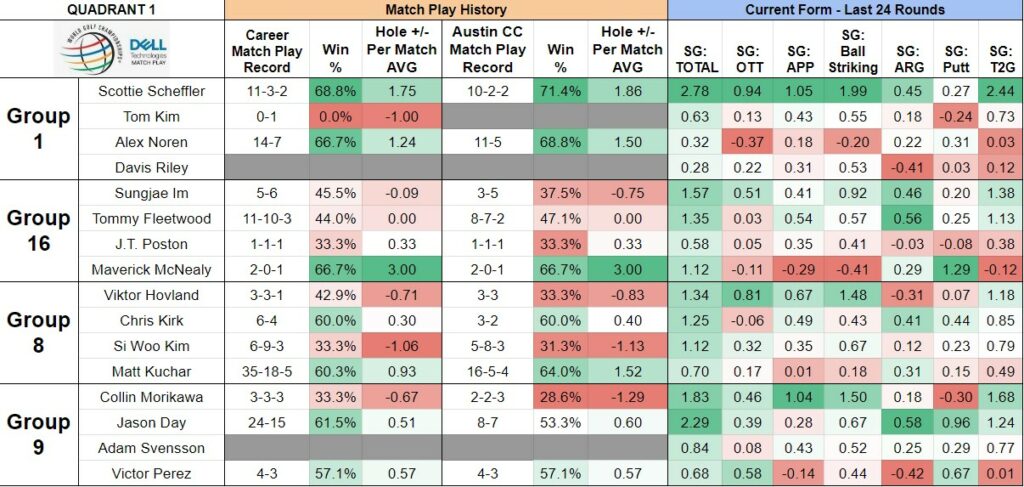
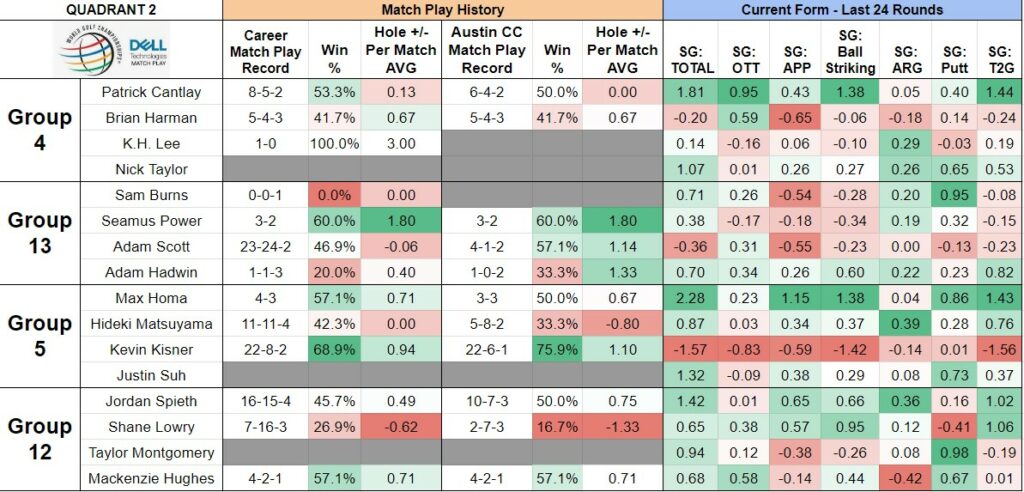
The Quadrants
Course Features
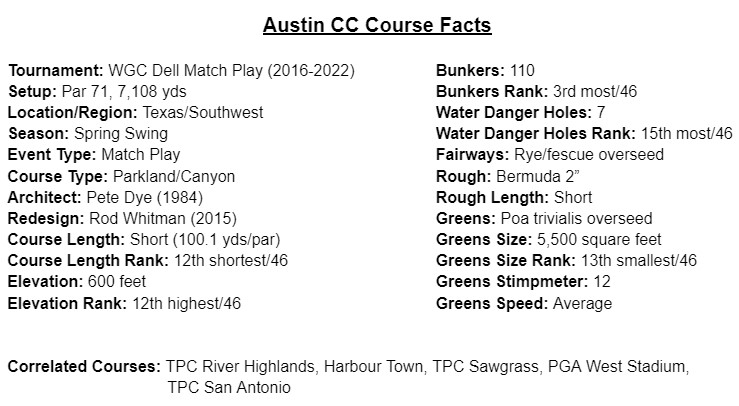
Austin Country Club is a shorter par-71 course that measures 7,108 yards. Located along the banks of the Colorado River, it spans over 180 acres of hill country vistas and canyon views just west of downtown Austin, Texas. Playing host to the World Golf Championships match-play event, Pete Dye designed a difficult test of golf featuring uneven lies, forced carries, and menacing pot bunkers that challenge the best golfers in the world. True to his reputation, this Dye track will force players to play positional golf by strategizing their way around the course and being sharp with every club in their bag.
While the course does have Bermuda grass in play throughout much of the year, it is still dormant during this time in March because of the cooler temperatures. So the fairways are overseeded with ryegrass and fescue while the rough is an ugly dormant brown Bermuda and is very short at only two inches. The greens are Poa trivialis and are the same surface as was just seen at both the PLAYERS and Valspar Championships. While many of the greens have undulations and numerous tricky areas, they run around a 12 on the stimpmeter which is Tour-average speed.
The front-nine plays more like a traditional Texas-style course. Pete Dye used the rolling hills and naturally elevated terrain of the property to create more of a rugged landscape full of native obstacles that will challenge players both off the tee and on their approach shots. There are often huge undulations and uneven lies throughout the fairways and green complexes.
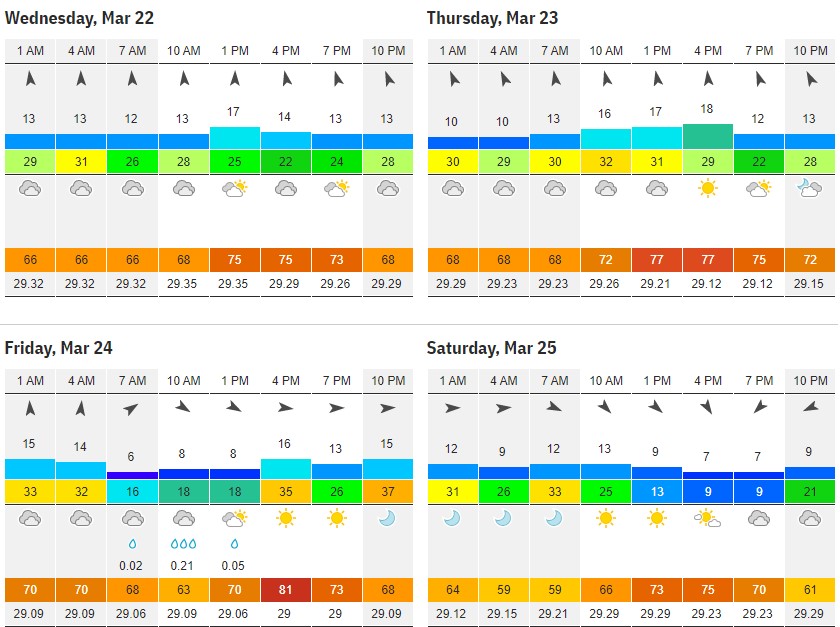
The back-nine is much lower in elevation with holes 12-16 playing closest to the Colorado River with the famous Pennybacker Bridge as a backdrop. Not only are there more water hazards on this side of the course, but we also see numerous Scottish-style pot bunkers as well as some of Dye’s notorious elongated fairway bunkers. The pot bunkers can be so troublesome that golfers are often forced to pitch out sideways in order to have a target towards the hole. In fact, Austin Country Club’s 110 bunkers are the third-most out of any Tour course. As players come down this closing stretch of holes, the trademark Texas winds can also play a big factor as this side of the course is more wide open and affected by gusty breezes.
Not only does the course have a scenic backdrop, but it sets up to be an excellent match-play course with three lengthy par 5s along with five par-4s under 400 yards. There are a couple of holes down the stretch that reward boldness for players who might be trailing in their match and need to take some risks. This includes the driveable 317-yard 13th hole over water and the 368-yard 18th hole which is downhill.
While the course is somewhat generous off the tee with wider fairways on many holes, it is filled with deep bunkers, a handful of water hazards, sidehill lies, and surrounding canyons to penalize those who are spraying their drives. Unless super accurate, bombing away off the tee here is simply not a wise choice. Any advantage that longer hitters have is neutralized on most drives.
Like always, but especially here for this event, some of the best ball-strikers in the world are also among the best match-play performers. While you can win some matches by scrambling or two-putting for pars, birdies are the name of the game for winning match play. And with flag sticks typically placed in tight positions and the greens being undulated, keeping the ball out of trouble off the tee, and then hitting approach shots with accuracy to the proper quadrant will be crucial.

Top 10 Most Important Stats
- SG: APP
- Fairways Gained
- Bogey Avoidance
- Scrambling
- Good Drive%
- Par 5 Scoring
- SG: Putting
- Proximity 175+ yards
- Birdie or Better %
- SG: Total on Short Courses
Austin, Texas Weather Forecast (March 22-26)