The PGA Tour heads north up the Pacific Coast to the Monterey Bay Peninsula for the second “Signature” event of the year featuring the iconic Pebble Beach Golf Links. And with what is a welcome change for many – the zaniness is gone. No more Bill Murray or Jason Bateman. No more six-hour rounds. No more pathetic celebrity exhibitions. This year’s event will be unlike any in recent memory thanks to drastic changes to the tournament structure.
“We’ve gone from 156 two-person teams to 80 two-person teams, we’ll play two golf courses instead of three,” pro-am tournament director Steve John said. The 54-hole cut has been removed. On Thursday and Friday, thirty-six holes will be played between Pebble Beach and Spyglass Hill, removing the Monterey Peninsula course altogether. The final two rounds will solely be played at Pebble Beach Golf Links.
The Pro-Am will also only feature select professional athletes including Tom Brady, Josh Allen, Larry Fitzgerald, and Pau Gasol among others. There will be no Hollywood actors or entertainers playing in this year’s event. The purse has also increased from $9.3 million to $20 million with the winner earning $3.6 million.
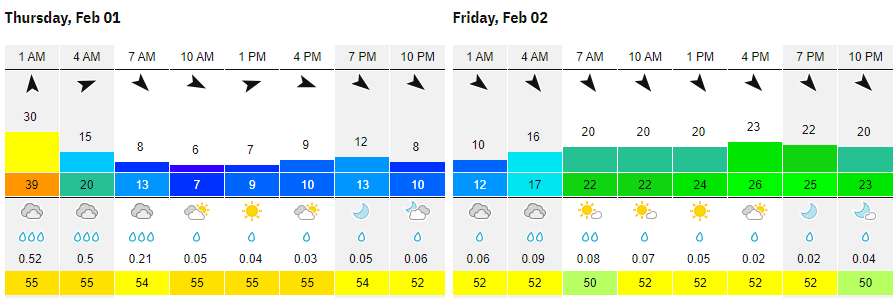
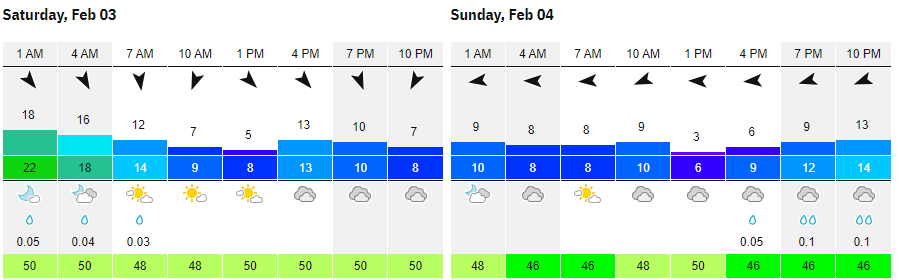
With both courses exposed to the Pacific coast, the weather can change quickly and influence the outcome of this tournament. Both courses share other similarities as well. Each is among the shortest courses on Tour at under 7,100 yards. Each is among the top five of smallest greens with Pebble Beach coming in at the most minuscule on Tour at an average of only 3,500 square feet. And finally, each course has the same agronomy with a blend of Poa annua and Ryegrass in the fairways and rough along with pure Poa greens.
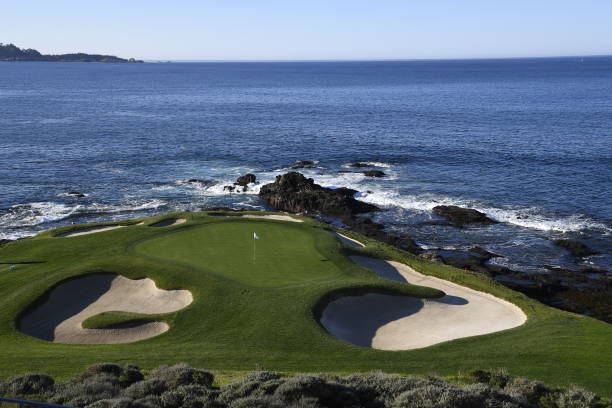
While Spyglass Hill is scenic in its own right, Pebble Beach is the crown jewel of this tournament. The way the jagged coastline meets the cliffs is beyond words. It truly is the greatest meeting of land and sea in American golf. Said Jack Nicklaus, “If I had only one more round to play, I would choose to play at Pebble Beach. I loved this course from the first time I saw it. It’s possibly the best in the world.”
Having hosted this event since 1947, past winners are a historical “who’s who” of golf including Ben Hogan, Byron Nelson, Billy Casper, Ken Venturi, Johnny Miller, Jack Nicklaus, Tom Watson, Davis Love III, Vijay Singh, and Tiger Woods.
A second-shot course if there ever was one, players will be provided with a challenging test of patience, pitching wedges, and Poa putting. For those who played last week at Torrey Pines, the emphasis shifts from distance and long-iron play to short-iron precision on equally difficult greens. Since 2010, winning scores have averaged 18-under par with last year’s champion, Justin Rose, finishing at that number. With a cold and wet winter thus far, expect much softer greens and scoring conditions similar to last year.
The Field
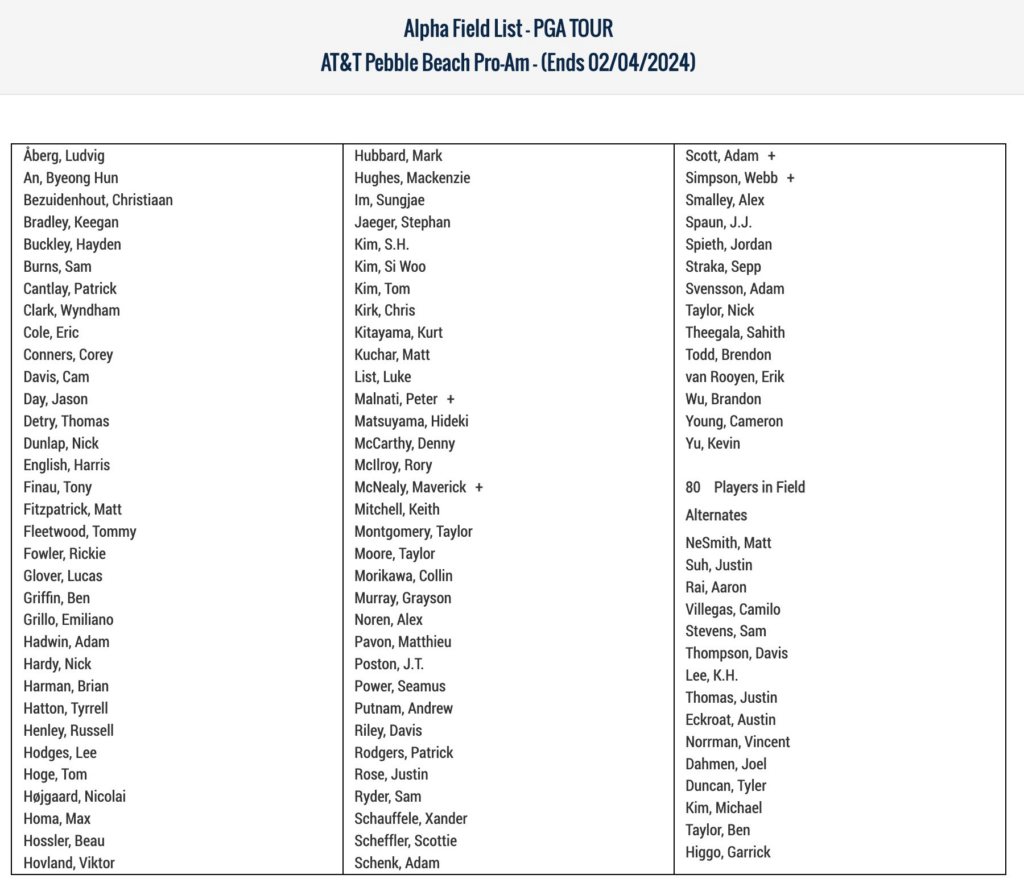
In recent years, this tournament has struggled to attract an elite field. In fact, last year just 21 of the top 100 in the Official World Golf Ranking were in the field with more than half ranked outside the top 300. Between more lucrative events overseas, its place on the schedule before the popular Phoenix Open, and most golfers not wanting to play six-hour rounds with amateurs, the best players have annually skipped Pebble Beach. “For years I’d hear I’d love to come to Pebble, but it just isn’t working for me,” said John. Turning it into a “Signature” event with a huge prize pool was needed to help restore the luster of this once-beloved event.
This year, every eligible player in the top 30 of the world rankings, including the entire top 50 in the 2022-2023 FedExCup standings will be in attendance at Pebble Beach. Also playing are the top 10 finishers in the FedExCup Fall standing along with the best points earners from the last three “swing” events (Aon Swing 5).
Pebble Beach Course History
Pebble Beach Golf Links was built by Jack Neville and Douglas Grant during the golden age of golf course architecture in 1919. When it opened for play on February 22nd, it measured slightly over 6,000 yards. “The big idea was to get as many holes as possible along the bay,” Neville said. “Nature had intended it to be nothing else but a golf links.”
The San Francisco Chronicle said the course was opened “somewhat prematurely.” At a time when golf balls cost more than the greens fee, the course was deemed too difficult. The California Golf Association, however, did not believe the course suitable to host even the state amateur. Improvements were continually made over the next decade, culminating with a renovation to prepare Pebble Beach to host the 1929 U.S. Amateur, which was the first of the United States Golf Association’s major championships to be held west of the Mississippi.
Neville’s and Grant’s routing provided the framework for today’s course, but H. Chandler Egan is most responsible for how the course plays today. In 1928, he extensively revised the layout by replacing 16 of the 18 greens and completely reconfigured the bunkering on the course bringing much more strategy into play. Other architects who have helped to renovate the course in different ways include Alistair MacKenzie, Robert Hunter, Arnold Palmer, and Jack Nicklaus (who created the new 5th hole in 1998).
The Pebble Beach National Pro-Am was originally called the Bing Crosby Pro-Am, and it has been held at Pebble Beach Golf Links every year since 1947. This year’s tournament notwithstanding, this event has typically had a trio of courses in play for the week. Along with Pebble Beach, Spyglass Hill and Monterey Peninsula – Cypress Point and Poppy Hills have also been utilized in years past. Along with all of the legendary golfers who have walked its fairways, it has hosted six U.S. Opens and one PGA Championship.
We have partnered with Vivid Picks to bring you an easy way to claim a FREE, no-strings-attached 2024 season at Betsperts Golf, plus a 100% deposit match up to $250! Click here to learn more!
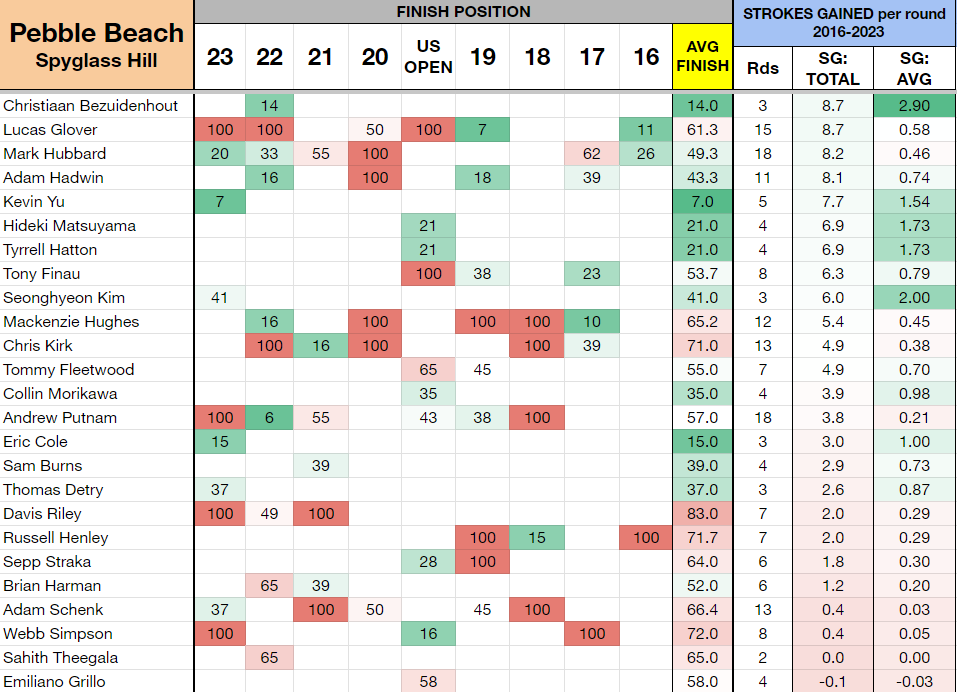
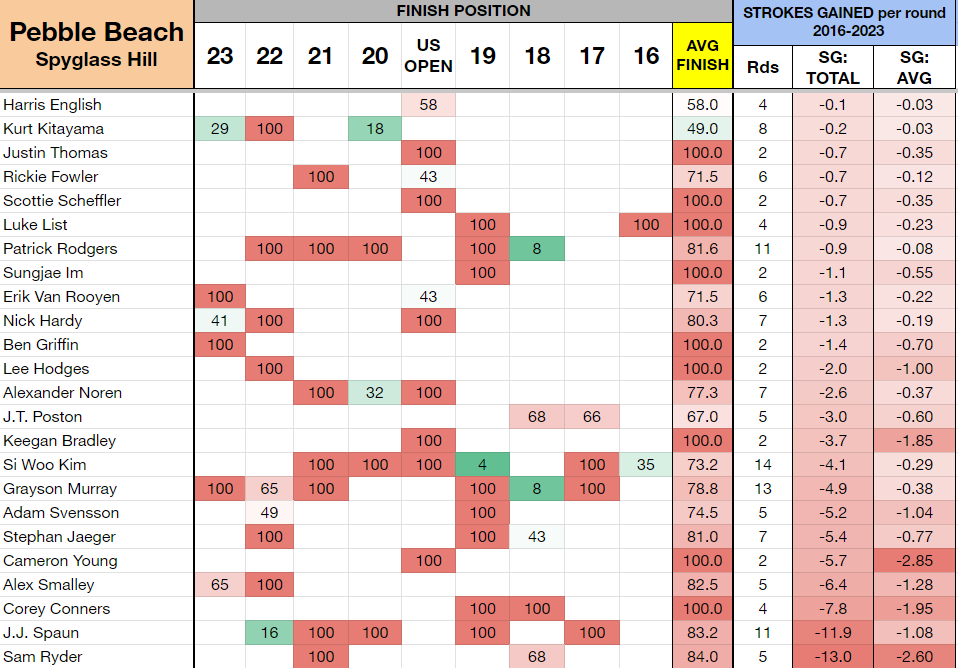
Finish Position and Strokes Gained Event History (2016-2023)
This includes the average finish position and Strokes Gained per round. Players are sorted by SG: Total. Pebble Beach Golf Links is the 17th (out of 44) most predictive annual course on Tour.
f684b2f3d4218ee06dad551b3bb2074b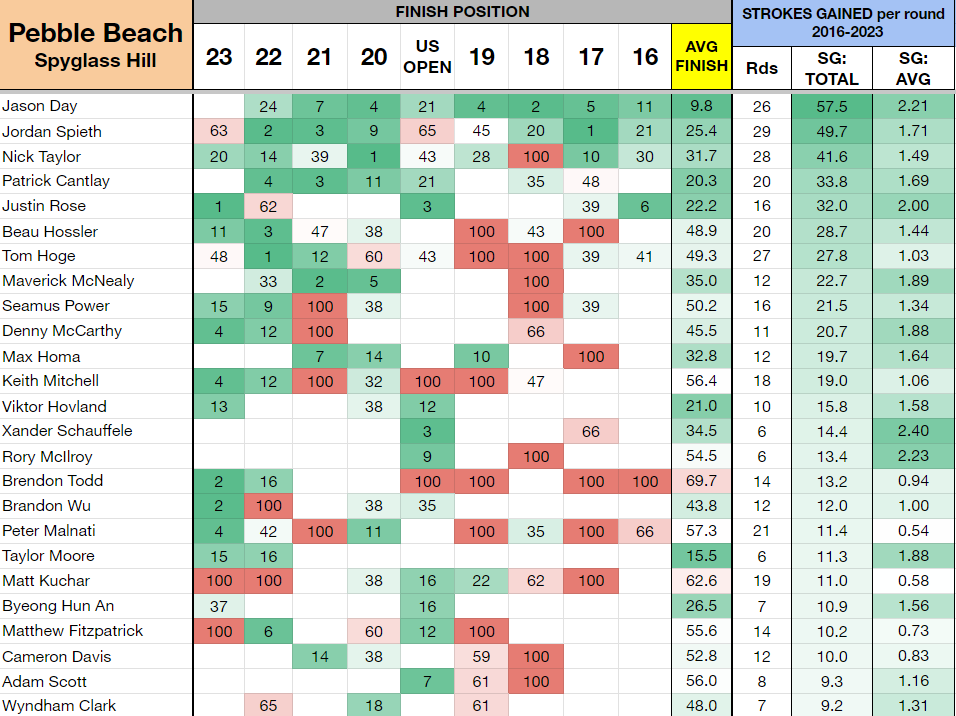
Pebble Beach Golf Links – Course Features
With Pebble Beach typically only hosting two rounds per year at this event, the other rounds have been played on non-ShotLink courses, meaning there is no historical Strokes Gained data for half of this event. Thus, there will not be any stat correlations for this event since the data is incomplete.
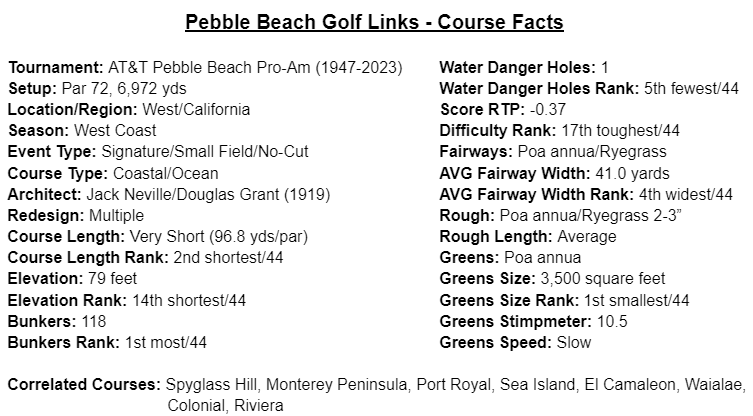
Pebble Beach is perhaps the most visually mesmerizing course in the world. It hugs the rugged California coastline along the cliffs of the Monterey Peninsula with wide open views of Carmel Bay and the Pacific Ocean. As you would expect, coastal winds are one of the course’s main defenses. Last year, winds were a factor for every round with gusts over 30 mph each day. High winds along with wet course conditions forced a rare Monday finish Overall, Pebble Beach rates as the 17th toughest course on Tour averaging 0.37 strokes under par per round since 2019.
Unlike the U.S. Opens that were held here, the course is usually set up with wide fairways and non-penal rough so that the amateurs playing in the pro-am can get around the course in a timely fashion. However, with actual athletes mostly making up the amateur pool this week and perhaps the best field this event has seen, it will be interesting to see if the course setup is tougher than usual. One change already noticed is that the rough is listed as up to an inch longer (2″-3″) than in past years.
As for the course itself, as a par-72 that measures only 6,972 yards, Pebble Beach is the 2nd shortest track on Tour. Other than Congaree, which has the most acres of sand (they are not called bunkers there), Pebble has the most bunkers on Tour with 118. The ones around the greens are notably tricky. From an agronomy standpoint, the fairways and rough are a mixture of Poa and ryegrass while the greens are the famous bumpy California Poa annua.
One of the main reasons this classical course has remained challenging and stood the test of time is the ingenious way it uses the expansive slopes that traverse the property. Most of the fairways tilt toward the ocean and are set across the holes. This results in players often hitting their approach shots from uneven lies with the ball above or below their feet. As you can imagine, this only adds to the challenge of trying to land second shots on its diminutive greens.
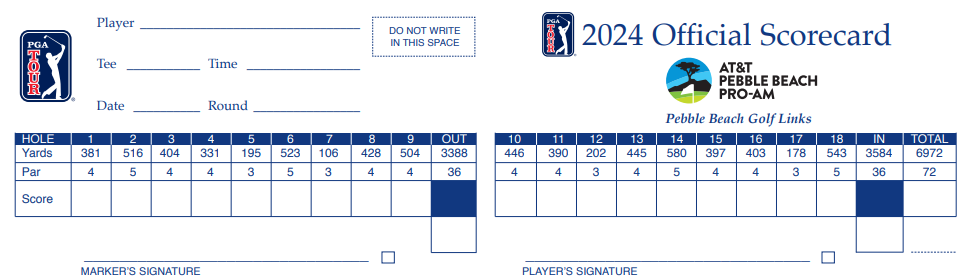
After an undemanding 7-hole opening stretch where four of the holes average under par, things toughen up quickly with three of the most difficult and scenic par 4s in the world. Many believe this stretch on the front nine constitutes the greatest sequence of holes found anywhere. The back nine does not get any more comfortable with seven of the holes averaging over par.
The par 4s and 5s play as the third shortest group on Tour averaging only 443 yards per hole. In keeping with the short theme, three of the par 5s are under 545 yards and six of the par 4s are under 400 yards. The par 5s are no cakewalk, however, as both the 14th and 18th holes present a challenge. The 14th scores over par and ranks as one of the most challenging par 5s on Tour. It plays uphill away from the water before doglegging to the right. The 18th is a risk-reward that dares players to flirt with Stillwater Cove along the coastline.
Strokes Gained Analysis
Off the Tee
Due to the numerous angles faced off the tee, players are forced to use “less-than-driver” on many holes. Because of this, along with its lack of length, Pebble Beach has the shortest average driving distance on Tour averaging only 272 yards which is well below the Tour average. Longer hitters have a minimal advantage here.
Because fairways are so wide and the rough is cut short, accuracy off the tee means little as well. Add in the fact that players are clubbing down, and the result is driving accuracy above 72%. There are fairway bunkers that litter the course along with the impending ocean beyond the cliffs, but thanks to all of the forced layups these dangerous areas are mostly avoided.
With Pebble Beach being a clear “second shot” course, the only relevant stat (in my opinion) to analyze OTT is Good Drive %, which measures how often a player lands their second shot on the green no matter where their tee shot landed.
Approach
Overall, Pebble Beach has the smallest greens on Tour at an average of only 3,500 square feet compared to the average of 6,200. With a GIR rate below the Tour average at 63%, golfers who can simply get themselves on the green and as close to the pin as possible should create the most birdie opportunities on the tricky Poa surfaces. On average, over 46% of approach shots are under 150 yards. Expect wedges galore this week. Jordan Spieth summed it up best by calling it “a dart-throwing contest to see who can make the most putts”.
With wide fairways and non-penal rough making off-the-tee impact minimal, players can separate from the field with pinpoint accuracy on approach shots. This is much easier said than done. Besides facing many sidehill lies, many of the greens are also elevated. All of these factors combined, along with the effects of the wind, make Pebble Beach the sixth toughest annual ShotLink-measured course in which to gain strokes on approach.
Those greens are one reason Rich Beem, the 2002 PGA Championship winner, called Pebble Beach “one of the most intimidating golf courses I’ve ever played.” “You get caught up in the views so easily,” he said, “and all of a sudden you’ve got all of these difficult shots into greens that look like the size of dimes.”
Around the Greens and Putting
With so many players missing greens, scrambling becomes even more important, not just from the rough, but also from Pebble’s many difficult green-side bunkers. The good news is that it’s one of the easiest courses to gain strokes around the greens as chipping from the short grass and rough areas is very simple.
Once on the Poa annua greens, the complexes at Pebble Beach are traditionally some of the hardest to putt on from within 15 feet. In fact, the greens rank as one of the five toughest on the entire Tour. Also, keep in mind that 3-putts are 26% higher here than average because of all the missed short putts. Even though they run slower at around 10.5 on the stimpmeter, strong putting splits on these bumpy Poa greens are a requirement when targeting players this week.
Spyglass Hill – Course Features
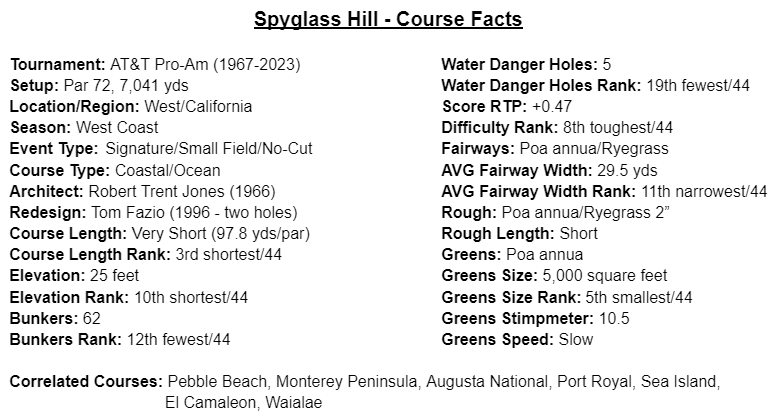
Often overshadowed by Pebble Beach, Spyglass Hill is rated as the 11th-best public golf course in the U.S. by Golf Digest and is one of the most underrated courses in America. Designed by Robert Trent Jones in 1966, it is operated by the Pebble Beach Company and has been in the rotation for this event since 1967.
Spyglass Hill is a 7,041-yard par 72 course that most players agree is the most difficult test of the three layouts when conditions are calm. It averages 0.47 strokes over par per round which makes it the 8th toughest annual course. It is rated one of the most challenging courses in the world from the Championship tees, boasting a course rating of 75.5 and a slope rating of 147. When the wind kicks up, however, it tends to become the “easiest” of the three because it is the most tree-lined and sheltered from the coastal breezes. Many a golfer has described Spyglass as relentless and a course that demands high-quality golf shots.

The first five holes are among the most beautiful in the area and lie exposed to the coastline. But the remaining holes turn inland and wind through the Del Monte forest. Robert Trent Jones said that the opening coastal holes through sand dunes are supposed to bring memories of Pine Valley, while the rest were designed to mimic Augusta National.
Thanks to the tree-lined fairways, the course is better protected from any poor weather conditions. These holes often contain dramatic elevation changes with a good number of them playing uphill with fairways substantially tilted in different directions. This makes Spyglass play longer than its measured yardage. Three of the par 3s play under 180 yards while four par 4s play under 400 yards. The four par 5s have an average birdie or better rate of 36% and are by far the four easiest holes on the course.
The biggest difference between Spyglass and Pebble Beach is that distance off the tee is a much more predictive measurement of success at Spyglass than it is at Pebble. Along with the sloping terrain, the 13 forested holes play very straight with few doglegs. The fairways also don’t bottleneck in as much as they do at Pebble Beach to force a layup. With straighter holes, golfers can swing away with drivers at Spyglass much more then they can at Pebble Beach.
That being said, the average fairway width is much more narrow here at only 29.5 yards. The rough is also described as being thicker than the alleged 2″ listed by the GCSAA. Those facts, combined with relatively small greens at an average of 5,000 square feet per hole make Spyglass Hill one of the most stringent ball-striking challenges you can find.
With this being a Robert Trent Jones course, you had better believe there are some challenging bunkers. Elevated greens are protected by a cadre of large and deep sand traps, many of which lie well below the level of the green.
The greens are full of “sucker pins” in difficult locations. Players who simply aim for the middle of the green and feed the ball toward the hole have much more success than those trying to attack the pin. While the greens don’t have huge undulations, most have subtle ridges and tiers which make reading the breaks on many putts quite difficult.
Most Important Stats For Success at the AT&T Pebble Beach Pro-Am
*In order of importance
- SG: APP
- SG: Putting (Poa)
- SG: Coastal Courses
- Proximity 75-150 yds
- SG: ARG/Scrambling
- Good Drive %
- SG: Short Courses
- Par 5 Scoring
- BoB%
- Bogey Avoidance
Weather Forecast – Pebble Beach, CA