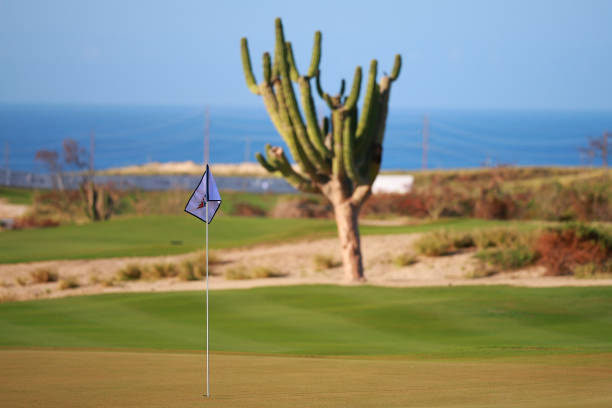
After a break from action over the past week, the PGA Tour heads to a new course, El Cardonal, in Los Cabos, Mexico for the World Wide Technology Championship. Opened in 2014, this 225-acre parcel in the foothills of the Baja California desert is the first golf course designed by 82-time PGA winner Tiger Woods and is the first time that a Tour event will be held on one of his courses.
El Cardonal’s design was inspired by the classic Golden Age courses on the West Coast that Woods played growing up. With several options for navigating each hole, proper decision-making is rewarded, as he created a course that emphasizes strategy and creativity.
Providing dramatic views of the Pacific Ocean, Diamante is a private resort located at the southern tip of Mexico’s Baja California Peninsula in the state of Baja California Sur. In addition to El Cardonal, Diamante also features the Dunes Course, designed by Davis Love III.
The World Wide Technology Championship is one of two FedExCup events in Mexico, along with the Mexico Open at Vidanta. The event previously had been played at El Camaleon Golf Club south of Cancun in Mexico’s Riviera Maya. But after 16 years of staging a PGA Tour event, the Greg Norman-designed course unsurprisingly ended its relationship with the Tour and instead hosted the inaugural event of the LIV Golf league’s second season in February.
Characterized by wide fairways, strategically placed bunkers, and enormous undulated greens, the resort-style course should be a birdie-maker’s delight. While howling winds off the coast and the encroaching desert arroyos will provide some pushback, El Cardonal should feature plenty of scoring opportunities throughout.
The Field
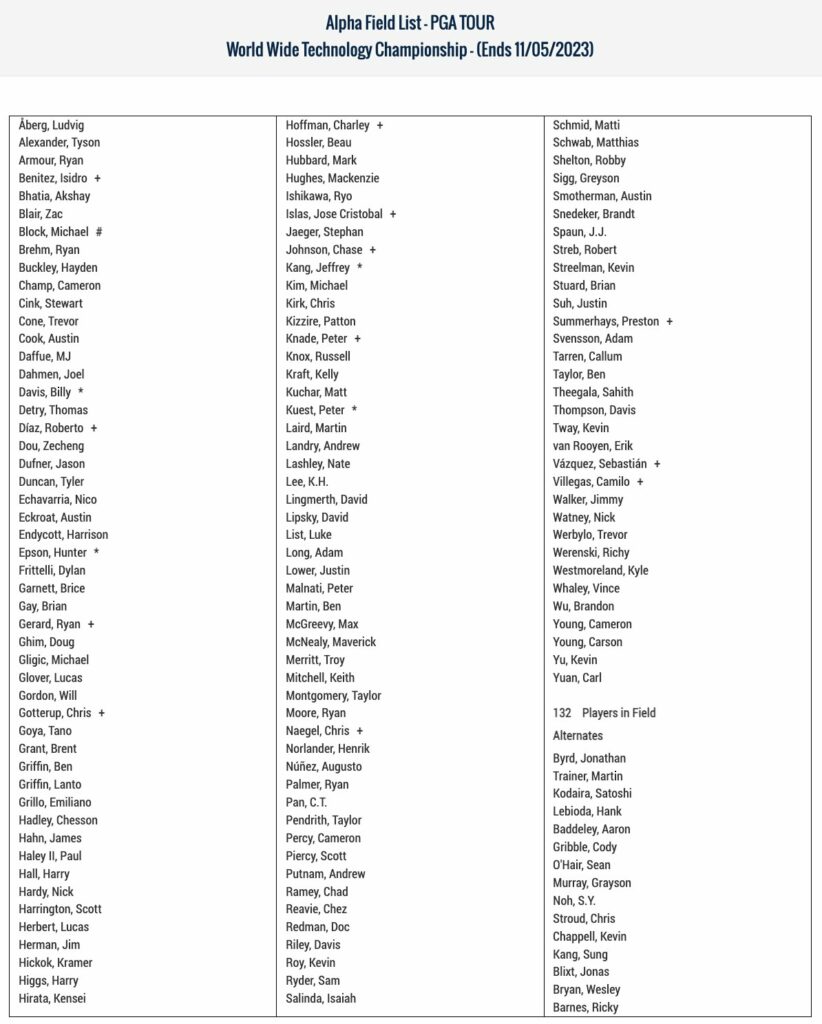
Though lacking in star power, this week’s World Wide Technology Championship will have 22 of the top 100 ranked players in the world in attendance, including Cameron Young, Sahith Theegala, Lucas Glover, Emiliano Grillo, and Ludvig Aberg. Featuring a field of 132 players, 500 FedExCup points and jobs are on the line as time is running out to become eligible to make the final top 125 for next year’s season, which begins in January.
Eligibility into the first few signature events next year also is based on this year’s points, so getting as close as possible to the top 50 is vital. Beau Hossler, Taylor Montgomery, Nick Hardy, and Ben Griffin are each among the golfers in this field who are sitting in the 51-60 range.

Course Features
Named after the tall, multi-armed cactus that thrives in the natural environment on the Baja California peninsula, El Cardonal at Diamante is a par-72 layout that stretches to 7,452 yards from the back tees. When taking into account the annual courses that encompass the Tour schedule, it would rank as the 15th longest. With fairways averaging 60 yards wide, it has the widest landing zones of any course played over the past decade with the exception of the Old Course at St. Andrews. Players have the ability to bomb away with the driver on every par 4 and par 5 hole.
The scale of El Cardonal is vast. With many elevated areas and the ocean in view, it seems the course stretches as far as the eye can see. The land drops over 240 feet along the mile stretch of land from the 17th tee to the third fairway. The course sits on a broad landscape dotted with palo verde trees, cacti, and desert flora.
Off the tee, the desert arroyos, native dunes, and well-placed fairway bunkers provide numerous risk-reward options. Somewhat similar to the barrancas found at Los Angeles Country Club, the site of the 2023 U.S. Open, an arroyo is simply a narrow steep-sided sandy channel in the ground that is usually dry except after heavy rain. Numerous fairways are routed around these sandy arroyos. With no rough in play this week, and only one hole with a planned water hazard, these arroyos are penal and will be among the main obstacles for golfers to overcome this week.
Due in large part to the expansive fairways, there are a variety of angles and options off the tee in strategizing for the best possible approach to the green. Players must decide whether to take on the arroyos and bunkers to set up easier approaches or to play it more conservatively, which results in a longer approach. When approaching the greens, the bold and sharp contours of the bunkers tend to deceive golfers into thinking they are closer to the greens than they appear.
As Tiger Woods said about El Cardonal, “I set up the golf strategy to make golfers think and make choices. Regardless of your handicap, there are going to be different ways to play every hole. Angles of approach are going to be very important and will dictate the type of shots you should consider. I love this kind of golf.”
Another potential course defense is the ocean winds that typically blow out of the north but can flip and gust from the south within minutes. Sudden reversals in conditions will provide a challenge to players and caddies alike. As of now, calm breezes and sunny skies are forecast throughout the event with daytime highs in the low 80s.
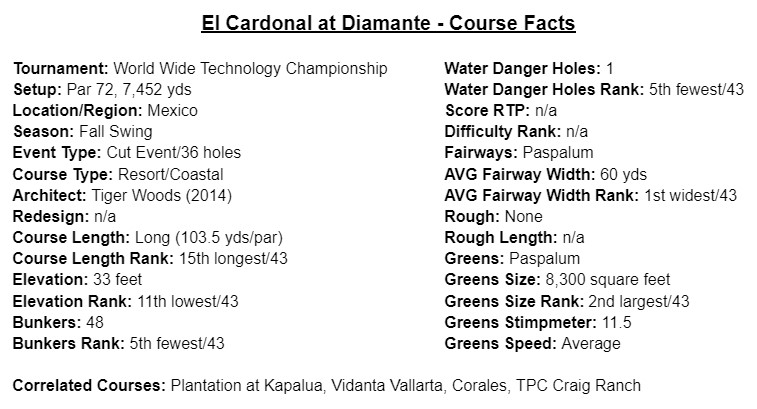
The greens are absolutely massive, averaging 8,300 square feet on average, which places them as the second largest on Tour, behind only the Plantation Course at Kapalua. This will bring lag putting into play, and golfers who excel at avoiding three-putts will have an edge on the field. The greens here at El Cardonal have their own distinctive flair to them with their different forms and shapes. Examples are the T-shaped 8th green or the three-tiered surface on the 18th hole. Their size and contouring also allow for numerous options for pin positions.
Looking at the turf, golfers will see wall-to-wall Platinum paspalum which is common on resort coastal courses. The course features 7 acres of fairway on turf that normally plays firm and fast due to the dry and windy conditions. Paspalum often produces favorable lies in fairways and other short grass areas and produces a consistent roll on the putting surfaces that will run at a speed of around 11.5 on the stimpmeter. There’s also no rough at El Cardonal, which is not an uncommon omission on resort courses. This lack of rough around the greens will allow for an abundance of options in attempting to navigate the expansive putting surfaces.
El Cardonal weaves through dune-framed fairways on the front nine and over the desert arroyos on the back. The course begins and ends with a gentle handshake with two easy, downhill par 5s that will see plenty of birdies and eagles. Woods always feasted on the par 5s so it’s no surprise he created four reachable scoring holes.
After going downhill for Nos. 1 and 2, the short, driveable 351-yard par 4 third hole is on flat ground on the lowest section of the course. It marks the transition point for the uphill climb starting with the 483-yard, par-4 fourth that goes up 30 feet from tee to green. Following that, the 601-yard, par-5 sixth ascends 70 more feet to the green. The course then turns back down the hill at the 489-yard, par-4 seventh. That hole dives 60 feet from tee to green. The roller coaster ride continues with the stretch from the 10th to the 14th involving up-and-down switchbacks on every hole.
Top 10 Most Important Stats
- SG: APP
- Driving Distance
- 3-Putt AVD
- Birdie or Better %
- SG: Putting (Bent)
- Opportunities Gained
- Par 5 Scoring
- Sand Save %
- SG: Easy Scoring Conditions
- Proximity 175+ yds