*In case you missed it, here is an excellent discussion on strategies, and favorite plays for every pricing tier for the DraftKings slate. My thoughts are fully encapsulated here in the show. If anyone has specific player questions, I’ll be checking Discord all night until lock.
Strategy
This week is a perfect example of a wide-open tournament full of volatility and variance. Anytime a course has an easy hit rate of both fairways and greens, the gap between the best and worst players gets shrunk. Combine this easy scoring with a weaker field and the threat of water danger everywhere, and you have the perfect setup for some extreme randomness.
What I love about the DraftKings slate this week is that there is so much boom or bust potential with many of these players in the field. You could start a lineup with Tony Finau, Justin Thomas and Tom Hoge and their combined 28% ownership and have enormous upside. You could bottom out your lineups with Adam Svensson, Sam Bennett and Davis Thompson and acquire huge upside from the bottom of your lineup. This week is all about finding that upside for me. Will be taking more stands on fading chalk this week because anybody can have a blow up hole on this course.
At the top of the board, Cameron Young is my favorite play. After struggling through a two-month stretch between April and June, Young has emerged back to the ball-striking and dominant off-the-tee savant that saw him rise to a top-15 player in the world. He gained a staggering 16.8 strokes ball-striking at last week’s 8th place finish at the Open Championship which was preceded by a a 6th at the John Deere Classic. It’s also not a coincidence that a dramatic turn in performance occurred after switching back to the golf ball that he had most of his success with in the past. With his combination of accuracy and distance off the tee, he is a perfect fit to combat the water hazards at TPC Twin Cities.
I will also have a good deal of Tony Finau simply because of his upside. Not only do we have FedEx Cup points on the line but with a guy like Finau, he has the motivation to try to make a Ryder Cup team. It’s always hard to measure motivation but I see him playing very focused this week, especially coming off consecutive missed cuts. As for the rest of the plays that I like, each one is discussed in detail on our DFS show that is posted above.
The Course and Stats That Matter
The overriding feature and defense of TPC Twin Cities is one of mankind’s most basic needs for survival – water. But for the 156 golfers teeing it up on Thursday, their main goal is to stay as far away from the wet stuff as possible. 27 lakes dot the 235-acre property, which includes 13 holes with direct water danger. Players who have the accuracy off the tee to keep their ball dry and who are strong ball-strikers with their irons and can set up close birdie chances will have the best opportunity to survive the cut-line and propel themselves up the leaderboard over the weekend.
You also should not shy away from players who struggle around the green or with their putter, as that will not have much impact this week. Last year’s winner, Tony Finau had lost strokes putting in 11 of his 17 events leading up to the 3M Open and only gained 0.8 total strokes putting the week of his victory. And 2021’s winner, Cameron Champ was literally in the bottom-10 on Tour the week of leading into the 3M. He ended up leading the entire field in putting. This week, we have numerous players in the field who are excellent ball-strikers but who have been struggling with the putter. Players like Cameron Young, Gary Woodland, and Aaron Rai fit this category.
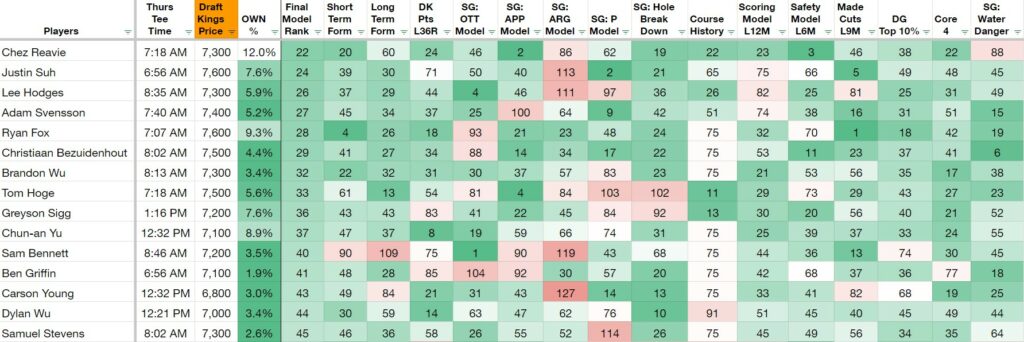
There are a few other data points to consider when choosing players this week that I have included in the model. One of which relates to all the water danger on the course, which mostly affects players off the tee (OTT). I gathered OTT data on every course on Tour going back to 2019 that had at least nine holes with water directly in play. This gives some historical perspective on which players are more comfortable on these types of courses with a lot of water. That split was included in the OTT sub-model this week. Good Drive % is another vital stat because it measures the success of getting one’s approach shot to the green from any lie on the course. If a player ranks highly in that metric, there is a very good chance they are likely to stay out of the water.
I also included a “water danger” split for strokes gained per round for the same time frame. The top five players on courses with the most water danger since 2019 (with a minimum of nine rounds) are Justin Thomas, Tony Finau, Eric Cole, Cameron Young, and Sungjae Im.
Finally, course history and even recent form have proven to not be as correlated with success on this course or on easy courses in general. This week in the model, I have weighed long-term form (12 months) almost equally with recent form. The cream doesn’t always rise to the top. But in a weaker field such as this, strong long-term players like Keith Mitchell or Christiaan Bezuidenhout (neither of whom are highly valued this week) make for great leverage plays. Also, players who thrive in easy-scoring conditions with weak fields make better plays than just looking at recent form. That metric has also been added to the model this week.
As for the course history angle, Matthew Wolff won here back in 2019 in only his fourth career start on Tour. 2020’s winner, Michael Thompson, finished dead last among cut-makers in 2019’s event. 2021’s winner Cameron Champ missed the cut in his only previous appearance at TPC Twin Cities. With this course ranking as the eighth least predictive on Tour, course history was given a very minor weight in the model this week.
Most Important Stats For Success at TPC Twin Cities
*In order of importance
- SG: OTT
- Total Driving
- SG: Approach
- Bogey/Double-Bogey Avoidance
- Good Drive %
- Proximity 175+
- Birdie or Better %
- Par 4 Scoring
- Par 5 Scoring
- SG: Easy Scoring Courses
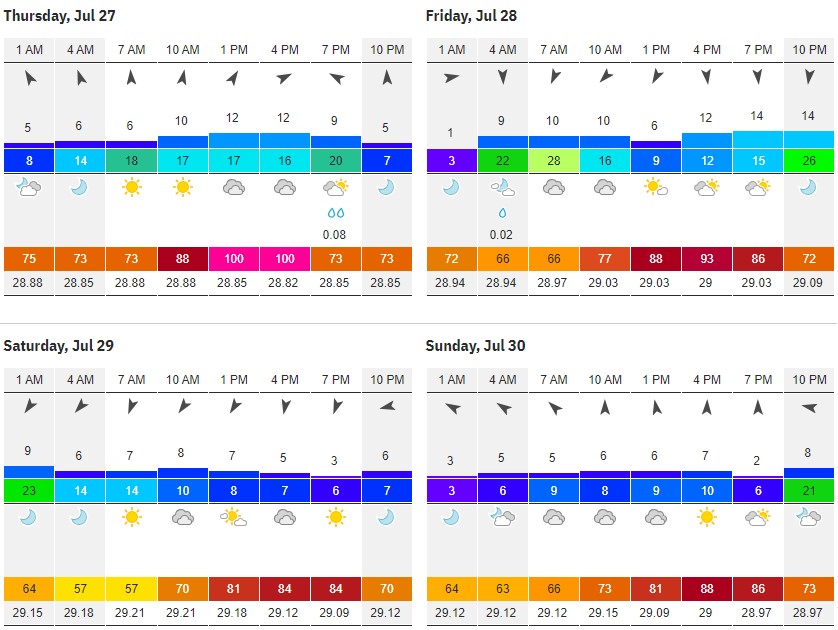
Weather Forecast – Blaine, Minnesota
3M Open – DraftKings Picks
Each week along with presenting my top choices for each of the categories below, I will include each of the pertinent stats for the specific event that comes directly from my model. Except for the “Core Plays,” which most weeks will typically be somewhat on the chalky side, I will include at least one player I am positive on who is forecast to be lower-owned and who will present a good pivot from some of the higher-owned options. In essence, the players you see below make up the majority of my player pool for this event.
Core Plays

Upper-Tier Plays

Mid-Range Plays

Value Plays