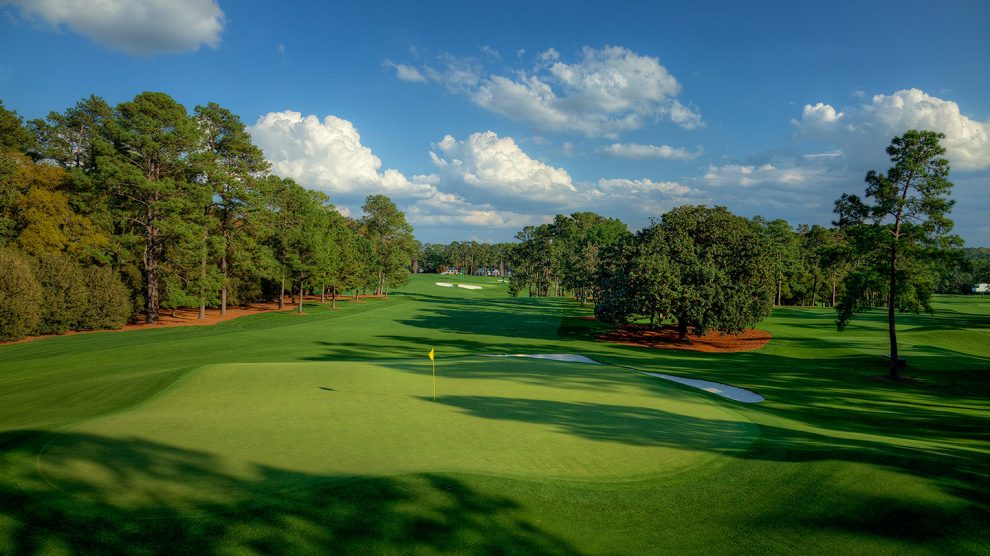
Undulating. Treacherous. Personalized. Secretive. The purest bentgrass on the planet. The greens at Augusta National Golf Club are without a doubt “one of a kind.” Every green is unique in that each one follows a different template that is dependent on its relationship to the approach shot required to play into it. Understanding the individual slopes and contours, the swells and plateaus – including the best places to miss on approach – takes years of experience.
Located in the heart of bermudagrass country, Augusta, Georgia is home to the world’s most famous golf tournament, the Masters. But due to the event’s timing being early in the spring, bermudagrass in northern Georgia would still be somewhat dormant. In order to have the best greens possible, bentgrass, a cool-season turfgrass is used instead. Most professional golfers will tell you that bentgrass greens provide the smoothest and most consistent putting surface.
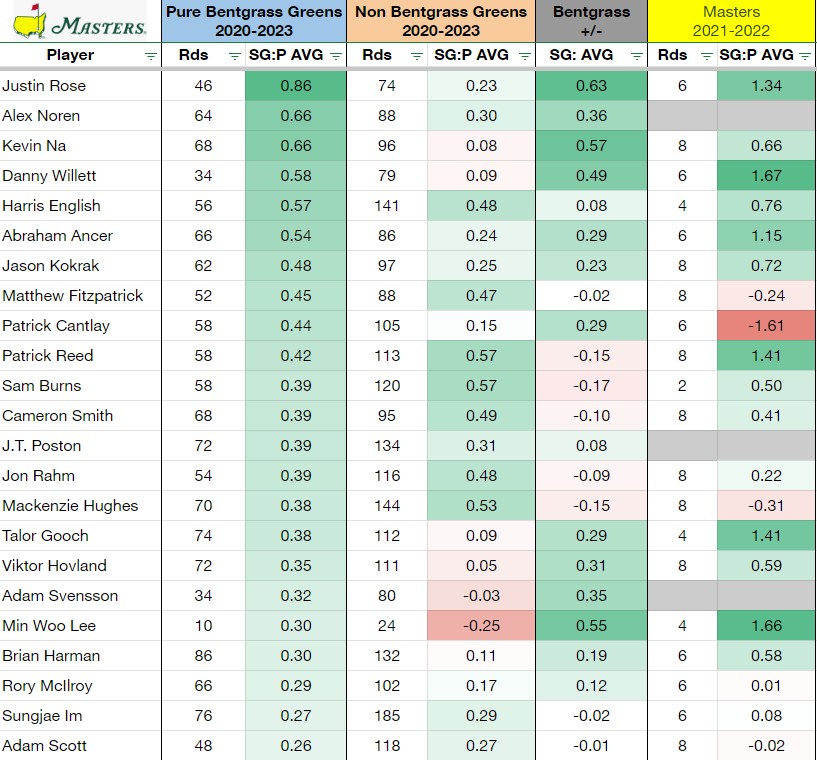
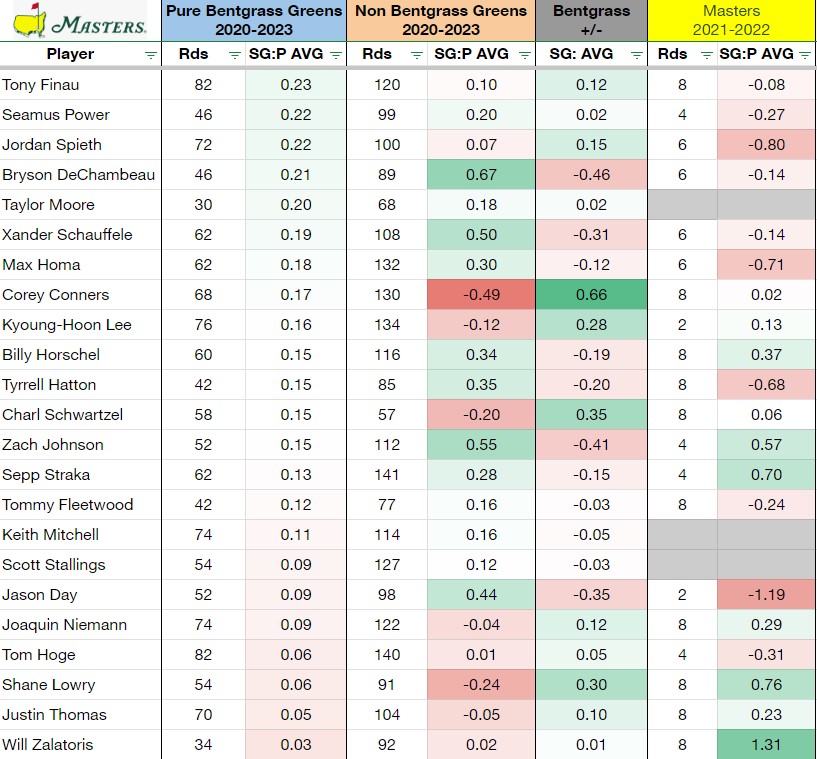
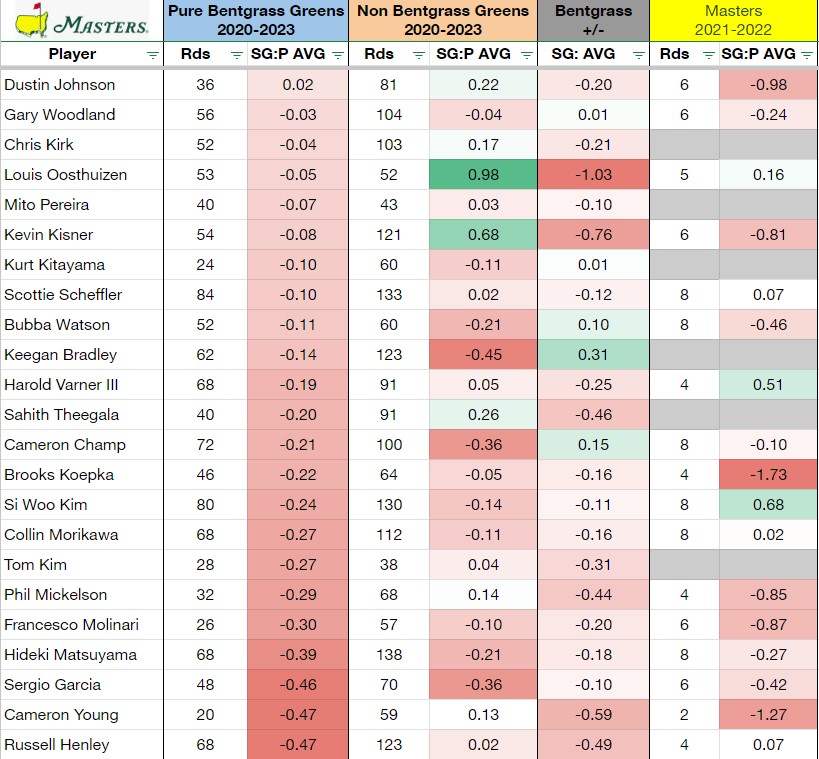
With the Masters upon us, let’s take a closer look at how the players in the field have historically performed from a Strokes Gained: Putting perspective on pure bentgrass greens since 2020 and also compare that number to their baseline putting average on non-bentgrass greens from the same time period. Notice that there are some past Masters champions high on the list (Danny Willett and Patrick Reed) and a couple that are closer to the bottom (Sergio Garcia and Hideki Matsuyama).
One of the main characteristics that the greens at Augusta are famous for is their extreme undulations. Overall, they are some of the most severely sloped greens anywhere, and when combined with their lightning speed, are downright treacherous. Everything about Augusta National has always been very secretive. They have never released the average green speed, nor their firmness level to the public. One reason is that the playing condition varies for each separate green complex. Due to some greens having more slope than others, each green is mowed differently and thus a uniform speed can not be given.
According to noted professional agronomist David Marcucilli, each green at Augusta National receives personalized treatment and conditioning that best reflects its slope, pin location, and shot-making values. The greens are also brushed before they are mowed. This promotes an upright blade orientation on the grass to ensure a uniform cut. Doing this also eliminates any grain on the greens, allowing them to run even purer.
Back in 2010, an unofficial rating of the course was conducted and green speeds ranged from an average 12′ to an ultra-fast 15′ on the stimpmeter. The variance in speed is meant to protect golfers on the holes that have the most contours and sloping. Players themselves have often noted that even on shorter putts they are sometimes simply trying to “lag putt” to a certain spot because if they putted directly at the hole and missed, the ball could roll off the green. With strokes gained data for the Masters only becoming available two years ago, we can now get a better picture from a statistical standpoint of just how difficult the greens are at Augusta National. The difficulty rankings are based on the 40-plus annual PGA Tour courses that are utilized in competition each year.
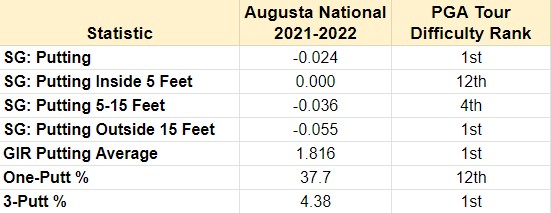
We can clearly see that putting is significantly more challenging than the average PGA Tour course. Augusta National has the highest 3-putt % by a large margin compared to other annual Tour courses. Now let’s analyze how players in the Masters’ field have performed since 2020 on other difficult greens that have similar sloping and lightning-fast speed. Some of these other courses with tricky green complexes include Winged Foot, Riviera, Olympia Fields, Torrey Pines South, Southern Hills, Quail Hollow, and others. Similar to the bentgrass data, past winners are scattered throughout this ranking as well. Reed, Zach Johnson, and Adam Scott have each performed consistently well on tougher green complexes recently and throughout their career, while Charl Schwartzel, Matsuyama, and Bubba Watson have struggled.
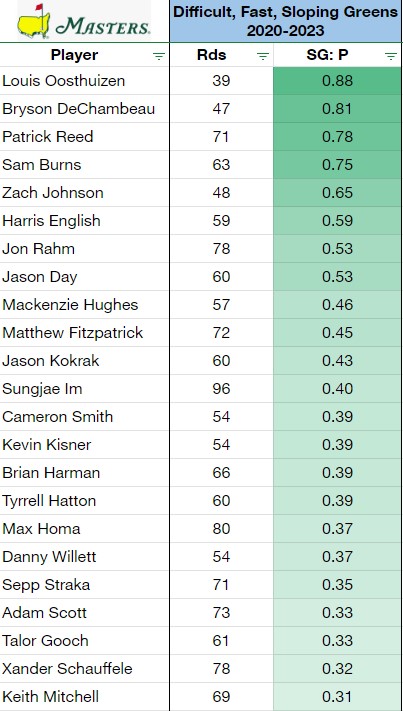
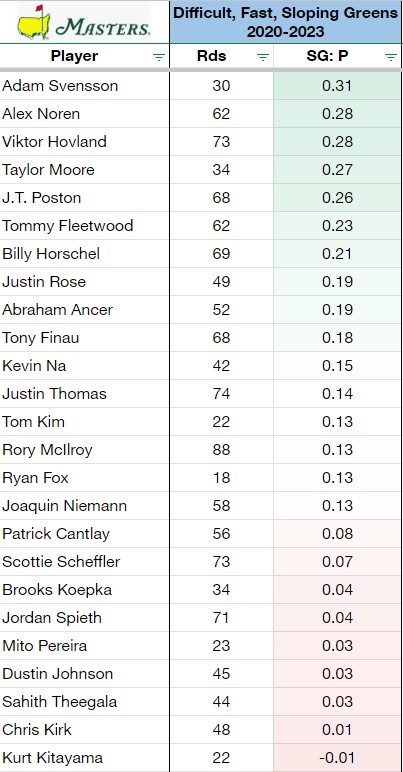
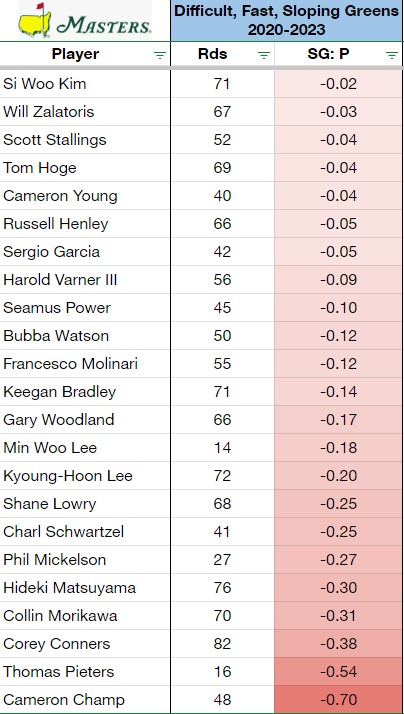
Now that we have determined that a player does not necessarily have to be a proven putter on bentgrass, nor on difficult speedy greens with extreme sloping to win the Masters, let’s check the overall Strokes Gained: Putting ranking of the past 15 winners in the season leading up to their victory.
2022: Scottie Scheffler – 58
2021: Hideki Matsuyama – 175
2020: Dustin Johnson – 48
2019: Tiger Woods – 74
2018: Patrick Reed – 72
2017: Sergio Garcia – 162
2016: Danny Willett – 60
2015: Jordan Spieth – 9
2014: Bubba Watson – 109
2013: Adam Scott – 130
2012: Bubba Watson – 142
2011: Charl Schwartzel – 96
2010: Phil Mickelson – 133
2009: Angel Cabrera – 63
2008: Trevor Immelman – 191
With an average putting rank of 89th for the 15 most recent winners at the Masters, the data shows that while being a successful putter both on bentgrass surfaces and on difficult greens is an obvious positive, it is far from necessary to make a dash up the leaderboard at Augusta National. There are a few other metrics that are far more important when studying the winners of the year’s first major that will be analyzed in my upcoming “Masters Trends” article.