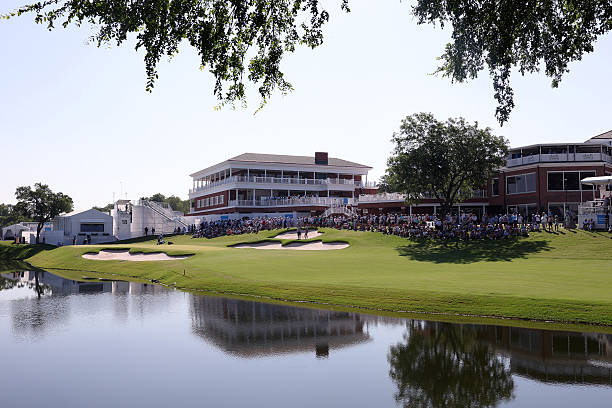
The “Texas Swing” comes to an end with the Charles Schwab Challenge played at the legendary Colonial Country Club in Fort Worth. This year the course is celebrating its 80th anniversary and marking eight decades as the PGA Tour’s longest running host venue for a non-major event.
Though the event’s name has changed numerous times, Colonial CC has hosted this tournament since 1946, making it the longest-running event on the PGA Tour held at the same location. From its beginning, the tournament has seen the most illustrious names in golf among its champions, including Ben Hogan, Jack Nicklaus, Arnold Palmer, Lee Trevino, and Tom Watson.
Colonial is one of those rare gems that has stood the test of time, challenging the world’s best golfers year after year. Colonial is a challenging, tree-lined shot-makers course with tight fairways, numerous doglegs, and small greens. It is perhaps the PGA Tour’s quintessential positional course that places a premium on accuracy off the tee and mid-iron play on approach. Ball-strikers with past success on strategic courses, who can be creative and shape their shots, and spike with their putter on the bentgrass greens will have an edge.
Jordan Spieth, perhaps, summed up Colonial best by saying, “Fit it into tight windows, hit fairways, and control the ball on the green.” With an average winning score of 12-under over the last 15 years, the list of recent past champions here is full of quality ball-strikers who can get hot with the flatstick, including players like Ben Griffin, Sam Burns, Daniel Berger, Kevin Na, Justin Rose, Jordan Spieth, Chris Kirk, and Zach Johnson.
The Field

The 2026 Charles Schwab Challenge field looks noticeably different this year as the PGA TOUR’s Signature Event schedule continues to reshape participation at several longtime stops. For the first time in his career, Texas native and past champion Jordan Spieth will not tee it up at Colonial Country Club, while fellow Dallas-area star Scottie Scheffler is also absent from the field. Spieth acknowledged the difficult scheduling situation earlier this season, saying, “It’s just a rock and a hard place for myself and Scottie and guys who are local, who grew up here. There is just such a premium on the elevated events.”
Even without those two headliners, the field still features strong depth at the top with seven of the top 20 players in the Official World Golf Ranking scheduled to compete. J. J. Spaun enters the week as the highest-ranked player in the field at No. 9 in the world, followed by Russell Henley at No. 11 and Ludvig Aberg at No. 13. Justin Thomas, Hideki Matsuyama, Robert MacIntyre, and defending champion Ben Griffin also headline a field that still brings plenty of high-end ball-striking talent to one of the TOUR’s most demanding positional courses.
Several former champions also return this week, including Davis Riley, Emiliano Grillo, Kevin Kisner, Chris Kirk, and Zach Johnson, while other notables including Akshay Bhatia, Rickie Fowler, Keegan Bradley, Harry Hall, and last week’s Byron Nelson winner, Wyndham Clark will look to add their names to the tournament’s historic list of winners and earn Colonial’s iconic tartan jacket.
Colonial Country Club – History
Located on the south bank of the Clear Fork of the Trinity River and just to the northwest of Texas Christian University sits Colonial Country Club. Founded in 1936 by Marvin Leonard, it was created out of his stubborn resolve to prove the naysayers wrong regarding the successful establishment of bentgrass greens in Texas.
Leonard convinced two visionaries in the golf architecture world, John Bredemus and Perry Maxwell to assist and help design the layout of the course. Bredemus drew up much of the original plan with Maxwell coming in after to improve the course by adjusting the routing of the holes. Maxwell specifically focused on toughening up holes 3-5 which today make up the “Horrible Horseshoe”.
When the course opened in 1936 it was quite similar to other layouts built during the same period. Narrow tree-lined fairways and tiny greens were the norm. And yes, Leonard defied the odds as Colonial sported the first bentgrass greens in Texas. Though unspectacular in many ways, throughout the years, Colonial has become the most iconic course in Texas. It hosted the U.S. Open in 1941 and became a mainstay as an annual Tour event starting in 1946. It was nicknamed “Hogan’s Alley” because of Ben Hogan winning five different times here on his home course.
The course was partially renovated in 2008 by Keith Foster. However, many people believe that his work did not restore enough of the original Maxwell design. So as soon as the last putt dropped in the 2023 tournament, Gil Hanse and his team started their restoration of the entire course to return it to its past glory. What is typically an 18-month project was completed in 11 months just in time for the 2024 tournament.
From a broad perspective, the project addressed every aspect of the course infrastructure, including a state-of-the-art irrigation system as well as new bunkers, tees, and greens. Many trees and bunkers were removed. Colonial’s abundance of trees had often made it seem like “a dark golf course”, Hanse said. “It felt as if you were hitting into these dark corridors. Greens were shrouded in the trees.” In their place will be more rough, light enough for amateurs but thickened during tournament week.
Just about every green was lowered and made “more receptive as targets.” Some have shifted slightly back or to either side a few yards. Also, “barrancas” were incorporated throughout the course. A barranca is a normally dry streambed that channels water during periods of heavy rain. The new barrancas are seen on holes 5, 6, 7, 8, 10, 15, 16, 17, and 18 ― making the most of the existing, natural drainage channels on the property.
The biggest changes were to holes eight and 13, both par 3s. “The par three eighth hole was shifted left into more of a north-to-south orientation, in somewhat of a mirror image of the original hole, with a creek on the left side rather than a river on the right,” a release notes. “The 13th green also moved back and left, with bunkers added in front of the hole.” Hanse called the changes on those holes “dramatic.” The fairway on No. 5 was leveled on the left side. Trees were removed on the right side so players will now be able to watch errant tee shots fly into the Trinity River. In the past, it was difficult to even know the Trinity was over there.
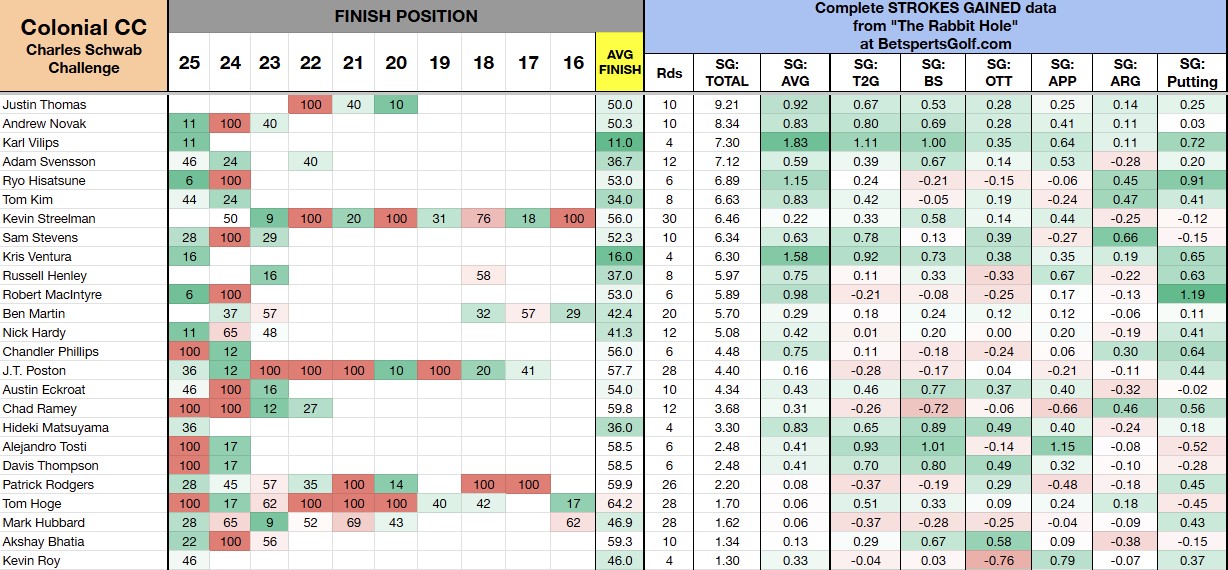
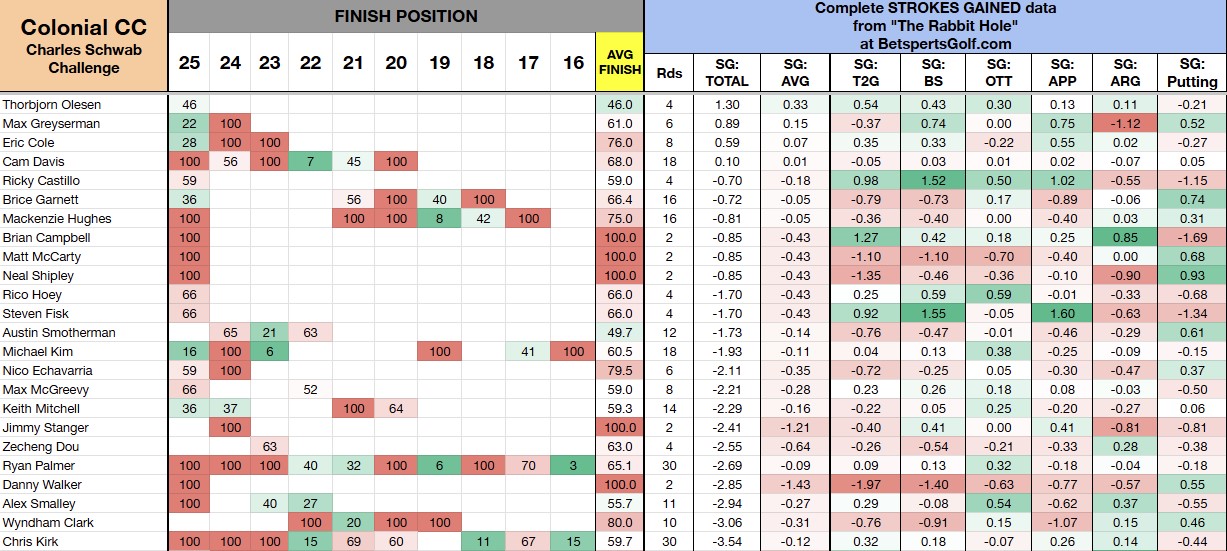
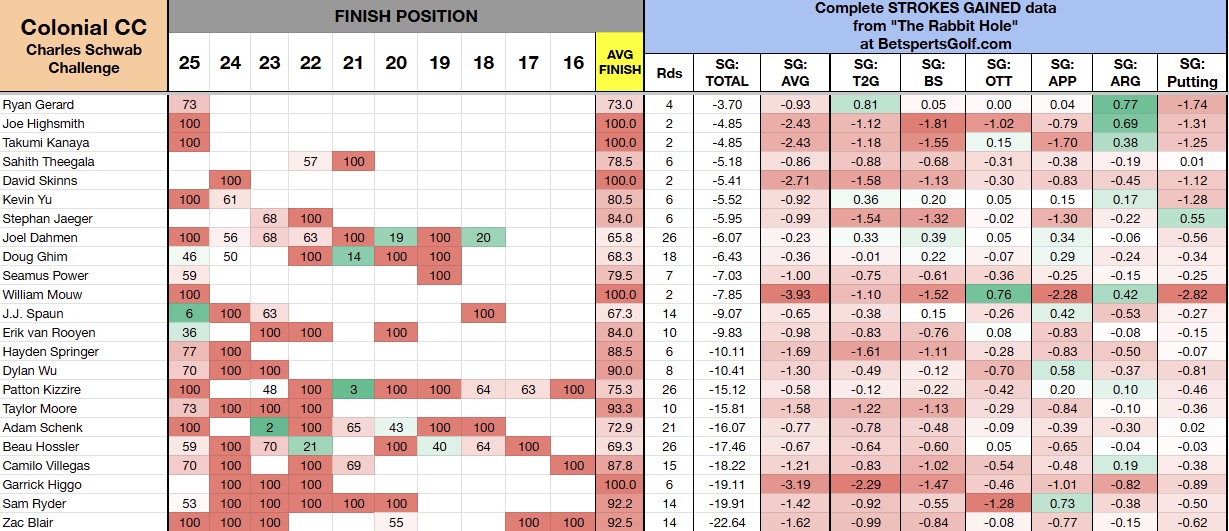
Finish Position and Strokes Gained History at Colonial CC (2016-2025)
This includes the average finish position and Strokes Gained per round. Players are sorted by SG: Total. Colonial is the 15th most predictive course on the PGA Tour. 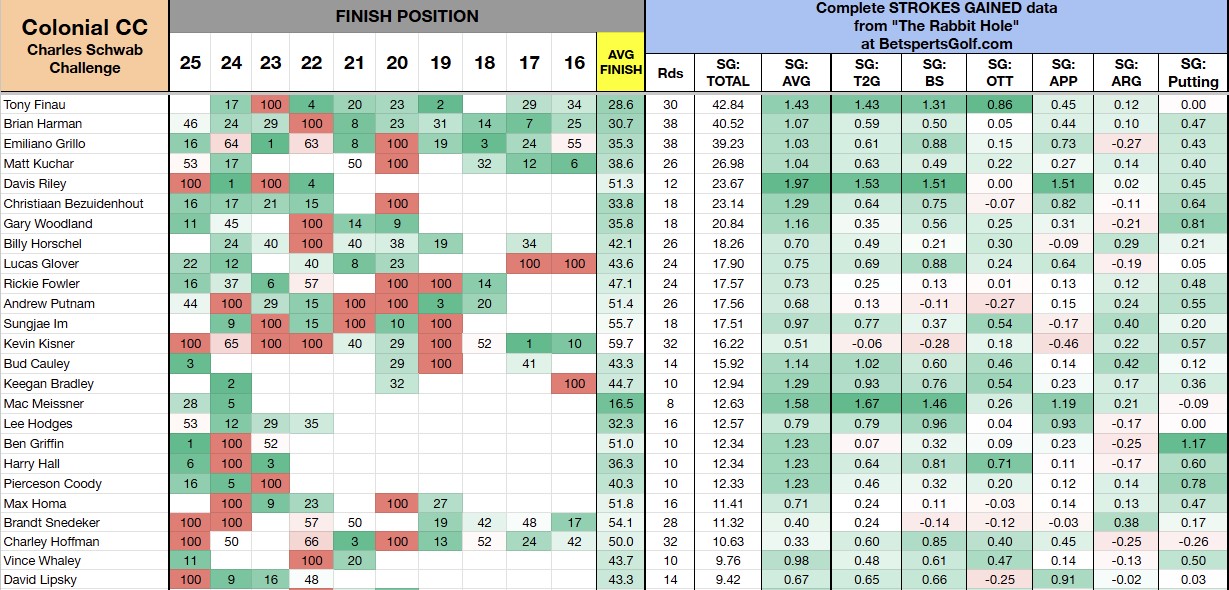
Course Features
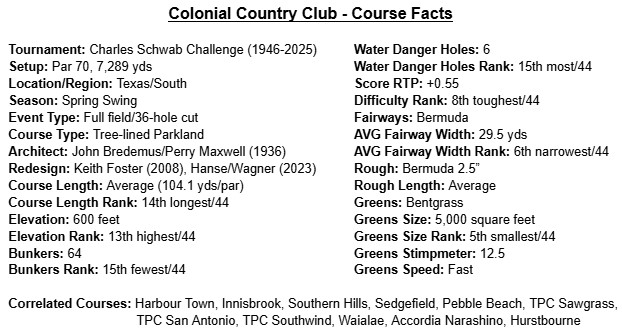
Colonial Country Club is a par 70 that measures 7,289 yards and remains one of the PGA TOUR’s premier classical positional golf courses. The tree-lined layout features numerous doglegs, tight driving corridors, and small green complexes that place a heavy emphasis on precision over raw power. Cut through pecan, walnut, and oak trees, Colonial has very little elevation change or dramatic sloping, but its creative routing constantly changes direction from hole to hole in a manner similar to a classic Donald Ross design. That unique routing becomes especially challenging when the Texas winds begin to swirl, forcing players to make difficult decisions off the tee and shape shots both directions throughout the round.
The course also presents one of the most demanding accuracy tests on TOUR, ranking among the tightest venues when combining fairway width and green size. Colonial’s fairways average just 29.5 yards wide, while the greens average roughly 5,000 square feet, giving it the third-smallest combined landing areas on the schedule. As a result, simply finding the fairway is not enough. Players must consistently position tee shots correctly in order to create ideal angles into pins and avoid awkward approaches into the course’s small, well-protected Bentgrass greens.
Agronomically, Colonial features Bermudagrass fairways and rough paired with pure Bentgrass putting surfaces. The greens themselves usually begin the week running near 12 on the stimpmeter before speeding up closer to 13 by Sunday, further increasing the importance of elite approach play, scrambling, and distance control throughout the week. The Bermuda rough is typically grown to around 2.5 inches early in the week before thickening closer to 3 inches by the weekend.
As a perennial contender at Colonial, Justin Rose noted that the Bermuda rough is quite unpredictable. “It’s the type of rough here where you catch a lot of fliers, and the greens are small and tricky. So catching fliers into these greens you’ll make a lot of bogeys. I think the rough is tough enough around here if you catch a bad lie it’s hard to get it to the green.”
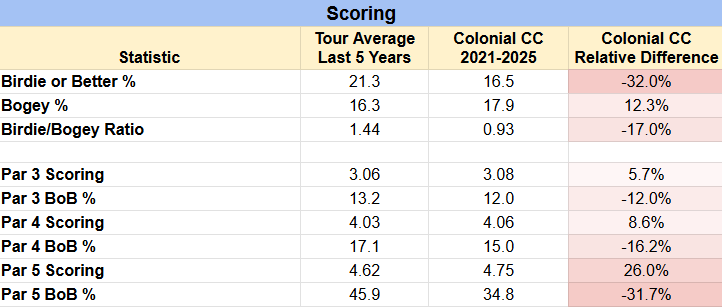
Colonial consistently ranks as one of the more difficult venues for generating birdies, largely because it cannot simply be overpowered with distance. Even with more drivers being hit over the last few years, Colonial continues to demand discipline, positioning, and precise iron play. Scoring has reflected that challenge in recent years, with Ben Griffin winning at just 12-under par last season, while Davis Riley was the only player to reach double digits under par during his 2024 victory.
What has stood out most is how little the course’s overall identity changed even after its significant renovation. Despite updates throughout the property, the tournament has continued to reward the same style of player that has historically succeeded at Colonial: smart positional golfers who can think their way around the course and consistently place the ball in the correct spots.
Jhonattan Vegas perfectly described the challenge by saying, “This course is all about precision. There is nothing about power around this place. You can drive to the wrong side of the fairway, and still not have a clear shot to some of these holes. It’s about thinking your way around this place. Obviously, all the past winners are guys that are able to do that really well.”
Since the 2023 renovation, one of the biggest changes to the course is the reduction in bunkers from 84 to 64. Taking down many trees also brings the Trinity River into play on a couple of extra holes. Along with the small greens and unpredictable bermuda rough, high winds help to keep scores down. This was the case in 2022 and 2023 when Emiliano Grillo and Sam Burns each won with single-digit scores as winds gusted 20-35 mph for multiple rounds each year.
Hole Preview
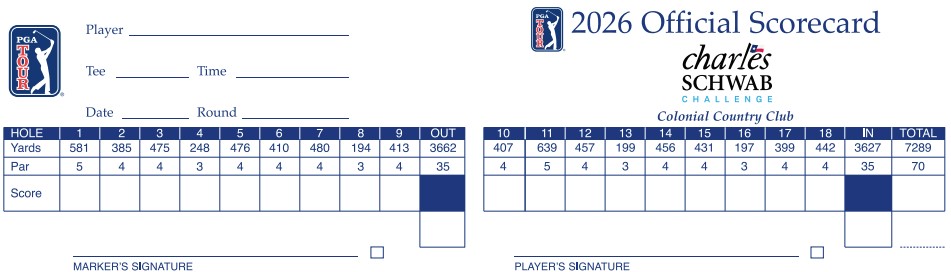
Overall, Colonial offers an excellent balance of demanding holes and legitimate birdie opportunities. As a par 70 layout, the course is heavily driven by par-4 performance, with its 12 par 4s providing the primary challenge throughout the week. Five of those holes fall in the 350 to 415-yard range where positioning and wedge play are critical, while the remaining seven stretch between 415 and 480 yards and place far more emphasis on long-iron precision and difficult approaches into small greens.
The par 3s are particularly brutal and consistently rank among the toughest one-shot holes on the PGA TOUR. All four measure over 190 yards and collectively produce the lowest birdie rate on TOUR at just 14 percent. The demanding 247-yard 4th hole is especially difficult, yielding birdies only around eight percent of the time while producing a bogey-or-worse rate of roughly 21 percent.
Players typically have an opportunity to get off to a fast start because the opening hole, a 581-yard par 5, is the easiest on the course. Reachable in two shots for most of the field, it carries nearly a 47 percent birdie-or-better rate and represents one of the best scoring chances of the week. Colonial’s second par 5 at the 11th hole presents an entirely different challenge. Measuring a massive 639 yards, it is extremely difficult to reach in two and produces a much lower birdie-or-better rate closer to 29 percent.
After the relatively manageable opening stretch, the course quickly becomes far more demanding at Colonial’s most iconic stretch, holes 3 through 5, famously known as the “Horrible Horseshoe.” Wrapping around the practice range in a horseshoe shape, the trio consistently ranks as the toughest stretch on the golf course both mentally and statistically. Since 2003, the three-hole run has played as the second-hardest three-hole stretch on the PGA TOUR, averaging a combined 0.49 strokes over par and forcing players to survive a sequence that places enormous pressure on driving accuracy, long-iron play, and scrambling.
Strokes Gained Analysis
Off the Tee
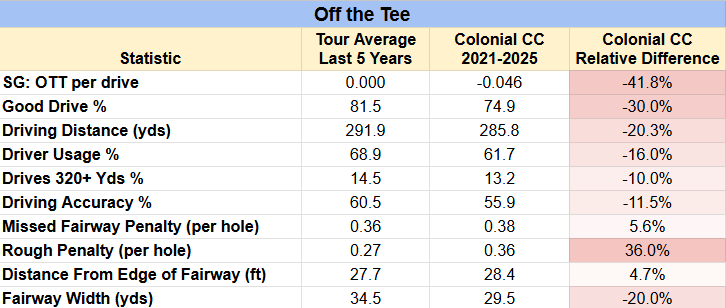
The unique routing at Colonial has long rewarded golfers who can shape the ball both directions off the tee. With fairways constantly turning and changing angles throughout the round, legendary Colonial icon Ben Hogan famously said that a “straight ball will get you in more trouble at Colonial than any course I know.” Because many of the doglegs move from right to left, players who naturally hit a controlled draw have historically enjoyed success here. Former champion Chris Kirk acknowledged that advantage when he said, “It’s been a course that’s suited guys who hit the ball right to left over the years…and I definitely fit into that category.”
Colonial continues to stand out as one of the TOUR’s most demanding driving tests, ranking as the fourth-toughest course on TOUR to gain strokes off the tee. The narrow fairways, which average just 29.5 yards wide and rank as the sixth-narrowest on the schedule, force players to prioritize positioning and angle creation rather than simply overpowering the course with distance. The abundance of trees lining both sides of the fairways, combined with sticky and unpredictable Bermuda rough, has traditionally made Colonial a classic positional golf course where many players opt for less than driver in order to stay short of trouble and keep approach angles open into the small greens.
At the same time, the modern game has begun to slightly reshape how some players attack the course. Longer hitters such as Sam Burns and Jason Kokrak have shown in recent years that aggressive lines can occasionally be taken over the tops of certain doglegs, allowing bombers to cut corners and carry trees that were previously not in play. That strategic shift contributed to driving distance reaching a tournament-record average of 294 yards last season, while driver usage climbed to 69 percent after historically sitting closer to 58 percent.
Even with those more aggressive tactics emerging, Colonial still heavily punishes missed fairways and failed attempts to cut corners. Players who drift into the rough or get blocked out by trees are frequently forced to manufacture recovery shots or deal with awkward approaches into some of the smallest greens on TOUR. Ultimately, accurate “target golf” remains the preferred blueprint for success. Speaking about the importance of precision off the tee, Adam Scott explained it simply: “You can’t be wild around this golf course. You have to really hit the fairway this week. There’s a premium on that.”
Approach
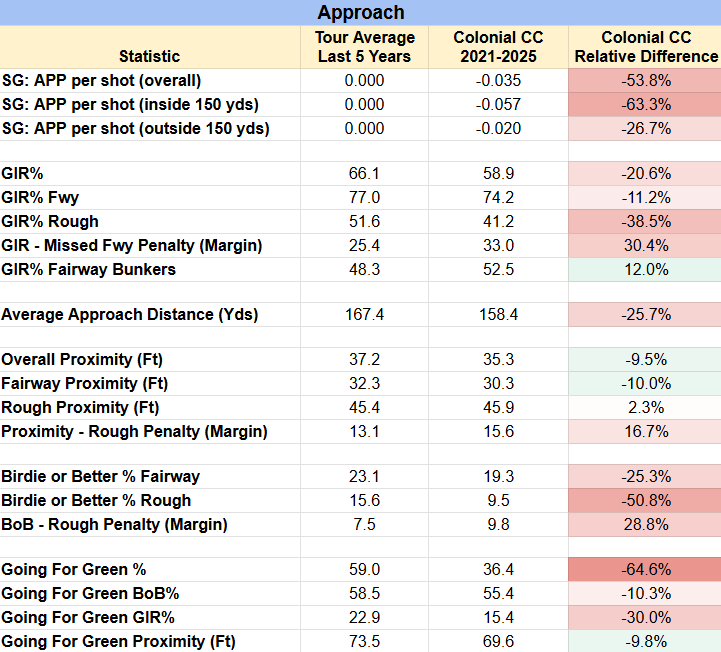
With its combination of tight fairways, penal Bermuda rough, and some of the smallest greens on TOUR, Colonial Country Club places a massive emphasis on elite ball-striking. Colonial features the fifth-smallest greens on the PGA TOUR schedule, and because the rough carries a higher-than-average penalty, players who miss fairways often struggle to control spin and distance into firm putting surfaces. That difficulty is reflected in a 41% GIR from the rough over the last five years.
More than almost any other statistic this week, success at Colonial begins with consistently finding greens in regulation. The course ranked as the sixth-toughest venue on TOUR for gaining strokes on approach last season, reinforcing how demanding the iron play test can become throughout four rounds. Approach shots from the 100 to 175-yard range made up roughly 55 percent of all approaches last year, placing additional importance on precise short-to-mid iron play and distance control into firm Bentgrass greens that are typically among the fastest and firmest surfaces players see all season.
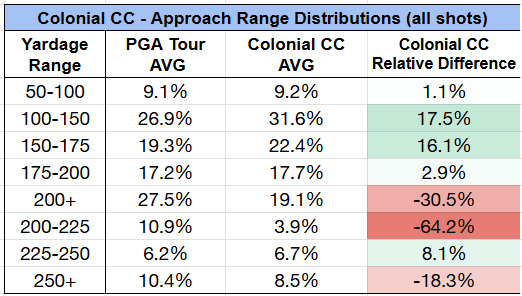
Because of those conditions, strong total driving alone is not enough. Players who combine accuracy off the tee with high-quality approach play from difficult conditions tend to separate themselves at Colonial. This makes Good Drive Percentage an especially valuable metric to emphasize in the Rabbit Hole this week, particularly when paired with the “Difficult” filter for strokes gained on approach, which helps isolate golfers capable of consistently hitting greens and creating scoring opportunities under demanding conditions.
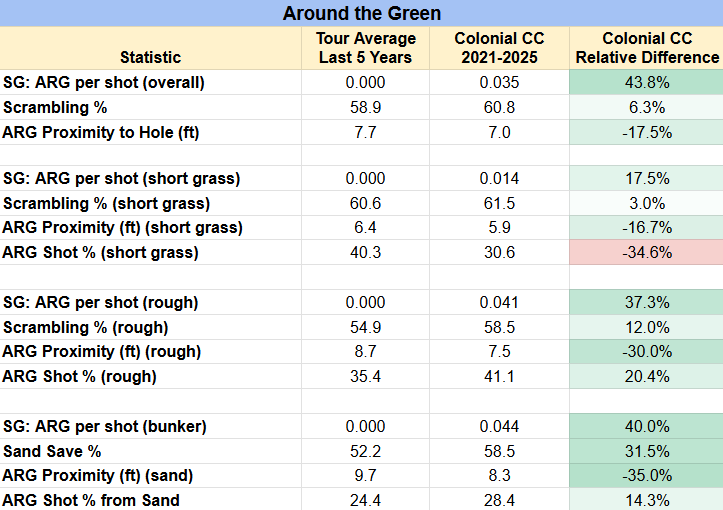
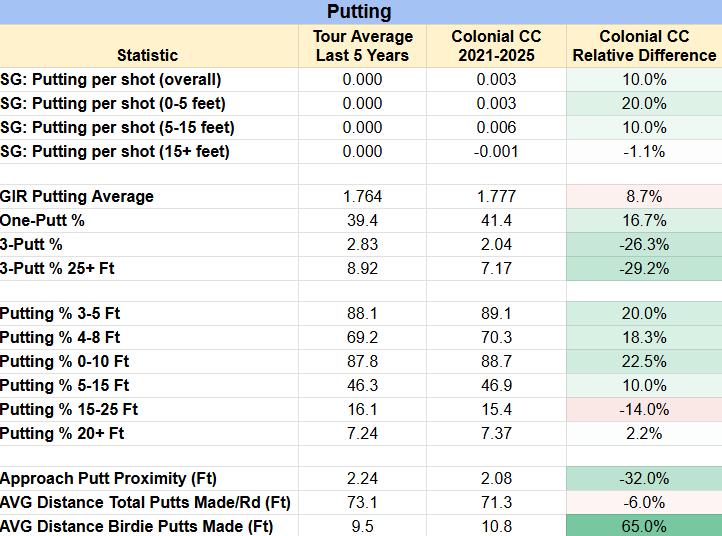
Around the Green and Putting