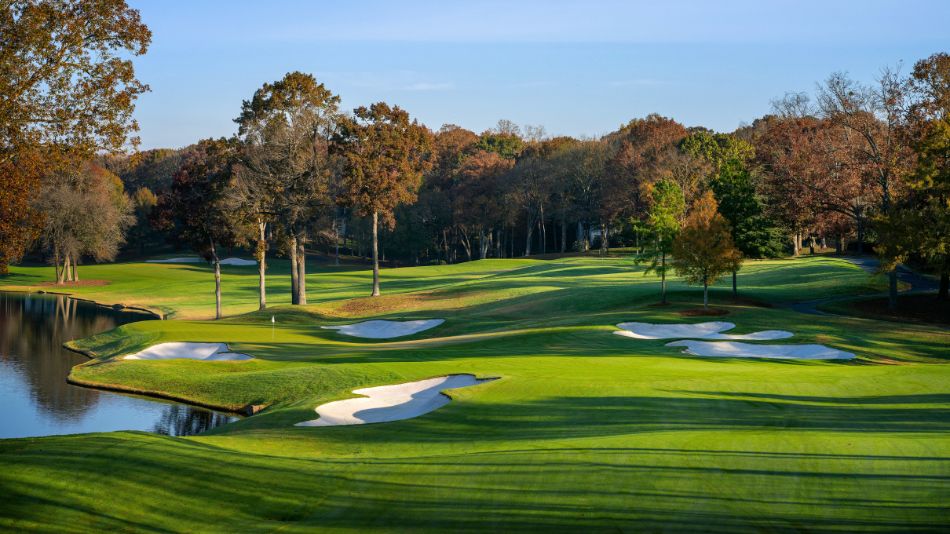
With only one week before the year’s second major, the PGA Tour heads to North Carolina for the Wells Fargo Championship and yet another small-field, no-cut “Signature” event. Located just southeast of downtown Charlotte, Quail Hollow Club has hosted a PGA Tour event almost every year since 2003. Along with the 2017 and 2025 PGA Championship, the world-class course also hosted the prestigious 2022 Presidents Cup.
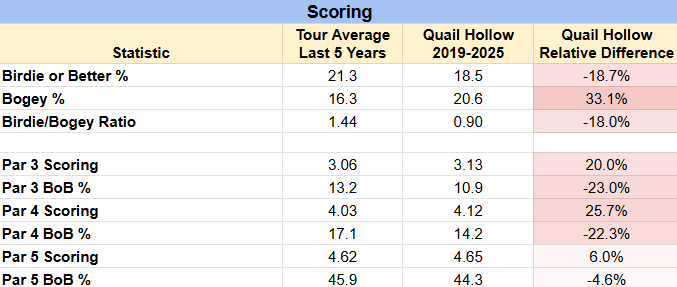
Quail Hollow is typically one of the most challenging courses on Tour playing to an average of +0.75 strokes per round. At the two recent majors held here, the course played +1.99 per round. It’s a demanding par-71 that stretches to 7,583 yards from the back tees.
The tree-lined parkland layout is a favorite among players, combining pristine conditions with scenic, rolling terrain to create one of the most enjoyable walks on tour. Its routing flows seamlessly, with each green leading effortlessly into the next tee just steps away.
As with any course that has hosted major events, every facet of a golfer’s game will be tested this week. As recent past winners here demonstrate, including Wyndham Clark, Rory McIlroy (four times), Max Homa, and Jason Day, distance off the tee and positive long iron play are especially advantageous this week. Another important skill is scrambling for pars on some of the toughest green complexes that players will face all year.
Said Quail Hollow’s Director of Green and Grounds, Keith Wood, “We want a fair course, and a challenge,” he said. “We want it to play long but not soft. Honestly, from my point of view, we just want to see a great competition. On Sunday, as the leaders are making the turn to the back nine, you know, we want to have six or seven guys in contention. That’s exciting, a lot of competition, good drama.”
The Field

Another Signature Event brings the PGA TOUR’s elite to Charlotte this week, with a tightly packed 72-player field at Quail Hollow. Every eligible top-35 player in the world is set to tee it up, with the lone absences being world No. 1 Scottie Scheffler, No. 8 Russell Henley, and No. 35 Shane Lowry.
Rory McIlroy returns as the most recent winner here, having cruised to a five-shot victory in 2024. The Grand Slam champion now sits at 30 PGA TOUR wins, four of which have come at Quail Hollow Club, further cementing his dominance at this venue. Past champions at Quail Hollow include Max Homa, Jason Day, and Rickie Fowler. Justin Thomas also brings strong course history, having captured the 2017 PGA Championship on these grounds.
Several players enter the field via exemptions, including Tony Finau, Max Homa, Mackenzie Hughes, and Webb Simpson on sponsor invites. Kristoffer Reitan earned his spot through the Aon Swing 5, while David Lipsky, Ricky Castillo, Matt Wallace, and Chandler Blanchet round out the field through the same pathway.
Quail Hollow Club – History
Quail Hollow was laid out on what once was the largest dairy farm in North Carolina and was named for the plethora of quail that inhabited the property. Built on a 270-acre tract of land, architect George Cobb completed the course in 1961, intending to capture the beauty and natural terrain of the Piedmont region. The early Cobb design was a product of its times, with flashed-up bunkers rising to meet elevated putting surfaces that required an aerial attack through tight tree-lined fairways. It hosted the Kemper Open on the PGA Tour from 1969 through 1979 followed by the Senior Tour’s Paine Webber Invitational from 1983 through 1989.
Arnold Palmer helped to redesign the layout in 1986. Tom Fazio made further alterations in 1997 and again in 2003 to prepare the course for PGA Tour competition. The club stepped back into the limelight that year with the PGA Tour’s Wachovia Championship. Over time, it was renamed the Quail Hollow Championship and is now the Wells Fargo Championship.
Most of what is seen on the ground today is the result of decades of work led by Tom Fazio, one of the most successful golf architects of the modern era. “There’s not much of the George Cobb design left, except for a little bit of the routing,” Wood said. “Mr. Palmer came in and did some work, and it still was a Cobb course. Mr. Palmer took what was there and created new greens complexes, new bunkers, things like that. But after Mr. Fazio really started having some influence and doing things on the golf course, it really became a Fazio course.”
From 2014 to 2016, in preparation for the 2017 PGA Championship, Fazio renovated much of the course, including a complete rebuild of all 18 greens and converting the putting surfaces to Champion Bermuda turf. Tee boxes were shifted, and more than 100 trees were removed to allow for more sunlight and clearer sight lines. The course now plays through wider corridors, still with trees at the sides but with much more room to navigate while allowing ample sunshine to nourish the turf. The greens are flatter to the ground and much more natural in appearance than the pushed-up originals.
Four holes were also significantly altered and lengthened to further strengthen Quail Hollow’s championship credentials. The club also hosted the 2022 Presidents Club in which the U.S. team soundly defeated the International team 17.5 to 12.5.
In 2023, Fazio was back at it in what Wood called more of a housekeeping renovation in which the greens were re-grassed with the modern Tif Eagle Bermuda grass. “There was very little architectural change in 2023,” Wood said. “We did change the 13th tee complex, and we added a tee on 16, but that was it. We did resurface the greens and get the speeds up to 13. And we redid the bunkers and put new liners in the bunkers.”
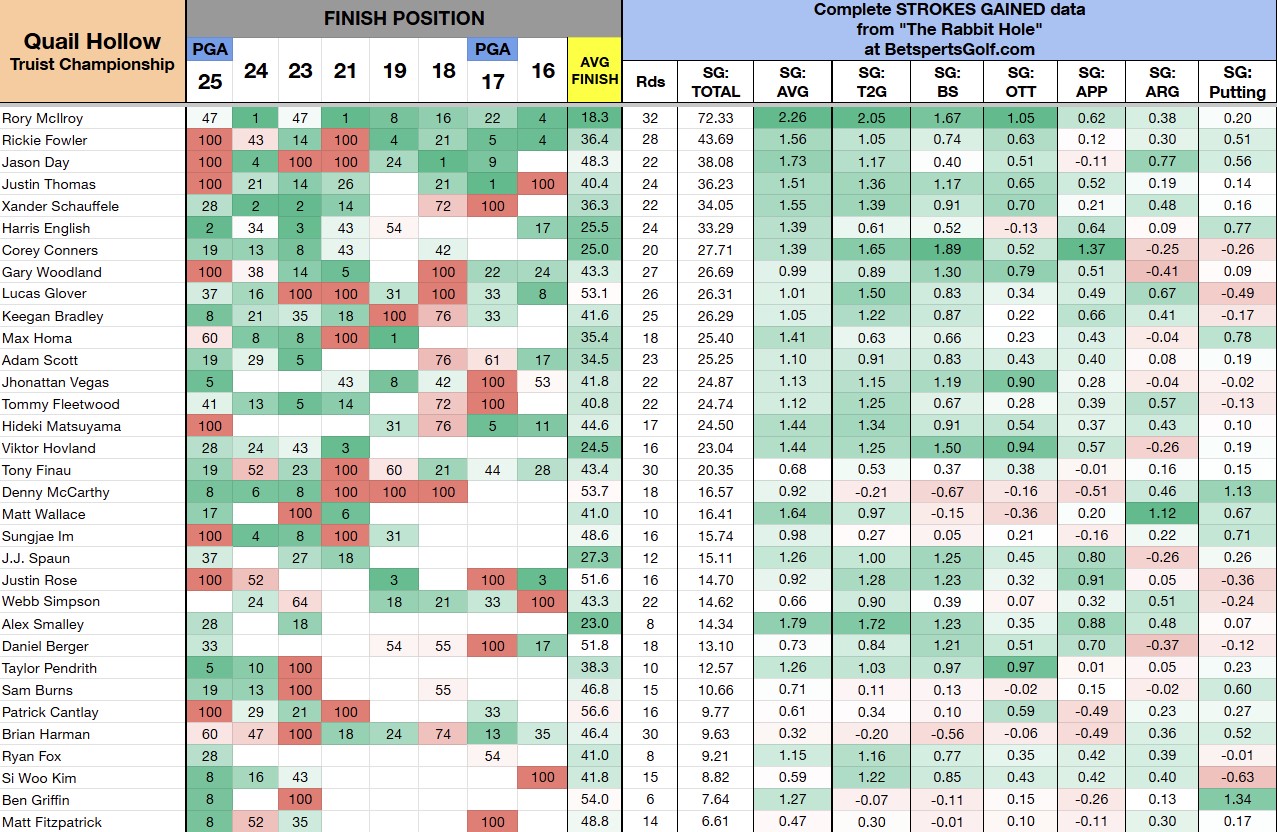
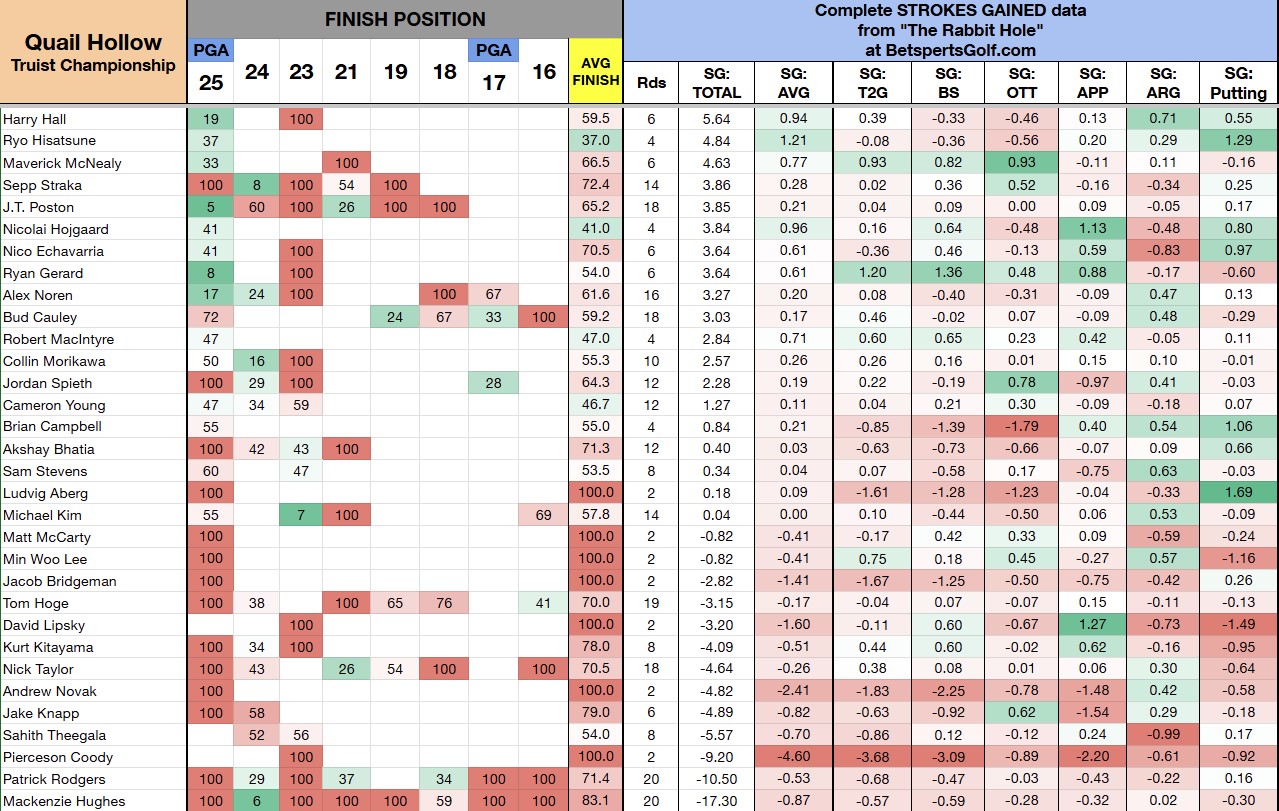
Finish Position and Strokes Gained History at Quail Hollow Club (2016-2025)
This includes the average finish position and Strokes Gained per round. Players are sorted by SG: Total. Quail Hollow is the 6th most predictive course on the PGA Tour. Data includes the 2025 and 2017 PGA Championship.
Course Features
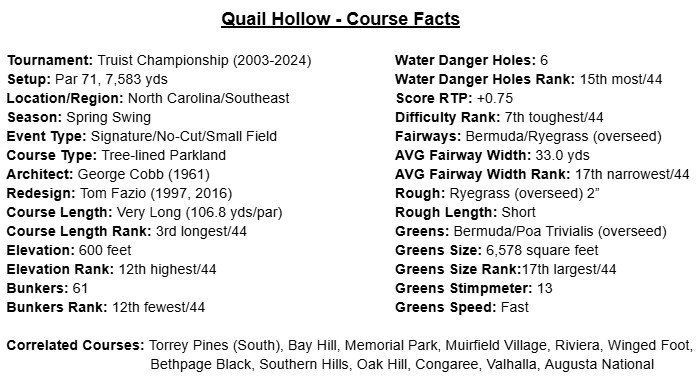
Measuring 7,583 yards, Quail Hollow Club is a demanding par-71 that places a premium on both power and precision. Much like Torrey Pines and Bay Hill, it combines sheer length with consistently difficult scoring conditions. It ranks as the third-longest course on the PGA TOUR schedule and the seventh-toughest in terms of scoring, while also featuring the sixth-longest combined yardage across its par 4s and par 5s.
Scoring opportunities are limited. The three par 5s and a pair of short, semi-driveable par 4s under 350 yards represent the only true scoring chances. Contenders will need to capitalize on those five holes and then grind their way through the remaining 13, all of which historically play over par.
Quail Hollow demands precision as much as power. The layout is framed by tree-lined fairways and rolling terrain, with strategically placed water hazards and firm, undulating greens that place a premium on approach play. A variety of doglegs in multiple directions forces players to shape shots off the tee, while the bunker count is relatively low at just 61. Even so, they are positioned with intent—guarding key landing areas and sitting directly in the line of approach into many greens.
The SubAir system beneath the putting surfaces minimizes the impact of rain, allowing conditions to progressively firm up as the week unfolds. By Sunday, holding the greens becomes a significant challenge. That dynamic gives an edge to longer hitters, as added distance off the tee allows for higher-lofted approaches that can land softer on firm, fast surfaces.
Shotmaking is essential. Players must work the ball to match the course’s frequent bends while navigating overhanging trees and thick Bermuda rough. As Keith Wood noted, “If we have those firm conditions and you just hit it long without shaping it, you’re probably going to end up in the rough because the ball is going to bounce. We can put a real premium on hitting fairways, hitting greens and making putts.”
From an agronomic standpoint, the base turf at Quail Hollow is 100% bermudagrass. In the fall of each year, groundskeepers seed the course with bermuda, a warm-weather grass, and with rye, a grass meant for colder seasons. Right after the conclusion of this tournament each year, a herbicide is used to kill the ryegrass and let the bermuda grow for the summer.
With Charlotte being in the mid-Atlantic region, the beginning of May is still too cool for the bermuda to completely break through the overseed. According to Wood, approaches, tees, and fairways are around a 50/50 mix of overseeded rye grass and the underlying bermuda. The rough is 90% overseeded rye.
Said Wood, “Once that Bermuda grass wakes up and starts putting out some roots, it starts using up the moisture in the soil. It’s also providing a denser, tighter surface because it’s starting to compete with the rye grass for space in the canopy. Things are going to be firm so that balls can bounce and give people the opportunity to shape the ball versus just hit it long.”
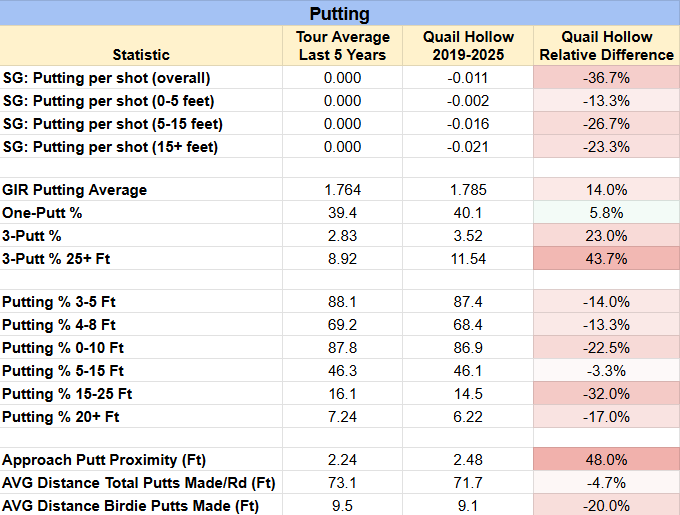
The rough length at the annual for the annual event at Quail Hollow has consistently been maintained at 2″. Greens are a 50/50 mix of Poa trivialis overseed and bermuda. Greens will be a speedy 13+ on the stimpmeter and are on the larger side, averaging over 6,500 square feet. Scrambling, putting from 5-15 feet, and three-putt avoidance will be key “short-game” stats this week.
Hole Preview
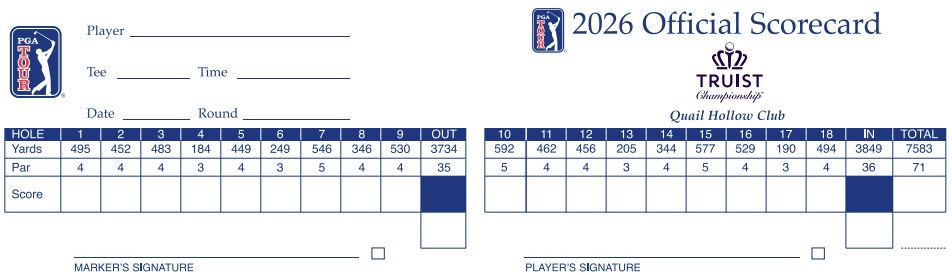
From an architectural standpoint, Quail Hollow is often viewed as more functional than flashy. Few holes truly stand out, with much of the opening 15 playing in a straightforward, somewhat repetitive manner. There is little trickery to it, as the course sits right in front of the player and places the emphasis squarely on execution.
As a par 71, it features just three par 5s, limiting scoring opportunities. All three produce birdies or better at a rate of at least 34 percent, making them essential to attack for anyone looking to contend. In contrast, the four par 3s are consistently demanding, combining to play to an average of 3.14. The par 3 sixth, which can stretch beyond 250 yards, is particularly punishing.
The par 4s further separate the field. While the eighth and fourteenth offer rare drivable chances, five of the par 4s measure over 480 yards. Right from the start, the opening hole, which was extended during Tom Fazio’s redesign, sets a difficult tone as a 495 yard test that produces a bogey or worse nearly 28 percent of the time.
Quail Hollow is perhaps best known for its three-hole closing stretch known as the “Green Mile”. Each hole of the white-knuckle stretch features dangerous water hazards, strategically placed sand traps, tricky elevation changes, and firm, undulating green complexes. Tour player, Brandt Snedeker said, “It’s got to be one of the toughest stretches in golf. There’s no bail-out on any of the holes. You just have to suck it up and get through it.”
“Those are three really brutal finishing holes,” Tour veteran Adam Scott said. “If you can survive those holes and win, you’ve certainly proved that to yourself because they’re so demanding. There is no breather.” The three holes have combined to play a staggering 0.87 strokes over par with a bogey-or-worse rate of 29.7% compared to a birdie rate of only 8.4%. Since 2003, there have been over 1,900 “water balls” on these three holes combined.
Strokes Gained Analysis
Off the Tee
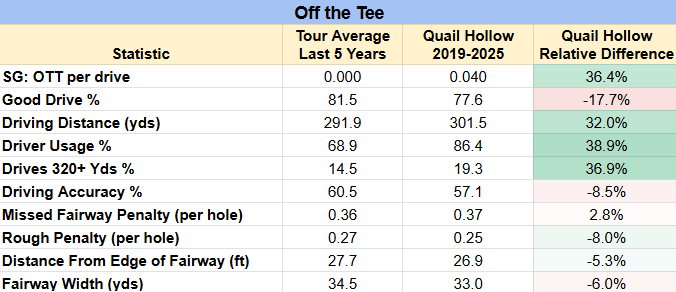
With the average drive pushing past 300 yards, Quail Hollow clearly rewards a driver heavy approach. Its length and relatively modest penalty for misses encourage players to lean on power, giving an edge to those who can carry the ball long distances. In fact, over the last five events here, more than 85% of tee shots have traveled at least 280 yards, the highest rate on TOUR. With recent rainfall softening the fairways and tall trees guarding the corners of doglegs, carry distance and peak height become even more important.
The course’s sheer yardage makes it a demanding test off the tee. While shorter hitters with strong long iron play can still find a path, the margin for error is slim. Fairway accuracy typically sits around 55%, one of the lowest marks on TOUR, and thicker rough only heightens the importance of total driving. Recent winners reflect that trend, averaging 316 yards off the tee while sacrificing accuracy. Rory McIlroy is the clearest example, ranking near the top in distance during his wins here while finishing near the bottom in fairways hit.
Power has consistently shown up on the leaderboard. Nearly every winner since 2014 has entered the week already ranking among the top 15 in driving distance over their previous 36 rounds, reinforcing just how strongly Quail Hollow favors players who can overpower the course.
Brooks Koepka spoke on the importance of length off the tee here, saying, “It’s a bomber’s paradise. There’s some lines we can take over some trees. Number two, I just take it up over the tree. You can take a short line into a bunch of them. Like I hit a pitching wedge into number one today. I’m pretty sure a bunch of guys are going to be hitting a six-, maybe five-iron into that hole. Length is a key factor out here.”
Because wayward drives are not penalized as severely as at many other venues, players who generate more distance off the tee are left with shorter approach shots into firm greens. That advantage becomes even more meaningful here, where holding the putting surfaces is a challenge and higher, softer landing shots are at a premium.
In simple terms, Quail Hollow encourages aggression off the tee. Players who can overpower the course give themselves more scoring opportunities and a clearer path to separating from shorter hitters who are forced to play more conservatively.
Approach
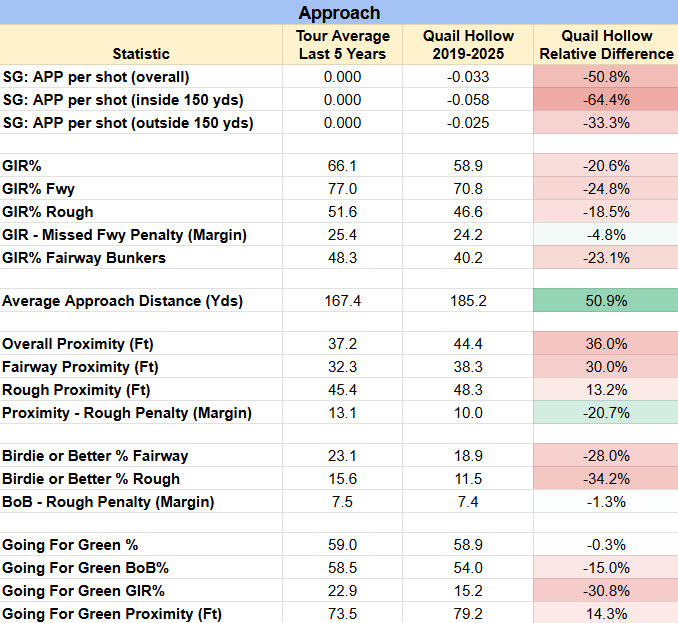
On approach, Quail Hollow has been one of the more demanding tests on TOUR, ranking as the ninth toughest ShotLink course to gain strokes over the last five years. The average Greens in Regulation rate sits around 60%, well below the TOUR average of 66%. Much of that difficulty stems from firm putting surfaces and the fact that roughly 55% of approach shots come from 175 plus yards. Misses can be severe, with shots lacking the proper trajectory and spin often bounding well past the target and leaving challenging recoveries. With difficult pin placements, average proximity hovers around 43.7 feet, one of the longest on TOUR.
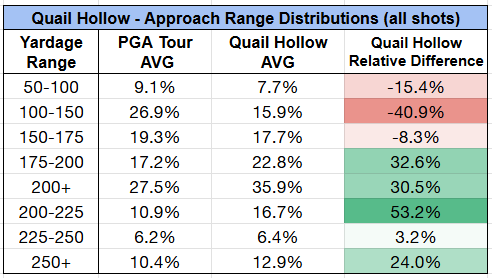
Viktor Hovland highlighted that challenge during his debut here in 2021, when he finished third, noting that “With how hard it’s playing, you’ve just got to hit greens. There are so many hole locations where you’re just not looking at the pin. Maybe on a couple of holes, you can get it close, and the par 5s maybe you can make some birdies. The rest of the place you’re just trying to hold on for dear life.”
Even with the emphasis on driving distance, strong approach play remains critical, especially with long irons. In 2024, 16 of the top 20 finishers gained strokes on approach, with 13 of them picking up at least 2.2 strokes on the field. Scoring opportunities on the par 5s are not automatic either. Players attempting to go for the green in two face a stiff test, with the hitting the green rate sitting at just 15%, compared to a TOUR average of 22.4% on par 5s elsewhere.
Around the Green and Putting
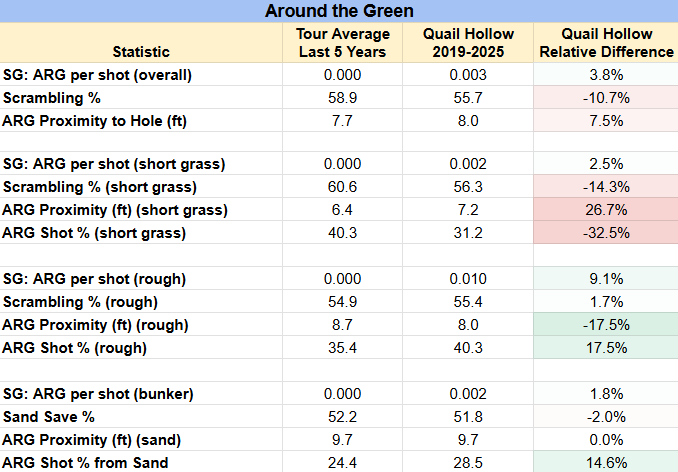
Around the greens, Quail Hollow plays slightly tougher than the TOUR average. The complexity of the green complexes makes scrambling from both the rough and fairway a few percentage points more difficult than usual. Shaved runoff areas and subtle false fronts add another layer of challenge, often repelling marginal shots and leaving awkward chips. That said, players who are consistently hitting greens in regulation can largely minimize the importance of short game.
The putting surfaces themselves are one of the course’s biggest defenses. Quail Hollow ranks as the sixth toughest venue on TOUR for gaining strokes putting, and it becomes especially demanding from distance. Putts outside 15 feet are among the hardest to convert, contributing to a 3 putt rate around 3.6%, one of the highest on TOUR. These Poa trivialis greens are also some of the fastest that players will see all year, running around 13 on the stimpmeter.
While tee to green performance carries more weight overall, poor putting can quickly derail a contender. Recent results show that success on the greens still plays a major role. Wyndham Clark paired elite approach play with a strong putting week during his win, while Rory McIlroy also gained significantly with the putter in his most recent victory here, reinforcing that a well rounded performance is still required to win.
Most Important Stats For Success at Quail Hollow
*In order of importance
- SG: APP
- Driving Distance
- Proximity 175+
- SG: Par 4 (Difficult par 4s)
- SG: Long/Difficult Courses
- SG: Putting
- Scrambling/ARG Proximity
- Bogey Avoidance (Difficult Scoring)
- Good Drive % (Difficult Approach)
- 3-Putt Avoidance
Key Rabbit Hole Filters
- Course Region: Southeast
- Scoring Conditions: Difficult
- Course Length: Very Long
- Field Strength: Strong
- Event Type: Signature/No-Cut
- Green Surface: Poa Trivialis/Bermuda
- Green Speed: Fast
- OTT Club: Driver Heavy
- Gain APP: Difficult
- Gain Putting: Very Difficult
- 3-Putt AVD: Difficult
- Par 4s: Difficult
