
With the conclusion of the Florida Swing and just two weeks remaining until the Masters, the PGA Tour now shifts its focus to Texas for the Houston Open at Memorial Park Golf Course. The long Par 70 track, which measures 7,475 yards, features a unique layout with five par 3s and three par 5s. The course features a modest 24 bunkers and only four water hazards, all of which were added during the 2019 Brooks Koepka-led redesign. Its defense lies in the distinctive green complexes characterized by undulating surfaces and short-grass runoffs with false fronts. According to course superintendent Parker Henry, while everything is visible, the green complexes can be challenging if not approached accurately.
The course has historically played over par, emphasizing the need for a well-rounded game. The tournament’s move from fall to spring has significantly changed the course’s agronomy and how the field approaches the challenges of Memorial Park. The once bermudagrass-covered course now showcases Poa trivialis on the greens. Additionally, the rough has transitioned from penal 2.5″ Bermuda to a more manageable 1.25″ ryegrass.
The challenge in handicapping this week is that the sample size of how I expect the course to play is very small. I don’t think the fall data is particularly relevant, and last year’s conditions were softer than what we saw in 2024 and what I’m anticipating this week. So, in short, I think we see something closer to the 2024 result from a scoring standpoint, with the winner in the 10-to-14-under range instead of Min Woo Lee‘s 20-under.
Memorial Park offers a well-balanced mix of doglegs and straight holes, featuring a variety of distances across its layout. Lengthy holes are a prominent characteristic of the course. Three of the five par 3 holes exceed 200 yards, while eight par 4 holes measure over 440 yards. The course presents its challenges, with five par 4s playing over 490 yards and an average bogey-or-worse rate of 28.9%. Even the par 5 holes are demanding, including the 576-yard 16th hole, which has a Birdie or Better rate of only 22%. This is a grip-it-and-rip-it course off the tee, and the penalty for missing the fairway is basically non-existent.
Every approach shot at Memorial Park is tougher than the Tour average. The key challenge is landing your second shot in the right quadrant of the large sloping greens. With steep slopes and false fronts near the edges, hitting the wrong section makes it difficult to secure makeable birdie putts. Sometimes, missing the green on the correct side is preferable to hitting it and facing a long, complicated putt. The low greens-in-regulation rate, despite the large greens, brings the around-the-green and lag putting into play this week. Chipping from the courses’ shaved runoffs is also a required skill this week, with 67.4% of the around-the-green shots here coming from short grass. Line that up against a Tour average event of 40.3%, and you can see why it matters.
For more course details, check out Ron’s course preview. It’s the best in the business, bar none. Also, don’t forget to check out our research tools, the Memorial Park course stats, along with the Tournament Cheat Sheet.
We have partnered up with Novig to bring you a FREE Betsperts Golf subscription + $50 in Novig Coins with your first $5 purchase! Click here to learn more!
Podcast: Apple | Spotify
YouTube: Betsperts Golf
Key Rabbit Hole Stats This Week:
- SG: Total (Last 2 Years, Long and Very Long Courses)
- Driving Distance/Carry Distance
- SG: T2G (Last 50 Rounds)
- SG: APP (Rolling Form, last 12, 24, and 50 rounds)
- SG: Ball-striking (OTT Club, Driver Heavy)
- ARG Proximity (Short Grass)
There are millions of ways to bet on this beautiful game. My goal with this piece is to touch on the golfers I’m targeting in the outright market this week. Remember to check out the Rabbit Hole, our customizable stat database. It can help you pare down your player pool each week.
Utilize our Discord for up-to-the-minute lines and betting advice. My full card and live in-tournament bets will be posted there. Reach out if you need help getting started.
For outrights, I typically allot for 1.5 units, sometimes up to 2 for bigger events. I think this structure is important, and it helps steady the tides of outright betting. It prevents me from chasing, knowing that I’m positioned to profit if I can hit 5-6 outrights a season. It also helps me stake bets to a flat “to win” amount regardless of their outright price.
*Betting lines are accurate at the time of publication in Discord.

Noonan’s Texas Children’s Houston Open Outright Targets
Brooks Kopeka
I’ve been in a wait-and-see holding pattern on Brooks, but I’ve seen enough. His ball-striking numbers are outstanding right now, and they’re impossible to ignore. Koepka leads this week’s field in SG: T2G, SG: APP, and SG: BS in 2026. The sample is not huge, but it’s not nothing.

We know his putter was holding him back earlier this season, but he’s been slightly positive (0.3 strokes per round) over his past 12 rounds, and he’s historically an above-average putter on Poa Trivialis greens. He’s always been one of the longest players on Tour, yet his ball speed is up nearly a full 2 mph (182.14) over his 100-round baseline (180.17), and that added distance will show up here. I think 25-30/1 is more than fair, but I played him at 40/1 in the each-way market, covering 3 places.
Nicolai Hojgaard
Over the past 24 rounds, Nicolai Hojgaard ranks fourth in this week’s field in SG: Total (1.33), gaining across the board. His T55 at last week’s Valspar Championship was just his second finish outside the top 30 in his past 11 starts, dating back to October’s Baycurrent Classic.
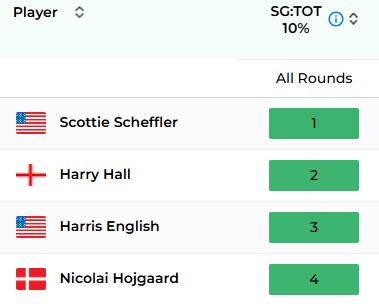
Nicolai finished fifth in my Rabbit Hole model this week, grading out well on long courses with difficult scoring conditions. His distance is an asset this week, as is his putting, which has been a weapon this season. He’s gained an average of 0.51 strokes per round over the past 24 rounds, and he maintains that rate on Poa Trivialis greens. I’d play him to win at 30-35/1, and again, I played the bigger 50/1 e/w option with 3 places.
Michael Thorbjornsen
I didn’t want to see my guy, Michael Thorbjornsen, collapse on Sunday at The PLAYERS, but I was also terrified that he’d win when I didn’t have a ticket on him. Can you imagine?! Nightmare fuel.
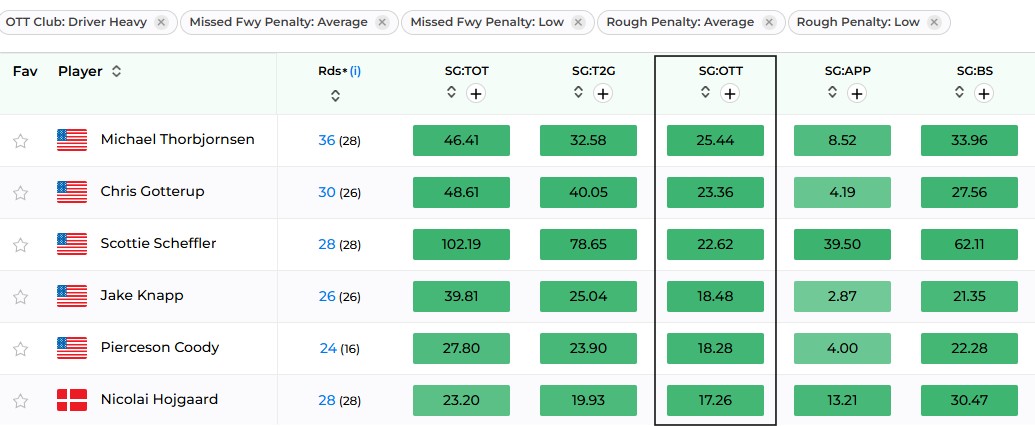
What we saw in Rounds 2 and 3, though, gaining 7.4 and 4.5 strokes respectively, against one of the best fields on one of the Tour’s toughest tracks, was exactly why I continue to beat the drum for him so often. There’s so much upside to his game; he just needs to find a bit more consistency and learn from the experience he’s gaining with these late weekend tee times. A driver-heavy layout suits him well, and I like his chances at finding another late Sunday tee time this week. Let’s see if he can close.
Adam Scott
As a fellow 45-year-old, I absolutely love what I’m seeing from Adam Scott right now. Distance off the tee was always a strength of his game, but it’s uncommon to see someone take strides forward with their ball speed in their mid-40s. Over the past 100 rounds, Adam Scott‘s average ball speed sits at 180.51. That ranks 23rd in this week’s field, so he’s comfortably above the Tour average. In 2026, Scott’s ball speed is up to 184.78 mph, a 4-mph jump that has him a touch above Chris Gotterup, Luke Clanton, Alejandro Tosti, and Wyndham Clark.
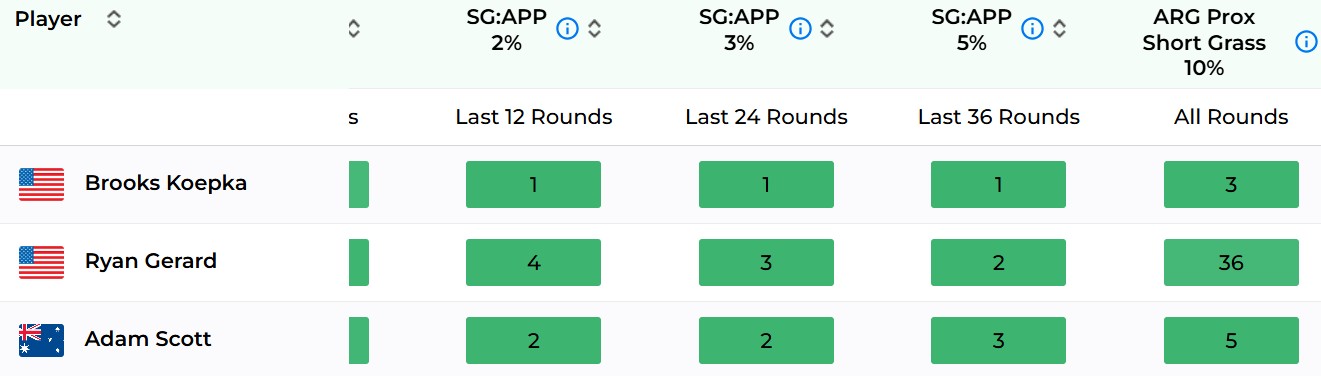
Scott’s also played his best golf of late on the toughest layouts against strong fields. While we don’t have an elite field in Houston this week, Memorial Park is a demanding test. Scott posted top 20 finishes at last year’s PGA Championship and U.S. Open, and his best 2026 finishes have come at Riviera (solo 4th) and Bay Hill (T11).
Ryan Gerard
Ryan Gerard isn’t a pure bomber, so he might fly under the radar for some this week, but I think that’s a mistake. His ball speed is up over 2 mph in 2026 from his 100-round baseline, and he’s above the Tour average, but it’s certainly not his calling card. Even in last year’s bomb’s away setup in soft conditions, Gerard finished in solo-ninth, where he was second in SG: APP on the week (1.89 strokes gained per round).
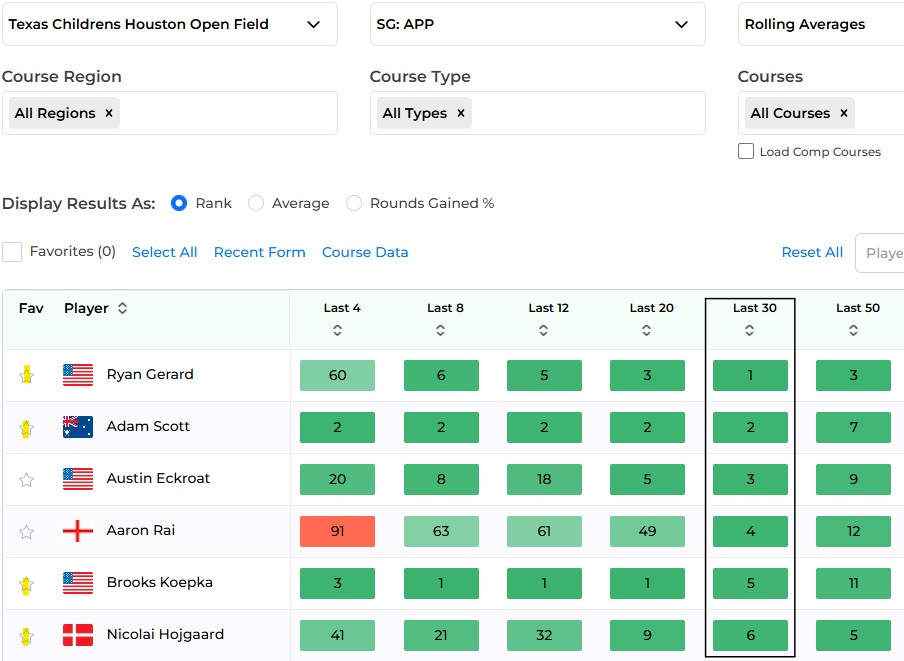
Gerard ranks ninth in my model this week, a result of his stellar approach play. Over the past 12 months, only Scottie Scheffler and Emiliano Grillo rate out better in SG: APP on long and very long courses, and Brooks Koepka is the only golfer ahead of him in SG: APP over the past 36 rounds. The setup at Memorial Park helps Gerard’s short game, too. Poa Trivialis is his best putting surface and the only one he’s strokes-gained positive over the past 12 months (0.48 strokes per round). His around-the-green play looks poor on the surface, but if you look specifically at his around-the-green proximity on short grass, he rates out much better. He’s available at 50/1, and I played him at 80/1 e/w with 3 places.
Ryan Fox
I’ve noted this before, but Ryan Fox is probably the most form-dependent golfer on the PGA Tour. When he’s dialed in, it doesn’t matter the setup. There’s a good chance that he’s going to contend. If he’s riding a bit of a cold streak, it doesn’t matter how perfect the course suits his game; he’ll likely struggle.
Now, the challenge here is figuring out when he slips out of form. You can certainly make the case that a surgery to remove kidney stones is the sort of situation that can push one out of form. On Thursday morning of The PLAYERS, Fox withdrew to undergo a procedure to fix a kidney stone issue, and this will be the first time he’s teed it up since Bay Hill. He gained strokes tee-to-green and ball-striking in his past four starts, with three T24 finishes and a T7 at Riviera mixed in. All four starts were strong fields, with three of the four being Signature Events. The risk is baked into the number because he really has no business being 100/1. I played Fox at 150/1, e/w with 3 places.
