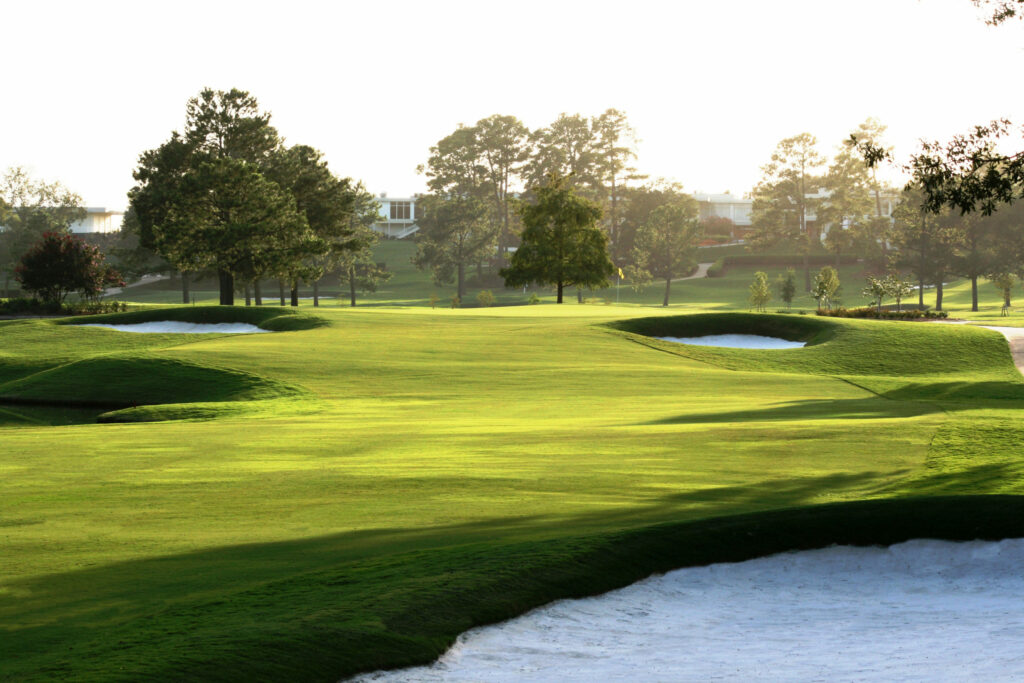
After a couple of weeks off, including last week’s European victory at the Presidents Cup, the PGA Tour returns to stroke play competition for the second event of the FedExCup Fall in Jackson, Mississippi, for the Sanderson Farms Championship.
Played at the Country Club of Jackson for the 12th consecutive year, it is a relatively long and straightforward tree-lined parkland course. Golfers with added length off the tee and who can get hot with the putter on the fast Bermuda greens will have an edge on the field. With minimal hazards and non-penal rough, scores have averaged 19-under par over the last five events.
The Field

The Sanderson Farms Championship boasts a surprisingly strong field this week, highlighted by a number of players who are itching to get back into competition. Headliners include Akshay Bhatia, Luke Clanton, Emiliano Grillo, Tom Hoge, Max Homa, Tom Kim, Min Woo Lee, Keith Mitchell, J.T. Poston, Davis Thompson, and the Hojgaard brothers, Nicolai and Rasmus.
Last year, Kevin Yu won his first PGA Tour title by defeating Beau Hossler in a playoff. Seven of the last 11 winners at this event have been first-time winners on the PGA Tour.
CC of Jackson – Course History
Founded in 1914, the original Country Club of Jackson was a Tom Bendelow-designed course built on 100 acres five miles west of the city’s center. In the late 1950s, the club purchased a 400-acre property northeast of Jackson, with famed architect Dick Wilson contracted to design the course, which opened in 1962.
While the Sanderson Farms Championship event has had different names over the years, it has been played in Mississippi and has been on the PGA Tour schedule since 1968. As for the course itself, it was a renovation by John Fought in 2008 that prompted its inclusion as a host for a PGA Tour event. The course members wanted the layout to incorporate more of a “Golden Age” feel, and thus, Fought redesigned the course with Donald Ross-type characteristics in mind. The course incorporated a classical parkland-style out-to-in routing. The par-3s are well-conceived and challenging. The biggest change was to the green complexes, many of which are elevated and slope from back to front, which is very similar to other Ross designs.
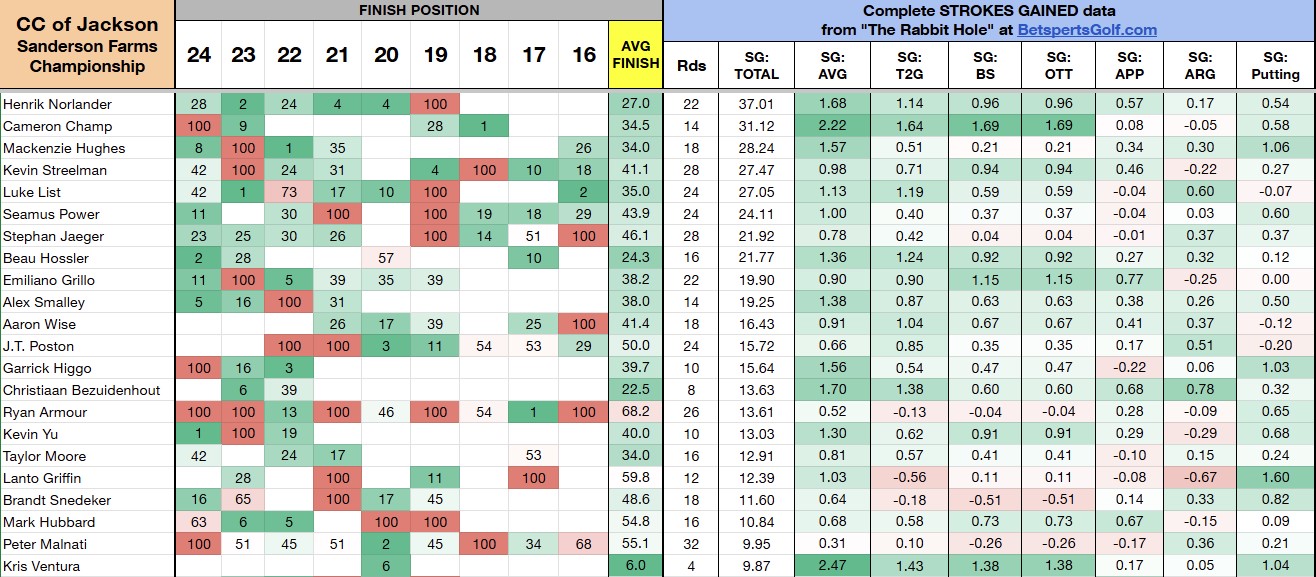
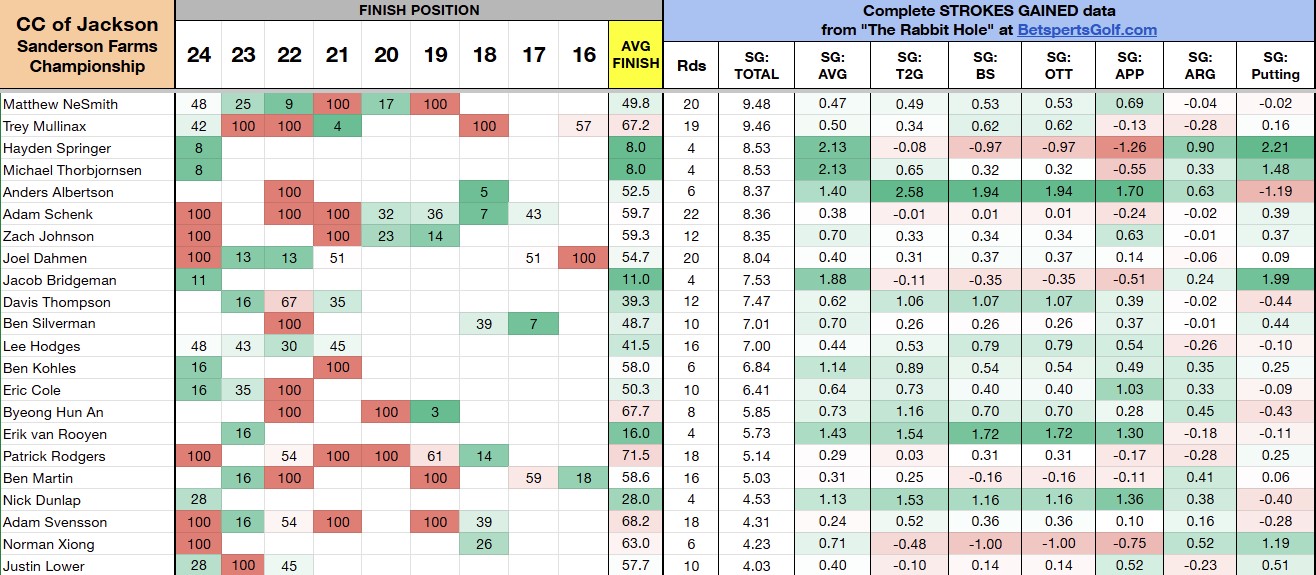
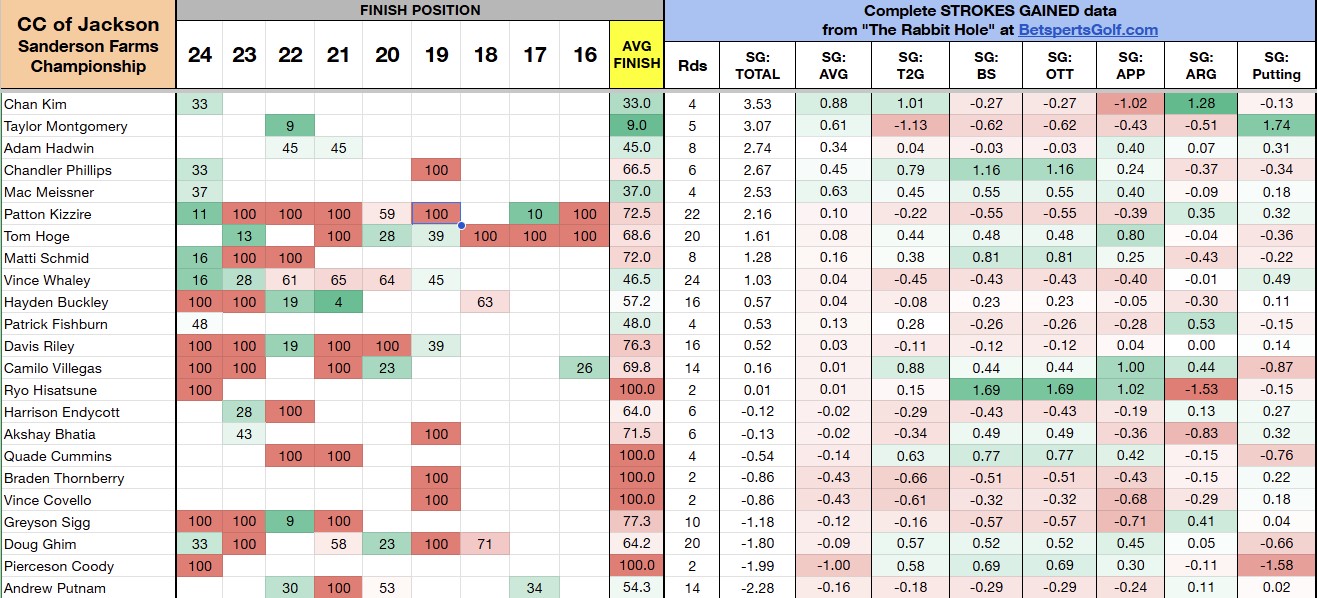
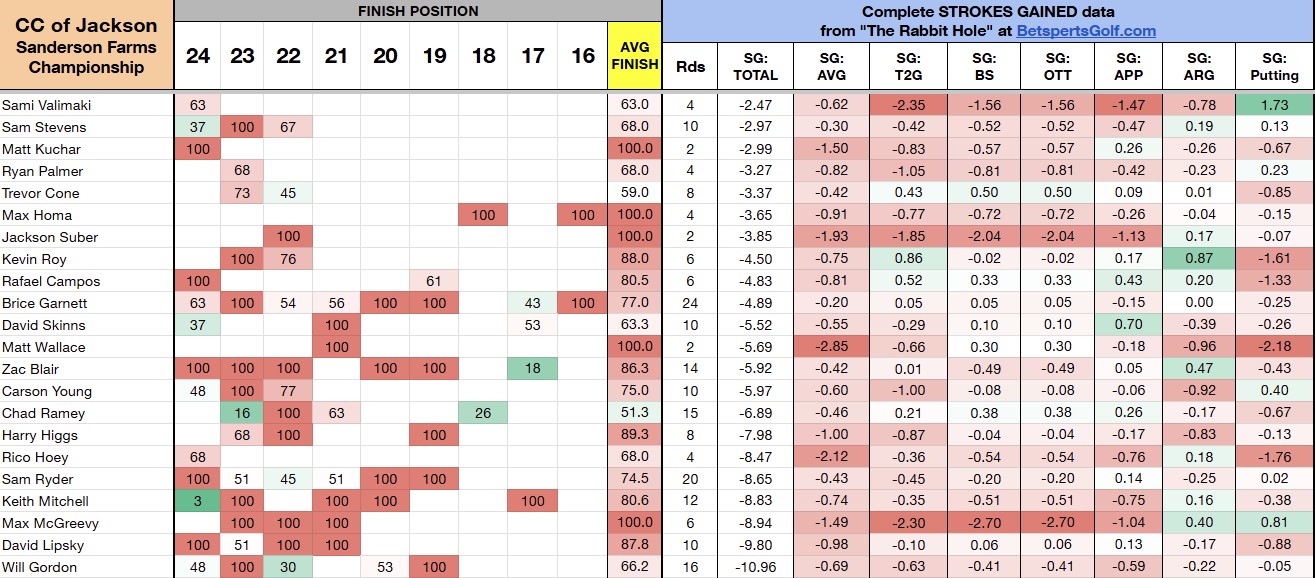
Finish Position and Strokes Gained History at the Country Club of Jackson (2016-2024)
This includes the average finish position and Strokes Gained per round since 2016 for each of the categories. Players are sorted by SG: Total. Silverado is the 20th most predictive annual course on Tour.
Course Features
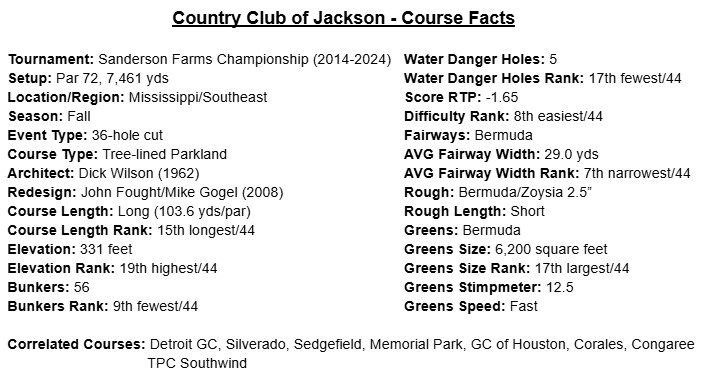
Located in a rural setting in the Deep South, the Country Club of Jackson is a long par-72 course that plays just under 7,500 yards. The course meanders through 400 acres of lowland property with very few elevation changes. It features narrow fairways, non-penal 2.5″ rough, and speedy Bermuda greens. There isn’t much danger on the course in the form of water hazards and bunkers. With water danger on only five holes and the ninth fewest bunkers on Tour courses, it ranks as the 8th easiest course at -1.65 strokes under par per round. Last year, it played the easiest it ever has at -2.58 per round.
This week’s setup features Bermuda fairways and greens, with a Bermuda/zoysia rough cut to just two inches. Unlike pure Bermuda rough, this mix has historically offered relatively little resistance, placing less premium on finding the short grass. The greens measure a Tour-average 6,200 square feet but run firm and fast, reaching speeds north of 12.5 on the stimpmeter.
Agronomically, the key variable is the putting surface. Players raised in the South who grew up on Bermuda typically express a greater sense of comfort on these greens, and historical leaderboards support that edge. A significant number of past winners have had strong ties to the region, suggesting that familiarity with the subtleties of Bermuda—particularly its grain—has been a repeat factor in success at Jackson.
The Sanderson Farms Championship is contested on a composite layout that blends the Dogwood and Azalea nines. Since 2015, winning scores have consistently fallen in the range of -18 to -23, underscoring how receptive and scoreable the course tends to play under Tour conditions.
From a design standpoint, the track offers little in terms of strategic decision-making or risk/reward opportunities. It is widely viewed as a straightforward, execution-based test rather than one that forces players into difficult choices off the tee or on approach. In essence, the course places the emphasis squarely on ball-striking and putting performance rather than creativity or tactical nuance.
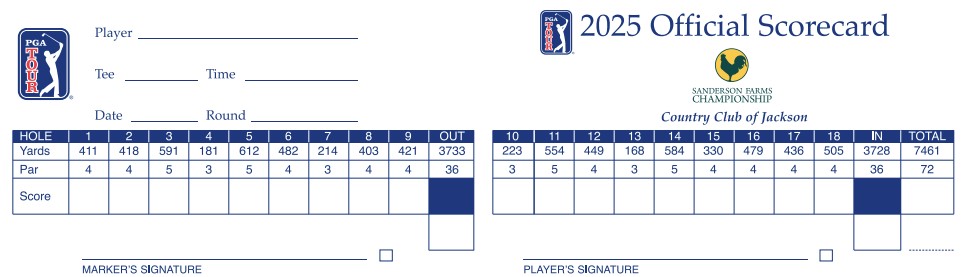
In addition to the quick greens, the course’s primary line of defense lies in its par-5s. While there are four on the card, three measure beyond 580 yards, limiting the number of players capable of reaching them in two. The exception, the 554-yard 11th, still poses a significant challenge with water running the length of the right side. Collectively, these holes suppress scoring relative to the Tour norm, producing one of the lowest eagle rates on par-5s at just 1.3%. Instead of being scoring bonanzas, they often play as three-shot holes where birdie is still attainable but far from guaranteed.
There is a good mixture of holes with three par-4s that play over 475 yards and five other par-4s that are under 425 yards. Three of the par-3s rank among the seven toughest holes on the course and will also provide some challenge.
When John Fought and his associate Mike Gogel completed the design in 2008, their goal was to place a premium on accuracy—not just finding fairways, but also approaching greens from the correct angle. In practice, that vision has only partially materialized. While the course does rank on the tougher side for driving accuracy, it offers above-average green-in-regulation rates from both the fairway and the rough, making recovery less penal than intended.
Where the challenge does show up is in approach precision. Proximity to the hole is nearly two feet longer than the Tour average, suggesting that while greens are accessible, controlling distance and finding the right sections remains a separator. In effect, the test here is less about avoiding missed greens and more about creating realistic birdie chances.
Strokes Gained Analysis
Off the Tee
Off the tee, the Country Club of Jackson has many similarities with the last Tour event at Silverado for the Procore Championship. A combination of non-penal rough and lack of danger allows players to swing away with their driver. The Country Club of Jackson is also one of the straightest courses on Tour, with only four holes that have “skinny doglegs”.
Driving distance off the tee has increased almost every year, with last year seeing a record high of 298.2 yards. In a similar vein, strong drivers of the ball have fared quite well at this event, with six of the last seven winners having been longer than average in the distance department. In 2019, Cameron Champ bombed his way to victory by leading in driving distance at 308 yards. In 2020, Sebastian Munoz finished third in the same category, while 2021’s winner, Sergio Garcia, finished ninth. Luke List, 2023’s winner, is one of the longest drivers on Tour.
But there have also been high-accuracy and shorter players off the tee, like Ryan Armour and Mackenzie Hughes, who have also won here in Jackson. Armour’s average driving distance in his victory back in 2017 was only 264 yards. Traditionally, Ross courses encourage precision off the tee, including hitting to the correct side of the fairway to set up the best approach angle to the green.
The fairways are the seventh narrowest on Tour and have a fairway accuracy rate of just 52.8% over the past five years. But again, because it is not true Bermuda rough (it is mixed with zoysia grass), the threat of unpredictable lies and fliers to the green from balls that miss the fairway is much less here. This encourages players to swing freely and bomb away from the tee box. In fact, the penalty for missing the fairway here is the third-least penal on Tour.
The bottom line is that while distance off the tee is an edge for players who have that skill, there are almost just as many players surrounding the top of the leaderboard in past years who are shorter hitters.
Approach
With a greens-in-regulation rate of 68.7%, well above the Tour average, players cannot separate themselves at the Country Club of Jackson merely by hitting greens. In fact, the course ranks as the 10th easiest on Tour for gaining strokes on approach. While it might appear that proximity to the hole would serve as the key differentiator, historical leaderboards suggest otherwise—proximity leaders have not consistently translated that advantage into high finishes.
As a result, the tournament often tilts toward putting performance. With limited separation available tee-to-green, the Sanderson Farms Championship has repeatedly rewarded those who can get hot with the putter on fast Bermuda surfaces.
There are two key approach ranges to focus on for this week. 34% of approaches are from the wedge range of 100-150 yards. The Tour average from this range is only 27%. Also, thanks to the lengthy par 5s, 18% of approaches will come from 250+ yards, which is well above the average of 10%. Accuracy when “Going for the Green” with second shot approaches on the par 5s will be crucial. This is where the longer hitters have a definite advantage in attempting to set up birdie opportunities on the four par 5s. The par 5s here rank as the second toughest on Tour in “Hitting the Green %” when going for the green on the second shot.
Around the Green and Putting
Gaining strokes around the greens is the 10th easiest on Tour here at the Country Club of Jackson. Many of the greens are raised and have run-off areas similar to other Ross designs. The greenside bunkers rank as the most undemanding of all measured courses on Tour. With greens being hit at such a high rate, combined with the ease of rough and bunkers surrounding the greens, the effect of a poor short game will be somewhat mitigated this week. In each of the past three events here, one-third of players in the top 15 actually lost strokes around the greens.
The data backs up the notion that putting is the most difficult area from which to gain strokes on this course. That being said, it still ranks in the middle of the pack overall. The Champion Bermuda greens are among the fastest on Tour at 12.5 on the stimpmeter and are allowed to push 13 on the weekend. Hole locations are known for being placed in some of the most sloped parts of the green complexes. As a result, these greens are the ninth toughest on Tour in which to gain strokes putting from inside of five feet.
Even with some challenges on the greens, this event is well-known for bad putters having success. Sergio Garcia is one of the worst putters in recent history and managed to gain almost three strokes in the year he won. Cameron Champ is also not known for his putting skills, yet he managed to gain over nine strokes in 2019. Luke List ranks outside the top 100 in putting, yet spiked on the greens in his victory. Last year’s winner, Kevin Yu, who has been one of the worst putters on Tour, gained 8.7 strokes on the greens.
In general, those who finish high in putting for the week typically have a great chance to contend. Seven of the past nine winners have finished in the top six in putting for the week.
Most Important Stats For Success at the Country Club of Jackson
*In order of importance
- SG: Approach
- Birdie or Better %
- SG: Putting (Bermuda)
- Driving Distance
- Par 5 Scoring
- Proximity: 100-150
- SG: Easy Scoring Courses
- Proximity: 200+
- Putting 5-10 feet
- SG: ARG
Key Rabbit Hole Filters
- Course Region: Southeast
- Scoring Conditions: Easy
- Course Length: Long
- Field Strength: Weak
- Event Season: Fall
- Bunker #: Low
- Greens Speed: Fast
- Greens Surface: Bermuda
- Rough Surface: Bermuda/Zoysia
- OTT Club Type: Driver Heavy
- Fairway Accuracy: Difficult
- Missed Fairway Penalty: Low
- Scrambling Rough: Easy