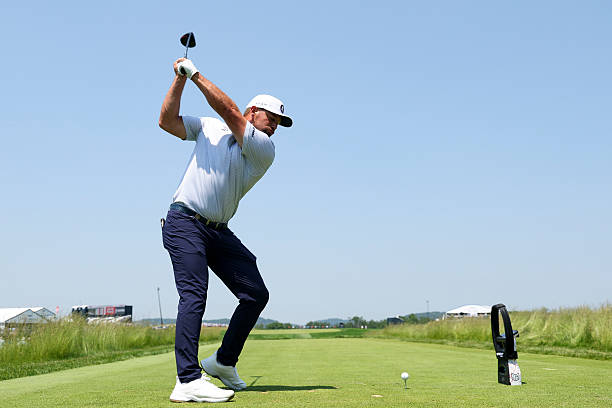
The 125th U.S. Open returns to western Pennsylvania and the legendary Oakmont Country Club for the ultimate examination of championship golf. Renowned for being one of the most difficult courses in the world, Oakmont presents a true test of skill, mental toughness, and resilience.
With its narrow fairways, deep bunkers, unforgiving rough, and lightning-fast greens, Oakmont offers little room for error. The course’s signature feature, the notorious “church pew” bunker, lies between the third and fourth fairways and will undoubtedly come into play, punishing errant tee shots. The undulating greens, among the fastest in the world, demand precision putting, as any misread or overhit putt can easily lead to a three-putt or worse.
Established 121 years ago in 1903, it’s one of the oldest and most revered courses in the United States. Oakmont is no stranger to hosting major championships. No course in America has hosted more U.S. Opens than Oakmont, with this being the club’s 10th since 1927. Several of the game’s best have won the national championship here: Ben Hogan, Jack Nicklaus, Johnny Miller, Ernie Els, and Dustin Johnson, to name a few. Eight of its nine U.S. Open champions are multiple major winners.
It has also presided over three PGA Championships, six U.S. Amateurs, two U.S. Women’s Opens, and three NCAA men’s championships. It was designated a National Historic Landmark in 1987.
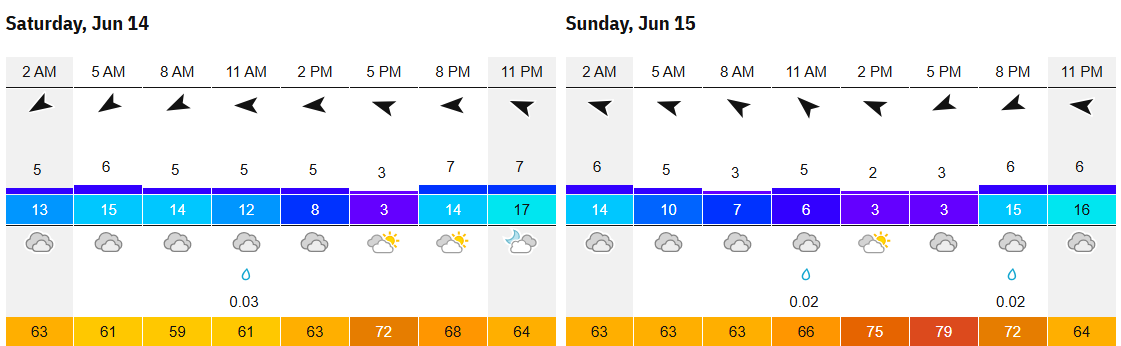
Due to three inches of rain and soft conditions at the 2016 U.S. Open at Oakmont, the average score was +3.56 per round. Only four players finished under par as Dustin Johnson finished atop the leaderboard at -4, winning his first major championship. The 2007 edition at Oakmont had the highest U.S. Open average this century at +5.70, with Angel Cabrera outlasting Tiger Woods and Jim Furyk by one shot to win at +5.
“This course is really dependent on weather,” said John Lynch, President of Oakmont Country Club. “If we get wet weather, you’ve got an opportunity to go under par. If it’s dry with a little bit of wind, they’re gonna be over par.”
There have been several changes to the historic course since it last hosted the U.S. Open in 2016. It underwent an extensive renovation project led by Gil Hanse that aimed at returning the property to its original design.
In last year’s U.S. Open at Pinehurst #2, Bryson DeChambeau claimed his second U.S. Open title with a dramatic up-and-down par from a bunker on the 72nd hole to edge 2011 champion Rory McIlroy by one stroke.
The Field
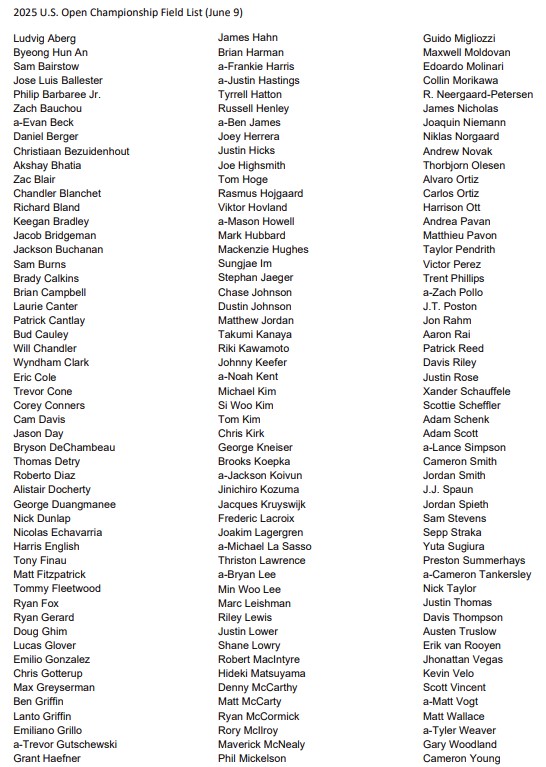
The U.S. Open Championship represents the essence of meritocracy in professional sports. Any professional or amateur with a 0.4 handicap index or lower can sign up to compete for a spot in the tournament. “Golf’s Longest Day” once again witnessed high drama as amateurs, first-time qualifiers, past major winners, a 17-year-old high schooler, and even a dentist competed to earn their way to Oakmont.
This year, the USGA accepted a record 10,202 entries. While several players qualified for the U.S. Open via various exemption categories, others chased a spot at Oakmont via two stages of qualifying. Local Qualifying (18 holes) was contested across 110 sites in late April and early May. Players who advanced from the local stage competed at Final Qualifying (36 holes in one day), which was contested across May 19 (three sites) and June 2 (10 sites).
Anyone in the top 60 of the OWGR automatically earned a spot in the field. Overall, 74 of the top 80 players in the world rankings will be in attendance at Oakmont. Headlining the field is the unquestioned No. 1 player in the world, coming off his third career major victory at the PGA Championship, Scottie Scheffler.
While Scheffler and world No. 2 Rory McIlroy are chasing multiple majors this season, they arrive at Oakmont going in different directions. After having won the PGA, Scheffler followed that by winning the Memorial two weeks ago. McIlroy, on the other hand, finished 47th at the PGA and last week posted a +9 score to miss the cut at the RBC Canadian Open.
Other elite players in the field, many of whom are lacking in recent tournament wins and who are also in mediocre form, include Xander Schauffele, Viktor Hovland, Collin Morikawa, Ludvig Aberg, Justin Thomas, Patrick Cantlay, Hideki Matsuyama, Russell Henley, and Tommy Fleetwood.
With McIlroy appearing disinterested since his Masters victory, Scheffler’s main challenger is LIV golfer and defending U.S. Open champion, Bryson DeChambeau, who has five top-6 finishes in his last six major appearances.
After 12 LIV golfers competed in The Masters and 16 made their way to Quail Hollow for the PGA Championship, 14 players from the PIF-backed circuit will travel to Oakmont. Other LIV players in the field are Jon Rahm, Brooks Koepka, Phil Mickelson, Dustin Johnson, Cameron Smith, Joaquin Niemann, Tyrrell Hatton, Patrick Reed, Richard Bland, Carlos Ortiz, Marc Leishman, Jinichiro Kozuma, and the newly signed Josele Ballester.
The U.S. Open is a four-round, 72-hole stroke-play championship, with a cut after 36 holes. The top 60 players and ties make the cut.
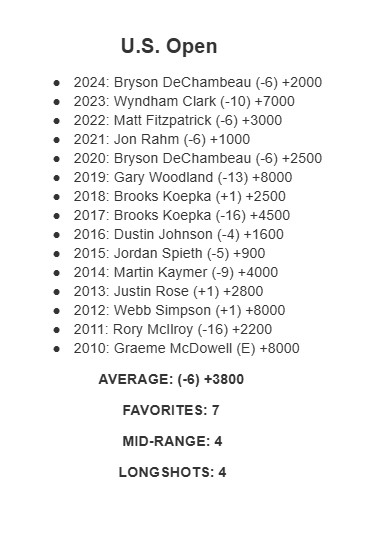
Past Winners/Odds – U.S. Open
Most Important Stats For Success at Oakmont
*In order of importance
- Distance From Edge of Fairway/Driving Accuracy
- 3-Putt Avoidance/25+ feet (Difficult/Large Greens)
- SG: Approach/GIR (Very Difficult Approach)
- SG: Total (Very Difficult Scoring Conditions)
- Scrambling (Long Rough)
- SG: Putting (Fast Greens)
- Driving Distance
- Bogey Avoidance (Very Difficult Scoring Conditions)
- ARG Proximity (Difficult ARG)
- Par 4 BoB% (Difficult Par 4s)
Key Rabbit Hole Filters
- Course Region: Northeast
- Scoring Conditions: Very Difficult
- Course Length: Long
- Field Strength: Very Strong
- Par: 70
- Event Type: Major
- Green Surface: Poa
- Green Speed: Fast
- Green Size: Large
- Missed Fairway Penalty: High
- Rough Penalty: High
- Gain OTT: Very Difficult
- Gain APP: Very Difficult
- Gain ARG: Very Difficult
- Gain Putting: Very Difficult
- 3-Putt AVD: Difficult
- Par 4s: Difficult
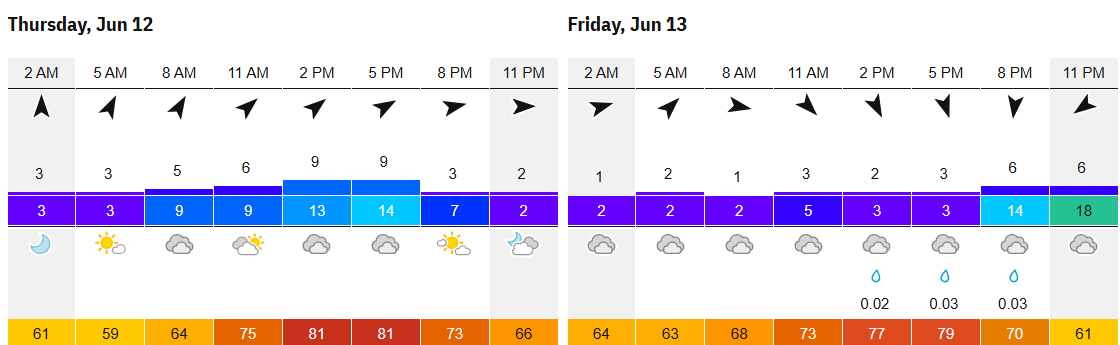
Weather Forecast – Oakmont, Pennsylvania
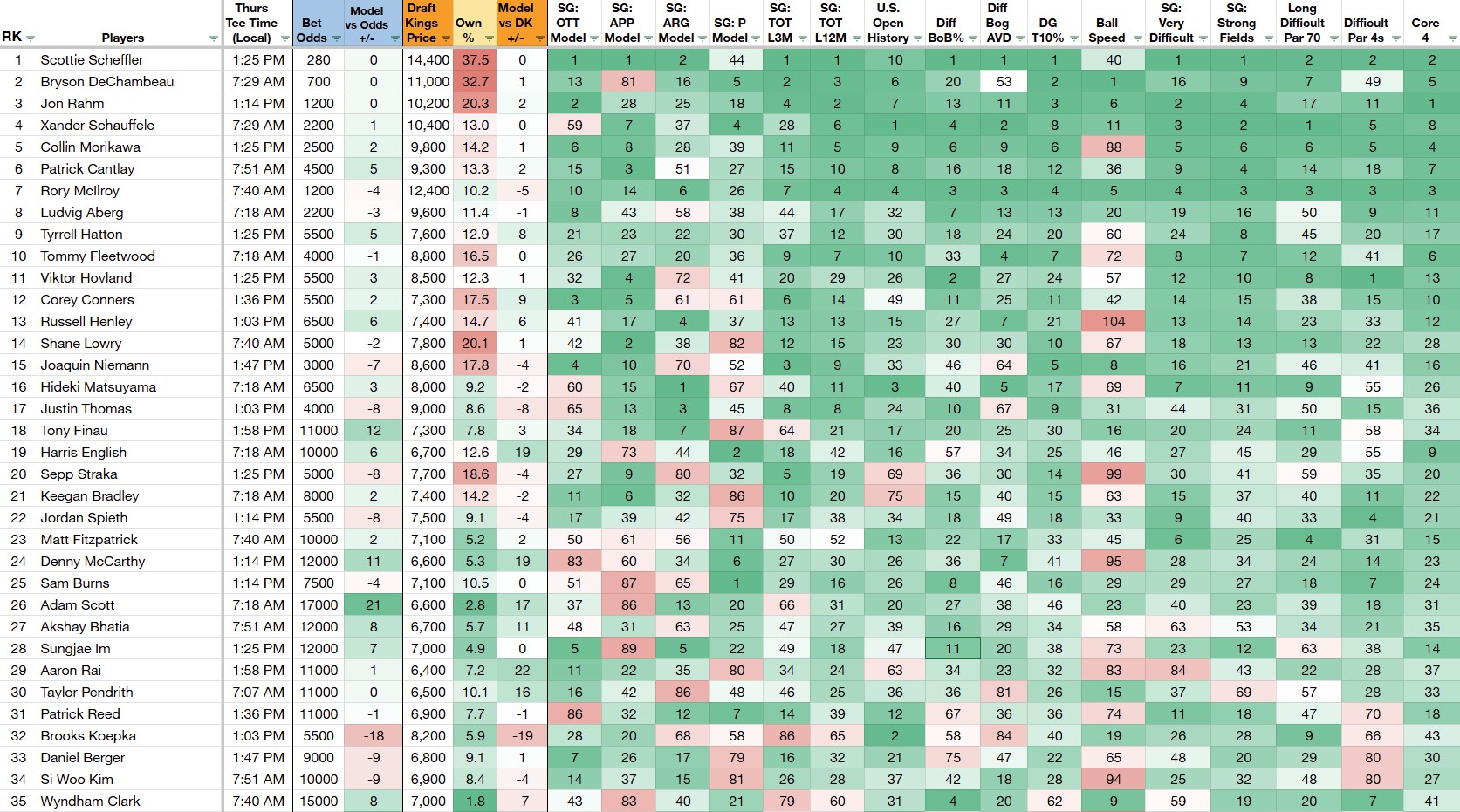
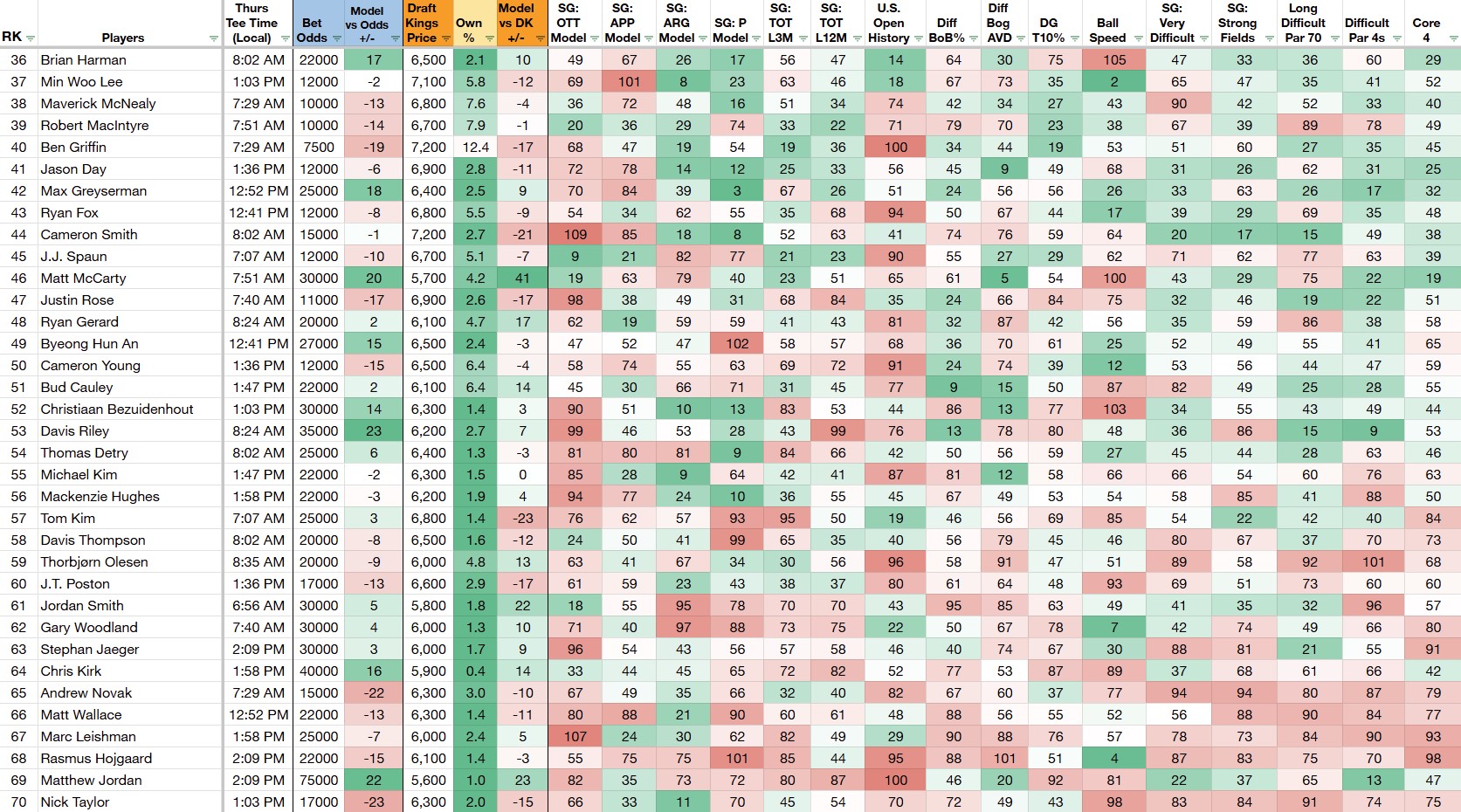
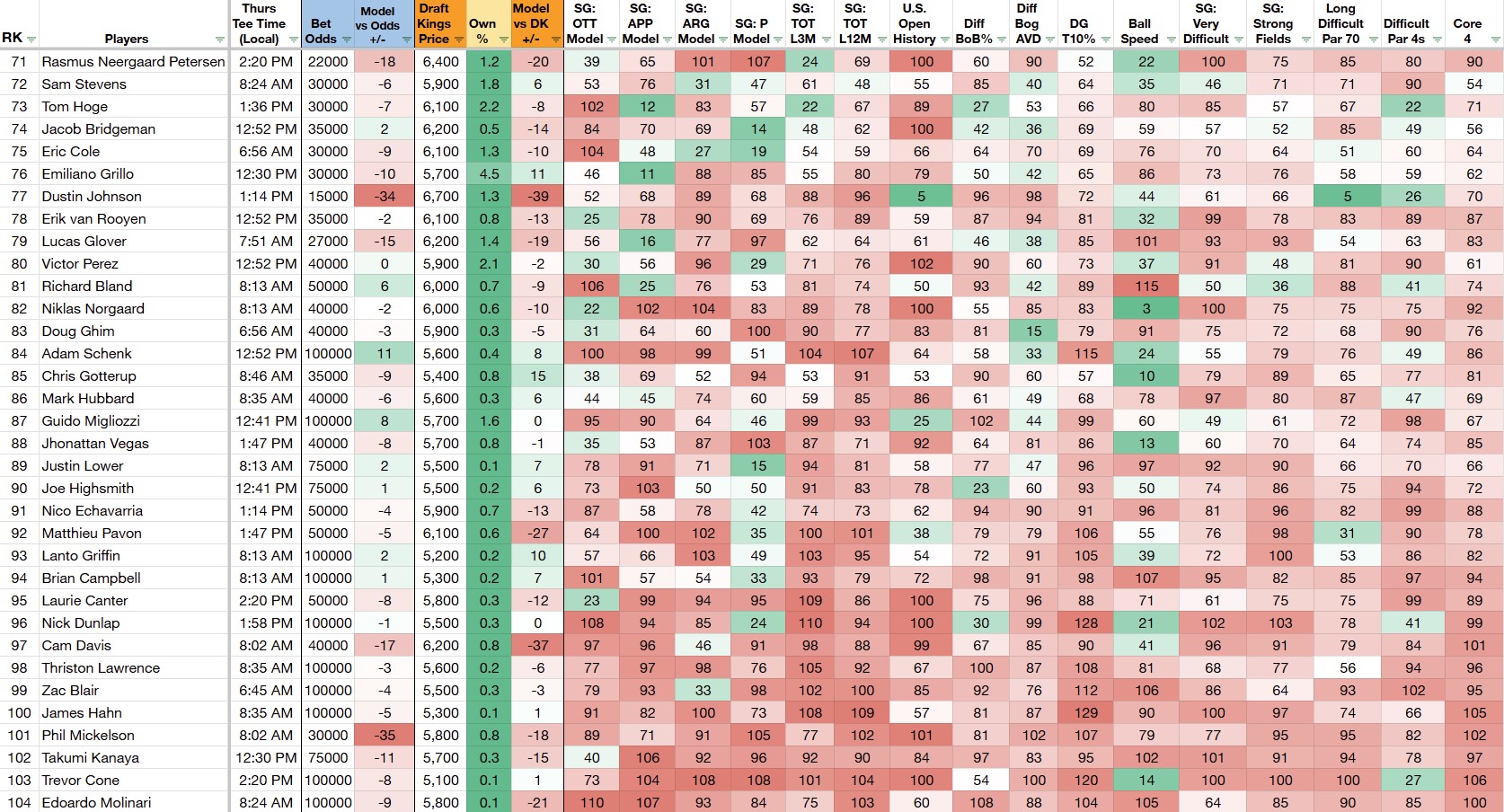
The U.S. Open – Final Model
In each preview article and on Discord, I present my final model, which gives a detailed player ranking of the most important stats and splits for the week. My modeling is built around the PGA’s Strokes Gained data, which is divided into SG: Off the Tee (OTT), SG: Approach (APP), SG: Around the Green (ARG), and SG: Putting (P). Learn more about Strokes Gained and why it can be so useful in analyzing the past and predicting future performance. Many of these specific metrics and conditions can be found in “The Rabbit Hole“, with my final model exclusively published here and in the Discord for subscribers.
https://docs.google.com/spreadsheets/d/1VpLNLv7y3tGHwwlfWwWfSCqfr5E8zQdmdsi1zWaRSEk/edit?usp=sharing
Outright Betting Selections
For the most up-to-date picks, check out my Twitter and subscribe to our Discord at BetspertsGolf.com.
*Lines accurate at the time of publication.
- DeChambeau +1000 (2.4u) – 365
- Schauffele +2500 (0.96u) – Rivers
- Aberg +3500 (0.68u) – DK
Finish Positions
Top 10
- DeChambeau -105 (1.1u) – DK
- Rahm +125 (1u) – DK
Top 20
- Schauffele -105 (1.5u) – DK
Top 30
- Aberg -115 (1.2u) – DK
- Cantlay -110 (1.1u) – DK
- Henley +105 (1u) – DK
Top 40
- Hovland -120 (1.2u) – DK
- Matsuyama -120 (1.2u) – DK
- Pendrith +105 (1u) – MGM
This article is intended for entertainment purposes and adult users only. Call 1-800-GAMBLER if you have a gambling problem.
Photo by Sam Greenwood/Getty Images