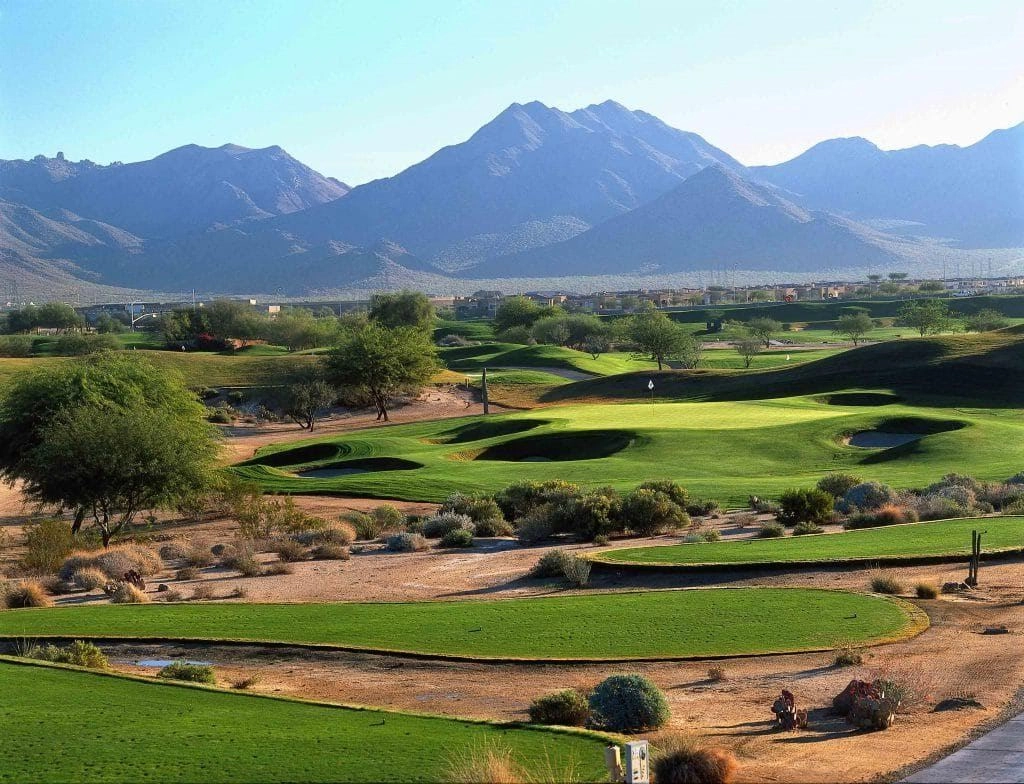
Set in the Sonoran Desert and surrounded by the rugged McDowell Mountains, the PGA Tour heads to TPC Scottsdale for this week’s Waste Management Phoenix Open. Completed in 1986 and designed by Tom Weiskopf and Jay Morrish, TPC Scottsdale has hosted this event for the last 37 years.
The “People’s Open” is one of the most popular sporting events in the world, hosting around 750,000 spectators annually. Known for its raucous crowds, especially at the par-3 16th hole, this event has a unique atmosphere and often produces a dramatic finale. The scoring margin has been one stroke in 15 of the past 18 years with eight playoffs, including last year when Nick Taylor outlasted Charley Hoffman on the second playoff hole.
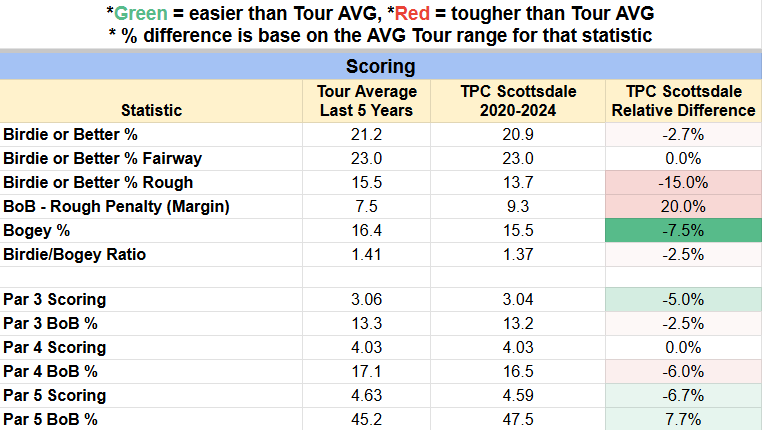
While there are plenty of scoring chances at TPC Scottsdale, the winning score has only reached 20-under par twice in the last 17 years. Over the past five years, scoring has averaged -0.82. Strong drivers of the ball have had great success here, including Scottie Scheffler (won twice), Brooks Koepka, Hideki Matsuyama (won twice), Jon Rahm, Rickie Fowler and Justin Thomas.
Ball-striking and distance off the tee are also important, especially in the thinner air where all three par-5s are reachable and can be aggressively attacked to set up eagle and birdie chances which are vital to success. Past course history also matters as TPC Scottsdale is the fourth most predictive course based on past performance.
The Field

After three consecutive weeks of course rotations and pro-am set-ups, it’s back to normal tournament golf with a 132-player field and a cut after 36 holes with the top 65 and ties advancing to the weekend. Scheffler, The No. 1 player in the Official World Golf Ranking (OWGR) will be going for his third WM Phoenix Open victory in the last four years. Other top-25 players in the field include Hideki Matsuyama, Wyndham Clark, Justin Thomas, Sahith Theegala, Robert Macintyre, Sungjae Im, Billy Horschel, Sepp Straka, Sam Burns, Tom Kim, and Byeong Hun An.
TPC Scottsdale Course History
Commissioned by the City of Scottsdale to design a municipal golf course that would also test the best players in the world, many would agree that Tom Weiskopf and Jay Morrish achieved their goal with flying colors. Having sculpted it from the Sonoran Desert, it has become one of the most popular annual courses on the PGA Tour. While the Phoenix Open event has been called many names since it began in 1932, it moved to its present location at TPC Scottsdale in 1987.
TPC Scottsdale designer and one of the best architects of recent times, Tom Weiskopf, passed away in 2022. One of his most important contributions to course architectural philosophy was reviving the idea of driveable par 4s. He made a habit of including at least one on almost every course he designed, and typically on the back nine at crucial holes down the stretch. Most would agree that his most famous par 4 is the driveable 17th here at TPC Scottsdale. It’s the hole with the only par-4 ace in PGA Tour history thanks to Andrew Magee in 2001.
Another impact Weiskopf had on the game was his attempt to enhance the idea of “stadium golf”. Designed by Pete Dye, TPC Sawgrass was the first of the PGA Tour’s “stadium” courses. Weiskopf continued the tradition at TPC Scottsdale which has perhaps the most “stadium” feel of any course thanks to the 16th hole and the entire dramatic finishing stretch.
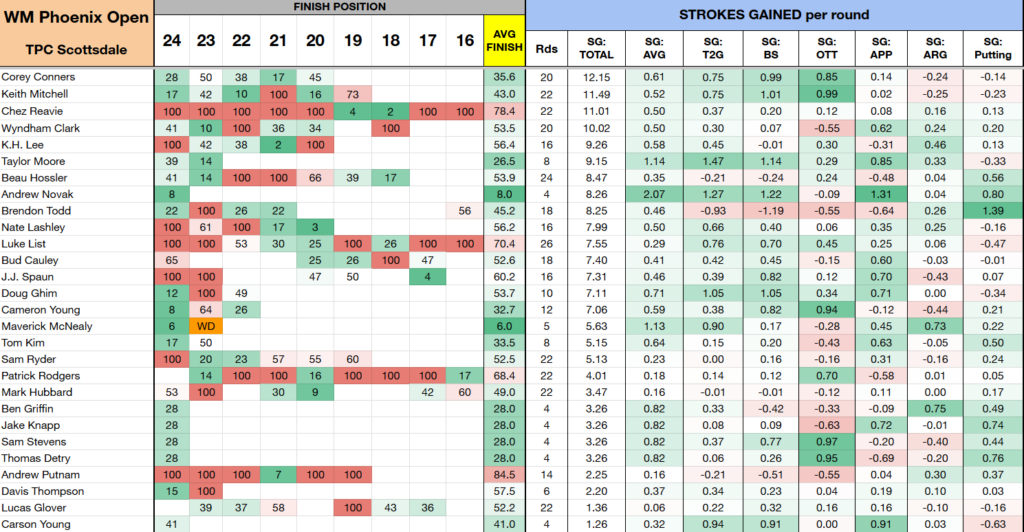
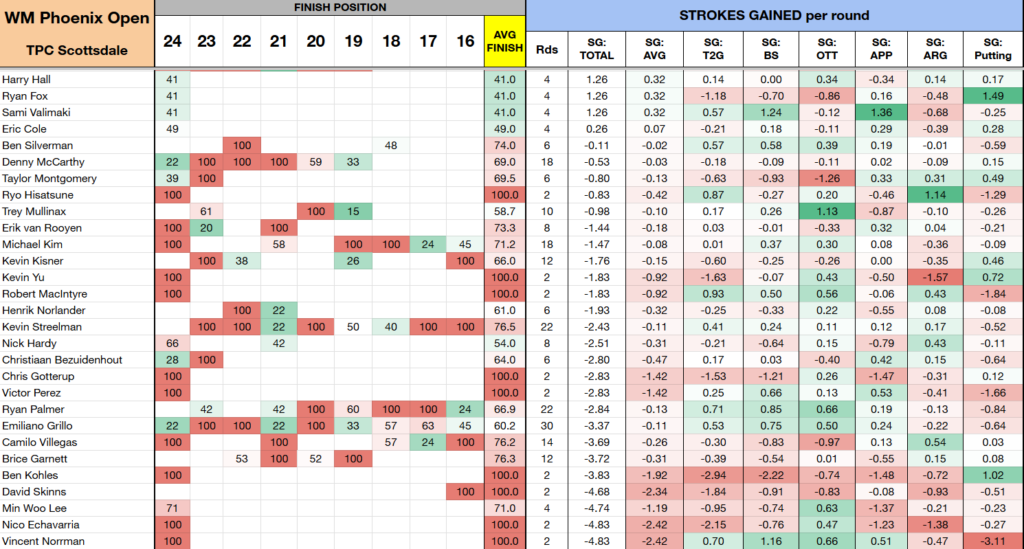
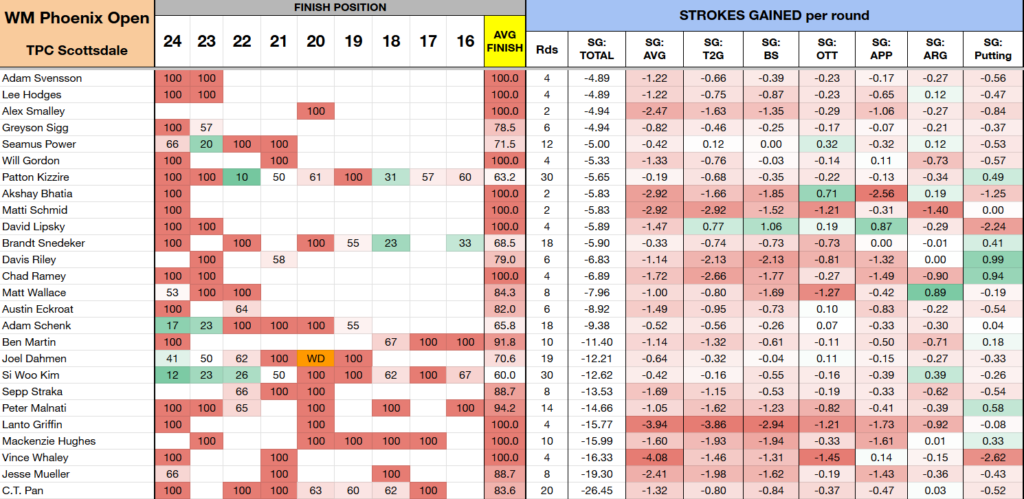
Finish Position and Strokes Gained History at TPC Scottsdale (2016-2024)
This includes the average finish position and Strokes Gained per round. Players are sorted by SG: Total.
f684b2f3d4218ee06dad551b3bb2074b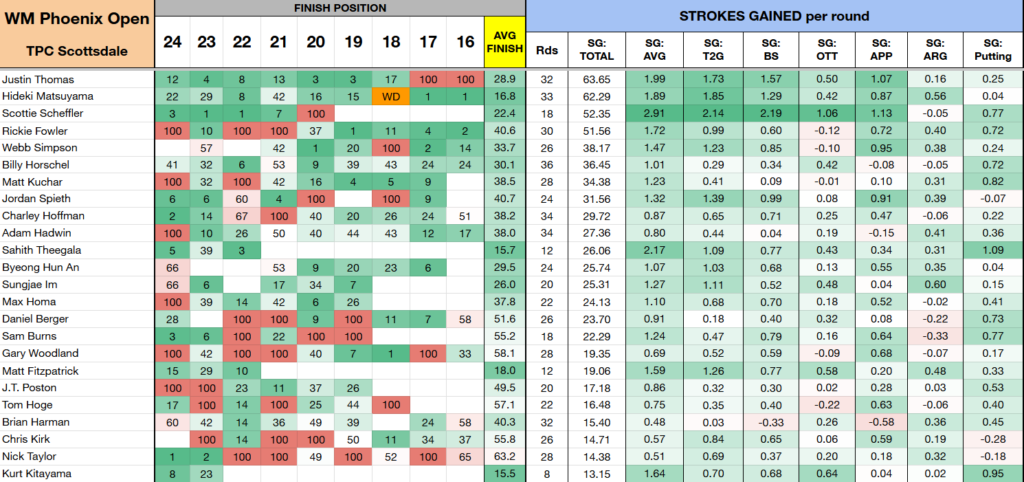
Course Features
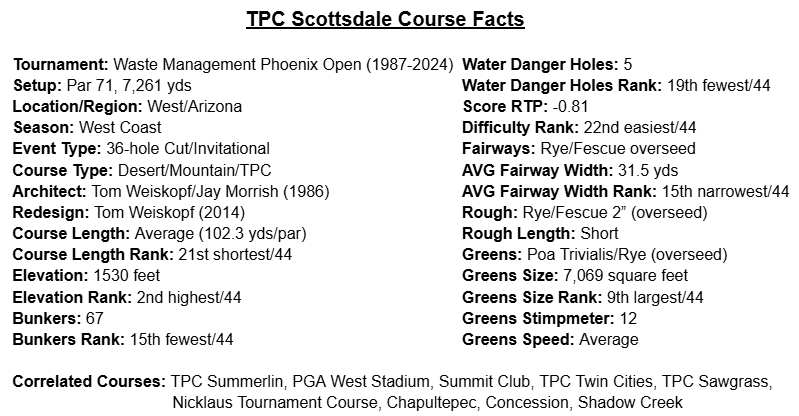
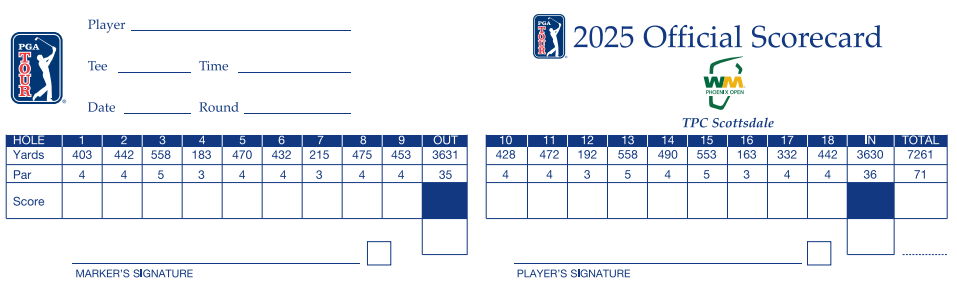
Sitting at just over 7,200 yards, TPC Scottsdale is a Par-71 layout that trades one par-5 for an additional par-4. While it is average in distance by PGA Tour norms, it tends to play much shorter thanks to an average elevation of over 1,500 feet. The course is the second-highest on Tour, which contributes to the increase in driving distance off the tee and gives the impression that it is a “bombers” paradise.
Though the course is elevated, there is very little change in terrain. The course itself has more of a unique, hybrid style. With a lack of trees, it is not a parkland course. While some holes have a desert backdrop, it is also not a true desert course because it lacks the vast waste areas and natural desert environment of other courses in the Southwest.
With the bermudagrass still dormant, fairways and rough are overseeded with rye and fescue. The rough is short at only two inches. Greens are a majority Poa trivialis with some ryegrass mixed in and are very similar to the greens at the Pete Dye Stadium Course, TPC Sawgrass, Innisbrook, TPC San Antonio, and Harbour Town. The greens are also twice as large as what we saw at Pebble Beach last week at an average of over 7,000 square feet per green and are paced at a 12 on the stimpmeter.
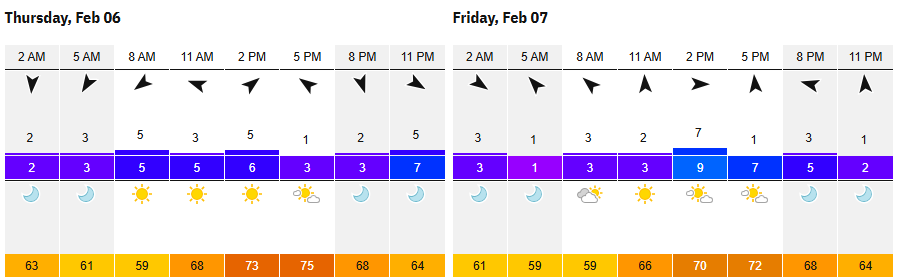
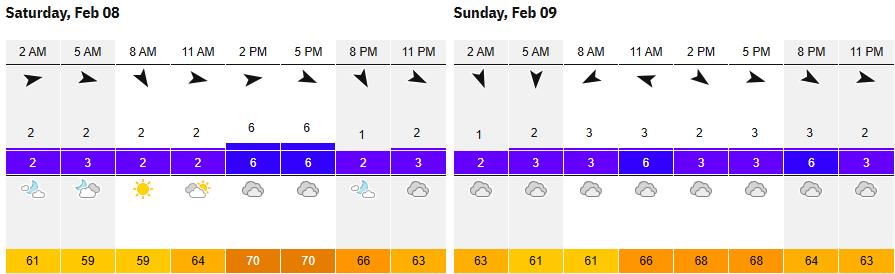
With non-penal rough, reachable par 5s, and huge greens, there aren’t many danger areas to cause players much adversity. Similar to the courses at the American Express, the wind is rarely a concern and players often have a dome-like environment in which to score. Due to an abundance of sunlight and the lack of precipitation in this part of the country, the course typically plays firmer and faster as the week progresses. This can affect players negatively on both fairway rollouts into trouble areas and on approaches to the greens that bounce off the putting surface and onto short grass areas. The other potential danger area is off the tee where five holes have water danger and others have scattered waste areas that can affect wildly errant shots.
Hole Preview
The course features 10 par-4s between 400-500 yards. All three par 5s stand between 550-600 yards, and are reachable in two shots for most of the field. They are three of the most scoreable par 5s on Tour as each has a birdie or better rate of over 41%. In order to move up the leaderboard, players will need to birdie and eagle those holes.
The first 14 holes are quite bland in their design. Most of these holes are very straightforward and reward players for hitting it long and straight off the tee. The excitement begins on the back nine as there are numerous risk/reward holes on the closing stretch that bring water and the desert surroundings into play, most notably the drivable par-4 17th. Danger lurks around every corner on the closing stretch, but so too do scoring opportunities. To shoot a good score here, players will have to be aggressive and take some chances on these risk/reward holes.
It all starts on the 15th hole with a 553-yard par 5 that features an island green. Players typically have no issue reaching in two shots, and as the 15th easiest hole on the course, making a birdie should be the worst-case scenario.
The par 3 16th hole also known as “The Coliseum” is one of the most intimidating and raucous shots in golf. While the chaos reverberating from the grandstands can be an issue for some, realistically, it should be a simple hole that plays anywhere from 120 to 160 yards into a two-tiered green.
As mentioned, the par 4 17th is the most stressful and exciting hole on the course. Tournaments are won and lost here (just ask Sahith Theegala). It is because of holes like the 17th that since 2009, only two 54-hole leaders have managed to close out and win the tournament on Sunday.
The closing hole is a 442-yard par 4 that doglegs to the left with water down the entire left side. This water hazard has been the death knell for many a golfer as it has the third-highest double-bogey or worse rate on the course at 2.7% and plays over par.
Strokes Gained Analysis
Off the Tee
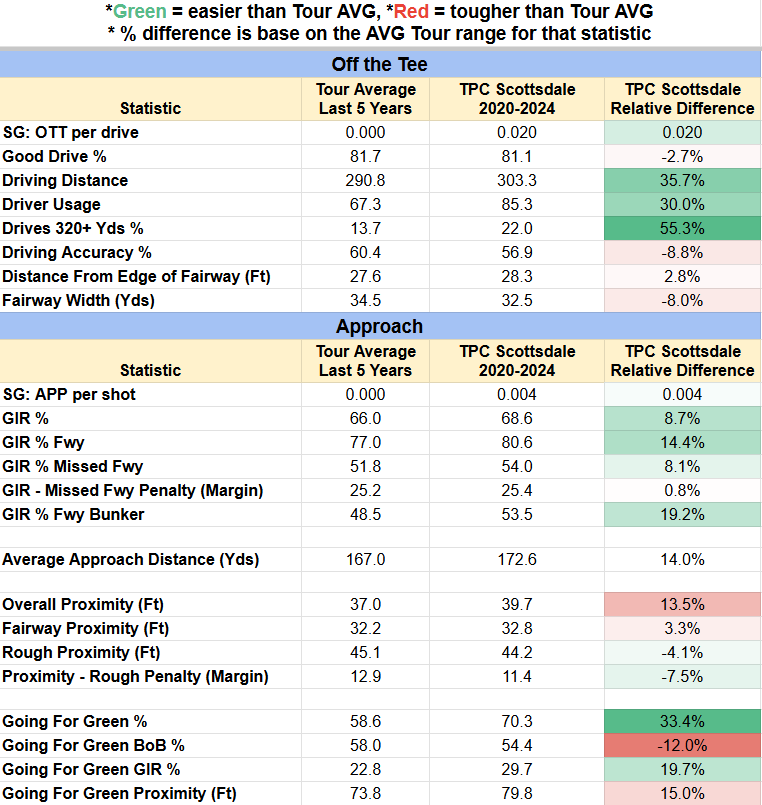
TPC Scottsdale holds the title of the longest average driving distance course on Tour. With the desert air and firm conditions, the driver-heavy course averages over 303 yards off the tee. The elevation advantage measures an additional 7.5 yards of distance per 300-yard drive. Accuracy with the driver is also important as players must avoid water and desert surroundings.
Total Driving will be one of the key stats this week as 14 of the last 15 winners here ranked inside the top 55 in Total Driving on the PGA Tour in the season of their victory (with an average rank of 35th out of 188). When handicapping this week, it’s also important to remember that while many elite drivers of the ball have had great success here, shorter more accurate ball-strikers like Webb Simpson, J.T. Poston, and Matt Kuchar also have high finishes at TPC Scottsdale.
Much of the time, the ultimate strategy here is the good old-fashioned philosophy of just trying to “grip it and rip it.” The course is fairly open even with the 14th narrowest fairways at only 31 yards wide on average. But if you do happen to get sidetracked, you can pay the ultimate price. Missed fairways often result in some sort of penalty. While the 2.5″ rough is non-penal, there are numerous water hazards and waste areas with native bushes that are littered along the sides of most of the driving holes. Wayward drives finding these trouble areas lead TPC Scottsdale to rank third among the Tour’s annual courses for the highest rate of tee shots finding the penalty areas.
Approach
Along with Total Driving, ball-striking is the name of the game here in Scottsdale. With firm greens in play this week leading to a 16% relative increase in average proximity to the hole, the ability to hit approach shots close for birdie looks is vital. Because of this, a high ball flight is much preferred, which adds to the importance of distance of the tee because it means having shorter lofted irons into greens on approach shots.
Overall, TPC Scottsdale ranks in the middle of the pack in strokes gained approach difficulty. Last year, 62% of all approaches came from 125-200 yards which is well above average. Every other approach range falls below the Tour norm. Related to the importance of “second shots” this week, 14 of the last 16 winners ranked inside the top 40 in Ball Striking on the PGA Tour in the season of their victory. Scottie Scheffler gained 9.5 strokes on approach in his victory here last year.
With three reachable par-5s and the driveable par-4 17th hole, players who are aggressive and skilled in “Going for the Green” have a sizeable edge this week. With the winning score approaching 20-under and an eagle rate of over 2.5%, players will need to take some chances on these four holes to attempt to gain separation on the field.
Around the Greens and Putting
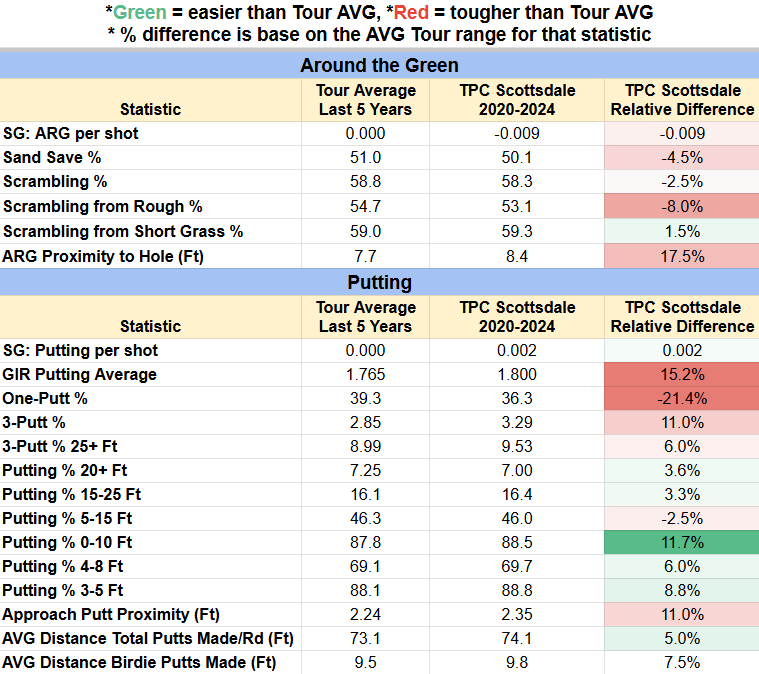
Related to the short game, scrambling is slightly easier than Tour average. With huge greens, golfers do not need to be short-game wizards to score low here. The one area that can test players’ short-game skills is chipping from the short grass areas. Most greens feature collection areas that funnel errant approaches leading to the 10th toughest conditions to scramble for par on Tour.
Over the past five years, the greens at TPC Scottsdale are some of the easiest for putting on Tour. They are relatively flat and lack many undulations. With the likes of bad putters such as Hideki Matsuyama, Kevin Stadler, and even Kyle Stanley winning here, putting skill seems to matter much less than at other courses. The overseeded Poa trivialis greens roll fast and pure. They have yielded the third-highest percentage of made putts outside of 15 feet.
Most Important Stats For Success at TPC Scottsdale
*In order of importance
- SG: APP
- Total Driving
- Birdie or Better %
- Par 4 Scoring
- TPC Scottsdale Course History
- Bogey Avoidance
- SG: Putting (Poa Trivialis/Bent)
- SG: OTT
- Good Drive %
- Scrambling – Short Grass
Unique Rabbit Hole Filters
- Course Region: West
- Course Type: Desert
- Scoring Conditions: Average
- Water Danger: High
- Course Length: Average
- Elevation: High
- Event Season: West Coast
- Greens Surface: Poa Trivialis
- Greens Speed: Fast
- Greens Size: Large
- OTT Club Type: Driver Heavy
- Rough Penalty: Low
- Scrambling Short Grass: Difficult
Weather Forecast – Scottsdale, Arizona