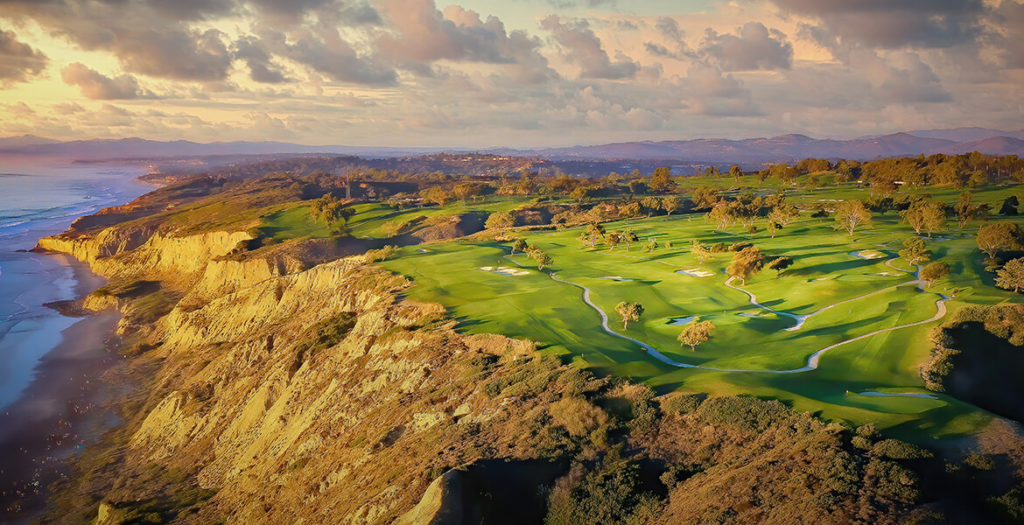
The PGA Tour’s west coast swing continues this Wednesday with the Farmers Insurance Open featuring the scenic Torrey Pines South Golf Course in La Jolla, California. Torrey Pines has hosted this event every year since 1968. Lying on land occupied by an anti-aircraft battery during World War II, it is one of America’s most scenic course layouts atop coastal bluffs north of San Diego with dazzling views of the Pacific Ocean.
Thanks to the frequent morning fog delays and early sunsets, there will be two courses utilized this week. Both are owned and maintained by the City of San Diego. Golfers will play both the North and South courses once before the cut on Friday. Only the South course will be used on the weekend. While the North course plays much easier and is more tree-lined, the South course sits much closer to the Pacific bringing possible weather effects into play. It is a massively lengthy track. In fact, it is the longest annual Tour course in the rotation, stretching over 7,700 yards.
Other than the one round on the North Course, the scoring this week will be the complete opposite of the birdie-fests we have seen for the first three events of this year. The South Course is the seventh-most difficult layout on Tour. The course provides no let-up and forces players to use every club in their bag. Unlike the previous few events, Torrey Pines offers a true barometer on the state of a golfer’s all-around game early in the 2025 season.
Even though it’s played at sea level, Torrey Pines plays even longer than the scorecard yardage due to softer fairways and the cooler January air. Every golfer will need to dust off the cobwebs from their long irons because they will be needed here. Winning scores at this event have been 15-under par or less in 11 of the past 12 years.
This is a “sticky” course when looking at the type of players who have success. Par will be a good score on a majority of the holes. With it being such a long track, bombers have a definite advantage. Yet the winners’ list has also been filled with elite scramblers and Poa putting specialists. Ideally, players who are long and accurate off the tee and who also excel with their short game, particularly on Poa greens, have the best chance for success.
The Field
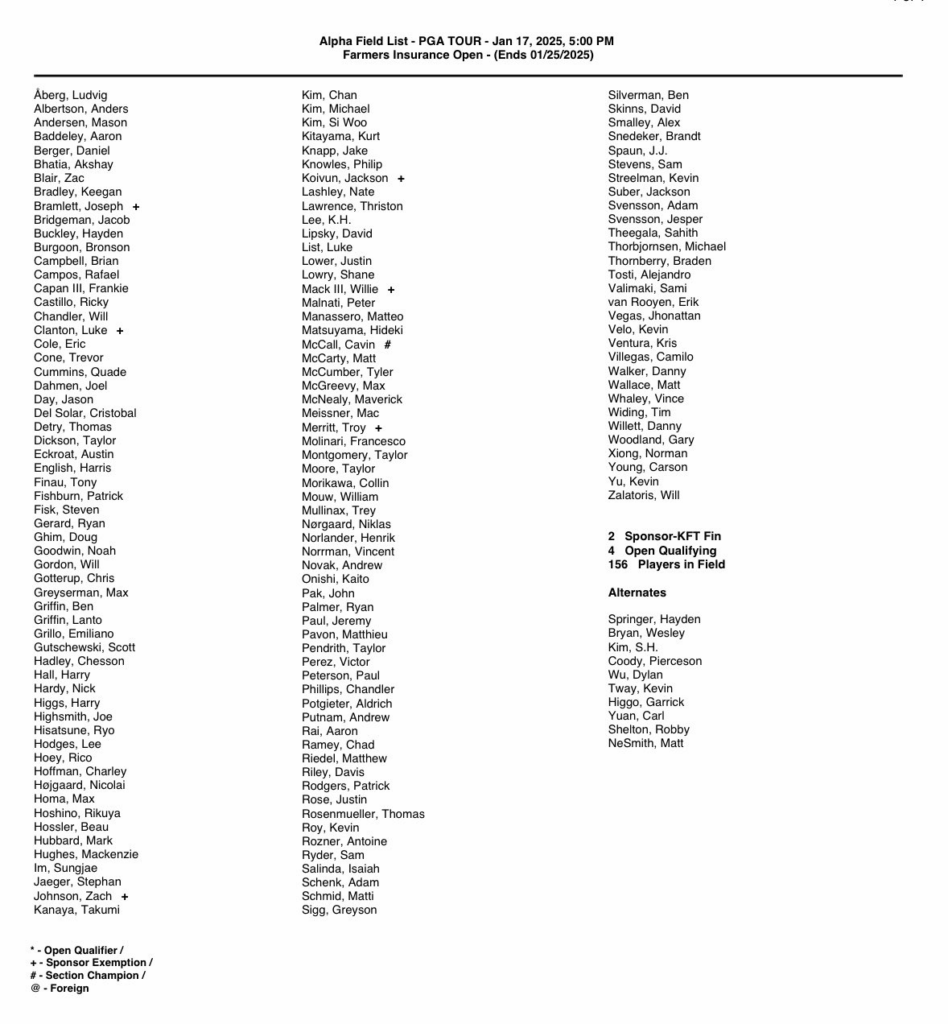
It’s the first tough test of the new calendar year, and while some of the elite names have shown up to take on the challenge, many are sitting out this week. World No. 1 Scottie Scheffler remains out with a hand injury while World No. 2 Xander Schauffele is also skipping the event with an undisclosed injury. And then on Sunday, World No. 4 Collin Morikawa withdrew due to “illness”.
Top-30 players in attendance include Hideki Matsuyama, Ludvig Aberg, Keegan Bradley, Sahith Theegala, Tony Finau, Aaron Rai, Maverick McNealy, Shane Lowry, and Akshay Bhatia. Matthieu Pavon returns as the defending champion, while past champions Max Homa, Luke List, Justin Rose, Jason Day, and Brandt Snedeker are also entered.
The tournament will be played from Wednesday to Saturday for the fourth consecutive year to appease the NFL playoff schedule. We are back to a standard 36-hole cut this week with the top 65 and ties playing the weekend. Only the South Course is equipped with ShotLink data. This is the last chance for players to earn a spot in next week’s AT&T Pebble Beach Pro-AM. The top five FedExCup points earners from the Sony Open, The American Express, and this week’s Farmers Insurance Open will gain entry into next week’s “Signature Event.”
Torrey Pines – Course History
One of the most famous municipal golf properties in the country, Torrey Pines was designed by William Bell in 1957. Located at the previous site of Camp Callan, a U.S. Army installation, it was built on a tract of land with mountains to the north and the Pacific Ocean to the west.
Since 1968, Torrey Pines has hosted the PGA Tour’s Farmers Insurance Open, which was originally known as the San Diego Open. During its first few decades, the South Course was around 6,850 yards. The South Course was first renovated in the late 1970s by local hero Billy Casper.
It was then completely redesigned by Rees Jones in 2001. Jones moved multiple greens, doubled the number of bunkers, added ten new tee boxes, and extended the yardage to a whopping 7,607 yards. He also brought several coastal canyons into play, namely on the 3rd and 14th holes. The goal was to make the course more competitive for the modern-day player. Jones’s efforts were rewarded as the course hosted the 2008 U.S. Open.
Again in 2019, Rees Jones completed another renovation of the South Course. Bunkers were shifted and refurbished on five different holes. Greens were repositioned closer to canyons to bring more of an element of danger into play. Jones also extended the course another 150+ yards. Two years after this renovation, the South Course was again awarded the U.S. Open in 2021.
As for the North Course, it stood the test of time until it was finally renovated in 2016 by Tom Weiskopf. He overhauled the greens and created more challenging pin positions, eliminated more than a dozen bunkers, and flipped the nines so that the routing now finishes along the coast. He also stretched the course out to its current length.
Finish Position and Strokes Gained History at Torrey Pines (2016-2024)
This includes the average finish position and Strokes Gained per round. Players are sorted by SG: Total. Torrey Pines South is the 11th most predictive annual course on Tour.
f684b2f3d4218ee06dad551b3bb2074b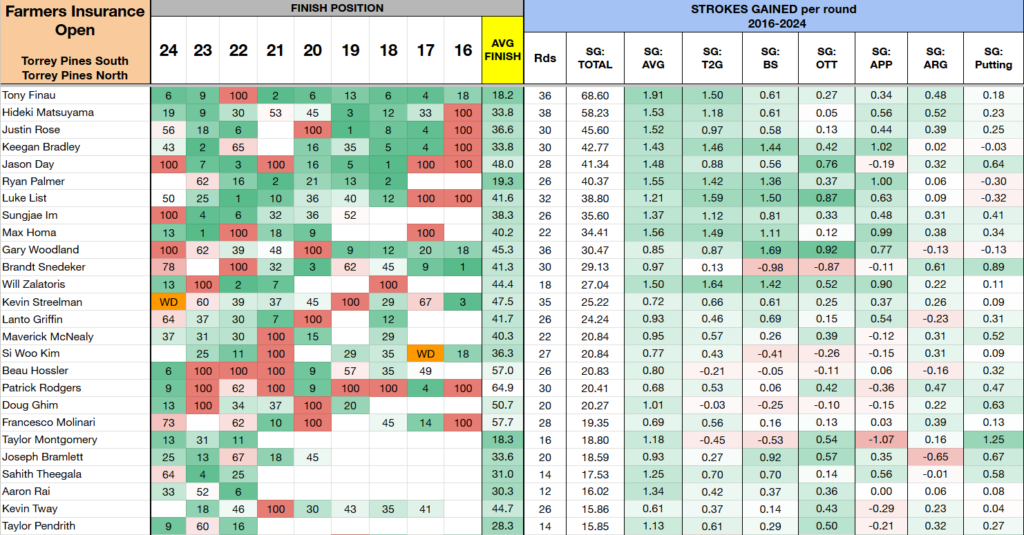
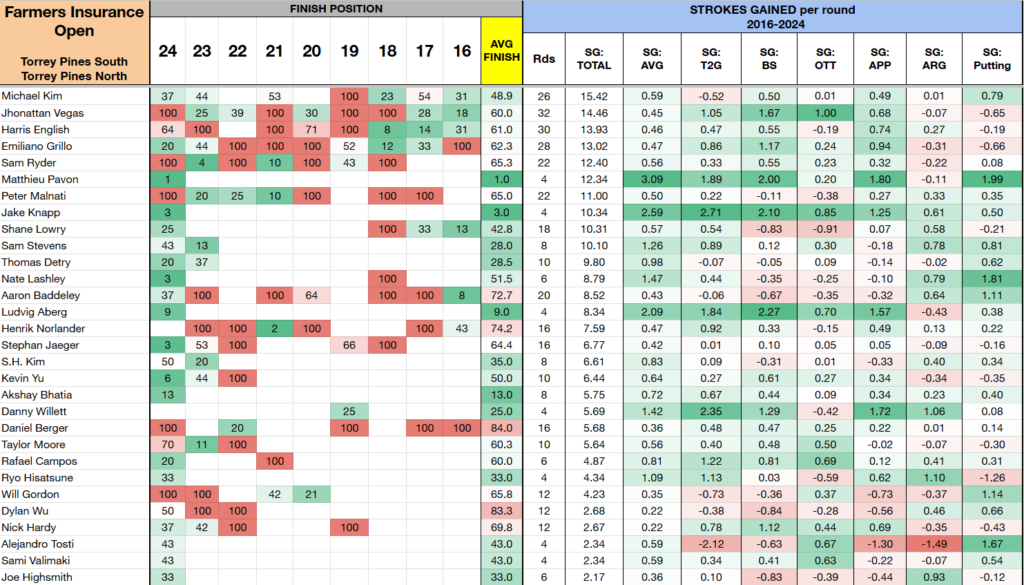
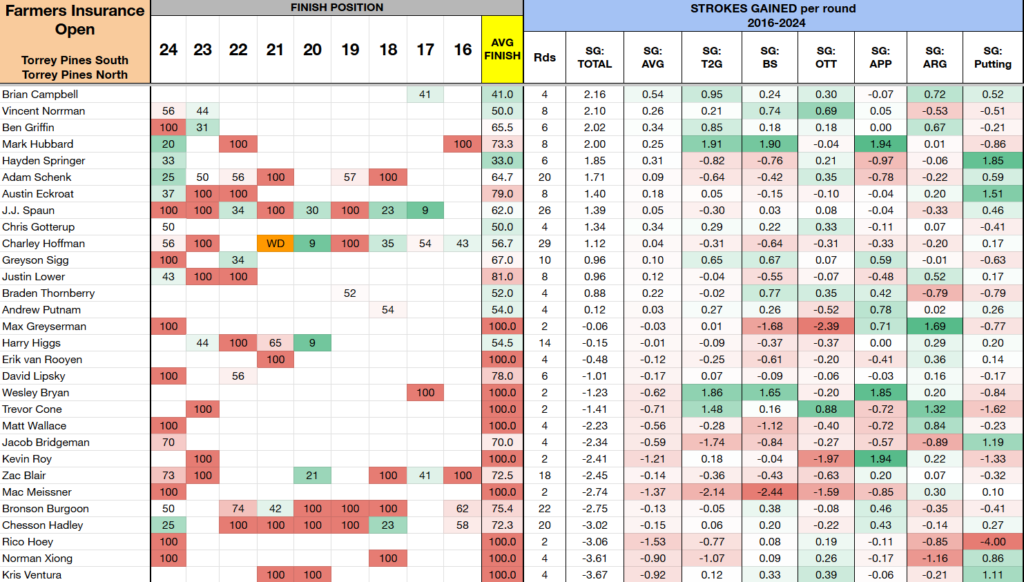
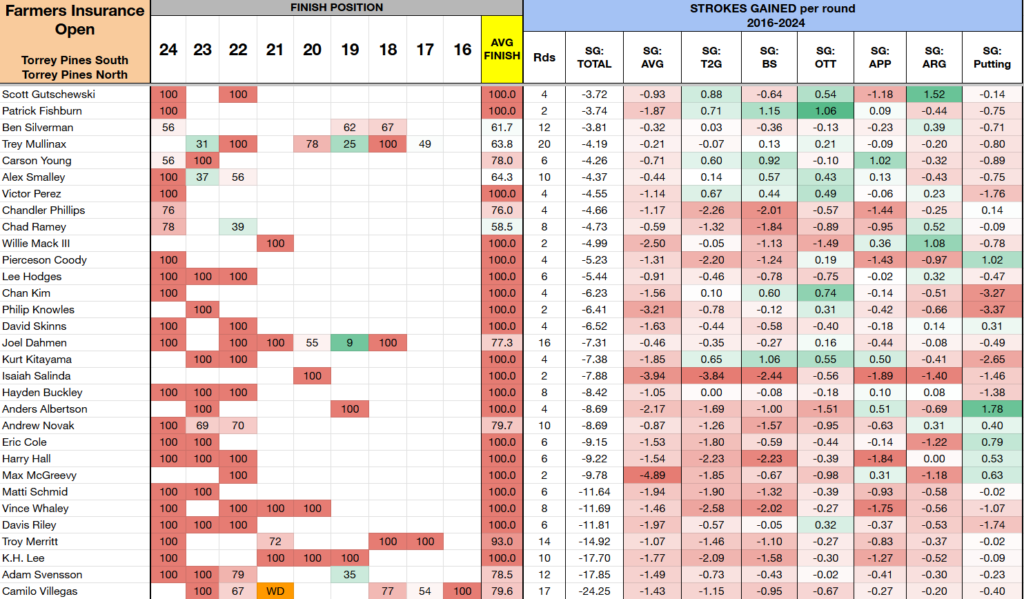
Torrey Pines South – Course Features
With the one round at the North Course not using ShotLink/Strokes Gained data, there will not be any stat correlations for this event since the data is incomplete.
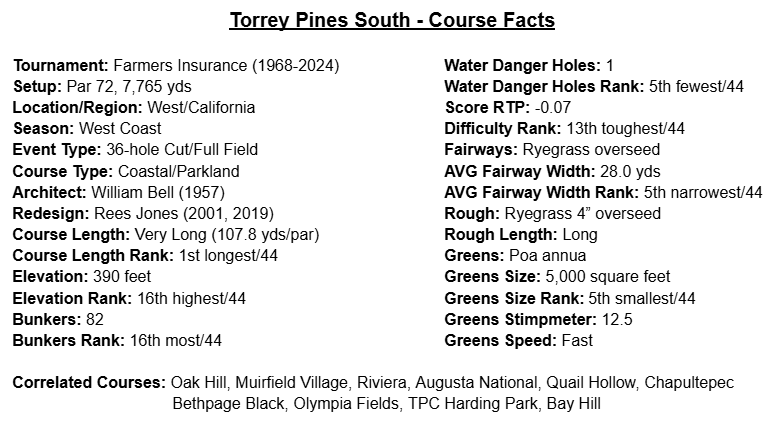
Enormous length, narrow fairways, deep rough, criminally tough greens – these are just a few of the ways to describe the South Course. While mostly flat, at 7,765 yards, Torrey Pines is a monster and the longest on Tour. Winds off the coast can also severely hamper a round. Xander Schauffele commented about both of these factors. “It’s brutal. It’s mentally exhausting. The place is a hike. Just everything about it. When the wind picks up, you’re just worn out at the end of the day.”
Over the past five years, it has been the 13th-toughest course at -0.07 per round. Almost every metric is more difficult than average – from scrambling to fairways hit to GIR %.
From an agronomy standpoint, greens are Poa annua. Fairways and rough are ryegrass overseed. Torrey Pines is infamous for its thick penal four-inch rough. The course typically plays very firm, as Scott Bentley the Deputy Director Golf Division for San Diego remarked, “For the tournament, our goal is to really have dry conditions. We like the fairways to be firm and fast, and we like to see a bounce in the greens. We do expect the rough to be long and lush.”

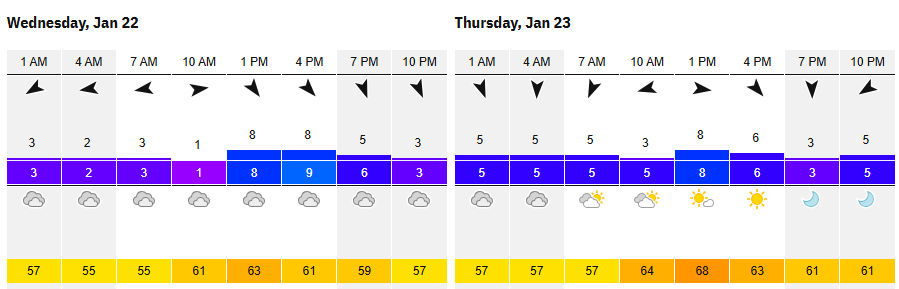
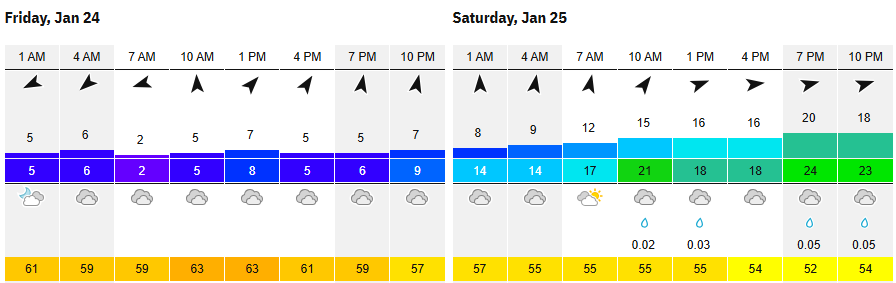
San Diego County is currently experiencing the driest start to the water year in recorded history, according to the National Weather Service, so it is highly unlikely that the golf course will be pounded by torrential rain as it has seen in years past. Unfortunately, another Santa Ana wind event is forecasted for Southern California later in the week.
Winners at Torrey Pines have typically fallen into two classifications – either bombers off the tee or players with elite short-game skills. From the bomber category, we have seen Luke List, Justin Rose, Jon Rahm, Scott Stallings, Tiger Woods, and Bubba Watson triumph. On the short-game side, Patrick Reed, Jason Day, Brandt Snedeker (twice), and Ben Crane. Interestingly, many of the bombers also have quality short games.
This par-72 layout has seven par-4s that play over 450 yards and two par-5s that measure over 615 yards. Golfers must take advantage of the four par-5s as they are generally the only birdie holes on the course, and possibly the only holes that will play under par for the week.
While the setting on the coast is fantastic, there is a lack of compelling hole architecture throughout Torrey Pines. The South Course often is criticized for not “architecturally” standing out enough. Almost each of the Par-4 and Par-5 holes is seemingly a replica of itself. It is very straightforward. There are no tricks. What you see is what you get.
Torrey Pines North – Course Features
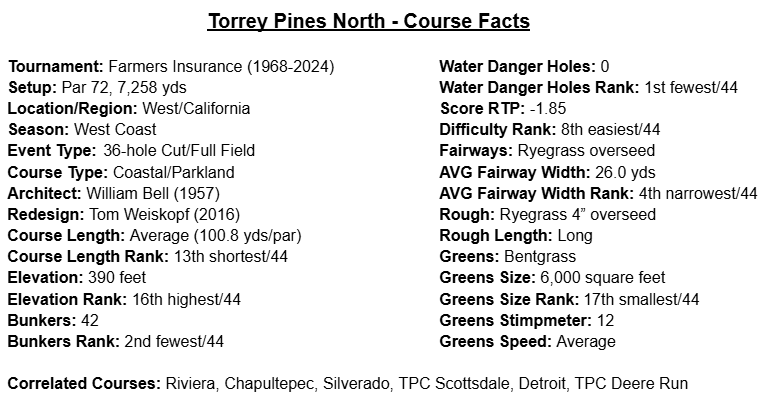
Playing their one round on the North Course will provide players with a brief respite from the monster that is the South Course. It’s a shorter par-72 layout that measures 7,258 yards on the scorecard. It is also much easier with an average of 1.85 strokes under par per round since 2018. The places it as the eighth easiest course on Tour.
That being said, it features a three-hole stretch (#2-4) known as “The Undertow” which ranks as one of the toughest trio of consecutive holes on Tour with each playing considerably over par and resulting in an average “bogey-or-worse” rate of 24.9%.
The North Course also has half as many bunkers as the South Course with only 42. Many of the greens are open-fronted which allows for bump-and-run type shots. Greens are Bentgrass and they run very pure. Players often speak about how good the greens roll. Fairways and rough are a Ryegrass overseed. The putting surfaces are average-sized and often slope from back to front, with little undulation. As is true with its sister course, it is recommended to stay below the flag on approaches.
Off the tee, the fairways are narrow, averaging only 26 yards wide. In the past, the rough has not been as penal here making it very susceptible to the bomb-and-gouge approach. Two years ago, however, the rough was extended to the same four-inch length as on the South Course.

Similar to the South Course, taking advantage of the par-5s is crucial. All four are under 560 yards and have eagle rates that average 3.1%, one of the highest on Tour. The par-3s are the most challenging aspect of the North Course as they average 0.12 strokes over par with a bogey or worse rate of 19.5%. The driveable par-4 7th hole also has a birdie or better rate of 36%. Like its sister track, the North Course won’t win any awards for being aesthetically pleasing. Most of the holes play straight ahead with even the doglegs having only slight angles.
One important note about the North Course is that historically speaking, if a golfer does not post a low round here, they have essentially eliminated themselves from contention. Over the past few years, the winner of this event has shot an average of 5.5 strokes under par in their North Course round.
Strokes Gained Analysis
*With three of the four rounds played on the South Course, we will focus our attention there.
Off the Tee
With its massive length, narrow fairways, and 4″ rough, Torrey Pines presents a true challenge off the tee. Fairways are the fifth-narrowest on Tour at only 28 yards wide. Simply put, distance matters here, especially when considering the cooler January air and the thick marine layer combined with less roll from the fairways due to the moisture in the grass. This is evidenced by Driving Distance only averaging 293 yards even though players are pounding drivers on almost every par 4 and par 5. Carry Distance will also have a greater emphasis this week with the soft and wet conditions.
While Driving Accuracy is one of the most difficult on Tour at only 52%, the data shows that hitting fairways is not paramount to success at Torrey Pines. Overall, the penalty for missing the fairway is +0.33 strokes per hole. That ranks in the middle of the pack when analyzing the 80 ShotLink courses used on Tour since 2015. While the rough itself is penal, since the fairways are so narrow and the greens smaller than average, players will be missing both all week.
Since most players will be in the rough numerous times this week, it only makes sense that those who drive the ball farthest will have shorter iron shots and a better chance of holding the green. It is much easier for a “bomber” to hit a higher-lofted iron out of deep rough. Four of the past 12 winners ranked first or second for the week in Driving Distance. Furthermore, with only 1.6% of tee shots going out of bounds and zero water hazards, the bigger hitters have complete freedom to bomb away.
Approach
With the combination of penal rough, small elevated greens, and an average approach distance of 196 yards, getting your ball into position to score at Torrey Pines is very difficult. The GIR rate is around Tour average at 65%. This course produces the most approach shots from over 200 yards on Tour. In total, about 55% of second shots come from greater than 175 yards. Successful long-iron and fairway-wood play here is paramount to finishing high on the leaderboard. With the recent dry conditions, greens should be firmer this week which will make hitting greens more of a challenge this week.
While there are not many hazards to deal with on approach, just about every green complex has a pair of bunkers on either side. Shorter players off the tee who don’t find the fairway will experience an unfortunate trickle-down effect as they are left trying to hack their ball out of the rough followed by scrambling just to make par. Jason Day spoke about how challenging this part of Torrey Pines can be by saying, “If you’re not hitting fairways, the rough is so brutal that where the pins are tucked, you hit it to 30, 40 feet. If you miss a lot of fairways and you’re hitting it to 30, 40 feet, it’s very difficult to hole those putts. So, it’s just about just getting it on the green.”
Around the Green and Putting
The rough and trickiness of the greens is what has made short-game and scrambling prowess such a critical component to gaining strokes at Torrey Pines. Unless in one of the 82 bunkers, almost every around-the-green shot will be played from the thick 4″ rough. With so many greens being missed, saving par and avoiding bogeys is extremely valuable. The winners over the past decade are a testament to this and are full of elite scramblers including Patrick Day, Jason Day, and Brandt Snedeker. On average over the past two events, 13 of the top 16 players on the leaderboard have gained strokes around the green.
The South Course at Torrey Pines ranks as the toughest course on Tour in which to make putts inside 15 feet and also inside five feet. There are no “gimme” five-footers here. Greens will run around a 12.5 on the stimpmeter which is faster than average, and much quicker than speeds that players have seen in the first few events this year. While these greens lack undulation, the speed will be a huge adjustment for players on these slick Poa surfaces. With the Poa grass being very inconsistent and unpredictable, especially later in the day, certain players struggle mightily, with most citing it as their least favorite putting surface. Some, like Max Homa, grew up on this surface and thrive on it.
Most Important Stats For Success at Torrey Pines
*In order of importance
- Scrambling/SG: ARG (Rough)
- Total Driving
- SG: Approach
- SG: Putting (Poa)
- Bogey Avoidance
- Par 5 Scoring
- Proximity 175+ yds
- SG: Torrey Pines Course History
- Rough Proximity 200+
- SG: Long and Difficult Courses
Weather Forecast – La Jolla, California