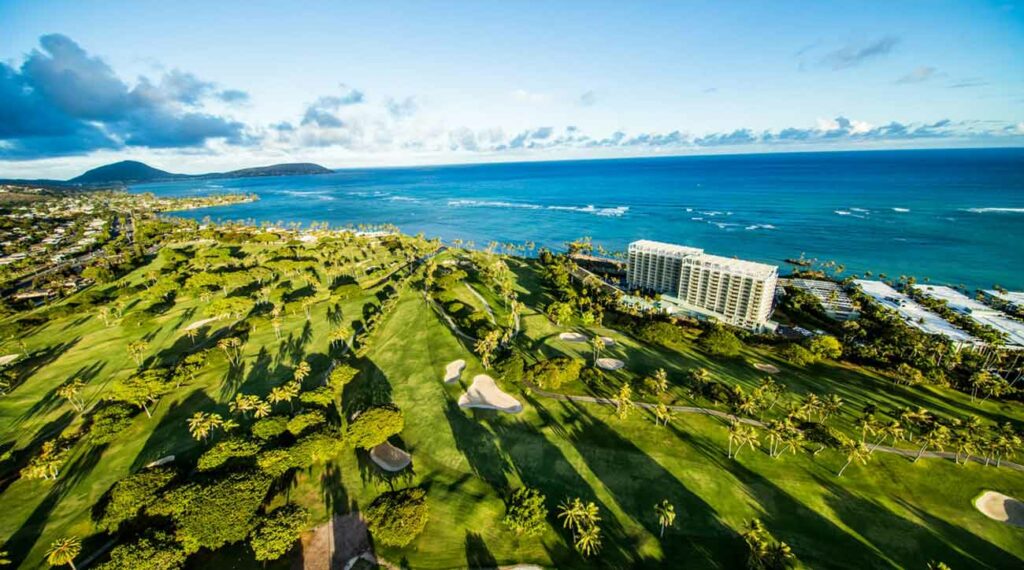
With “The Sentry” being left off the schedule in 2026, the Sony Open, held at the venerable Waialae Country Club in Honolulu, is the first official tournament of the year. With legendary figures such as Jack Nicklaus, Tom Watson, Lee Trevino, and Ben Crenshaw winning championships here, the course endures to this day, withstanding the test of time. Having hosted the Sony Open since 1965, it is the third-oldest annual course on Tour, only behind Colonial Country Club and Pebble Beach Golf Links.
Waialae CC is a shot-maker’s golf course distinguished by its narrow corridors, sharp doglegs, unpredictable Bermuda rough, and firm greens. It is a positional track that has effectively neutralized any advantages held by bombers off the tee. This week is about strategy, position, and shot-making on a tight and flat course. In the words of Kevin Kisner, “I like that it’s a shot-maker’s golf course. It’s a shorter, ball-striker’s paradise. You’ve got to play to certain spots. I think it’s Point A to Point B and make some putts.” This is why we typically see the same type of player (shorter-hitting ball-striker with a quality short game) succeed here year after year.
While not a complete birdie-fest, minus the wind-blown 2020 event, the average winning score over the past five tournaments has been 20-under par. It’s a course where quality shots can lead to birdies on almost every hole. But if you are in the rough or out of position, scrambling for par can be a challenge. It is also the fifth-most predictive course on the annual PGA schedule. Those who have a successful track record at Waialae tend to contend here on a yearly basis.
The Field

Around half the field from Kapalua will island-hop to Oahu, but most of the 144 players are making their first official start of the year. As the course trends show, those who did not play last week need to shake off the competitive rust and will be slightly disadvantaged. Past performance at Waialae is significant this week as it’s the ninth most predictive out of any course on Tour.
While not the star-studded event we saw at Kapalua, this will still be one of the strongest Sony Open fields ever with 20 of the top 50 Official World Golf Rankings in attendance. The main headliners include Sahith Theegala, Brian Harman, Robert Macintyre, Keegan Bradley, Russell Henley, Tom Kim, Corey Conners, and last week’s winner and past Sony Open champion, Hideki Matsuyama.
Other past champions in the field include Si Woo Kim, Mat Kuchar, Patton Kizzire, Zach Johnson, and Ryan Palmer. Last year’s winner, Grayson Murray will be remembered this week following his death last May. The purse is $8,700,000 with a winner’s share north of $1.5 million. FedEx Cup points earned will go toward the Aon Swing 5, the path to the next signature event, the AT&T Pebble Beach Pro-Am.
Waialae CC – Course History
Completed in 1926 by legendary architect, Seth Raynor, the course, at what is now Waialae Country Club was first opened in 1927. Raynor was known for designing courses with exceptional routing that made players think their way around the property. It has many of the same characteristics as the classical “Golden Age” of golf courses. Almost every other hole faces a different direction, forcing players to shape their shots and account for the wind at all times.
Raynor’s mentor and friend was the legendary course designer Charles Blair Macdonald. Many of the courses Raynor designed were influenced by Macdonald’s thoughts and ideas. He also incorporated elements from Scottish links-style courses that forced golfers to be creative shot-makers and to think their way around the property.
Unfortunately, Raynor passed away from pneumonia in 1926 just after completing Waialae. Originally named “The Royal Hawaiian Hotel and Waialae Golf Course”, it was built by the Territorial Hotel Company as part of a promotional program to develop luxury travel trade to Hawaii. And much like resort courses today, it was meant to be used by anyone staying at the hotel. Then in 1930, a collection of players at the course decided to designate it as an exclusive club and the name was changed to Waialae Country Club.
In the years after the Great Depression during the 1930s, business started to dramatically slow due to people not being able to afford to travel to vacation spots. When a fire destroyed portions of the clubhouse in 1941, it was decided that major renovations were needed. It was slow at first because parts of the course were used to aid the military during World War 2, but in the years after things started to progress. Amenities were added and certain holes were moved and redesigned in the early 1960s.
By 1965, Waialae Country Club was ready to host a PGA Tour event. The first Hawaiian Open on the PGA Tour was held at the course in November 1965. Since then, a PGA Tour event has been held here every year except for 1970. Over time there have been numerous minor renovations to the course led by numerous architects including Robert Trent Jones, Desmond Muirhead, Rick Smith, and Tom Doak.
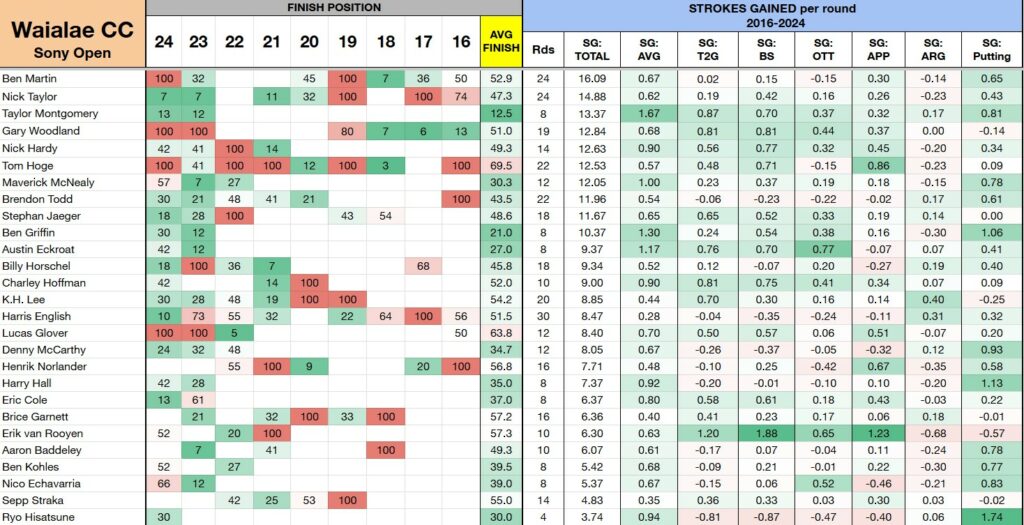
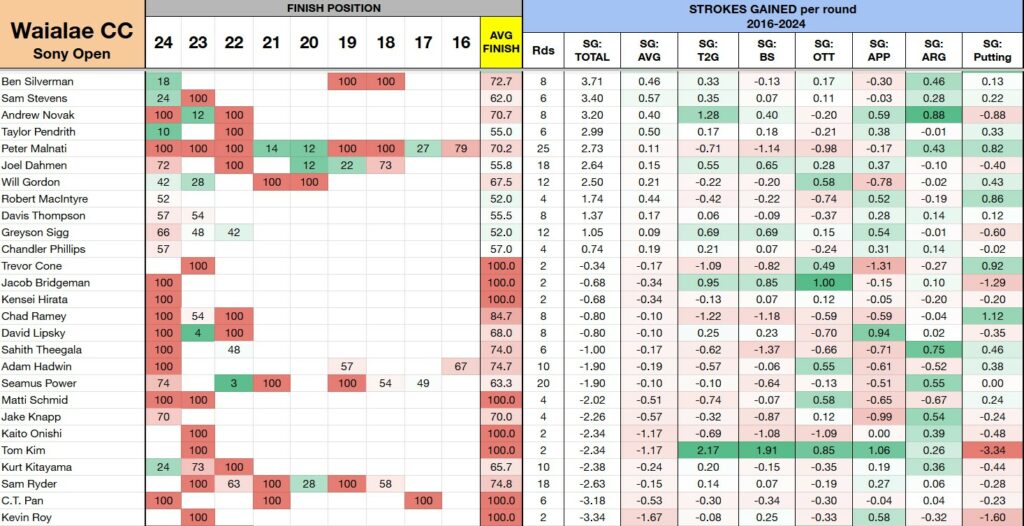
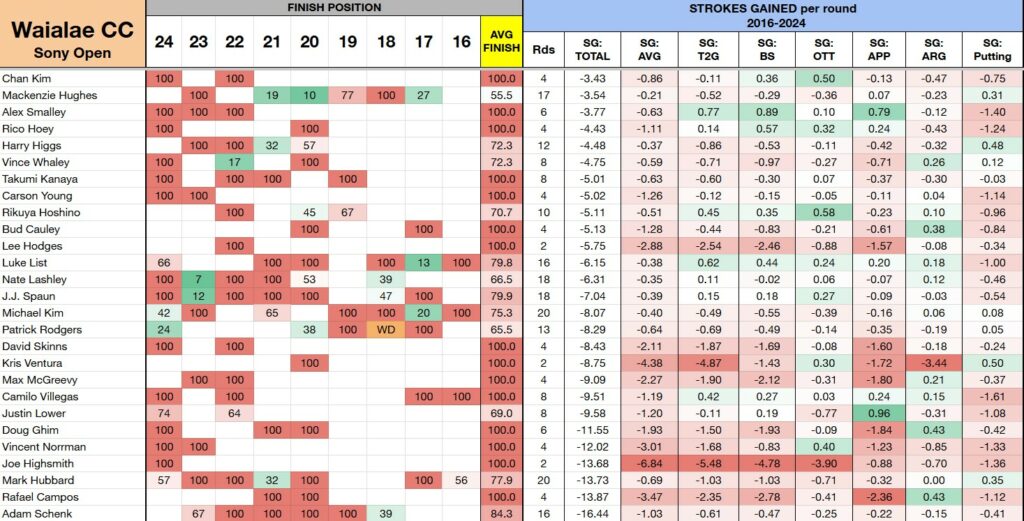
Finish Position and Strokes Gained Course History (2016-2024)
This includes average finish position and Strokes Gained per round in each category. Players are sorted by SG: Total. Waialae CC is the 9th most predictive annual course on Tour.
f684b2f3d4218ee06dad551b3bb2074b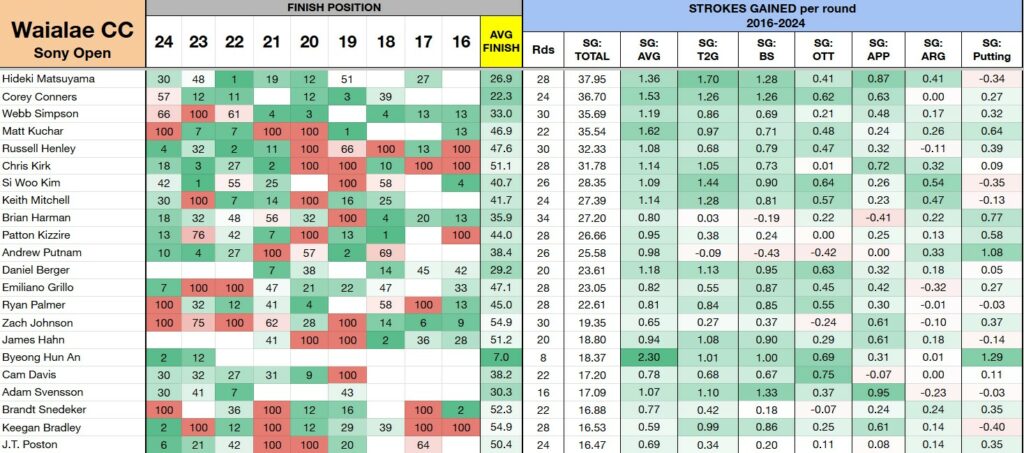
Course Features
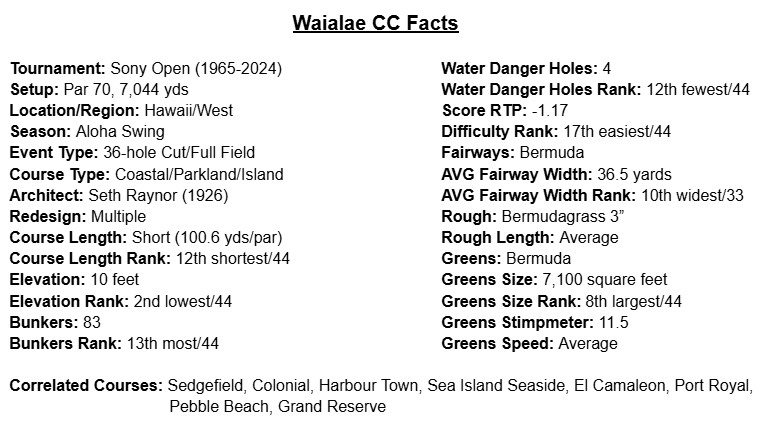
Waialae Country Club is a shorter par 70 course measuring 7,044 yards. Tucked away to the east of the sprawling city of Honolulu, the course only has a couple of holes bordering the ocean. Many holes are hundreds of yards inland and are somewhat protected from the trade winds by the palm-tree-lined fairways.
Waialae is a tight, flat, technical, coastal track that tends to favor shorter more accurate hitters who are creative both in their strategy and shot-making skills. While those types have had great success here, bigger hitters have the potential to cut across some of the doglegs and can shorten the course even further. Overall, however, the power game has mostly proven fruitless as bombers who cut corners and end up in the 3-inch Bermuda rough will have to deal with “fliers” jumping out of the thick grass on approach. Because the big hitters do not have an advantage, Waialae does a great job leveling the field.
The routing of the layout is excellent. The course features one of the highest amounts of dogleg holes on Tour. Raynor designed it to not favor one ball-flight type over the other as there is an equal mix of holes that bend in both directions. The variety of tee-to-green routing forces players to think and plot their way around the course.
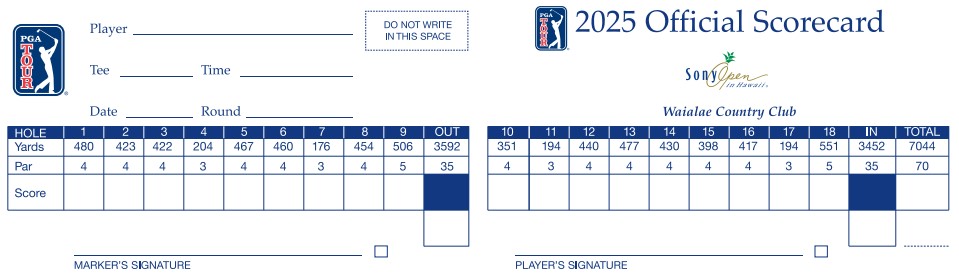
Depending on recent precipitation, Waialae tends to play fast and firm. While it does have tight tree-lined corridors, the fairways are the 10th widest on Tour at an average of 36 yards across. Nevertheless, because the course typically plays firm and the angles are so tight, hitting fairways is at a premium. Drives landing in the fairway and bouncing into the rough are a regular occurrence. As Charles Howell III said a few years back, “It’s a course where you always have to play your angles and plan your misses.”
Many of the 83 bunkers on the course are very well-positioned and laid out in a well-thought-out and challenging manner. And unlike last week, there is some water danger on the course which comes into play on four holes.
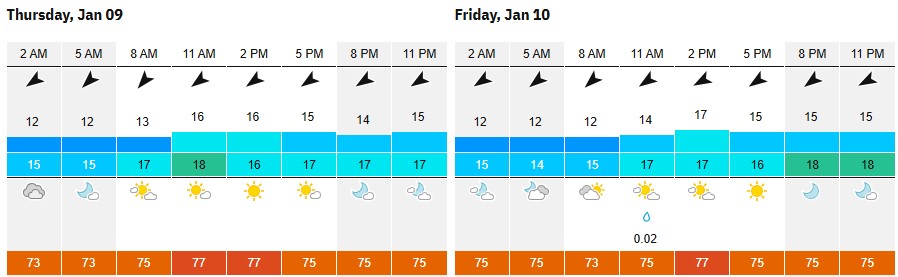
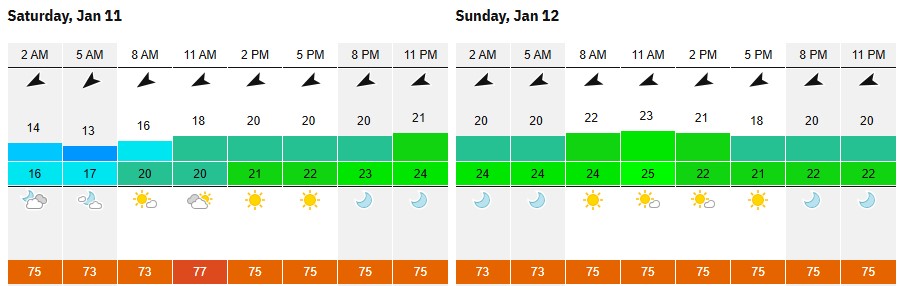
The wind is by far the course’s biggest defense. Winds have been mostly calm over the last handful of years except for 2020 in which Cam Smith won at a score of only 11-under. While scoring can be shaped by the strength of the coastal breezes, when conditions are calmer, there are a ton of birdies out there as it ranks as the 10th-easiest course on Tour. If the wind cooperates, scores should easily be able to push beyond 20-under again. If the wind is blowing like it is forecasted, greens will be difficult to hit. This is one of the reasons course history is so advantageous here because knowing the right spots to miss when the wind does blow presents an edge for those who play here every year.
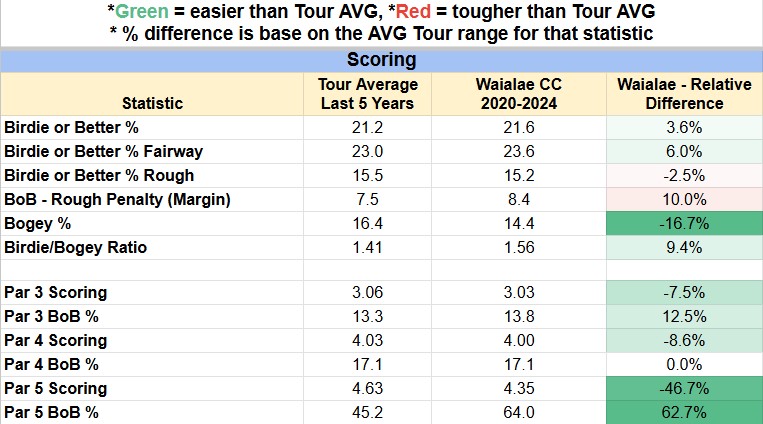
Hole Analysis
The first eight holes are among the toughest opening stretches on Tour as only the 3rd and 7th holes average under par. Four of those eight holes have a bogey or worse rate of 20% or higher. Once players hit the par-5 9th hole it becomes smoother sailing as seven of the remaining 10 holes average under par.
As is the case with most par 70 courses, there are two more par-4s and two fewer par-5s on which to score. This puts a premium on par-4 scoring as players do not have a full complement of scoring holes that typically come with par-5s. In fact, 11 of the holes are between the 400-480 yard range.
The two par-5s are the easiest par-5s on Tour with a scoring average of only 4.35 per hole and an enormous Birdie or Better rate of 64%. Each is also relatively short and can be reached in two shots, setting up potential eagle putts. In fact, over the last decade, the field has averaged 0.13 eagles per round which is one of the highest rates on Tour. Sitting at 506 and 551 yards respectively, it can not be emphasized how short and easy the par-5s are for everyone who can keep their ball in the short grass.
Strokes Gained Analysis
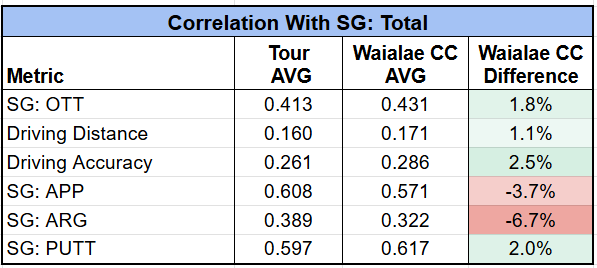
The “Correlation” chart below shows how many Strokes Gained (SG) from each category (for the entire field) were correlated to a player’s SG: Total. The higher the average, the more important that area is to success. I have also included the 5-year PGA Tour course average for each metric to allow for easy comparisons to the current event. Surprisingly, gaining with Driving Distance is still an advantage even at Waialae. SG: OTT and SG: Putting both see an increase in importance from a full-field perspective. But putting and approach are still the most important metrics at Waialae.
Analyzing the metrics from a different perspective, the “SG Average by Finish Position” chart below looks at performance per round based on finishing position. The value percentage gives a strong indication across the board of which SG areas matter the most. As you can see below, the last five winners along with those finishing in the top 25 of the Sony Open have been very successful both on the greens and on approach.

Off the Tee
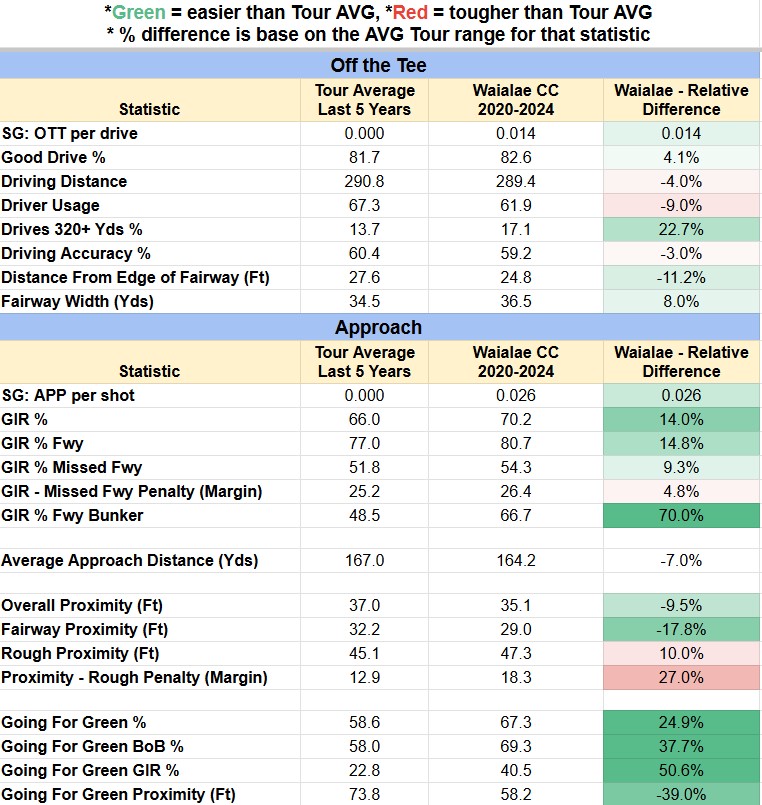
With its tight driving corridors, six doglegs and positional accuracy needed for quality approach shot angles, Waialae presents a challenge off the tee. As previously mentioned, the fairway width is wider than average, but the corridors are much narrower as the palm trees and other vegetation enclose on all sides. Another challenge is that oftentimes the wind is blowing the opposite of the dogleg shape which makes finding the fairway very difficult on those holes.
The data shows that Driving Accuracy is 4% tougher than the average Tour course. With positioning off the tee so critical, having the proper angle on approach shots, and staying out of the rough is more vital than distance. Golfers clubbing down and hitting “less than driver” is one of the main reasons why Driving Accuracy is not lower than it is. There are perhaps more long irons hit off the tee here than anyplace else. Justin Thomas said that he hit almost exclusively 2-irons off the tee which still left him with shorter approaches into the greens.
As for why Driving Distance is slightly above average here, the fairways at Waialae are typically quite firm and provide extra rollout, even when hitting irons. Also, players using driver off the tee (even on the dogleg holes) who have confidence in their accuracy to acquire the proper angle to the green, are rewarded here with higher-lofted approaches into these firm greens. This allows them a closer proximity to the hole which results in better scores. Players like Corey Conners, Russell Henley, Matt Kuchar, and Brian Harman fall directly into this category and their results here are direct evidence of this.
Because Waialae favors accuracy over distance, it does a great job of leveling the field and allowing every type of player to compete this week. Whoever can shape their drive into the best target zones on the fairway from which to access some of the trickier pin positions on the greens will have a huge edge.
With increases in distance over the years, more players have started to take aggressive lines from the tee, but there is danger with the ball running through the fairway and into the rough and having to hit an unpredictable 70-yard wedge that knuckles up to the green. The three-inch rough at Waialae (close to four inches by Sunday) is longer than it’s been in previous years and is long enough to make it difficult to control the spin. Golfers who have played here multiple times and understand where and when to lay up are going to have an advantage.
One of the subtleties of Waialae is that because of the acute angles on so many of the holes, there is typically one side of the fairway (or rough) that is a better place to be positioned for the approach shot compared to the opposite side. As Henley remarked, “You just have to pick what side of the fairway you want to miss. There’s usually one side out here that’s better than the other.” Golfers who mostly play a fade or a draw can be affected by the strong crosswinds that will push the ball in the opposite direction. This is another reason why it benefits players to be able to hit all types of shots whenever the course or conditions call for it.
Approach
While the greens are very receptive with a GIR rate of 70%, this course will test the short to mid-iron performance of these golfers. Over 68% of all approach shots are hit from the 125-200 yard range—23% more than the Tour average. Wedges from 50-125 yards are hit 32% less of the time, while shots from 225+ are hit 61% less than average. Many analysts have remarked about the “small” greens here (and some holes do have tiny greens), but in actuality, at 7,100 square feet on average, they are the 8th-largest on the Tour!
You will hear this many times throughout the year related to different courses, but Waialae is a true second-shot course. It is also a course where, because of the angles, it becomes target golf. On many holes, you are hitting Point A to be in the best position to hit the ball to Point B. The approach game is another area where strategy and shot-making come into play. Many hole locations are tucked into certain corners and challenging quadrants on the green requiring golfers to hit quality iron shots. Many of the greens have back-to-front sloping. Zach Johnson said that one of the keys to success is keeping the course in front of you at all times, and then once on the green to keep the ball below the pin.
While proximity to the hole from the fairway (29 feet) is much easier than the average, proximity from the rough (47 feet) is one of the most difficult on Tour. And with the rough listed at three inches again this year, finding the fairway takes on even stronger importance.
Around the Green and Putting
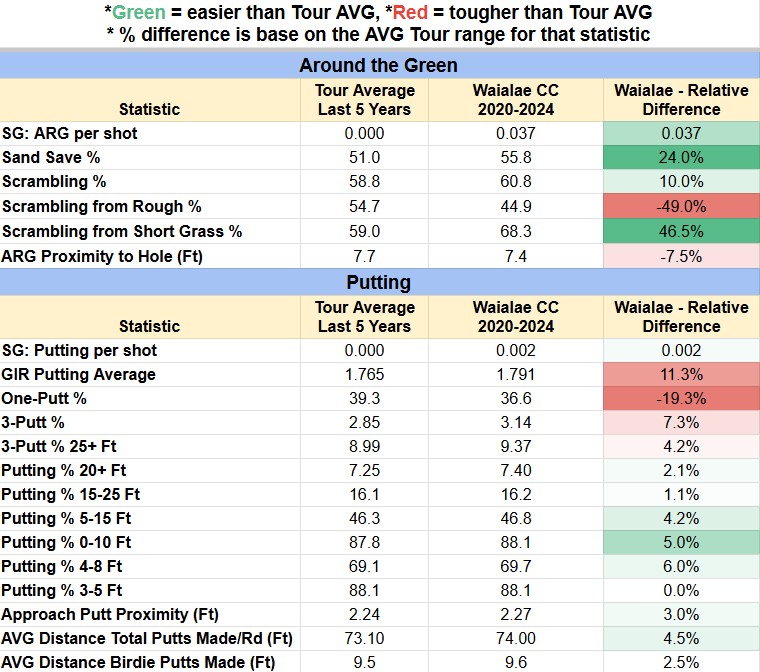
The short game on and around the greens is very straightforward at Waialae. While the longer Bermuda rough has posed a huge challenge (10% tougher than average), scrambling from fairway areas is 9% easier than average. As many players have remarked, those who have grown up playing on Bermuda rough and on the grainy-style greens will have a distinct advantage. Adam Scott spoke about how the need to scramble around the greens will affect everyone at some point. “I just don’t think anyone can get it around this course consistently without scrambling. It is really tough to keep it in play all day and under holes and not be in this gnarly rough.”
As is the case when “target golf” comes into play, putting is very important to success at Waialae. 2022’s winner, Matsuyama, gained a career-high 7.3 strokes putting on these greens. In 2020, winner Cam Smith gained 8.2 putting while Matt Kuchar gained 7 in his victory the year before. While there are some undulations around pin placements, overall, these greens are some of the flattest and easiest to putt on Tour.
Other than GIR putting average and one-putt %, every other statistic from 3-putt avoidance to each of the putting ranges is easier than normal. Raynor’s original green design was much more creative than what we see now, but much of that has been lost over time. Even those with experience on Bermuda turf have mentioned how the grain on these greens can be tough to read. After his victory in 2021, Kevin Na emphasized this by saying, “The greens roll great, but the only difficult part is the grains are sometimes difficult to judge. We’ve had a couple putts this week where it looks like it’s going to do one thing and it doesn’t. If you can just read these greens well, you’re going to be really ahead of the field.”
Most Important Stats For Success at Waialae Country Club
*In order of importance
- SG: APP
- Distance From Edge of Fairway (DFEF)
- Par 4 BoB %
- SG: Putting (Bermuda)
- SG: Short/Less Than Driver courses
- Proximity 125-200 yds
- Waialae CC Course History
- Good Drive %
- Bogeys Avoided
- SG: ARG
Unique Rabbit Hole Filters
- Course Region: Hawaii
- Scoring Conditions: Easy
- Course Length: Short/Very Short
- Course Type: Coastal/Island
- Field Size: Full Field
- Par: 70
- Greens Surface: Bermuda
- Green Size: Large
- Rough Surface: Bermuda
- OTT Club Type: Mixed
- Gain OTT: Easy
- Gain APP: Very Easy
- Gain ARG: Very Easy
Weather Forecast – Honolulu, Hawaii