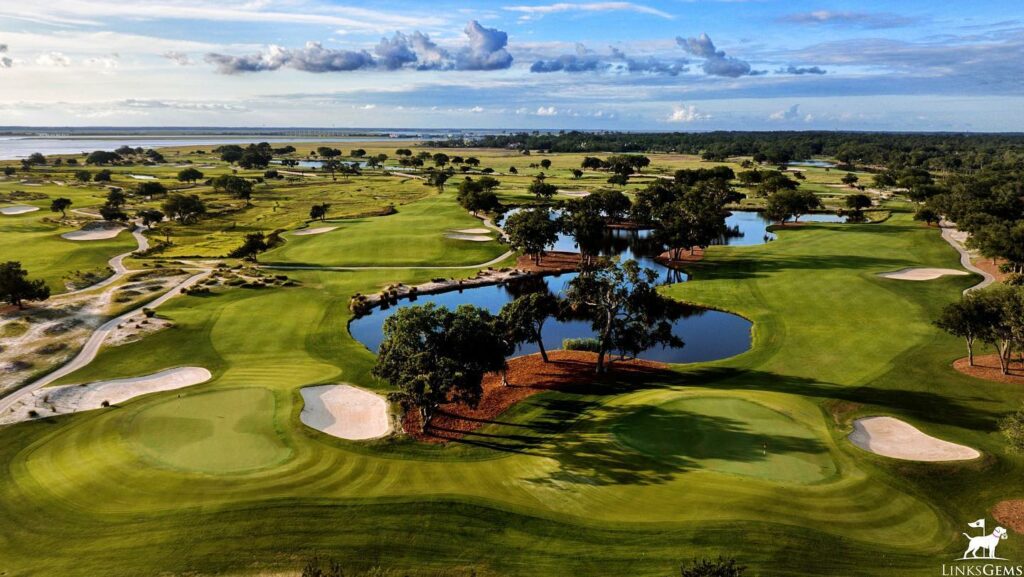
The PGA Tour heads to the eastern seaboard bringing the tournament calendar to a close at the idyllic Sea Island Resort in St. Simons Island, Georgia. This week’s RSM Classic is the final regular event of the 2024 year, and after its conclusion, the top 125 in the FedExCup standings going into next year will be finalized.
The RSM Classic has produced numerous longshot champions over the years including the likes of Robert Streb (twice), Tyler Duncan, and Austin Cook. Last year, Ludvig Aberg torched the field and the course finishing at a record 29-under. Each winner here has a similar recipe for success – hit fairways, attack pins on approach, and get hot on the greens.
As is the case with most coastal courses, the strength of the wind is the X-factor. Yet even with numerous “windy” rounds, over the 14 events played here, the average winning score has been 19-under par. The data shows that the Seaside and Plantation courses used in this event are among the easiest played on Tour in numerous statistical categories.
With daylight at a premium in mid-November, this event is still able to pack a full field of 156 thanks to the use of the two courses. Golfers will play both the Sea Island and Plantation courses one time before the 36-hole cut takes place with the top 65 and ties advancing on to play the weekend solely on the Seaside course.
The Field
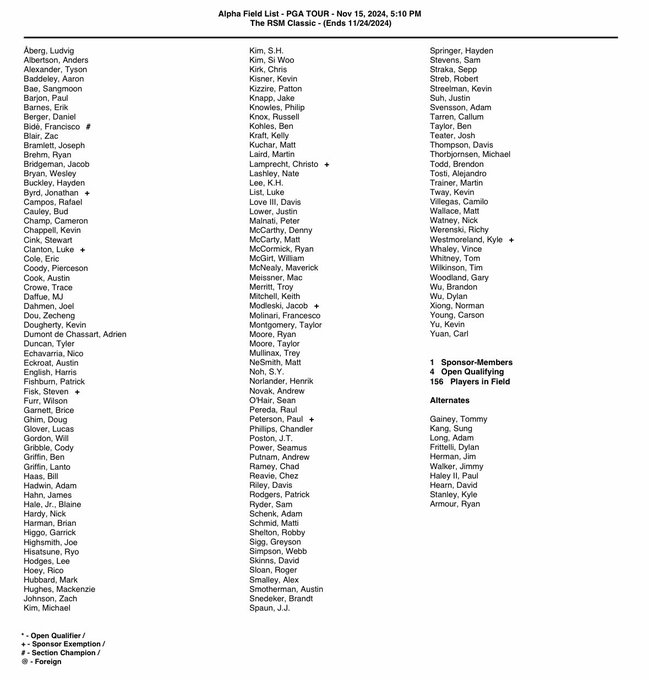
In what is typically a weak-field event here on St. Simons Island, this final event of the year has an actual legitimate field with 10 players ranked in the top-50 of the Official World Golf Rankings. Headliners include defending champion Ludvig Aberg, Brian Harman, Denny McCarthy, Austin Eckroat, Sepp Straka, Davis Thompson and J.T. Poston. Other interesting names in the field include Michael Thorbjornsen, Luke Clanton, Eric Cole, Si Woo Kim, Chris Kirk, Keith Mitchell, Jake Knapp, Harris English, Adam Hadwin, Mackenzie Hughes, and recent “Fall Swing” winners Nico Echavarria, Kevin Yu, Matt McCarty, Patton Kizzire, and Rafael Campos.
The top 125 players in the FedExCup Fall standings after this week will secure their 2025 Tour membership, earning spots in each full-field Event along with THE PLAYERS Championship. Those who finish ranked 51-60 will get into the first two “Signature Events” in 2025.
The RSM Classic has provided some memorable finishes as four of the last eight editions have gone to a playoff. One of the ironies of this event is that first-time Tour winners have had more success at Sea Island than the locals who call this course their home – none of whom have actually won the RSM Classic. Numerous members of the “Sea Island Mafia” will tee it up once again this week on their home course hoping for better results including J.T. Poston, Brian Harman, Harris English, Patton Kizzire, Zach Johnson, Matt Kuchar, Keith Mitchell, Andrew Novak, and Greyson Sigg.
Sea Island Golf Club – Course History
The Sea Island Golf Club and Resort had its origins in 1926 after its founder, Howard Coffin, bought a former cotton plantation on the island with the intention of turning it into one of the area’s first golf courses. Coffin brought in a former three-time U.S. Amateur Tournament winner and renowned architect Walter Travis. He was known for designing classic Scottish Links style courses along with “chocolate drop” mounds in the fairways and small, elevated greens.
Halfway through the completion of the Plantation course, Travis unexpectedly passed away. Coffin would not be deterred and brought in two other legendary architects, Harry S. Colt and Charles Alison to finish what Travis had started. By 1929, the nine-hole Seaside and nine-hole Plantation course were finally completed. In 1999, Tom Fazio was brought in to perform a complete renovation on the Seaside course that created the current routing of the holes.
Meanwhile, in 2019, the Plantation course was completely renovated by Davis Love III and his brother Mark along with the Love Golf Design team. The goal was to take parts from both the original nine holes from the Plantation course and historical features from Walter Travis’s original layout to create a modern course that can be enjoyed by golfers of all playing levels.
The RSM Classic made its debut on the PGA Tour in 2010 at the Seaside course. Since 2015, the tournament has been played on both the Seaside and Plantation courses.
We have partnered with Underdog to bring you an easy way to claim a FREE, no-strings-attached 90 days of Premium Access to Betsperts Golf, plus up to $250 in bonuses when you deposit! Click here to learn more!
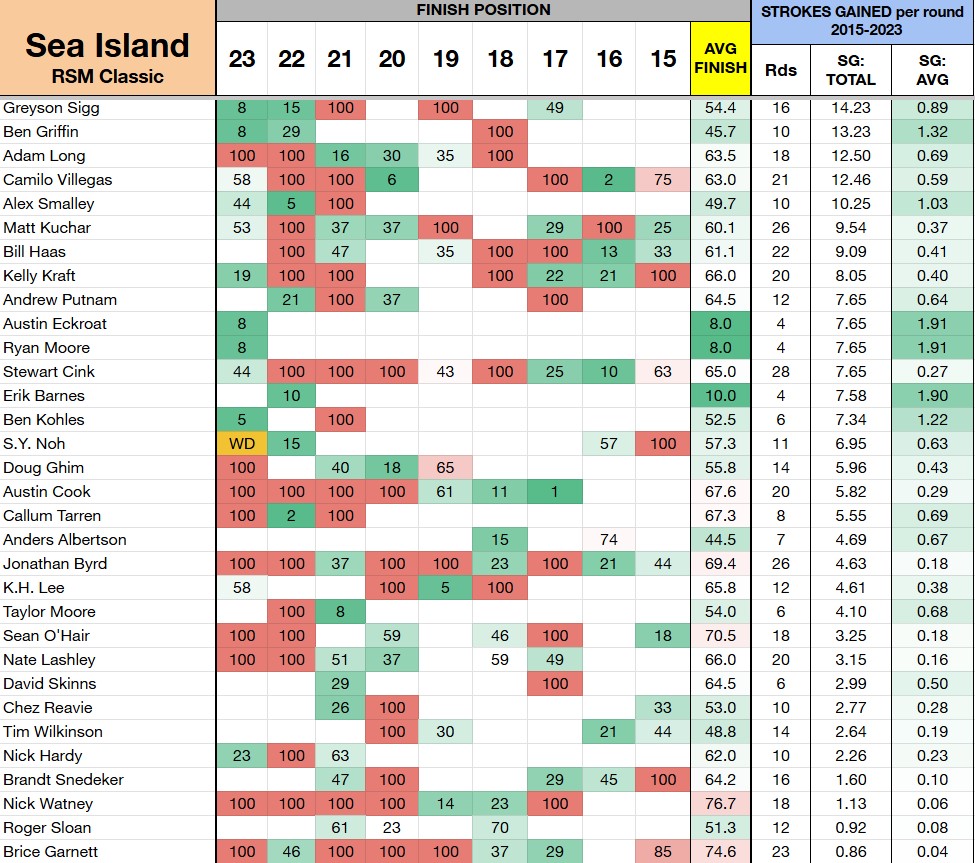
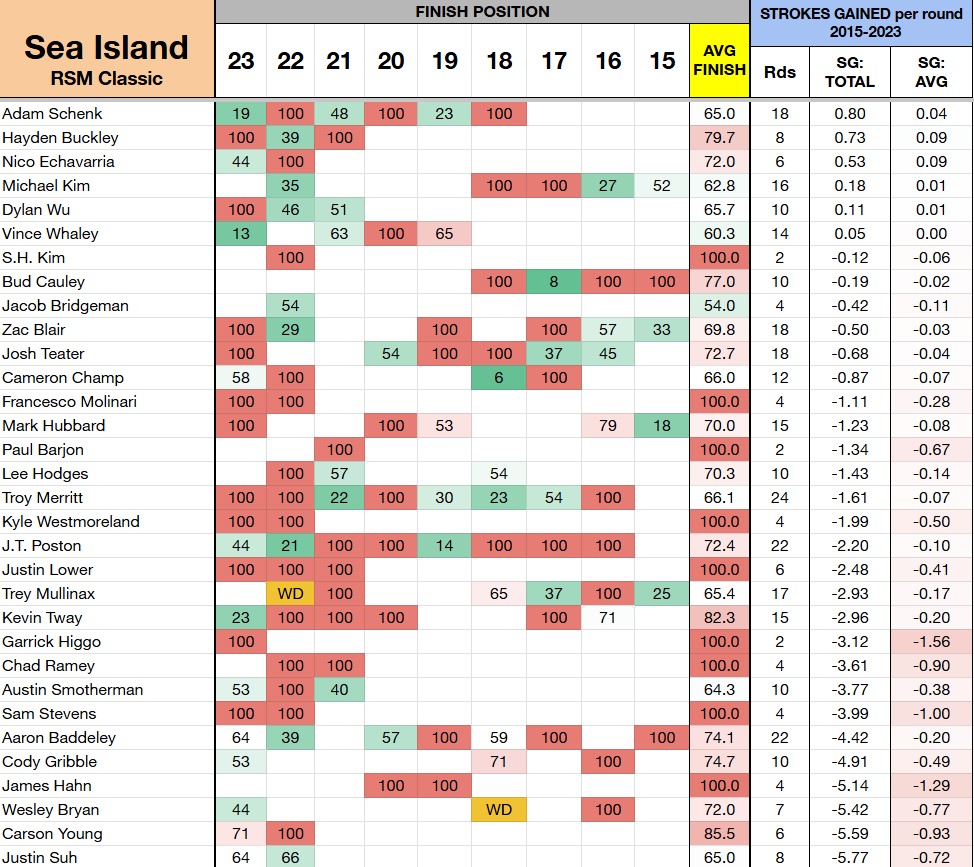
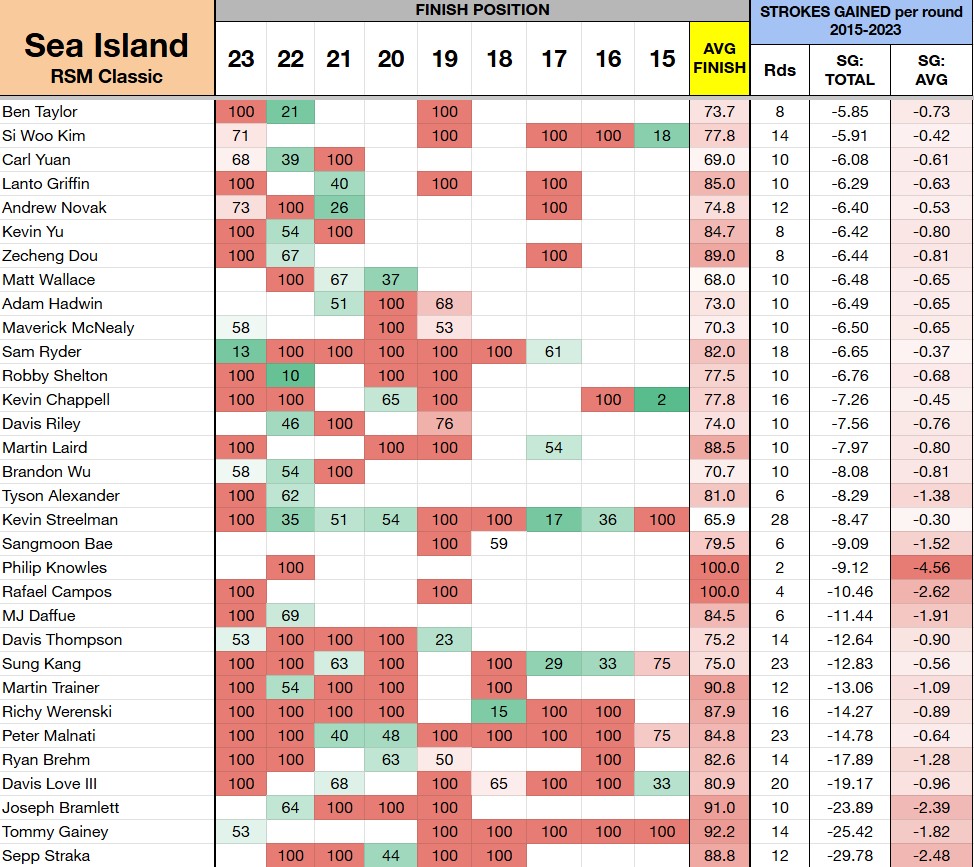
Finish Position and Strokes Gained Event History (2015-2023)
This includes the average finish position and Strokes Gained per round in each category. Players are sorted by SG: Total.
f684b2f3d4218ee06dad551b3bb2074b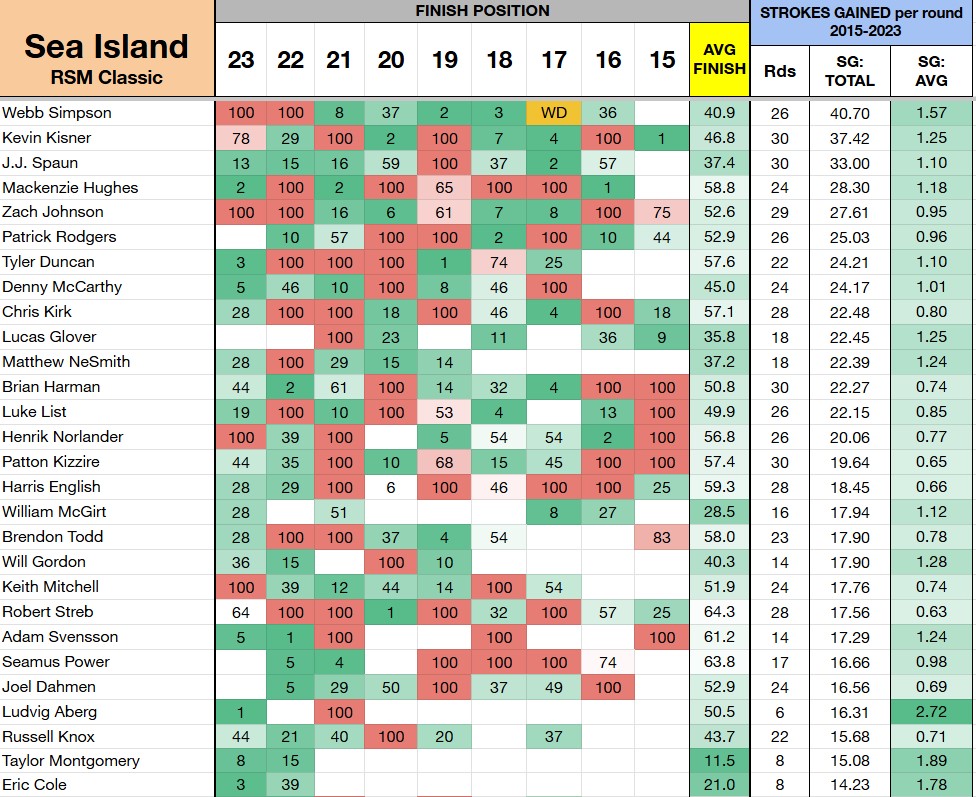
Course Features
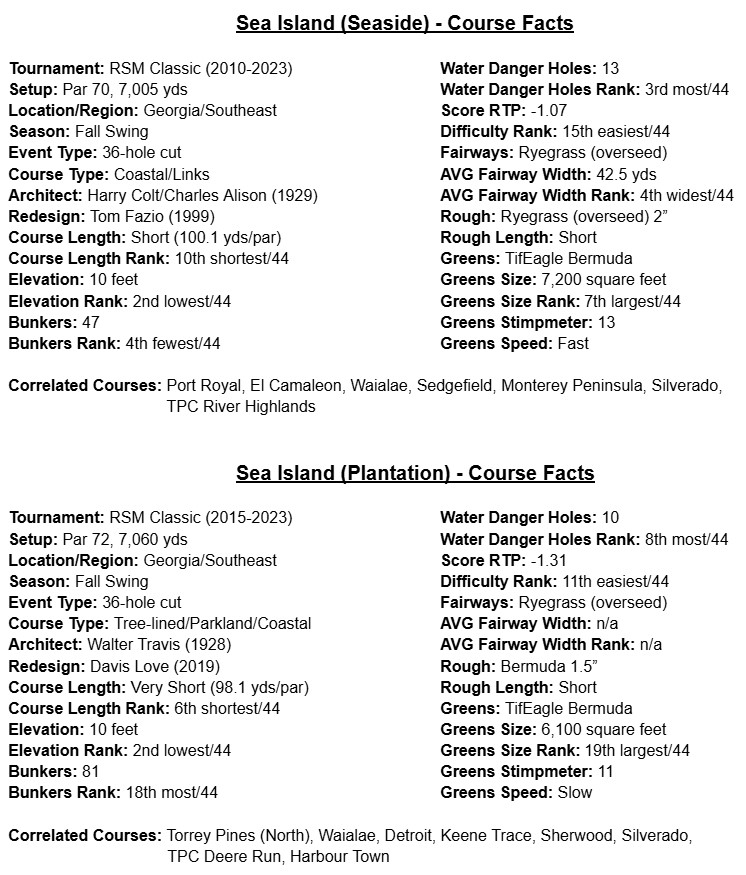
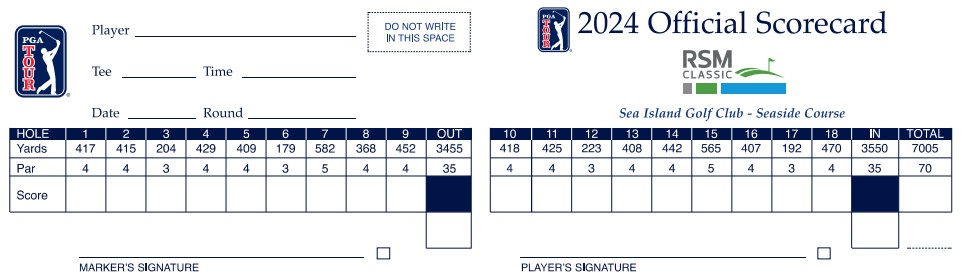
The main course at the RSM Classic that will host three rounds this week is the Seaside course. It is a par-70, 7,005-yard course that meanders along the coastal marshlands of St. Simons Sound. It ranks as the 10th shortest course on Tour and mitigates any distance advantage that some players have on longer tracks.
It was created as a links-style course surrounded by tidal creeks, man-made sand dunes, elevation changes, and the Atlantic Ocean. While it does help to use the ground game when winds increase, it does not play anything close to a true-links course. It features the fourth widest fairways and the seventh largest greens on Tour.
Seaside has played a quarter of a shot tougher than the Plantation course mostly due to its 13 holes with water danger and its location off the coast which makes it vulnerable to the wind. Players will see the same type of greens on both courses with Bermuda being the main surface. The course usually plays quite soft this time of year and was overseeded back in October. The fairways on both courses are ryegrass, while Seaside is listed as having overseeded rye for rough this year, perhaps due to the cooler conditions.
Even with only two par-5s on the Seaside course, they must be taken advantage of as they are two of the easiest scoring opportunities. It does feature four somewhat challenging par-3s that measure between 175-225 yards and includes two of the most difficult holes on the course. But ultimately, performance on the 12 par-4s will determine who contends on the leaderboard. These holes include five of the seven toughest on the course, each of which plays over par. Seven of the par-4s play under 420 yards which is one of the reasons nearly 67% of approach shots come from under 175 yards.
Compared to Seaside, Plantation is more of a tree-lined parkland course and is much less exposed to the coastal winds. Players have remarked that it has a definite “Carolina” feel to it and have compared it to Harbour Town. It features 1.5″ Bermuda grass rough and greens that will roll between 11-12 on the stimp meter. Ever since it was renovated by Davis Love III back in 2019, it has drawn rave reviews from players. and requires much more thoughtfulness and creativity than before.
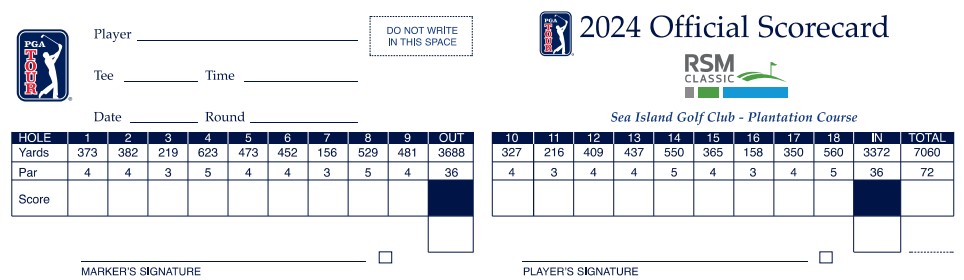
Plantation also boasts wide fairways, and at only 7,060 yards is the sixth shortest course on Tour. While the course does play easier overall compared to Seaside, it has gotten tougher since the renovation. Tidal creeks and lakes are in play on 10 different holes. While it does have four reachable par 5s, the par-72 course has much more difficult green complexes that have distinct quadrants with much more undulation than it did previously.
Strokes Gained Analysis
Off the Tee
*In this section, we will mostly focus on the Seaside course because there is no ShotLink data nor strokes gained metrics used at Plantation.
Fairways are massively wide on both courses, but especially at Seaside. The overseeded ryegrass rough is two inches and is not as unpredictable as during the warmer months when it is lush and can wrap itself around the golf ball. Each of the past five years, Seaside has ranked inside the top 10 in the lowest penalty for drives that land in the rough. There is still danger for golfers who are wild off the tee as a majority of holes do have water and marshland areas in play. These danger areas have caused Seaside to have the highest rate of penalty shots from off the tee since 2015.
The good news is that because both Seaside and Plantation are so short, distance off the tee is a non-factor this week. Most players will use “less than driver” and club down to ensure their ball finds the fairway. This is a huge reason why driving accuracy is almost 12% greater here than the average course. Overall, around 18% of total strokes gained at Seaside have come off the tee compared to the Tour average of 15%. With an average drive of around 275 yards, players who keep the ball in the short grass will be in much better shape to attack these greens with their second shots.
Approach
Once faced with their approach shots, players will attack larger-than-average greens (for the three Seaside rounds) this week. These larger greens, combined with potentially gusty coastal winds, will give an advantage to players who are sharp with their approach game. With this event being played on two of the shorter courses on Tour, and with a strong majority of the Par 4 holes in the 400-450 yard range, over 45% of approaches will be from the 125-175 yard distance.
In each of the last five years, Seaside has ranked among the 12 easiest courses to gain strokes on approach. And with Greens in Regulation (GIR) over 74%, Seaside ranks in the top five for easiest greens to hit on Tour. With only 33% of approaches coming from over 175 yards, both Seaside and Plantation are definitively wedge-to-middle-iron courses.
Since this week ultimately does boil down to a putting contest thanks to wide fairways and large greens, having the skill to attack flags on the correct side of these sloped greens will be key. Over the past few years, a majority of players on the first page of the leaderboard have gained at least 3.5 strokes on approach. Seaside’s greens have always had some tricky undulations, and with the renovation in 2019, Plantation’s greens were made much tougher by Davis Love.. As player Scott Brown said of the new greens, “It’s much tougher now with the new greens than it was before. You have to get it in the right quadrant. You can get some good looks if you get it in those quadrants with the greens the way they’re tiered. But on the other hand, if you hit it on the wrong side, you have a tough two-putt. So I think it’s a great golf course and they’ve made it a lot tougher.”
Around the Green and Putting
Over the past five years, Seaside has ranked inside the top 10 easiest courses in which to gain strokes around the greens. With such a high GIR rate, players simply won’t need to rely on their chipping and scrambling ability that much this week. Last year, for example, not a single player in the top 15 gained more than two strokes around the greens.
To state it simply, making putts on these grainy TifEagle Bermuda greens will be huge this week. Last year, 38% of all strokes gained were with the flat stick in what essentially becomes a putting contest year after year. Because neither course has many difficulties in the tee-to-green areas, Sea Island does not allow players to separate from the field based on their ball-striking skills.
These greens do present some challenges. Along with being sloped and tiered, many on the Seaside course are exposed to the wind. Numerous players have mentioned how difficult putting can be when the wind starts to gust. Tom Hoge said, “Out there on Seaside, very exposed so you have a lot of putts- if you had a left-to-right breaker with the wind going in the opposite direction, it was very hard to figure out what the putt was going to do exactly because the wind can grab it pretty good with some of those gusts out there.” Along with the wind, the greens on Seaside approach 13 on the stimp meter and typically play as some of the fastest on Tour.
Most Important Stats For Success at Sea Island GC
*In order of importance
- SG: Putting (Bermuda)
- SG: Coastal Courses/Windy Conditions
- SG: Approach
- Par 4 Birdie or Better
- SG: OTT – Less Than Driver
- Birdie or Better %
- Bogeys Avoided
- SG: Easy Scoring
- SG: Short Courses
- Proximity 75-150 yds