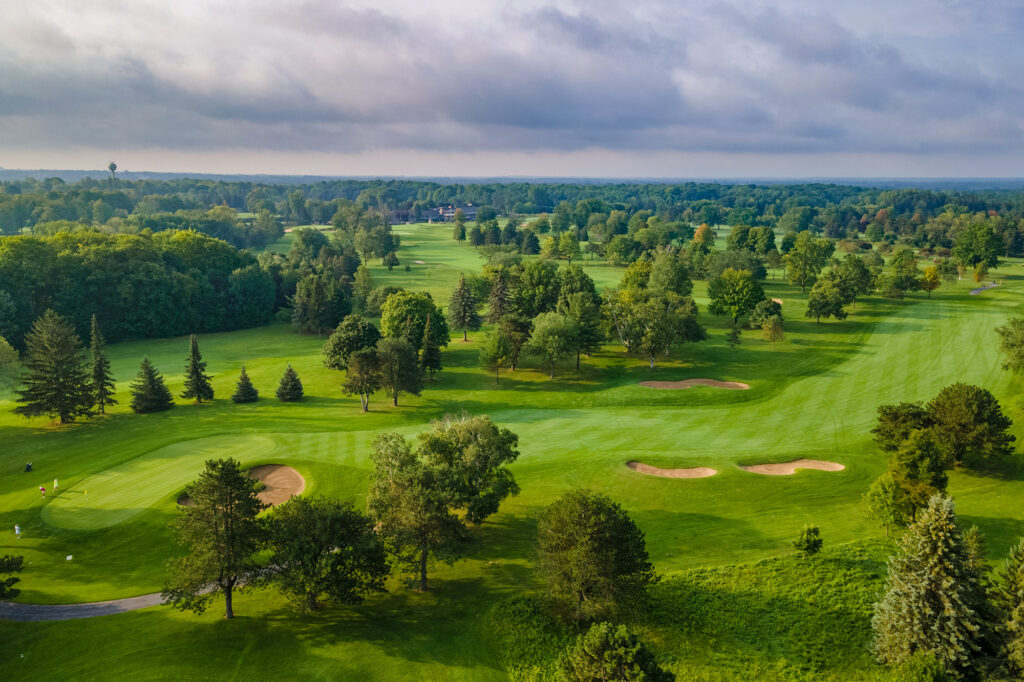
The 15th edition of the Presidents Cup tees off this week on the famed Blue Course at Royal Montreal Golf Club in Montreal, Canada. At the last competition in 2022 at Quail Hollow in Charlotte, North Carolina, the U.S. team defeated the International team 17.5-12.5. With all the money being thrown around in golf these days, surprisingly, there is no money at stake for the winners. Instead, the net proceeds are distributed to charities nominated by the players, captains, and captains’ assistants.
The Royal Montreal Golf Club is the oldest in North America, and the oldest in continuous existence, celebrating 150 years in 2023. Golf in Canada began earlier than in the USA due to Canada attracting the first Scottish immigrants. Royal Montreal’s origin in 1873 can be traced back to a small group of eight Scots who recreated their national sport and founded the club. The course is located an hour west of Montreal center on the Ile Bizard which is bracketed by the Prairies River and the Lake of Two Mountains.
With a closing stretch built for match-play drama, the Blue Course features picturesque North American parkland golf with narrow, tree-lined fairways and six holes with water danger. It has an ideal mixture of scoreable and difficult holes. Host to numerous Canadian Open championships, most recently in 2014, Royal Montreal is quite rightly proud of its heritage and the club also hosted the Presidents Cup in 2007 when the USA beat the International team by a margin of 19.5 to 14.5.
Format and Scoring
f684b2f3d4218ee06dad551b3bb2074bThe Presidents Cup uses a match play format instead of the typical stroke play format used each week on the PGA Tour. Match play is a form of competition where a player (or players) plays directly against an opponent (or opponents) in a head-to-head match. You win a hole by completing it in the fewest strokes, and you win a match when you win by more holes than remain to be played.
The Presidents Cup is a four-day competition. There will be five “Foursome” matches played on Thursday followed by five “Four-ball” matches on Friday. Saturday features four “Foursome” matches on Saturday morning followed by four “Four-ball” matches in the afternoon. The event finishes with 12 singles matches on Sunday. With 30 matches in total, and each being worth one point, it will take 15.5 points to win the Cup.
FOUR-BALL
Each member of a two-man team plays his own ball, so four balls are in play on every hole. Each team counts the lowest of its two scores on each hole, and the team whose player has the lowest score wins the hole. If the low scores are tied, the hole is halved.
FOURSOMES
Each two-man team plays one ball per hole with the players taking turns until each hole is complete. Players alternate hitting tee shots, with one leading off on odd-numbered holes, and the other hitting first on even-numbered holes. The team with the low score on each hole wins that hole. If their scores are tied, the hole is halved.
SINGLES
Each match features one player from each team. The player with the lower score on each hole wins that hole. If their scores are tied, the hole is halved. Players can concede a hole to their opponent if they have no chance of halving the hole.
Differing from the Ryder Cup in which the U.S. team plays against Europe, the Presidents Cup features the U.S. team against an “International” team, which specifically excludes players from Europe. It is held every two years, in non-Ryder cup years. The U.S. has dominated the series 11-1-1 with the sole International victory coming in 1998 in Australia.
Each of the teams is comprised of 12 players. Both teams had six qualifiers determined by a points list based on performance. Both captains (Jim Furyk for the U.S. and Mike Weir for the Internationals) also had six “captain” picks. While the U.S. team already had a huge talent advantage, LIV Golf defections continue to hamper the potential of the International roster with Weir having to dig deeper into the player pool for his final team selections.
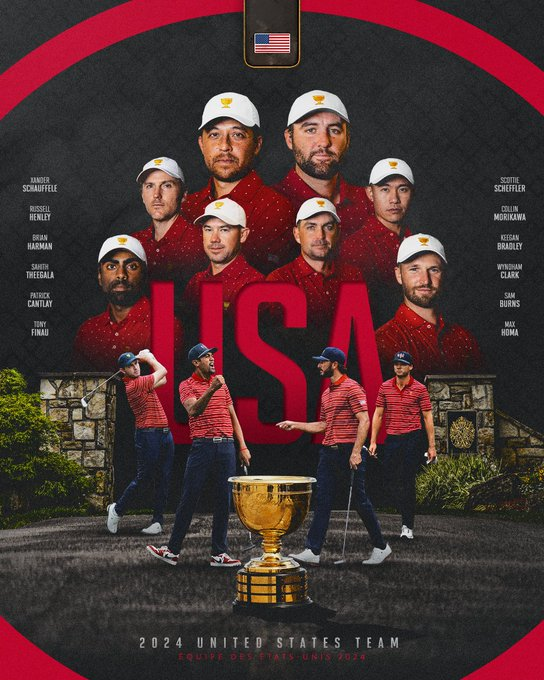
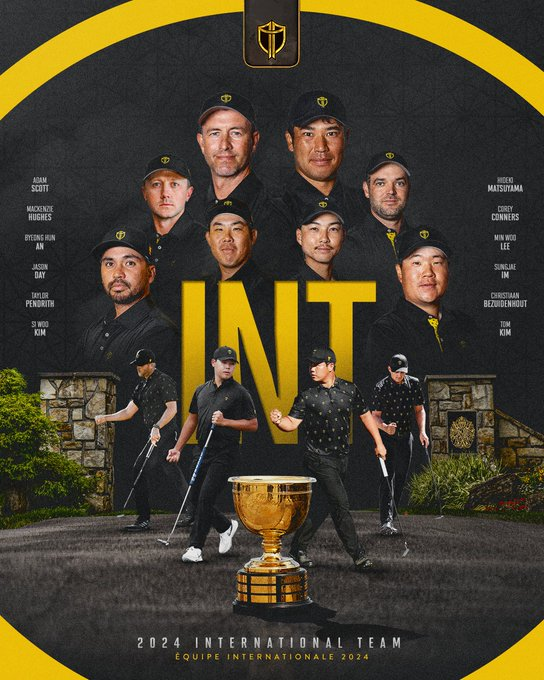
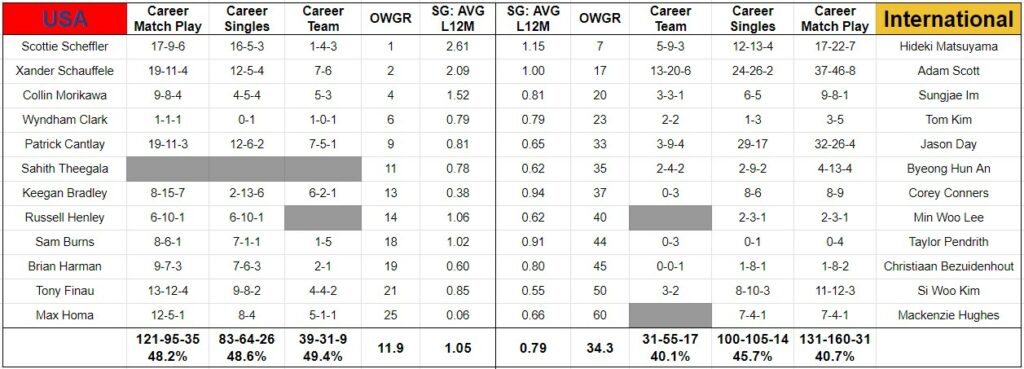
Below is the overall “Tale of the Tape” for the Presidents Cup. It includes career match play records, Official World Golf Rankings, and Strokes Gained Total per round. Each data chart is from performance over the past 12 months. When looking at the team averages in each category, it is clear to see why the USA is a heavy favorite at around -270 on most betting sites.
Tale of the Tape
The Course – Royal Montreal Golf Club
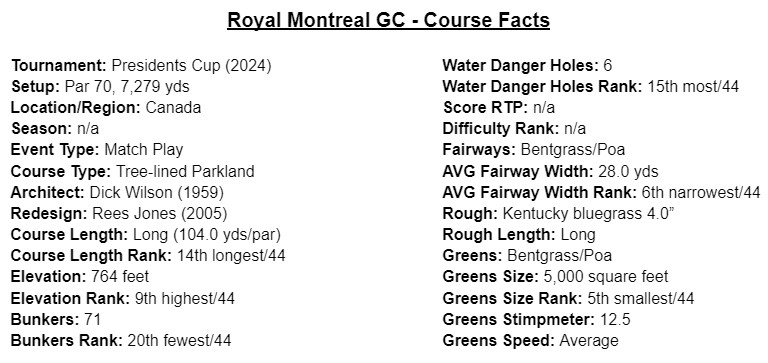
Host of five Canadian Opens, the Blue Course was called “spectacular” by Nicklaus when he captained the Presidents Cup in 2007. One of the finest tests of golf in Canada, it is regularly counted among the premier courses in the world. At 7,279 yards, the stock par 70 course has a typical allotment of four par 3s and only two par 5s. It’s a fairly easy walk with only 25 feet of elevation changes across the property. The front nine features heavily tree-lined playing corridors, while the back nine presents water intruding upon the line of play on six holes, including the concluding stretch of five holes.
Off the tee, both power and control are necessary to set up easier approach shots. Fairways average between 26-30 yards wide in the landing zones. As is the choice of the home captain, Mike Weir has a say in the agronomy and is expected to request especially thick, 4-inch rough that will produce a penalty for missed fairways. More evidence of Royal Montreal favoring accuracy over distance comes in the form of past winners here for the Canadian Open including two of the most accurate drivers of their time in Scott Verplank (2001) and Tim Clark (2014).
Dick Wilson’s original design featured elevated greens and sparse, strategic fairway bunkering. That character remains, with smaller-than-average putting surfaces at an average size of 5,000 square feet that are well protected by cashew-shaped greenside bunkers. Players who miss greens will face delicate uphill pitch shots to save par.
Agronomically, greens are a mix of bentgrass and poa. Many are “T-shaped” and the larger ones present a variety of potential sucker pin positions that will create drama in this match-play format. The multi-tiered contours will present another challenge for golfers whether chipping or putting. Avoiding three-putts will be huge factor in determining numerous matches.
Course renovation architect Rees Jones sees the closing stretch as ideal for match-play drama, starting with the reachable par-5 12th and long par-3 13th. Water bordering angled edges on the fairways of the closing holes will pose both a strategic and execution concern. The best “total drivers” of the ball will be able to separate themselves here. “The 14th, 15th and 16th holes, with the water, will be challenging depending on where they put the pins,” Jones said. “Those are going to be the key holes of the matches.”
This year, the already demanding 18th hole will typically play into the wind and is now 20 yards longer than it was in the 2007 Presidents Cup. The fairway, which is protected by a bunker on the right, has been narrowed down to just 25 yards wide. Water looms dangerously on the entire left side. The tee shot, however, is only the initial challenge. The green is considered the most difficult on the course. The putting surface features a small and relatively flat back plateau, while the front of the green is steeply sloped. It’s sure to provide a dramatic finish for the matches that last until this closing hole.