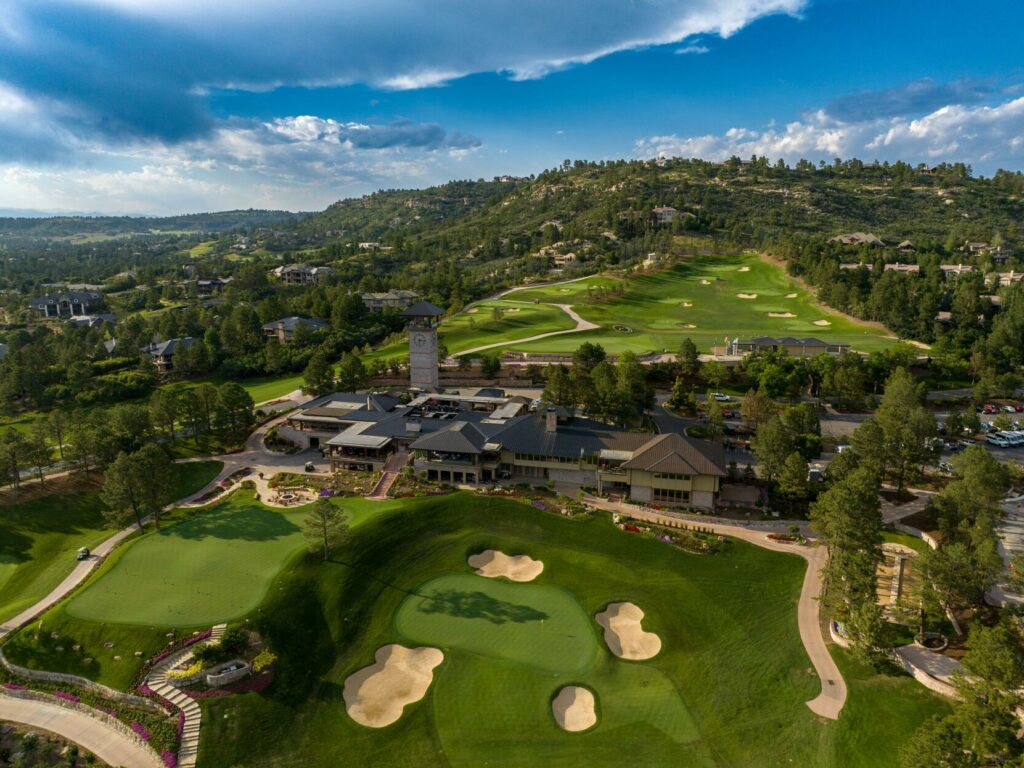
Carved out of a pine forest in the scenic foothills of the Rocky Mountains sits Castle Pines Golf Club. Located in Castle Rock, Colorado, just 27 miles south of Denver, Castle Pines is a Jack Nicklaus design that will be the longest course in PGA Tour history at 8,130 yards on the official scorecard.
Club founder Jack Vickers had urged architect Jack Nicklaus to produce a mountain venue design worthy of a major championship – a western version of Augusta National. Since its founding in 1981, Castle Pines has undergone a steady procession of hole alterations to keep pace with changing technology.
The par 72 layout features twisting hole shapes, dramatic elevation changes, elevated, multi-tiered greens, numerous water hazards, and Rocky Mountain air that allows golf balls to travel around 10% further than they would at sea level. The club has become a fixture inside the top 50 of America’s greatest courses.
For 21 years (1986-2006), this course was a mainstay on the PGA Tour, hosting “The International” tournament, that featured the distinctive Stableford scoring system which encouraged aggressive play and rewarded risk-takers. It consistently attracted many of the best players in professional golf and had winners including Retief Goosen, Davis Love III, Phil Mickelson, Brad Faxon, Ernie Els, and Greg Norman.
Unlike the FedEx St. Jude Championship or the Tour Championship, played at TPC Southwind and East Lake respectively, the second playoff tournament has been played on many different courses. Since the event’s name change from the Western Open to its rebranding in 2007, ten different courses have held 17 editions of the BMW Championship. At last year’s BMW Championship, Victor Hovland won his fifth PGA Tour title by two strokes at Olympia Fields over Scottie Scheffler and Matt Fitzpatrick before securing the FedEx Cup title a week later by winning at East Lake.
The Field
50 golfers are still alive heading into the second round of the FedEx Cup Playoffs. They can also breathe a sigh of relief as each one has guaranteed their spot in all eight Signature events next year. The top-30 in the FedEx Cup standings after this week will advance to next week’s Tour Championship. Similar to last week, this is another small-field, no-cut event.
Not one golfer teeing off this week has ever played an official round at Castle Pines. Only Adam Scott was even on the PGA Tour when the last tournament was held in 2006, and he did not compete that week.
The player with the most experience at Castle Pines is unsurprisingly, Colorado native Wyndham Clark who enters this week trending upward. Clark has estimated he’s played Castle Pines 25-30 times over the years. Three weeks ago at the Olympics, he tied for the best scoring total over the last three rounds en route to a 14th-place finish. This past week at the FedEx St. Jude Championship he soared up the leaderboard with a 64 on Sunday and a seventh-place finish.

Castle Pines GC – Course History
It was 1969 and Midwest oilman Jack Vickers had just moved to Denver and wanted “to get better acquainted with his new surroundings” when he stumbled upon the property that is now Castle Pines Golf Club. Out on a drive to explore the area, he came upon a dirt lane on the south side of town and, on a whim, turned onto Happy Canyon Road. He stopped his car about half way up the lane, got out and climbed to the top of a rocky ridge — discovering a 360-degree panorama of iconic Colorado scenery. He had found the perfect spot to build his world-class golf course and club.
It took 12 years before Vickers had persuaded the numerous local landowners involved to deed him the title to the acreage he needed. With the location of his club decided, Vickers turned his attention to the golf course and engaged Jack Nicklaus to be the course architect. Touring the site on foot and by helicopter, both Vickers and Nicklaus are fond of saying that though they seldom agreed, they ultimately hammered out the final layout to what would become one of the best golf courses in the country. Construction began in 1979 and Castle Pines Golf Club officially opened in October of 1981.
The entire course has been renovated since the last “International” in 2006 with help from Jack Nicklaus and Total Turf company. The renovation has included new bunkers, rebuilt tees and greens, redesigned water features, and an almost entirely new third hole.
We have partnered with Underdog to bring you an easy way to claim a FREE, no-strings-attached 90 days of Premium Access to Betsperts Golf, plus up to $250 in bonuses when you deposit! Click here to learn more!
f684b2f3d4218ee06dad551b3bb2074bCourse Features
Featuring manicured parkland-style golf in a rugged mountain setting with awe-inspiring panoramas, Castle Pines Golf Club is a sight to behold. Incorporated into the course environment are ponds, streams, wildlife, and flower beds seemingly everywhere you turn. The club annually plants between 80,000-100,000 flowers. A herd of 250 elk co-exist around the golf course. Other wildlife on the property include deer, bobcats, mountain lions, bears, bald eagles, hawks, and hummingbirds.
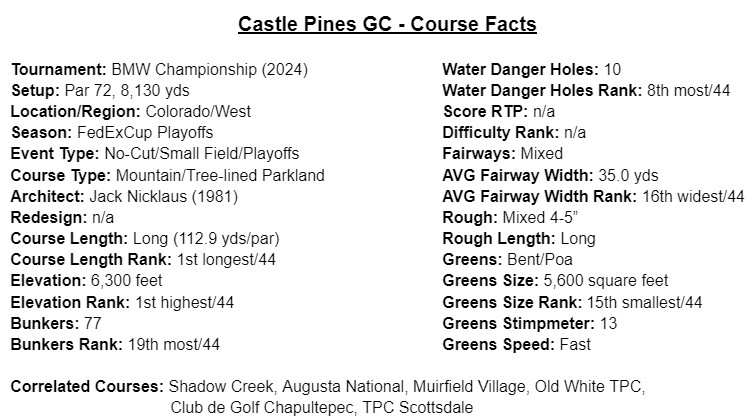
While Castle Pines will set a PGA Tour record for length measuring 8,130 yards, the ball travels around 10% further at the course which is 6,300 feet above sea level. Expect ShotLink to pick up some flattering superpower-type distances off the tee this week. In the past, the course has typically played at just over 7,600 yards but the club added 600 yards to lengthen the championship tees. Removing the distance gains from the altitude, Castle Pines will play to around 7,400 yards which is in the average range compared to other par 72 courses on Tour.
How difficult the course will actually play is up for debate. This brings us back to the player with the most experience here, Wyndham Clark, who remarked, “This is probably the most challenging course in Colorado because you first have the altitude, and then you have a lot of elevation change, which can be a challenge. It’s very tough off the tee, and then around the greens you have to be very precise. At altitude where we normally don’t play, that’s going to be difficult,” he said. “You’re going to see a lot of us Monday, Tuesday, Wednesday, spending a lot of time on the range with Trackmans and all the measuring devices on distance, trying to figure out how far the ball is going.” Both players and caddies will be plenty busy between shots calculating actual shot distances which will add an extra layer of strategy to the week.
Jack Nicklaus disturbed very little earth to create his course here at Castle Pines. It was designed with great care to follow the land’s natural contour and complement its densely wooded areas and rolling hills. The course has 400 feet of elevation change from start to finish. 13 of the 14 par 4 and par 5 holes wind their way through avenues of Ponderosa pines and oak trees. A couple of holes are more expansive and it’s from these holes that you appreciate the scale and delight of the surrounding rugged terrain.
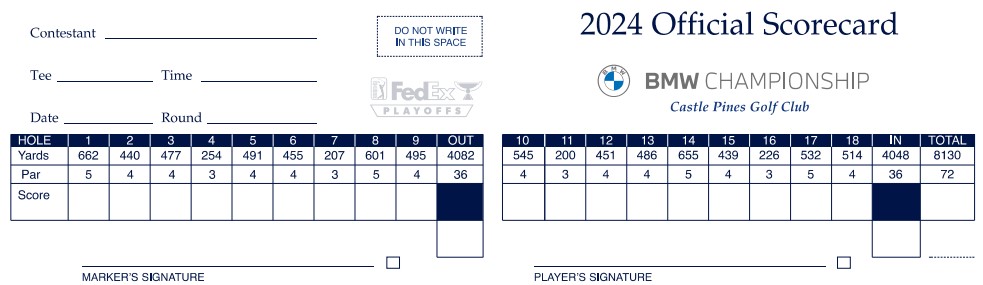
Each set of nine holes starts on the highest areas of the property before working down to the bottom and back to the top to finish out. With a full complement of four par 5s along with all the water hazards, there are plenty of risk/reward opportunities throughout the course.
Fairways vary in width with some expansive and others bottlenecking near the landing zones between 300-325 yards. Judging proper distance and lines off the tee will be crucial considering the numerous uphill and downhill tee shots, water hazards, deep fairways bunkers, and crowned fairways that camber to one side or the other. Early reports have the rough at 4+ inches and growing. The rough is a blend of Kentucky bluegrass, tall fescue, and perennial ryegrass.
Ten different holes present water danger as numerous ponds and babbling brooks are strategically placed to gobble up errant shots. Deep grassy barrancas also come into play on a few holes, mostly as penal runoff areas to collect errant approaches into these elevated greens.
As for the greens, they are heavily guarded by either bunkers or ponds. They don’t have many steep undulations but are multi-tiered with many sloping from back to front. Agronomically, the greens are 70% bentgrass and 30% poa annua and are set to run at a speedy 13 on the stimpmeter.
“It’s very exciting to see Castle Pines back in tournament golf,” Nicklaus said. “We have made some excellent changes to the golf course over the last five years, which make it more playable but still quite challenging. The players will really enjoy this renewed facility.”
Most Important Stats For Success at Castle Pines Golf Club
*In order of importance
- SG: Approach
- Total Driving
- Par 5 Scoring
- Proximity: 200+
- Good Drive %
- Birdie or Better %
- SG: Putting (Fast Greens)
- Bogey Avoidance
- Carry Distance
- SG: ARG
Key Rabbit Hole Filters
- Course Region: West
- Course Type: Mountain
- Course Length: Long
- Field Strength: Very Strong
- Field Size: Small Field
- Event Type: FedEx Cup Playoff
- Water Danger: High
- Elevation: High
- Architect: Jack Nicklaus
- Greens Surface: Bent/Poa
- Rough Length: Long
- Gain OTT: Difficult
- Missed Fairway Penalty: High