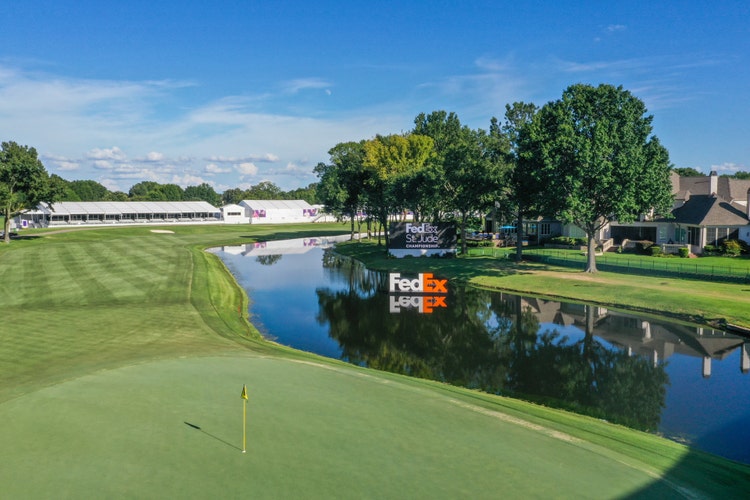
The top 70 golfers in the FedExCup standings will travel to Tennessee for the FedEx St. Jude Championship for the opening playoff event of the PGA Tour’s season-long points competition. Nestled in the rolling countryside just southeast of Memphis sits TPC Southwind, which is hosting a playoff event for the second consecutive year.
It is a course that is infamous for its “water balls” and one that historically rewards the best ball-strikers in the world. In the past six events played at this course, winners have included some of the best ball-strikers in the world including Will Zalatoris, Justin Thomas, Brooks Koepka, Dustin Johnson, Abraham Ancer, and Daniel Berger (twice). TPC Southwind is a course that favors players who are both familiar and competent on Bermuda grass surfaces as its firm and fast greens and its penal rough thrive in the heat and humidity of the American South.
Rory McIlroy gave a quality summation of what it takes to have success at TPC Southwind. “If you do hit it in the rough, it’s going to be hard to control your ball from there. So first thing, you put it in the fairway and put it in play, but I think the biggest thing around here is your approach play. I think sort of seems to be a lot of approach shots between like 140 yards to 170 yards, so that’s a key distance this week. If you can sort of get your pitching wedge through 7-iron dialed in and get those working really well, I think you’ll always have a good chance around this course.”
The Field
Continuing with last year’s newly devised playoff structure, only the top 50 in the FedExCup standings after this week will advance to the BMW Championship. With such a small field, this will be the second consecutive year that the opening event of the playoffs will not have a cut. Since this course has hosted a PGA Tour event every year since 1989 we have plenty of course history and data to rely on this week.
With $20 million in prize money on the line, there is plenty of motivation for the top players to not treat this week as a warm-up for the following two playoff events. Players outside of the top-50 can boost their place in the standings with a good performance this week as points are quadrupled for these first two playoff events, with the winner earning 2,000 points and 70th place earning only 12 points.
As for the 70 players that comprise this field, every eligible player will be in attendance including each of the top eight ranked players in the world, Scottie Scheffler, Xander Schauffele, Rory McIlroy, Ludvig Aberg, Wyndham Clark, Collin Morikawa, Viktor Hovland and Patrick Cantlay. The biggest names staying home who finished outside the top 70 include Keith Mitchell, Rickie Fowler, Nicolai Hojgaard, and last year’s winner here, Lucas Glover.
TPC Southwind – Course History
Designed with tournament in golf mind, TPC Southwind was built in 1988 and was designed by Ron Prichard, in consultation with Tour professionals Fuzzy Zoeller and Hubert Green. Prichard is well-known in golf architecture circles as the “father of restoration”, most notably with certain Donald Ross-designed courses. Though not a restoration, it is one of the more difficult “TPC” courses played on Tour.
TPC Southwind itself was first renovated in 2004 to modernize the course and make it more challenging. 11 new tee boxes were added along with 125 trees and 15 new bunkers. Three of the water hazards were also enlarged. Even more changes occurred back in 2020. This time, most of the upgrades were related to adding, resizing, and re-edging numerous bunkers. There were also a few holes such as the 3rd and the 7th that were extended fifteen-plus yards.
In 1989, the course began hosting the Federal Express St. Jude Classic just one year after it was built and would continue to do so through 2018. From 2019-2021, the course hosted the World Golf Championship (WGC) FedEx St. Jude Invitational. 2022 marked the first year TPC Southwind hosted the first round of the FedExCup Playoffs.
We have partnered with Underdog to bring you an easy way to claim a FREE, no-strings-attached 90 days of Premium Access to Betsperts Golf, plus up to $250 in bonuses when you deposit! Click here to learn more!
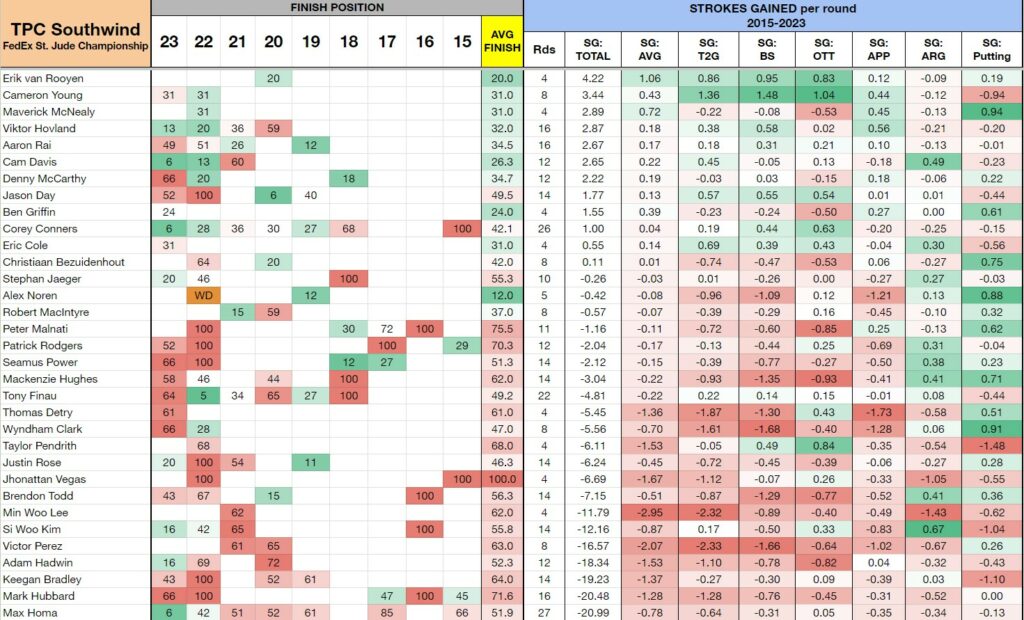
Finish Position and Strokes Gained Event History (2015-2023)
This includes the average finish position and Strokes Gained per round in each category. Players are sorted by SG: Total. TPC Southwind is the 14th least predictive course on Tour.
f684b2f3d4218ee06dad551b3bb2074b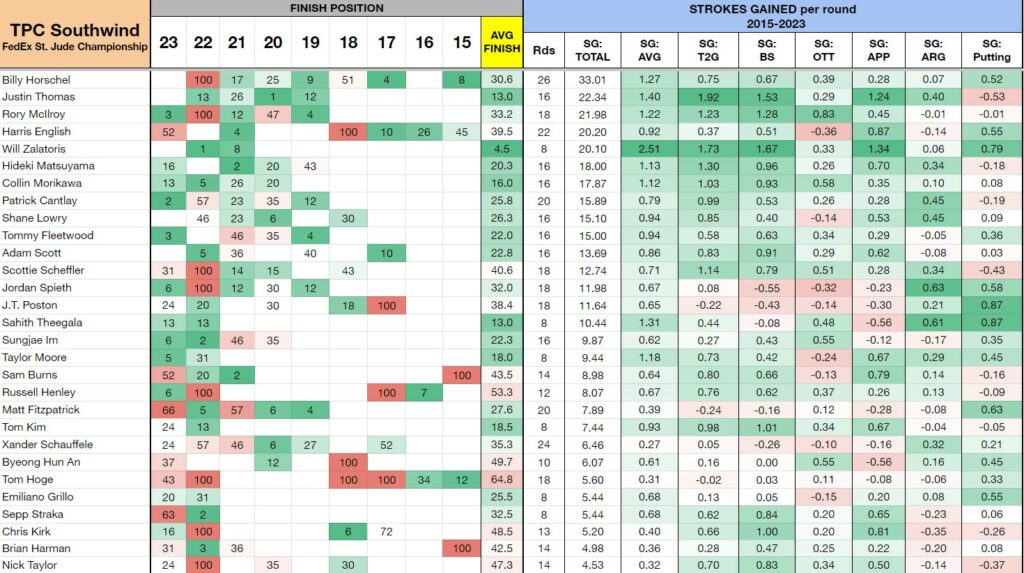
Course Features
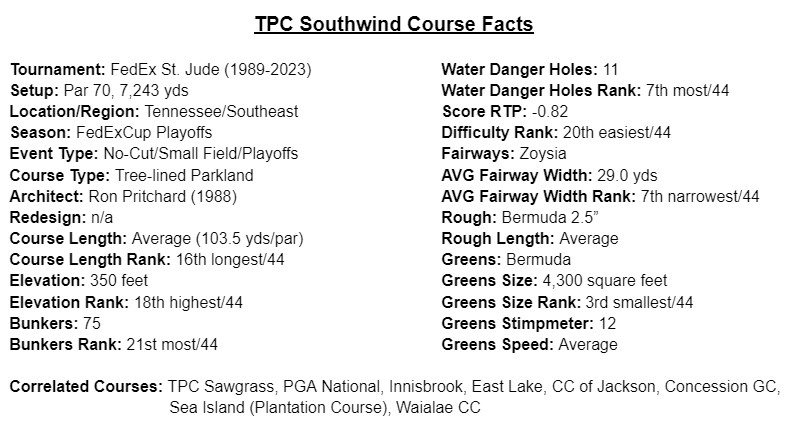
Built on the remnants of a dairy farm, TPC Southwind is a par-70, 7,243-yard tree-lined course that contains undulating narrow zoysia fairways, gnarly 2.5-inch Bermuda rough, and Champion Bermuda greens. Many players who grew up in the South or who have become used to chipping and putting on Bermuda will be very comfortable here in the Florida-like climate. Players with past success like Daniel Berger repeatedly talk about how comfortable they are in this environment. Much like at East Lake in Georgia, the zoysia grass used on fairways is very beneficial for the course due to the Memphis climate which has both sweltering heat in the summer and cold bursts in the winter.
Over the past five events, the course played to 0.82 strokes under par which puts it right near the middle for Tour difficulty. Since 2004, only one winning score has been outside the 9-under to 19-under range. While it is a par-70, TPC Southwind is not a short course like Harbour Town or Pebble Beach. There are eight lengthy par-4s, and the numerous doglegs stretch the course even further.
The course also features numerous lakes, streams, and ponds which add up to 11 holes with water directly in play. In fact, TPC Southwind has the most “water balls” on Tour by far. Since 2003, TPC Southwind’s 6,166 balls in the water are the most at any PGA TOUR course during that stretch. The second highest course is TPC Sawgrass with a huge drop to 5,089. Because of all the water danger, three different holes average higher than a 5% double bogey or worse rate.
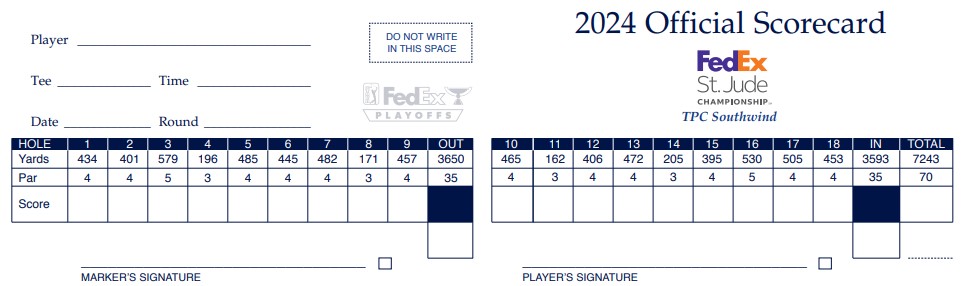
Said Webb Simpson on the reason for all the water balls, “You drive it in the fairway. You’re going to have a lot less chances to hit balls in the water. I think these water balls often come from guys who drive it in the rough on holes like 9 or 15, even 18, even 12. There are a lot of holes where in the rough you have a decision to make: Are you going to bring on the water and go for the green or are you going to lay up? It’s really hard to lay up from 150 yards.”
With just two par 5s, scoring chances will be limited. Par 4 scoring will be key as the threat of bogeys will be brought much more into play than has been seen over the past couple of weeks. Overall, there are more holes with a 17% bogey rate (ten) than a 17% birdie rate (six). While the rough isn’t ultra-penalizing, the unpredictability of the Bermuda grass results in numerous bogeys, and it becomes a very difficult track to play if you’re missing fairways and greens or splashing it into the water. The greens present another challenge as the third smallest on Tour and are heavily guarded by either water or multiple greenside bunkers.
The course itself does not have many unique holes that stand out. Most feature narrow, tree-lined fairways with either a bunker or water hazard near the landing zone. With birdies coming at a premium, players need to take advantage of the two reachable par-5s that have a combined birdie or better rate of 43%. While patience is needed to survive the many obstacles on the course, players will need to pick their spots to be aggressive as simply grinding out pars won’t get it done here.
Strokes Gained Analysis
Off the Tee
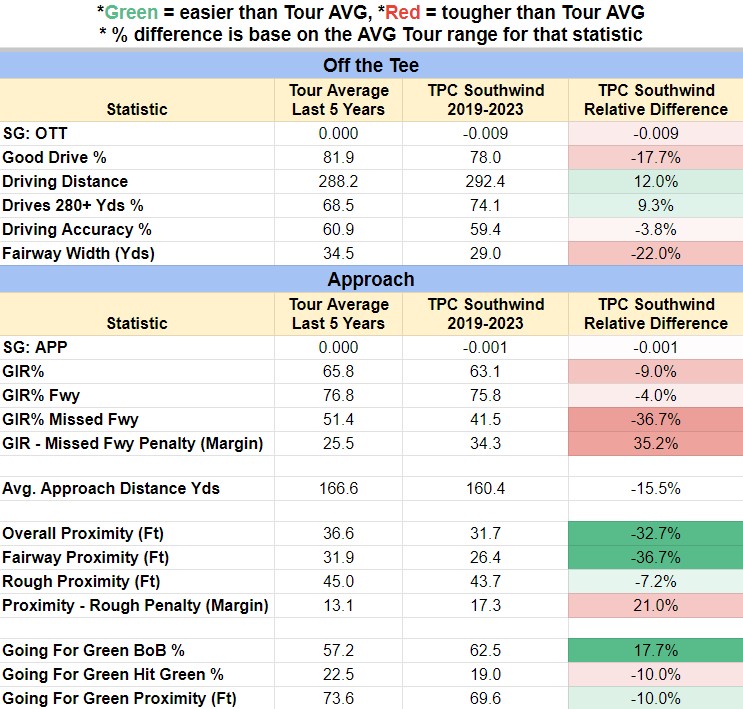
With the approach game getting most of the “ball-striking” love at TPC Southwind, Off the Tee is very underrated for this week as the course presents players with multiple challenges. Not only are there 12 doglegs and the second narrowest fairways (averaging 25 yards wide in the landing zones), but there are multiple water hazards, fairway bunkers, and penal Bermuda rough waiting to swallow any errant shots. Players who can consistently find the fairway and position themselves well off the tee will have checked the first box in having success this week. As Brendon Todd said, “It’s not overly long and it rewards accuracy. Even though I only drive it 280, I can hit the ball in the fairway and still attack the pins. So I feel like it’s a really fair course for all the different lengths we have out here and it just comes down to who’s playing well, hitting good shots and making putts.”
Similar to Sedgefield, the Bermuda rough is very unpredictable to play from due to the grass stems wrapping around the ball. This produces either fliers over the green or low-tumbling approaches that finish well short of the hole. Either way, spin control is almost non-existent from the rough, and players are typically left scrambling to save par. TPC Southwind is among the 10 toughest courses in both “Rough Penalty” and “Rough Difficulty”. Said Jon Rahm about the need to stay out of the rough, “It’s Bermuda rough. You can get flyers. You can just lose control of the ball and end up in a pretty bad spot.” There is definitely a premium on accuracy off the tee this week.
As important as it is to consistently find fairways, players also benefit from distance OTT on the longer par-4 holes. As the power game in golf continues to increase we are seeing Driving Distance numbers continue to rise here at TPC Southwind as many players are cutting corners over the edges of doglegs. Over the last two years, distance off the tee has averaged over 294 yards which is the highest two-year span in the existence of this course as a PGA Tour event.
Good Drive % on other courses with difficult rough is another key stat this week as it provides a glimpse into which players can find the green on approach even if they missed the fairway. Over the past three years, 43 of the top 48 players on the leaderboard gained in Good Drive % as compared to the field.
Approach
Almost 45% of strokes gained at TPC Southwind have been from Approach compared to the Tour average of 35%. In 2021, the top five on the leaderboard gained at least four strokes in approach. And in 202, the top four gained an average of 5.2 strokes.
TPC Southwind’s tiny greens, perilous hazards, and penal rough have always demanded elite iron play. If wayward drives find the rough, GIR% drops from 76% from the fairway to an astounding 41% from a missed fairway. The rough leaves golfers with a choice to go for the green or to play more conservatively and try to avoid a big number, especially if water is in play on that hole. When in the fairway, short to middle iron play will be vital. On average, 65% of approaches this week will come from the 125-200 yard range which is well above the Tour average of 56%.
Around the Green and Putting
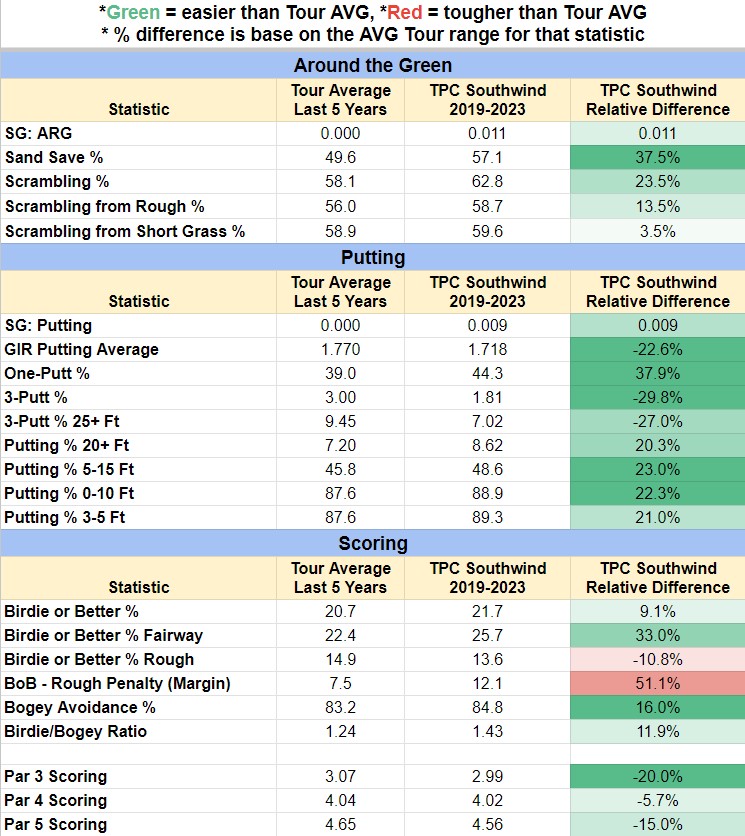
With both a below-average Driving Accuracy and GIR rate, this is a week where players will have to rely on their short game around the greens. Brandt Snedeker discussed this fact by saying, “You’re going to miss the greens here. The greens are very small and are tough to hit. So you have to understand you’re going to miss four, five greens a day here. That’s just the way it is. Got to be able to get it up and down.” While the bunkers are among the easiest on Tour, because of the unpredictable rough and the numerous tight lies that surround the green complexes, gaining strokes around these greens ranks among the ten toughest on Tour.
On the flip side, literally every single putting category from these Bermuda greens is easier than the Tour average. 3-putt % along with every range show that these greens are among the easiest on Tour. There are very few ridges and undulations, and pin positions are quite benign. This dramatically levels the field related to the importance of putting this week compared to overall tee-to-green performance.
Most Important Stats For Success at TPC Southwind
*In order of importance
- SG: Approach
- Total Driving – DFEF
- SG: ARG/Scrambling (Bermuda)
- Proximity: 125-200
- SG: Par 4
- Birdie or Better %
- Good Drive % (Bermuda rough)
- Bogey Avoidance
- SG: Bermuda courses
- SG: Putting (Bermuda)
Key Rabbit Hole Filters
- Course Region: Southeast
- Scoring Conditions: Average/Easy
- Field Strength: Very Strong
- Par: 70
- Field Size: Small Field
- Event Type: FedEx Cup Playoff
- Water Danger: High
- Greens Surface: Bermuda
- Green Size: Small
- Rough Surface: Bermuda
- Missed Fairway Penalty: High
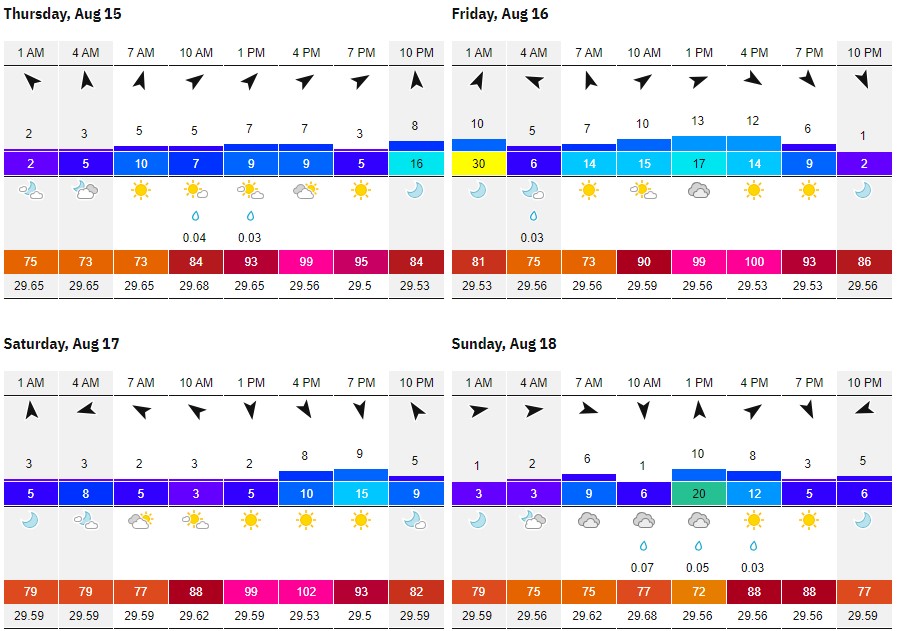
Weather Forecast – Memphis, TN