Sitting adjacent to Muirfield on 300 acres along the famous golf-playing coastline off the Firth of Forth in North Berwick, Scotland is “The Renaissance Club”. Completed in 2008 by famed architect Tom Doak, it was designed from the swath of an ancient pine forest. With only four holes by the ocean, undulating terrain, thick rough off the fairway, and numerous wooded areas, the course is not a traditional links setup. But it does have links qualities with its seaside location, firm turf, and deep pot bunkers with riveted faces. And its greens encourage the use of the ground game.
It hasn’t always played as tough as a typical links course due to the effects of the wind which have had a major impact on scoring conditions through the first five editions played at The Renaissance Club. With light winds for most of last year’s event along with 2019 and 2021, the course played much easier at -0.69 per round. But when the coastal breezes kick up like in 2020 and 2022, scoring becomes much tougher as evidenced by it averaging +1.46 per round. With hardly any penalty for missing the fairway, the course favors length off the tee along with accurate long iron players who can flight their ball in the wind and avoid 3-putts on the huge, undulating greens.
Over the past decade, the club has become a mainstay in the Scottish golfing scene, having hosted four other Scottish Opens along with professional women’s and senior events. This tournament along with the concurrent ISCO Championship in Kentucky are the only co-sanctioned events between the PGA Tour and DP World Tour. Before this became a PGA Tour event two years ago, 22 of the past 24 champions were regular members of the DP World Tour. PGA players have typically viewed this tournament as a warm-up for The Open Championship. But over the past two years, PGA stalwarts, Xander Schauffele and Rory McIlroy (last year) broke through with victories.
The Field

With 18 of the top 30 players in the world making the trip to North Berwick, the field for this year’s Scottish Open will be one of its strongest ever. With it being a co-sanctioned event, the number of PGA Tour players and DP World Tour players is evenly split with 75 players in attendance from each. Motivation for many will be high as three spots in the Open Championship are up for grabs to the top three finishers who have not already qualified provided they finish in the top 10 at Renaissance.
With world No. 1 Scottie Scheffler choosing to prepare on his own for next week’s Open Championship, he joins Patrick Cantlay as the only eligible top-25 players not in attendance this week. Other top players not making the trek overseas include Tony Finau, Russell Henley, Keegan Bradley, Cameron Young, and Akshay Bhatia.
Rory McIlroy returns to defend his win from last year and makes his first appearance since faltering down the stretch at last month’s U.S. Open. Scotland native, Robert Macintyre, who was runner-up last year, returns home as a PGA Tour champion having won the Canadian Open a few weeks ago. Other past Scottish Open champions teeing it up this week include world No. 3 Xander Schauffele, Min Woo Lee, Aaron Rai, and DP World Tour player and former LIV Golf member, Bernd Wiesberger.
From the DP World Tour side, the top players in the field this week aside from Wiesberger include the likes of Rasmus Hojgaard, Jordan Smith, Guido Migliozzi, Tom McKibbin, Keita Nakajima, and Thriston Lawrence. Many former DP World Tour players are now regulars on the PGA Tour including Macintyre, Ryan Fox, Alexander Bjork, and Matthieu Pavon.
The Renaissance Club – History
Famed American architect Tom Doak had always embraced “Old Country” course designs. And in 2005, he finally received an offer to build a Scottish course that would be named The Renaissance Club. A group of American investors obtained a 99-year lease from the Duke of Hamilton on a 300-acre portion of the Archerfield Estate on the East Lothian coastline where they wanted Doak to create a private course worthy of major championships.
One of the main reasons Doak was hired to create a world-class course was his renowned ability to leave nature undisturbed. In that regard, Doak did not disappoint as he was able to showcase the natural features of the Archerfield tract. Speaking on the land, Doak remarked, “It was very different from other properties in the area because of the trees and lack of dunes, but as well as being sandy, the land has beautiful subtle movement.”
When three new holes along the coastline were added in 2013, it gave the course an entirely new feel. The holes from 9-11 connected the course to the coastline for the first time. Holes 9 and 11 are scenic par-3s while the par-4 10th hole has a narrow fairway with a sloped green that sits right next to the edge of the cliffs looking down on the Firth of Forth.
We have partnered with Underdog to bring you an easy way to claim a FREE, no-strings-attached 90 days of Premium Access to Betsperts Golf, plus up to $250 in bonuses when you deposit! Click here to learn more!
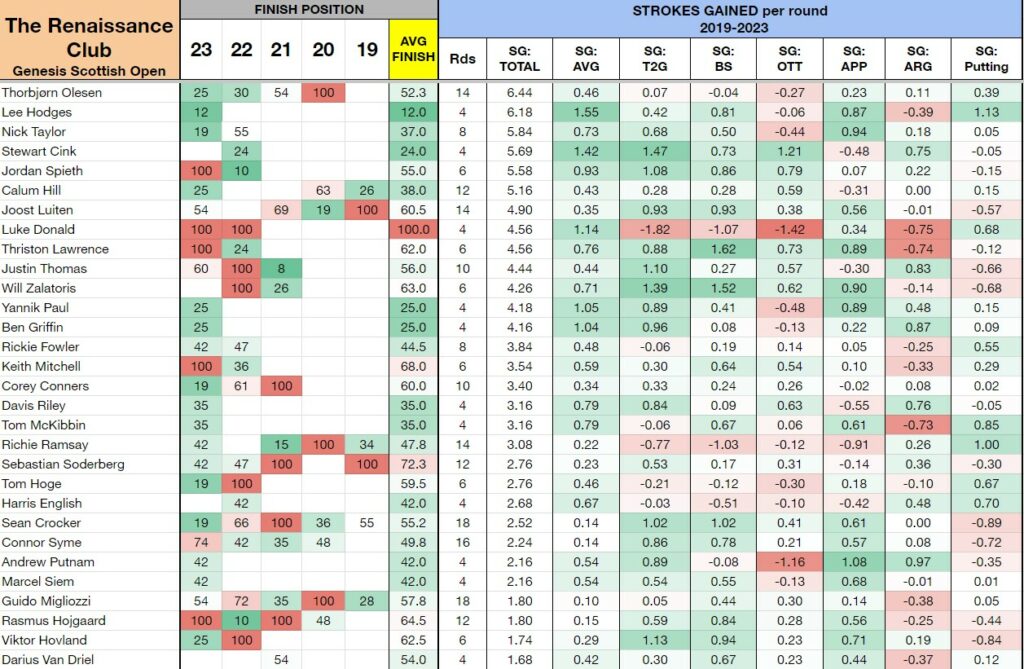
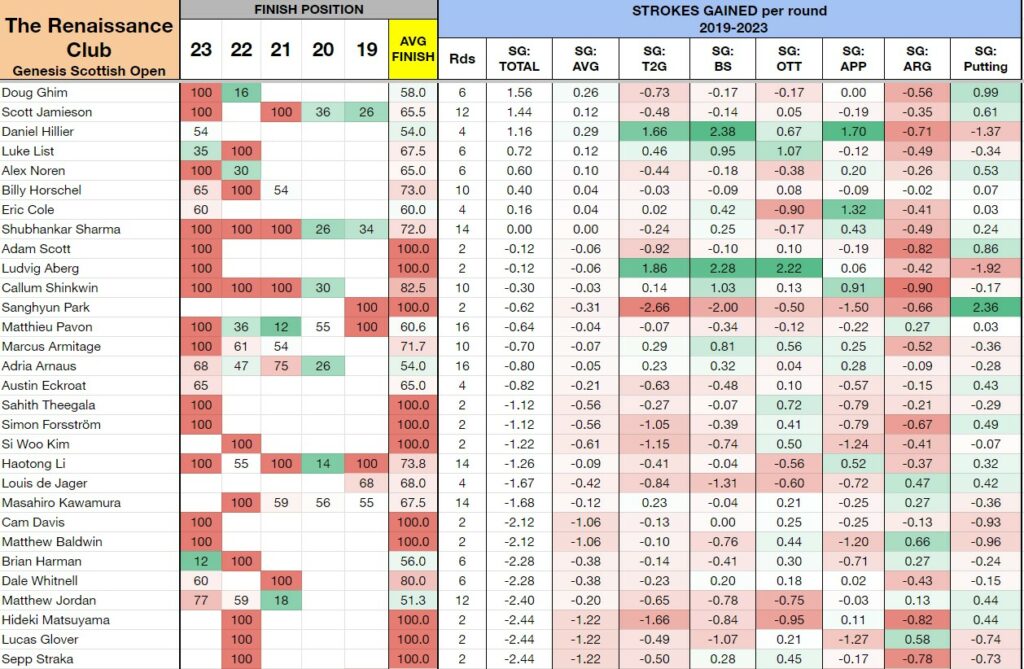
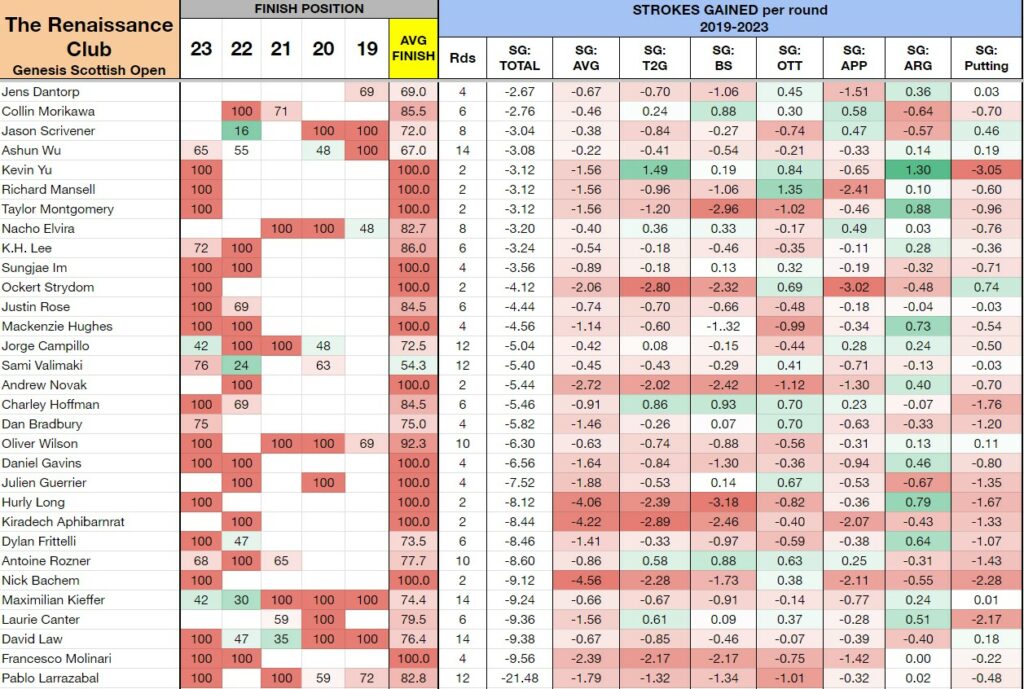
Finish Position and Strokes Gained Course History (2019-2023)
This includes the average finish position and Strokes Gained per round since 2019 for each of the categories. Players are sorted by SG: Total. The Renaissance Club is the least predictive annual course on Tour.
f684b2f3d4218ee06dad551b3bb2074b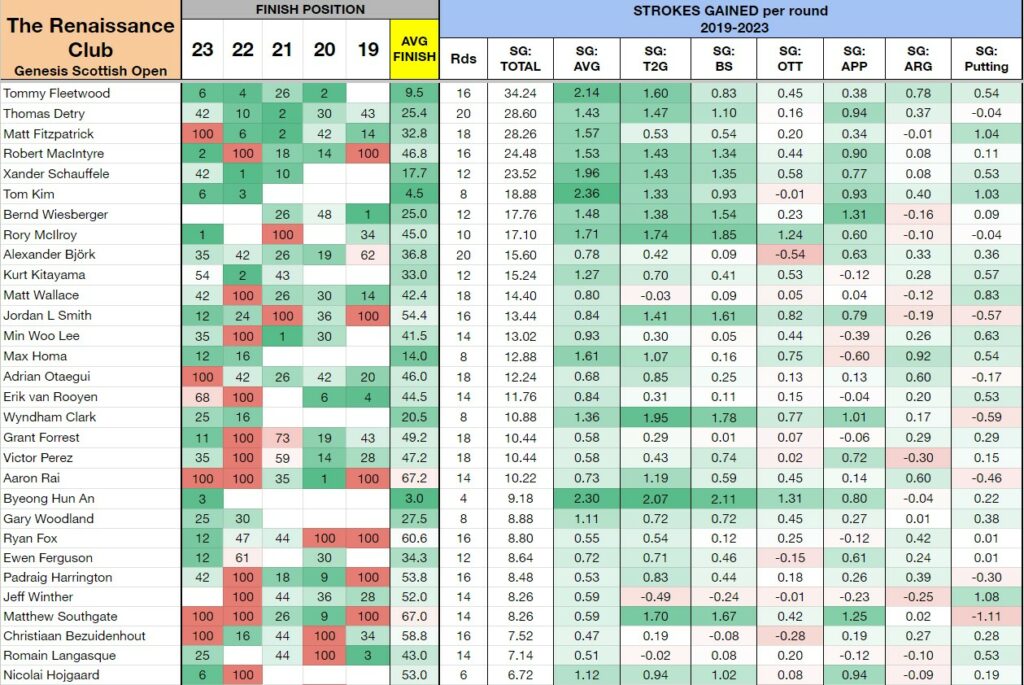
Course Features
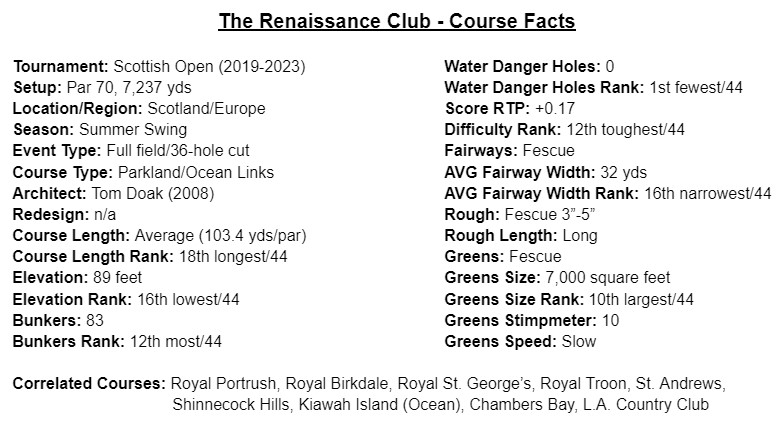
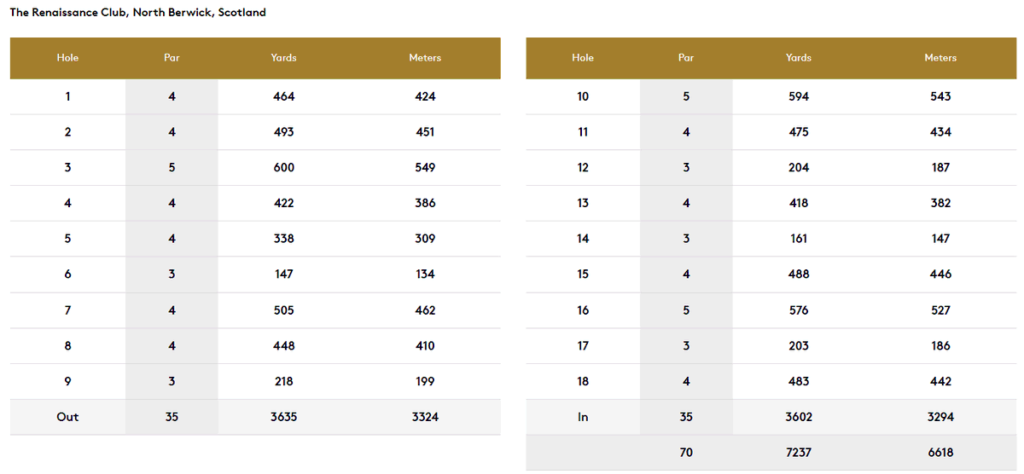
Due to potential windy conditions, The Renaissance Club was built with extreme versatility in tee placements and can play as short as 5,400 yards out to its Scottish Open length of 7,237 yards. While it was a par-71 course in its first four editions, this is the second year it will be a par-70 course with a unique mixture of ten par-4s, five par-3s, and three par-5s. Overall, it is a hybrid of parkland, heathland, and links-style courses. The layout was carved through a forest of evergreens and has an undulating sand-based terrain that includes ancient rock walls, ocean cliffs, and forested woodlands.
In regards to agronomy, the Renaissance Club was seeded with the most common grass choice in Scotland – red fescue. Fairways, rough and greens are all 100% fescue. The rough is much thicker here compared to the wispiness of other links-style courses in Great Britain. As is typical for most coastal courses, greens run very slow at around 10 on the stimpmeter. The greens here are cut at a minimum of 5 mm high. Most PGA Tour greens are typically cut to around 2.5 mm. With the greens playing so slow, many of the PGA Tour players who are used to faster speeds will have to adjust.
Overall, the course has a great blend of long and short par-4s and 5s. Three of the four par-5s play over 575 yards and, dependent on the wind and firmness of the fairways, can each be reached in two shots. Four of the five par-4s are over 475 yards while three of the par-3s play over 200 yards. Distance off the tee and accuracy with longer irons will be an advantage.
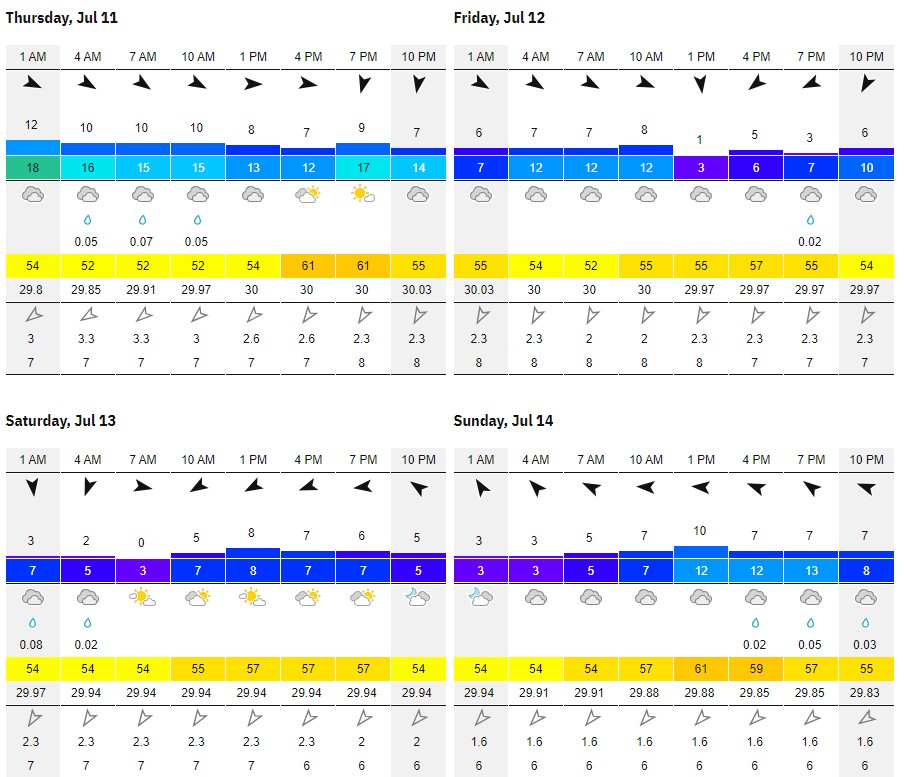
Even with menacing and strategically placed bunkers, thick rough and undulated greens, calm winds have led to low scores in the brief history of professional golf at The Renaissance Club. Both the 2019 and 2021 events saw birdies made in bunches as the average score approached a full two shots under par with the winning score averaging 20-under.
In 2020, when the wind and rain became a factor, Aaron Rai won at only 11-under. And in 2022, Schauffele’s winning score was 7-under. Last year didn’t see any wind until it gusted 30+ mph in the final round. With the club exposed to the North Sea coastline, potential bad weather is the course’s best defense. As Doak himself said about the conditions, “The windier and firmer it is, the more ball-striking plays a premium. If it’s soft, it becomes more of a putting contest, and that’s not what the players want to see.”
As to how easy or difficult the course will play this year, it cannot be emphasized enough that weather will be the main determining factor. Said Schauffele on the conditions after his win, “I don’t know if it was love at first sight, but I did enjoy playing with winds blowing 30 (mph) and playing the ball down closer to the ground and you know, it being okay to sort of aim 100 yards away from a bunker you can’t go in and just play from there. It’s just fun golf for me.”
While the architecture may be bland overall, the routing is superb moving from heathland to heavily treed areas to coastal dunes and back to the forest and heath. The holes also alternate in facing different directions which provides for a variety of wind conditions on different holes.
The course is not a pure links setup with the numerous tree-lined holes, undulations and heavy rough in play just off the fairways (especially on the back nine). But there is a definitive links-style component to the course. Not only is it off the coastline, and subject to windy conditions, but the fescue turf is firm and tight. This leads to fast-running surfaces on the fairways and aprons leading to the greens. Combine that with no bunkers in front of the greens and the use of the ground game and bump-and-run shots are encouraged. Many of the course’s 83 bunkers are also links-style pot bunkers with deep riveted faces.
Strokes Gained Analysis
Off the Tee
The effects of potentially windy conditions shouldn’t impact how one views performance off the tee The Renaissance Club. For example, in gusty conditions in 2022, the Driving Accuracy rate was only 49%. Yet it ranked as the second easiest course in “Missed Fairway Penalty”. A big part of the reason for that is there just aren’t many hazards to trouble players off the tee. Greens were still hit in regulation 59% of the time. If the winds are a factor, everyone will struggle to hit these fairways which rank on the narrow side at only 32 yards wide on average.
Though atypical of links-style courses where shorter hitters can use rollouts on tee shots to make up for lost carry distance, length OTT is a definite advantage at The Renaissance Club. Last year, the average driving distance was 295 yards which is well above the Tour average. And with the reputation of playing longer than its yardage, along with four par-4s over 475 yards, a driveable par-4, and three lengthy par-5s, distance off the tee brings many advantages. There are also a couple of longer carries off the tee into potentially gusty winds that favor the longer hitters as well.
While shorter hitters like Aaron Rai and Tommy Fleetwood can have success here, the past two leaderboards have been filled with longer drivers of the ball including player like McIlroy, Macintyre, Schauffele, Kurt Kitayama, Thomas Detry, Dean Burmester and Rasmus Hojgaard.
Approach
On approaching the green this week, players will have a variety of options. If winds remain on the calmer side, longer players off the tee will have the advantage of hitting higher lofted irons into the proper quadrants on the tiered greens. Whether the winds are high or not, thanks to Doak creating a firm surface with no bunkers or water in front of the greens, all players will have the option to utilize the ground game to run their ball onto the greens.
When the weather cooperates, hitting these greens is not even a remote issue. Out of the 77 players to make the cut in 2021, for example, only 13 of them had a GIR rate of under 70%. 15 players were above 80%! That being said, with the greens being so huge and undulating, proximity to the hole and positioning approaches relative to the pin to leave an uphill putt is vital. The course favors strong iron players. Last year, six of the top seven on the leaderboard gained at least 2.3 strokes on approach. In 2022, seven of the top-15 on the leaderboard gained at least 4.6 strokes on approach.
If conditions are windy, approaching the green is the one area most affected. 2022’s windy conditions allowed the Renaissance Club to play as the fourth toughest course to gain strokes on approach. Two years of ShotLink data show the course to be relatively average in terms of the approach range buckets. The one range that stood out as above average last year was 43.4% of approaches came from between 150-200 yards.
Around the Green and Putting
While scrambling and performance around the greens would seem to be important on most links courses, this is another stat at the Renaissance Club that is weather-dependent. In 2021 and last year with calm winds and players hitting so many greens in regulation, it didn’t factor in much and the course ranked as the easiest on Tour in which to gain strokes around the green. But if greens are firm and the winds increase as they did in 2022, the undulating nature of the green surfaces will repel shots into the pot bunkers and runoff areas, and that will produce chips off of tight lies. The scrambling rate in 2022 was only 53% while it jumped up to 61% in last year’s calmer conditions.
The green complexes, in a word, can be described as adventurous. They are firm, large, and well-contoured with a variety of possible pin positions. Last year these greens ranked as the fifth most difficult on which to gain strokes putting. Making putts inside 15 feet, especially in windy conditions, will be crucial.
Some players have commented that the breaks are very difficult to identify while others have said they look much more severe than they play. One thing is for sure, the speed will be much slower than typical PGA Tour courses and may cause some players to start slow while they adjust. With such large green surfaces, lag putting and three-putt avoidance will be huge this week as last year’s tournament saw one of the highest 3-putt rates on Tour at 4.91%.
Most Important Stats For Success at The Renaissance Club
*In order of importance
- SG: Approach
- SG: Putting
- SG: Links/Wind Courses
- Proximity: 175+ yds
- SG: ARG/Scrambling
- Three-putt AVD
- Bogey AVD
- Par 4: 450-500
- Birdie or Better %
- Driving Distance
Key Rabbit Hole Filters
- Course Region: UK/Ireland
- Course Type: Links
- Scoring Conditions: Difficult
- Field Strength: Strong
- Field Size: Full Field
- Greens Surface: Fescue
- Green Size: Large
- OTT Club Type: Driver Heavy
- Missed Fairway Penalty: Low
- Gain APP: Difficult
- Gain ARG: Easy
- Gain Putting: Difficult
- 3-Putt AVD: Difficult
Weather Forecast – North Berwick, Scotland