
Support us by checking out our sponsor, Fanduel Faceoff!
Just click on the banner!
f684b2f3d4218ee06dad551b3bb2074bThe 124th edition of the U.S. Open will be held at one of the historic courses for golf in America, Pinehurst No. 2. Home of Donald Ross’s masterpiece, it will host its fourth U.S. Open championship in the last 25 years. “Some say it’s our St. Andrews – it’s certainly something special, and that’s why we’re going back there for the 2024 U.S. Open”, said Thomas J. O’Toole Jr., the former president of the USGA.
Pinehurst Resort and Country Club consists of nine 18-hole golf courses, each named simply by a number, and a 9-hole short course. Pinehurst No. 2 has consistently been ranked as one of the top courses in North Carolina and among the best in the United States.
With its classic Donald Ross design, it was restored by the team of Bill Coore and Ben Crenshaw in 2010 to reinvigorate the historic course with Ross’ original 1930s playing conditions. First opened in 1907, it is considered to be Ross’ best work and he called it “the fairest test of championship golf I have ever designed.” He continued to perfect it until his death in 1948.
Lush green grass. Five inches of club-tangling penal rough. Narrow fairways. Those are the typical characteristics of a standard U.S. Open course. But not here. The land itself is far from dramatic. There are no sweeping vistas, no chiseled bunkers, and no breathtaking water hazards. With each of these features absent, Pinehurst will present an unfamiliar test. The brilliance of the design resides not in the spectacle but in the subtle nuances in which mere inches can result in extremely different shot outcomes. Simply being on the wrong side of a slope can mean the difference between a par and a double bogey. Said 2006 U.S. Open champion, Geoff Ogilvy, “When I think about Pinehurst No. 2, I think brilliant golf course but scary to play.”
Compared to conventional U.S. Open layouts, the fairways are expansive and lined with towering pines. There is no rough on the property. Fairways instead bleed into sandy waste areas full of wire grass, pineweed, and other native vegetation. With expected firm and fast conditions, distance control, precision, and humility in approaching greens will be paramount for climbing the leaderboard. While there are different options to play each hole, players with accuracy off the tee, quality long-iron skills, and short-game acumen will have the best chance to contend.
Pinehurst is a course where the closer you get to the hole the more it gets in your head. It’s famous for its diabolically crowned green complexes where they sit like upturned saucers and repel balls in every direction. Johnny Miller once famously compared trying to land a shot on a Pinehurst green as “like trying to hit a ball on top of a VW Beetle.” Where you end up and how you mentally respond are part of the experience and make for a unique examination.
The 2024 U.S. Open will be the 13th USGA championship to be hosted by Pinehurst and the 12th Pinehurst USGA event in the last 35 years, which is more than any other site in the United States. Other significant championships played on Pinehurst No. 2 include the 1936 PGA Championship (won by Denny Shute), the 1951 Ryder Cup Match (won by the USA), the 2005 U.S. Open (won by Michael Campbell), and the 2014 U.S. Open (won by Martin Kaymer). It will also mark the 25th anniversary of the moment Payne Stewart won the 1999 U.S. Open here with a dramatic par putt to win by a stroke over Phil Mickelson. Indelibly linked to Pinehurst, it was just four months later that Stewart would tragically die in a plane crash.
The Field
The U.S. Open is a four-round, 72-hole stroke-play championship, with a cut after 36 holes. The top 60 players and ties make the cut. After 10,052 golfers attempted to qualify for this year’s national championship, along with the conclusion of the Memorial tournament, the 156-player field is officially set. It consists of 82 exempt players and 68 qualifiers, 15 of which are amateurs.
The USGA conducted 100+ 18-hole Local Qualifiers. All players advancing then competed in 36-hole Final Qualifiers that were held at 13 sites, 10 in the U.S., one in England, one in Canada and one in Japan. Those wrapped up June 3, dubbed by some as “Golf’s Longest Day,” with some dramatic stories of young amateurs, first-time qualifiers and even a past U.S. Open champion (Webb Simpson) earning their way to start at Pinehurst.
Anyone in the top 60 of the OWGR automatically earned a spot in the field. Overall, 76 of the top 80 players in the world rankings will be in attendance at Pinehurst. Headlining the field is the unquestioned No. 1 player in the world, coming off his fifth win of the year at the Memorial, Scottie Scheffler. Just a month removed from his arrest at Valhalla which sidetracked his chances at the PGA Championship, the sky is the limit for Scheffler on a course like Pinehurst that perfectly fits his game.
There are numerous other contenders including the winner of the PGA Championship, Xander Schauffele who has the all-around game to compete with Scheffler. The No. 3-ranked player, Rory McIlroy has done everything but win a major in the past decade. Plenty of other big names exist in the next tier of favorites, though each enters with almost as many questions as answers. This includes Viktor Hovland, Collin Morikawa, Ludvig Aberg, Justin Thomas, Max Homa, Patrick Cantlay, Hideki Matsuyama, Brian Harman, Tommy Fleetwood, and last year’s winner, Wyndham Clark.
Included in the field are 13 players from LIV Golf led by Jon Rahm, Bryson DeChambeau, Brooks Koepka, Dustin Johnson, Cameron Smith, Tyrrell Hatton, and the 2014 U.S. Open winner here, Martin Kaymer. This major will feature the lowest intake of LIV players since the breakaway circuit was formed – that is despite 35 of its roster opting to try and make it through sectional qualifying in the weeks leading up to the championship. Players such as Joaquin Niemann, Patrick Reed, and Talor Gooch each failed to qualify.
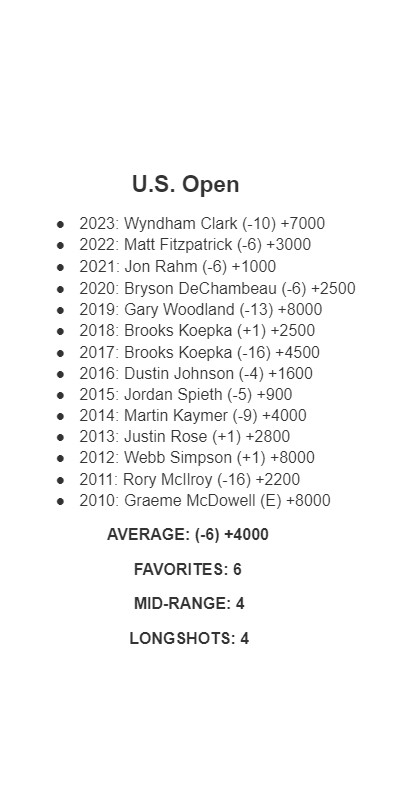
Past Winners/Odds
Betting Thoughts
After chasing players not named “Scottie Scheffler” in every important event thus far this season for my outright card, I’ve thrown my hands in the air and laid a +400 ticket on the 5-time Tour winner for this year. From every angle, whether strategic, mental, or physical, Pinehurst No. 2 fits Scheffler perfectly. That being said, this is a course that does produce variance in a sport that is already the most volatile. Questions and concerns remain for every other golfer in the upper tier. Is Xander Schauffele really going to win consecutive majors? Can Rory McIlroy be trusted on a course where his elite power OTT is somewhat limited? Can Collin Morikawa and Viktor Hovland get it done with their short game at a place that demands creativity and class around the greens?
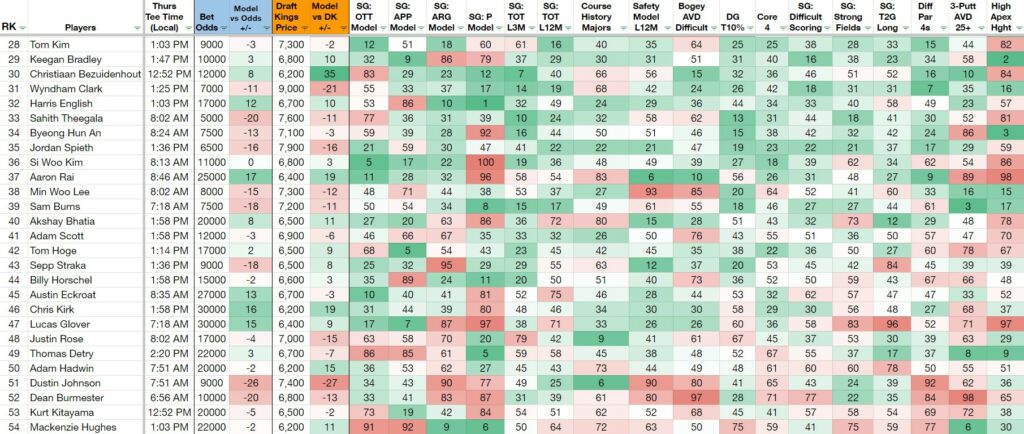
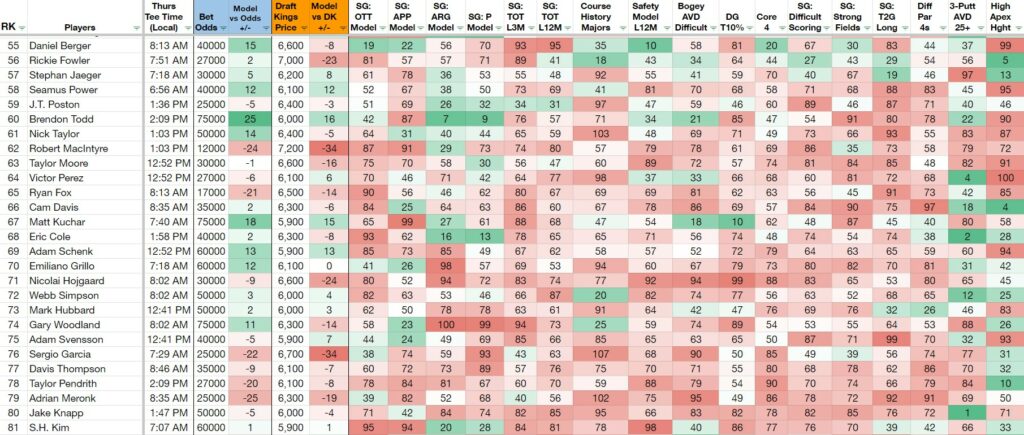
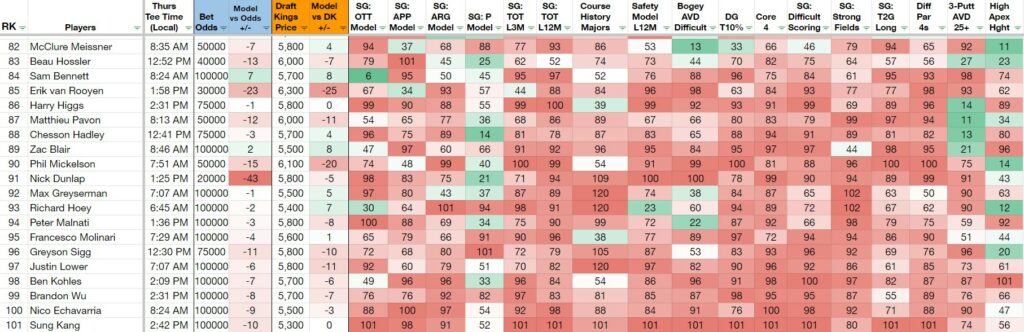
Pinehurst No. 2 demands different types of skillsets than typical U.S. Open courses. My model for the week has a strong focus on accuracy OTT, long-iron play from 175+ yards, and a myriad of short-game skills. It’s a week where just finding the green surface will be a major victory on each hole. Scoring chances are minimal with only two par 5s. It’s a long and difficult track. Having the mental capacity to survive with a par (or bogey) and move on to the next hole will be vital for moving up the leaderboard.
Starting with OTT, as with most great courses, the middle of the fairway generally isn’t the best spot to drive the ball. Many of the best locations for angles into the greens are actually getting close to the edges of the sandy waste areas. With wider fairways and expected dry and firm conditions, drives will tend to roll out until they reach these wiregrass-filled hazards which places a greater demand on shot control. With the amount of variance that comes into play with the vegetation in these areas, golfers who are precise off the tee and who rank highly in “Distance From Edge of Fairway” should be heavily targeted this week.
SG: Approach is heavily weighted as these greens are some of the toughest hold that players will see in their entire career. There are many ways to research Approach, and those metrics (which are all in the Rabbit Hole) are incorporated into that model this week. This includes GIR%, Proximity from 175+ yards, and past performance on other “Difficult Approach” courses. With approximately 55% of approach shots coming from 175+ yards, elite long-iron play presents a huge advantage and a path to separate from the field. Not only are all the greens crowned, but they also play firm and fast. Said Geoff Ogilvy, “You could put someone’s ball at a perfect drive on every hole and they still would miss five or six greens. They are that challenging. There are just disasters everywhere, even with wedges in hand.”
Targeting players with competent short-games might be the biggest key this week. Anything that misses the putting surface is going to keep running away because of the closely mown turf. And once it comes to rest, there are a variety of options that the player is going to have. All of a sudden, it creates choices and creates indecision. There are interesting mounds and slopes everywhere, and they extend far beyond the typical 5-10 yards from the fringe. The bunkers appear to eat into the greens and present their own troubles.
The “Safety” model incorporates all the important metrics that golfers need to be successful in order to survive the cut and give themselves a chance heading into the weekend. This includes: Bogey Avoidance, DFEF, Good Drive % on difficult courses, Sand Saves, Scrambling from Short Grass, putting from 5-15 feet, and positive rounds gained rate on difficult courses.
Finally, the model takes into account a myriad of other relevant data points including recent and long-term form, and past performance on difficult courses, in Majors, and on long courses. While not a deal breaker, “Apex Height” will also be crucial in having a higher ball flight with lofted irons into these firm greens.
Most Important Stats For Success at Pinehurst No. 2
*In order of importance
- Scrambling – Short Grass
- SG: Approach (Difficult APP Courses)
- Distance From Edge of Fairway (DFEF)
- SG: Total – Difficult Scoring/Majors
- Proximity 175+ yards
- Bogey Avoidance (Difficult Scoring)
- SG: ARG (Difficult ARG Courses)
- 3-putt Avoidance
- Good Drive % (Difficult APP Courses)
- Par 4 Scoring (Difficult Scoring)
Key Rabbit Hole Filters
- Course Region: Southeast
- Scoring Conditions: Very Difficult
- Course Length: Very Long
- Field Strength: Very Strong
- Event Type: Major
- Greens Surface: Bermuda
- Missed Fairway Penalty: High
- Gain APP: Very Difficult
- GIR Accuracy: Difficult
- Par 4 Scoring: Difficult
- Par 3 Scoring: Difficult
- Gain ARG: Very Difficult
- Scrambling – Short Grass: Difficult
- Gain Putting: Very Difficult
- 3-Putt AVD: Difficult
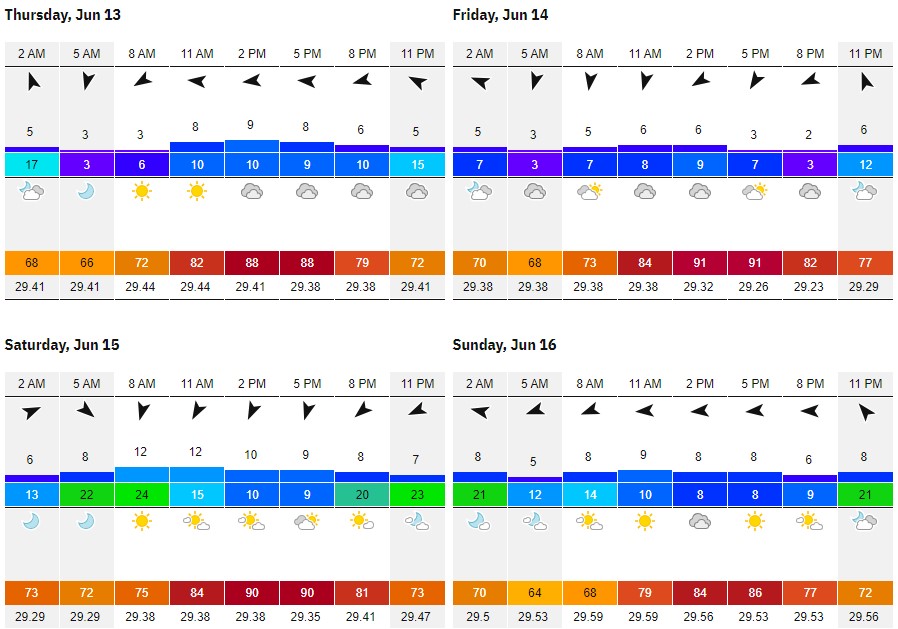
Weather Forecast – Pinehurst, North Carolina
The U.S. Open – Final Model
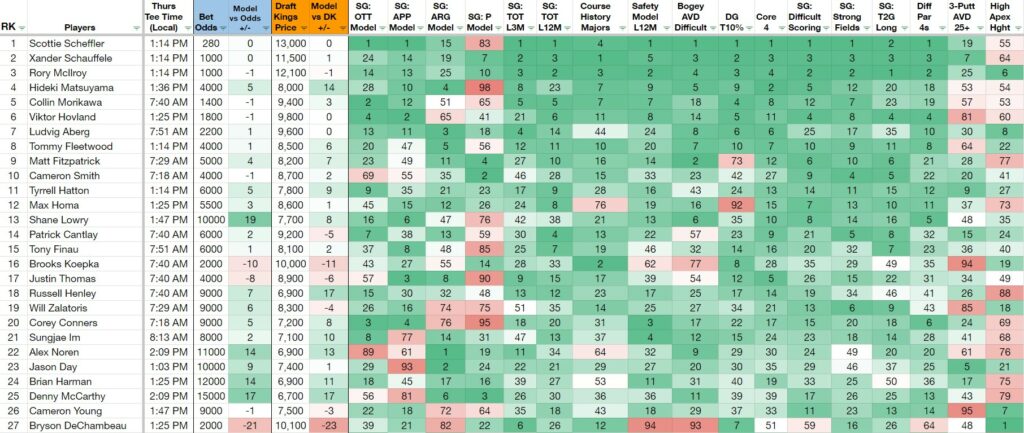
In each preview article and on Discord, I present my final model, which gives a detailed player ranking of the most important stats and splits for the week. My modeling is built around the PGA’s Strokes Gained data, which is divided into SG: Off the Tee (OTT), SG: Approach (APP), SG: Around the Green (ARG), and SG: Putting (P). Learn more about Strokes Gained and why it can be so useful in analyzing the past and predicting future performance. Many of these specific metrics and conditions can be found in “The Rabbit Hole“, with my final model exclusively published here and in the Discord for subscribers.
https://docs.google.com/spreadsheets/d/1E3qCBGpasZSIPcO0NILizg80FsSledM6nyfNDLv78oU/edit?usp=sharing
Outright Betting Selections
For the most up-to-date picks, check out my Twitter and subscribe to our Discord at BetspertsGolf.com.
*Lines accurate at the time of publication.
- Scottie Scheffler +400 (4u) – Caesars
Finishing Position Picks
Top 20
- Collin Morikawa -120 (1.2u) – Rivers
- Viktor Hovland -115 (1.2u) – DraftKings
- Tommy Fleetwood +150 (1u) – Rivers
- Cam Smith +150 (1u) – MGM
- Hideki Matsuyama +160 (1u) – MGM
Top 30 – all BetRivers
- Matt Fitzpatrick -105 (1.1u)
- Patrick Cantlay +110 (1u)
- M.W. Lee +163 (1u)
Top 40 – all FanDuel
- Byeong Hun An -115 (1.2u)
- Will Zalatoris -115 (1.2u)
- Harris English +150 (1u)
This article is intended for entertainment purposes and adult users only. Call 1-800-GAMBLER if you have a gambling problem.
Photo by Sam Greenwood/Getty Images