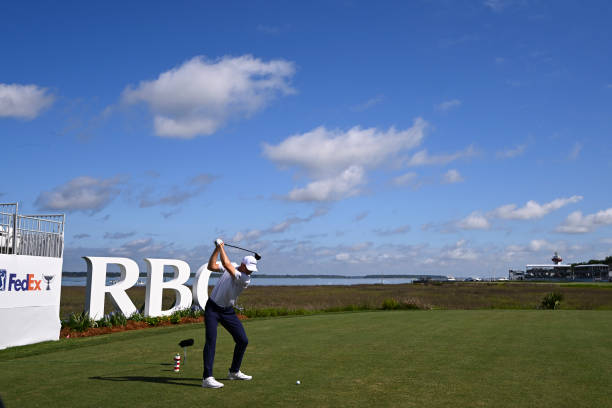
The PGA Tour heads southeast a couple of hours down the road toward the Atlantic coast for its traditional post-Masters event, the RBC Heritage. Always one of the most beloved events by players, in past years it has presented more of a relaxed vibe compared to the pressure cooker that is the Masters. For a second consecutive year, however, the pressure will be taken up a notch as one of the best fields ever gathered here will participate in one of the Tour’s “Signature” events.
Situated at the Sea Pines Resort on the southwest corner of Hilton Head Island, Harbour Town Golf Links has hosted the annual RBC Heritage on the PGA Tour held each April following the Masters tournament. From the pervasive palmetto trees and Spanish moss-draped oaks to the beautiful island scenery that Hilton Head provides, Sea Pines is one of the most popular golf resorts in the nation.
With tight fairways, numerous doglegs, and sharp angles, it presents a stark contrast for players coming over from Augusta National and its broad wide-open expanses. Harbour Town is a course where finesse and shot-making are prioritized over length and power. Few other courses on Tour require such a premium on accuracy off the tee and precise iron shots into minuscule greens. The list of past winners and contenders is filled with elite wedge players with stellar short games: Matt Fitzpatrick, Jordan Spieth, Webb Simpson, Jim Furyk, Shane Lowry, Matt Kuchar, Luke Donald, J.T. Poston.
The Field
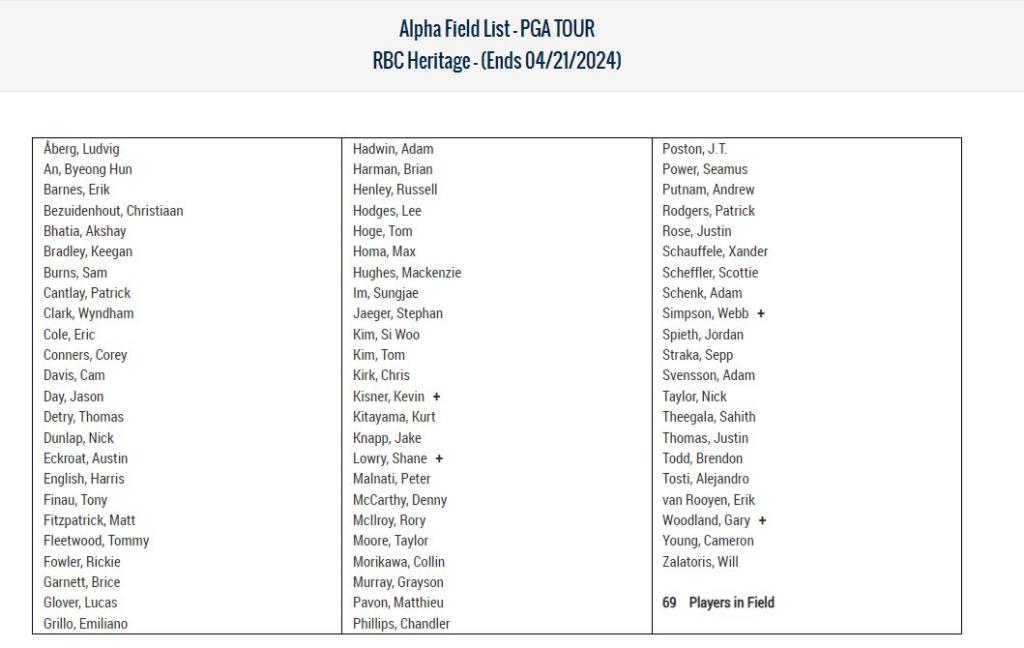
Another elite field will assemble this week in Hilton Head. Every eligible player inside the OWGR top 30 except for Hideki Matsuyama and Viktor Hovland will be in attendance. It will be another limited-field, no-cut event, smaller than even the Masters with only 68 players scheduled to compete. Coming off his second win at Augusta National, world No. 1 Scottie Scheffler is tentatively still listed in the field even with his wife expecting their first child in the next two weeks. Sam Burns is another who could withdraw at any moment as his wife is due within days.
Most elite golfers rarely play the week after a major. But with $20 million on the line, including a $3.6 million share to the winner, along with PIP (Player Impact Program) requirements, it’s back to the grind with no time to decompress from the tension of last week’s Masters. The last three winners of this event, Fitzpatrick, Spieth, and Stewart Cink each participated in the Masters the week before. Whether it’s Scheffler coming off a second Green Jacket or Max Homa and Collin Morikawa, who both faltered down the stretch on Sunday, it will be fascinating to see how the big names respond after last week.
Some of the elite players in the field have very little course history at Harbour Town. Top-10 players Scheffler, Homa, Rory McIlroy, and Ludvig Aberg have a combined four starts here. While he hasn’t won here, Patrick Cantlay has the best course history with finishes of 3rd, 2nd, 3rd, 7th, and 3rd again at Harbour Town since 2017.
Harbour Town Golf Links – History
In 1967, when Hilton Head Island was a detached, sparsely populated barrier island, Jack Nicklaus landed the design contract for a new course named Harbour Town. Nicklaus appointed young architect Pete Dye to design the layout Dye saw it as an opportunity to distinguish his work from that of his rival, Robert Trent Jones.
Along with consultation from Nicklaus, Dye shocked the golf world with a revolutionary new course design. A layout with narrow fairways, elongated waste bunker areas, and tiny greens was unheard of at the time. Unlike other builds during the era, there were no mounds, no elevated greens, and flat lies all-around.
After his win at the inaugural “Heritage Classic” in 1969, Arnold Palmer described Harbour Town Golf Links as a “thinking man’s course”, and it brought now-famous course architect Pete Dye into the spotlight for the first time.
While the course caused a bit of an uproar in its early years, it has recently been voted as one of the top public courses in the country. Along with Palmer, Tom Watson, Greg Norman, Davis Love III, and Jack Nicklaus himself are just a few of the renowned champions of the RBC Heritage.
We have partnered with Vivid Picks to bring you an easy way to claim a FREE, no-strings-attached 2024 season at Betsperts Golf, plus a 100% deposit match up to $250! Click here to learn more!
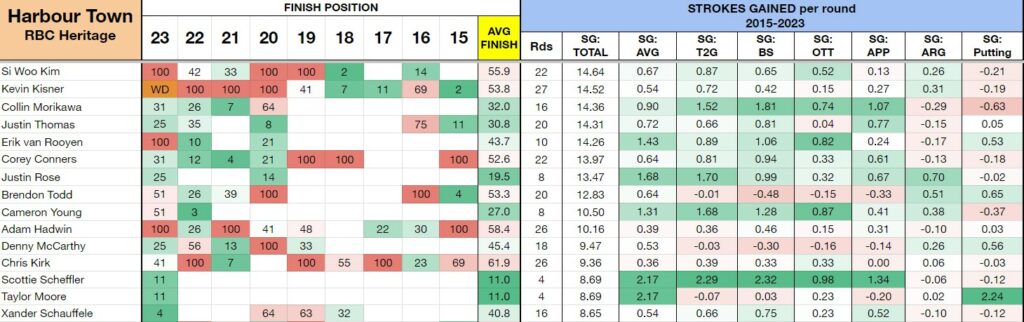
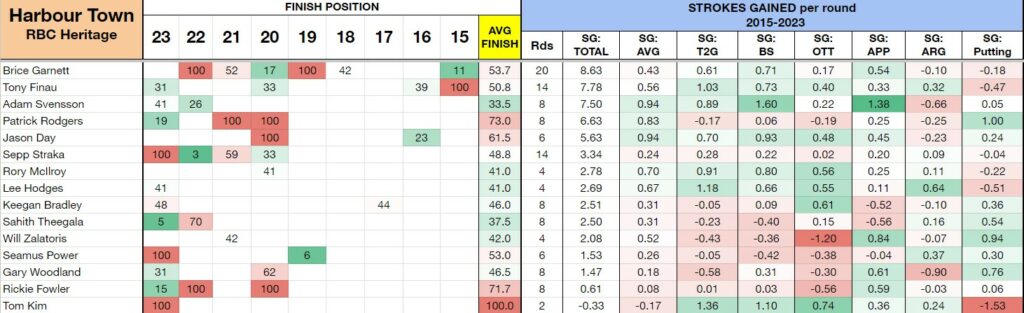
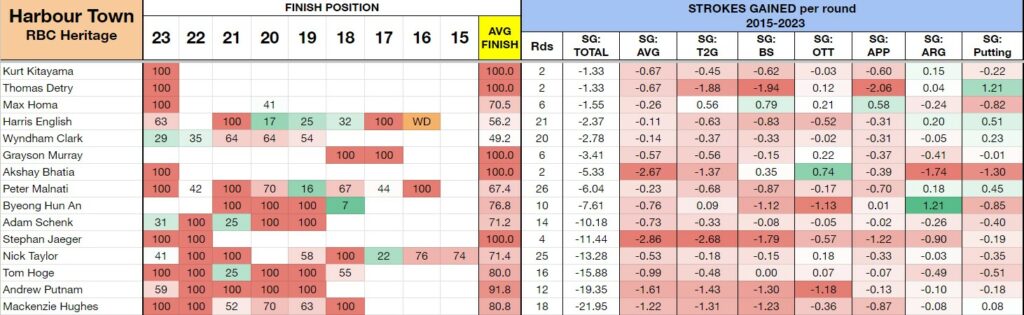
Finish Position and Strokes Gained Course History (2015-2023)
This includes the average finish position and Strokes Gained per round since 2015 for each of the categories. Players are sorted by SG: Total. Harbour Town is the 15th most (out of 44) predictive annual course on Tour.
f684b2f3d4218ee06dad551b3bb2074b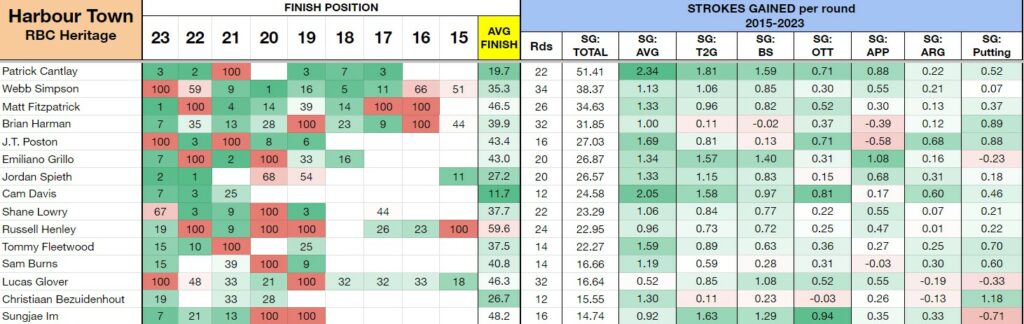
Course Features
Characterized by numerous doglegs, overhanging trees, a wide array of devilish bunkers, and minuscule greens, Harbour Town Golf Links is a coastal par-71 course that measures 7,213 yards. It is a relatively flat course with fairways flanked on all sides by a variety of trees including palmettos, oaks, and pines. There might not be a greater contradiction in courses played in consecutive weeks on Tour than going from the expansive, lengthy, and undulating Augusta National to the claustrophobic, concise, and level Harbour Town. It ranks as the 17th-shortest course on Tour.
As the Bermudagrass is still dormant this time of year, the tournament is played on fairways and rough overseeded with ryegrass. In years past, the rough has typically been minimal at only 0.75″, and more like the first cut at Augusta National. Last year the Tour gave it a massive increase up to 2.5″. This year the rough is back down to 1.25″. Greens are the second-smallest on Tour at an average of only 3,700 square feet. They are overseeded with Poa Trivialis and run around 11.5 on the stimpmeter.
Scoring overall can be a challenge here. Subtracting the 2020 event which had an ultra-strong field and was also played on Bermudagrass during the summer, the last five events have played 0.34 strokes under par. This ranks Harbour Town as the 16th toughest course on Tour.
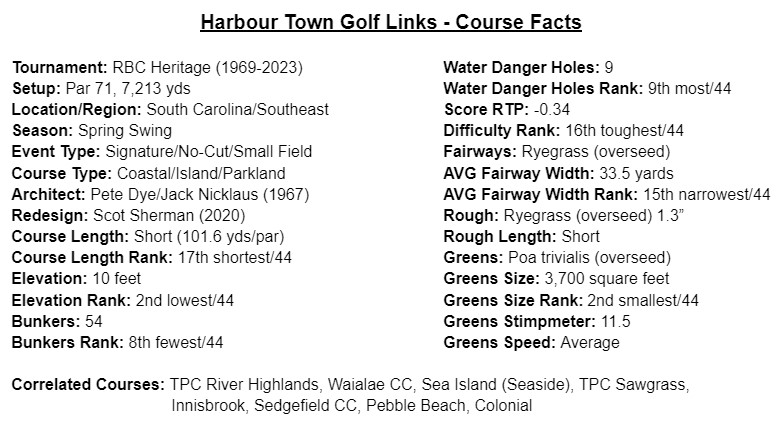
There are numerous reasons why birdies aren’t easy to come by at Harbour Town. With trees everywhere, drives off-the-tee that are not hit to the proper location on the fairway could be met with hanging branches on the following approach shot. Water comes into play on nine holes with six of those affecting approach shots. Also, the second-smallest greens on Tour combined with a course that is exposed to the wind from the Atlantic coast can cause GIR% numbers to shrink rapidly on windy days.
John Farrell, Director of Sports Operations at Harbour Town, believes it’s the target nature of the course that makes it so difficult and unique to play. “You have to be really precise with your iron play to score well here, and you’d better be able to drive it to a certain part of the fairway to set up your next shot. It’s a real position golf course that favors accuracy over brawn, and that’s why so many tour players like it.” 2020 champion Webb Simpson echoed these thoughts by adding, “It’s very much kind of a plotter’s golf course, point A to point B. You’ve got to really control your ball flight, and shot shape. Those things get me excited about the course. I love thinking through where am I hitting it on this hole and where am I hitting it on this green.”
There are also many Pete Dye trademarks that can trick players and cause trouble. These include blind shots off-the-tee, treacherous Scottish-style pot bunkers, and firm sloping greens. Overall, Pete Dye does an excellent job of using the natural environment to intimidate the player. Those who can strategize their way around the course and hit their targets will have the best chance to raise the trophy on Sunday.
Simply put, Harbour Town is a test of accuracy and short-game skills. Each hole requires a game plan and the ability to control both line and distance off the tee. It is a station-to-station layout that severely minimizes the effects of driving distance, and it presents golfers with an almost-exact recipe for success. If players can accurately hit the ball from point to point and into specific targets they will be able to take advantage. From tee to green, there is very little margin for error. It demands strategy, touch, and shot-making ability.
Matt Kuchar, who has gained the most strokes by a large margin here since 2015, summed up Harbour Town the best. “It’s so uniquely different, with the tree-lined fairways…they have slight doglegs that make it exciting to play chess around this golf course, and positioning your tee shot in the right spot in the fairway. All the greens are made so that you do have a play. They’re basically on the same level as the fairway. They’re not perched up with bunkers everywhere, where you’re just trying to leave yourself a bunker shot. You can actually run them all up on the greens. They’re small greens. If you’re on the green, you have a shot at birdie. It’s a great layout, a great design, a memorable golf course. And I don’t think it necessarily rewards a typical type of player.”
Hole Preview
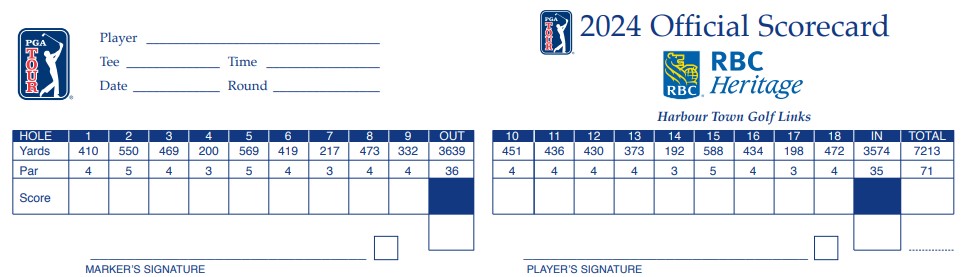
Harbour Town is a stock par-71 course with three par-5s and 11 par-4s. Two of the three par-5s are easily reachable in two shots and offer an excellent chance at birdie or eagle. Overall, the par 4s measure very short compared to the average. Seven of them play under 450 yards with none longer than 475. While eight of them have historically played over par, that number has gotten closer to even over the last few tournaments. While the par-4s and par-5s are average in difficulty, the four par-3s rank as the ninth toughest on Tour, each playing over 190 yards.
Most of the first 16 holes at Harbour Town have a reputation for being quite non-descript. They play inland as the course weaves through natural woodlands which are surrounded by a residential housing development.
The final two holes are in a class of their own. The 17th hole is a scenic par-3 with a beautiful background of the Calibogue Sound. It plays 185 yards over water to a green fronted by a large bunker that runs the entire length to the left side with bunkers on the right. It demands accurate club selection and a confident swing to avoid trouble.
The 18th is one of the most famous holes on the PGA Tour. It is a tough par-4 that features the recognizable 90-foot Harbour Town Lighthouse. Though it has a massive 75-yard fairway, it plays as one of the most difficult holes on the course due to the water that lines the left side of the hole along with the wind gusts that blow off the Calibogue Sound right into the player’s face.
Strokes Gained Analysis
Off the Tee
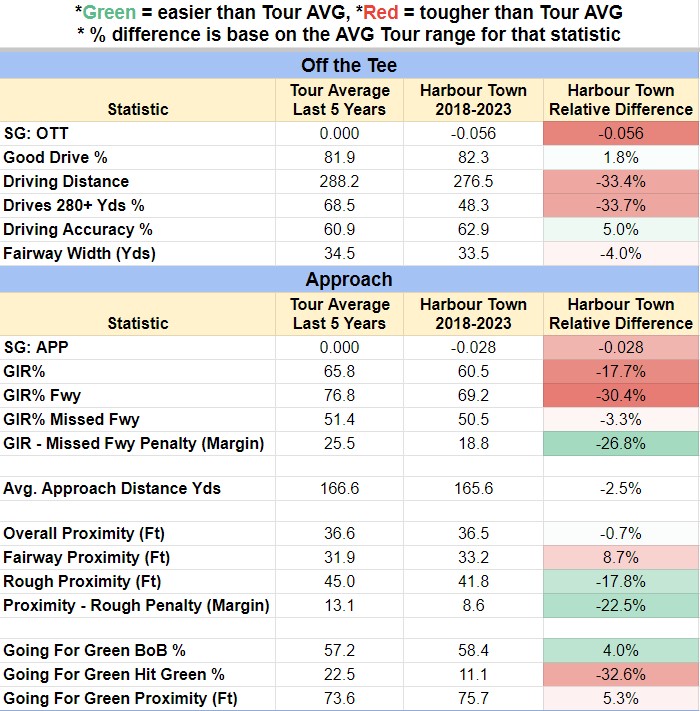
When players at the RBC Heritage reach into their bag for their club to tee off this week, very rarely will they grab a driver. Harbour Town has the fewest rate of drives over 280 yards at only 48.3%. It also has the second-lowest average driving distance on Tour at only 276.5 yards per drive. The past 14 winners have an average ranking of 51st in driving distance during the week they won. There is almost no chance for bombers to cheat the course by cutting corners on dog legs or hitting over the trees.
Harbour Town has a reputation for having tight fairways, but that is not the case as they average around 33 yards in width. From the tee box, the intimidation is mostly visual (in typical Pete Dye fashion). Dye presents golfers with a choice. Hitting towards the safe landing area only increases the difficulty of the approach shot. On the other hand, players who are aggressive and challenge the dogleg, bunkers, or water hazards are left with a much easier shot into the green.
Harbour Town is all about accuracy and playing positional golf. Hitting to the proper side of the fairway allows unobstructed paths to the green by avoiding dangling branches on approach. Trees can be an issue on as many as 10 holes. With the rough length short again, players won’t be penalized by slightly missing the fairway – provided of course they have missed in the proper location and are left with a clear view of the green. Because everyone is hitting to the same relative distance and area (target golf), it yields the second-fewest strokes gained off-the-tee on the PGA Tour.
Approach
With the second-smallest greens on Tour, and lagoons and coastal waterways edging towards numerous holes, SG: Approach and proximity to the hole will be vital this week. The 60% GIR rate is well below the Tour average of 65%. The tiny, elevated, firm greens are tough enough to hold as it is, and even more so if the tee shot is on the wrong side of the fairways or blocked behind a tree. Another reason scoring can be challenging is that the three par-5s only have a “Hit the Green” rate of only 11.1% (22.5% is average) when players go for the green on their second shot.
Golfers will need to be creative and ready to hit a variety of differing-shaped shots into the greens. Harbour Town is the eighth toughest course to gain strokes on approach and the fifth toughest to gain on shots from greater than 150 yards. With 46% of approaches coming between 150-200 yards, this week will be a true test of short-to-mid iron play.
Around the Green and Putting
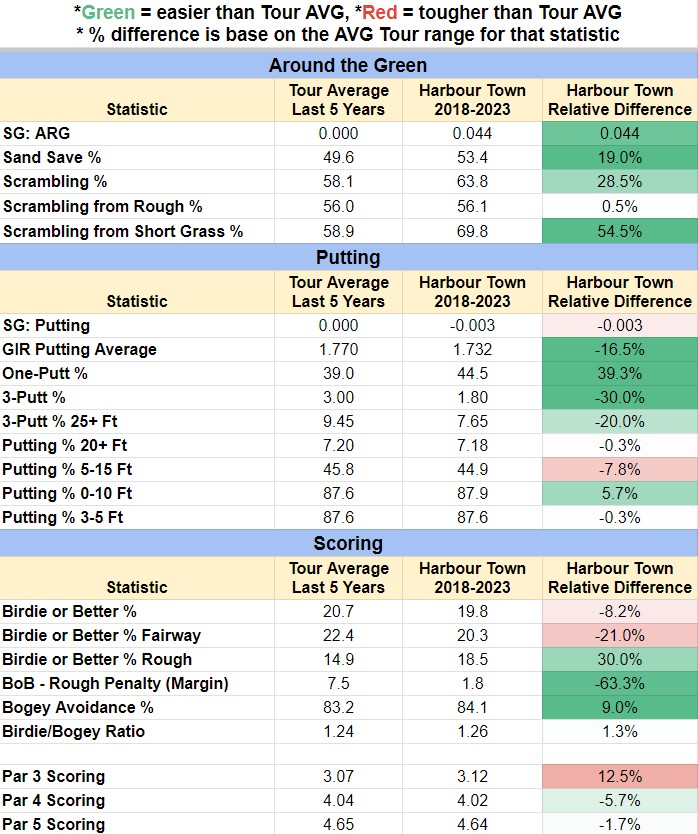
Though Scrambling and Sand Save % are both easier than average, because so many greens are missed, being able to scramble and save par is still a necessary skill this week. Firm greens with tricky pin placements will test even the best players. So many past winners here from Webb Simpson to Jim Furyk to Matt Kuchar have had excellent short games to help score on the par 5s and to scramble for par when necessary.
Similar to around-the-green play, putting is on the easier side as well. Because of the tiny greens, there aren’t many lengthy putts, making both “3-putt Avoidance” and “One-Putt %” one of the easiest on Tour. While there are some subtle and tricky slopes, the Poa Trivialis greens are one of the truest surfaces from which to putt.
Most Important Stats For Success at Harbour Town Golf Links
*In order of importance
- SG: APP
- Good Drive %
- Proximity 150-200 yds
- SG: ARG
- SG: Comp Courses
- Scrambling
- Distance From Edge of Fairway (DFEF in Rabbit Hole)
- Birdie or Better %
- SG: Total – Less Than Driver Courses
- Bogey Avoidance
Key Rabbit Hole Filters
- Region: Southeast
- Course Type: Coastal
- Scoring Conditions: Average/Difficult
- Course Length: Short
- Field Strength: Very Strong
- Event Type: No Cut
- Field Size: Small Field
- Greens Surface: Poa Trivialis
- Green Size: Small
- Rough Length: Short
- Architect: Pete Dye
- Gain OTT: Very Difficult
- OTT Club Type: Less Than Driver
- Missed Fwy Penalty: Low
- Gain APP: Very Difficult
- GIR Accuracy: Low
- Gain ARG: Very Easy
- Gain Putting Inside 15 ft: Difficult
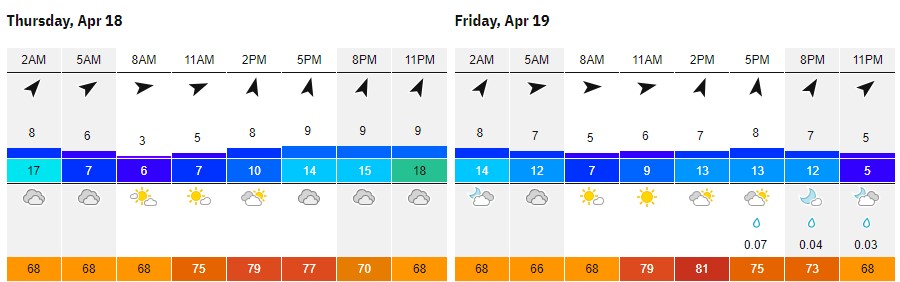
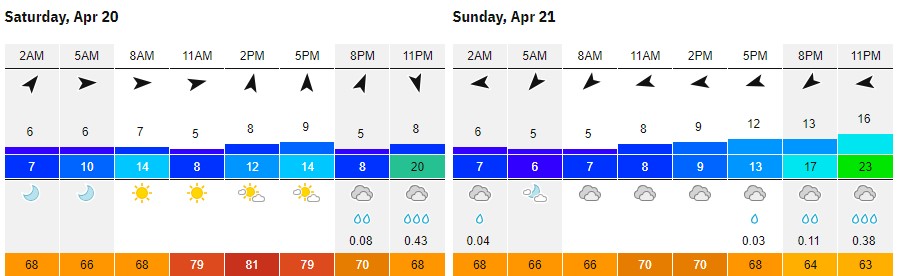
Weather Forecast – Hilton Head Island, South Carolina